

Deciding whether to replace every window in your home at once or tackle them gradually is one of the most practical and financially significant choices a homeowner can face. The answer depends on the condition of your existing windows, your energy costs, your budget, and your long-term goals for your property. This guide breaks down every factor you need to consider, so you can make a confident, informed decision.
This guide is written from a manufacturer’s perspective. Window Force has produced custom vinyl windows at our 80,000 sq ft Ontario facility since 2007, serving builders, dealers, contractors, and homeowners across Canada. We see the full range of replacement scenarios — from single-window swaps to 40+ unit whole-house projects — and the advice here reflects what we’ve learned from thousands of completed installations.
Key Takeaways
- Replacing all windows at once is most efficient when they are the same age and condition, delivering better energy performance, lower per-unit installation costs, and a consistent appearance.
- A phased replacement approach is practical if only some windows are failing or if budget constraints prevent a full upgrade.
- Common signs that windows need replacement include seal failure (fogging), drafts, rising energy bills, and difficulty operating the units.
- Window performance has a major impact on energy efficiency in cold climates. Outdated windows can account for up to one-third of total heat loss.
- Installation quality, especially proper air sealing of the rough opening, is just as important as the window product itself.
What Are the Main Signs That Your Windows Need to Be Replaced?
Not every window problem is obvious at first glance. Some issues show up visually, while others reveal themselves through your comfort levels and utility bills. Understanding the difference helps you prioritize which windows need attention first.
Physical Signs
The most visible indicators that a window has reached the end of its service life include:
- Warped, rotting, or cracked frames — particularly common in older wood-frame windows exposed to moisture over many years
- Failed glazing seals — identifiable by persistent fogging or condensation trapped between double or triple-pane glass that cannot be wiped away
- Visible gaps or daylight around the frame edges indicate that the window has shifted or the original installation has deteriorated
- Difficulty opening, closing, or locking — a sign of frame distortion or hardware failure that may also present a security risk
- Water stains or soft spots on the surrounding drywall or trim, suggesting chronic moisture infiltration
Performance Issues
Beyond what you can see, windows often signal trouble through how your home performs and maintains indoor comfort:
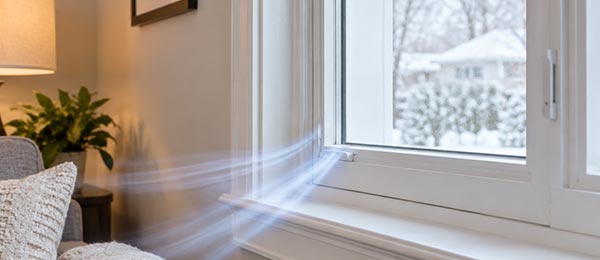
- Persistent drafts near closed windows, even after weatherstripping has been replaced
- Unusually cold interior glass surfaces, indicating poor thermal resistance
- Condensation forming on the interior surface of the glass during cold weather may indicate inadequate insulation or elevated indoor humidity levels
- Rising heating and cooling costs that cannot be explained by changes in occupancy or energy pricing
According to Natural Resources Canada's Office of Energy Efficiency, windows, doors, and skylights can account for up to 35 percent of total residential heat loss in Canadian homes. This makes window condition one of the most impactful variables in your home's overall energy performance, often more than homeowners expect.
Engineer Sergey Essipov, with over 20 years of experience in window manufacturing at Window Force, explains:
A failed sealed unit is not just an aesthetic problem — it is a thermal defect. Once the inert gas fill escapes from between the panes, the insulating value of the glass unit drops significantly, sometimes by 30 to 40 percent. Homeowners often don't realize how much heat they are losing through a window that looks structurally intact.
Windows Near Me
When Should You Replace Windows in Older Homes?
Older homes present a distinct set of challenges when it comes to window replacement. The decision involves more than selecting a modern product. It also requires an understanding of the building's original construction, its heritage status (if applicable), and the common failure modes of older window systems.
Heritage and Character Homes
In Canada, homes built before the 1960s often feature original wood-frame single-pane windows. These windows have historical value and, in some municipalities, may be subject to heritage preservation guidelines that restrict or regulate the type of replacement permitted. Homeowners in designated heritage districts should consult their local planning authority before proceeding with full replacement.
That said, even in heritage homes, window performance cannot be indefinitely deferred. Original single-pane wood windows offer an approximate R-value of 1, compared to modern double-pane low-emissivity (low-e) windows, which typically range from R-3 to R-5 depending on the glazing configuration. The thermal gap is significant.
Insulation and Structural Concerns
In homes built before modern building codes, window rough openings may have inadequate insulation around the frame cavity. Simply replacing the window unit without addressing the surrounding insulation will leave a persistent thermal bridge. A competent installer will assess and address this during the replacement process.
Safety Considerations
Older windows — particularly those with glazing that predates Canadian safety standards — may use annealed glass rather than tempered or laminated safety glass in locations where building codes now require it. Areas such as bathrooms, stairwells, and windows adjacent to doors should be assessed for compliance with current safety glazing requirements under the National Building Code of Canada.
Is It Better to Replace All Windows at Once or Gradually?
For most homeowners, the central question is whether to replace all windows at once or gradually. There is no single correct answer — the right approach depends on budget, home age, window condition, and your goals.
| Factor | Replace All at Once | Replace Gradually |
| Installation cost | One mobilization fee covers all units | Multiple mobilization fees add up over time |
| Visual consistency | All windows match in colour, profile, and style | Risk of mismatched frames or glass tones between phases |
| Disruption | Concentrated over a shorter period | Spread over months or years |
| Budget requirement | Higher upfront investment | Lower initial outlay per phase |
| Energy performance | Immediate whole-home improvement | Partial improvement until all units are replaced |
| Warranty alignment | All windows age together, simplifying service scheduling | Windows at different stages of their warranty lifespan |
| Ideal for | Homes with uniformly aged or failing windows | Homes where only specific units have failed |
- The case for full replacement is strongest when your windows are all of a similar age and showing similar wear — replacing them all at once maximizes the installation efficiency and ensures consistent thermal performance throughout the home.
- The case for gradual replacement makes sense when your windows are in mixed condition, your budget is constrained, or only a few units are causing measurable problems. In this case, prioritize the worst-performing windows first.
Because Window Force manufactures every unit to order, both approaches work equally well from a production standpoint. Each window is built independently to your exact specifications, so a phased approach does not affect product quality or consistency. Many of our customers start with the worst-performing windows — typically north-facing bedrooms or aging basement units — and complete the remaining openings in subsequent seasons as budget allows.
What Are the Energy Efficiency Benefits of Replacing Windows?
Modern replacement windows offer measurable, documented improvements in a home's thermal performance, which translate directly into reduced energy costs.
ENERGY STAR Certification
In Canada, windows that meet the ENERGY STAR standard are tested and certified through Natural Resources Canada's program. ENERGY STAR-certified windows must meet minimum performance thresholds for the specific climate zone in which they will be installed. Canada is divided into zones (Zones 1 through 3, with some products rated for multiple zones), and windows must meet the corresponding requirements for U-factor and solar heat gain coefficient (SHGC).
- U-factor measures the rate of heat transfer through the window — the lower the value, the better the insulation
- SHGC measures how much solar energy passes through the glass — a higher value is preferable for south-facing windows in cold climates to capture passive solar heat
According to Natural Resources Canada, replacing single-pane windows with ENERGY STAR-certified double- or triple-pane units can reduce heating and cooling costs by 8 to 15 percent annually in a typical Canadian home, depending on climate zone, home size, and existing insulation levels.
All Window Force windows are engineered to meet or exceed ENERGY STAR® requirements and carry CSA certification for quality and safety. As an ENERGY STAR Partner, we manufacture products across both our Ultraslim and Classic Series that qualify for applicable rebate programs. Our team can help confirm eligibility for your specific climate zone and project scope.
Low-Emissivity (Low-E) Coatings
Low-e glass coatings are thin metallic layers applied to the glass surface that reflect infrared radiation while allowing visible light to pass through. In cold climates, a hard-coat low-e applied to the inner glass surface reflects interior heat back into the room, improving the unit's effective R-value without meaningfully reducing natural light.
How Do You Know If Your Windows Are Costing You Money?
Diagnosing window-related energy loss requires a methodical approach. Here is a step-by-step process to assess whether your windows are a significant contributor to elevated energy costs:
If your heating costs have increased without a corresponding increase in occupancy or energy prices, window deterioration may be a contributing factor.
On a cold, windy day, hold your hand near the edges of each window frame and along the sill. A perceptible air movement indicates air infiltration. A stick of incense or a thin strip of tissue paper can make the test more precise.
On a cold day, carefully touch the interior face of the glass. A surface that feels significantly cold to the touch indicates low thermal resistance. In a properly performing double-pane low-e window, the interior glass surface should remain relatively close to room temperature.
Condensation on the interior glass surface indicates the surface temperature has fallen below the dew point, a sign of inadequate insulation. Condensation between the panes indicates a seal failure and a loss of the inert gas fill.
If your furnace or air conditioner is cycling more frequently than in previous years without a change in thermostat settings, thermal loss through windows or doors may be the cause.
A certified energy advisor through Natural Resources Canada's EnerGuide program can conduct a blower door test to quantify air leakage across the entire building envelope, including windows.
The National Energy Code of Canada for Buildings sets minimum requirements for fenestration thermal performance in new construction, which provides a useful benchmark for evaluating older windows. Current code requirements specify maximum U-factors for windows by climate zone — values that single-pane and older double-pane units often cannot meet. Homeowners comparing their existing windows against these benchmarks can quantify the performance gap before committing to a replacement budget.
What Factors Affect the Cost of Window Replacement?
Window replacement costs in Canada vary widely depending on product, labour, and project-specific factors. Understanding each factor helps you build a realistic budget and compare quotes effectively.
| Cost Factor | Low End | Mid Range | High End |
| Vinyl double-pane window (per unit, supply only) | $300 | $500—$700 | $900+ |
| Fibreglass window (per unit, supply only) | $600 | $900—$1,200 | $1,800+ |
| Wood-frame window (per unit, supply only) | $800 | $1,200—$1,800 | $3,000+ |
| Installation labour (per window) | $150 | $250—$400 | $600+ |
| Custom sizing or non-standard openings | +$200 | +$400—$600 | +$1,000+ |
| Removal and disposal of old windows | $30/unit | $50—$80/unit | $100+/unit |
| Trim repair or interior finishing | Included | $100—$200/window | $300+/window |
Key Variables Explained
Frame material is the largest single driver of product cost. Vinyl is the most cost-effective and lowest-maintenance option for most Canadian climates. Fibreglass offers superior dimensional stability and is better suited to extreme temperature swings. Wood provides the best insulation value and aesthetic appeal for heritage properties, but requires ongoing maintenance.
Window Force manufactures vinyl-frame windows exclusively — a deliberate product decision based on nearly two decades of manufacturing experience. Our lead-free uPVC profiles with multi-chamber construction and fusion-welded corners deliver the best balance of thermal performance, durability, and value for the Canadian residential market. For homeowners evaluating frame materials, vinyl consistently offers the lowest total cost of ownership when maintenance, longevity, and energy performance are factored together.
The number of windows affects both unit pricing and mobilization costs. Contractors typically offer volume pricing for whole-home replacement projects, and the fixed mobilization costs (travel, setup, equipment) are spread across more units.
Glazing configuration — double-pane versus triple-pane — adds approximately $80 to $200 per unit for triple-pane glazing, which is recommended for northern and central Canadian climates with severe winter temperatures.
Customization — arched tops, divided lites, specialty hardware, or non-standard colours — adds cost and may extend lead times.
What Time of Year Is Best to Replace Windows?
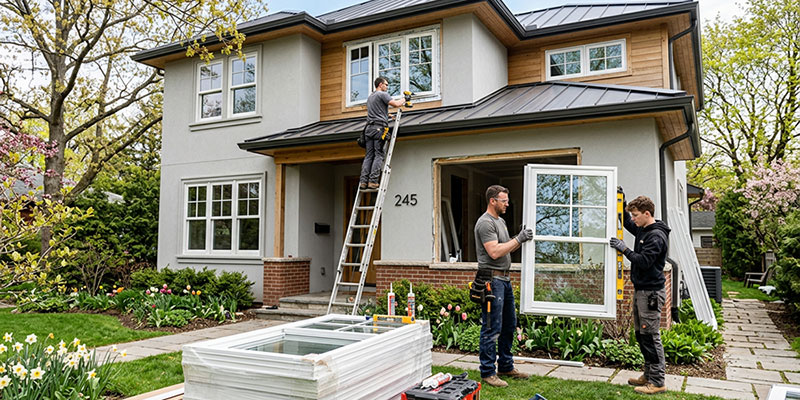
Each season presents trade-offs for window replacement. The best time depends on your priorities — whether that is installation conditions, pricing, or availability.
Spring (April to June)
Spring is widely considered the optimal installation window in Canada, especially for homeowners replacing windows in Ontario, where fluctuating spring temperatures remain suitable for proper sealant curing and installation. Temperatures are moderate, the risk of precipitation is manageable, and the construction season is ramping up. Installers have good working conditions, sealants and expanding foam cure reliably in mild temperatures, and lead times from manufacturers are typically shorter than in peak summer months.
Spring is also when many contractors offer early-season promotions. Booking in late March or April can yield discounts of 5 to 10 percent compared to peak summer rates.
Summer (July to August)
Summer offers the best weather conditions for installation, but it is also the busiest period for window contractors. Lead times can extend to 6 to 10 weeks, and pricing is typically at its highest due to demand. If you are not in a rush, summer is a reliable but not cost-efficient choice.
Fall (September to October)
Fall is a strong second choice. Temperatures remain workable, and contractors often have more scheduling availability as the residential renovation rush subsides. Some manufacturers and every major window supplier in Alberta typically offer end-of-season pricing incentives in September and October. Completing installation before the first frost ensures proper sealant cure time.
Winter (November to March)
Winter installation is feasible but requires more careful management. Sealants and caulking products have defined minimum application temperatures — most polyurethane and silicone-based products require temperatures above 5°C for proper cure. Professional installers can manage this with temporary heating, but it adds complexity.
The pricing advantage of winter is real: some contractors offer discounts of 10 to 15 percent during the off-season to maintain workflow. If cost is your primary concern and you have a reliable contractor experienced in cold-weather installation, winter can be a financially advantageous time to proceed.
Engineer Sergey Essipov, with over 20 years of experience in window manufacturing at Window Force, explains:
Cold-weather installation is not a problem if the contractor knows what they are doing. At Window Force, we include detailed installation specifications with every order that cover cold-weather procedures specifically — including minimum substrate temperatures for sealant application and proper foam expansion protocols. The critical step is ensuring the rough opening and surrounding framing reach a temperature above the minimum required for sealant curing (typically above 5°C) before sealants are applied, and that the new unit is properly supported while the foam expands. Skipping these steps in winter leads to air gaps that won't show up until the first heating season.
How Does Window Replacement Improve Home Value?
Window replacement is one of the few home improvement projects that delivers benefits through multiple channels: energy savings, improved curb appeal, and measurable resale return.
Resale Value
Replacing outdated windows can positively influence how buyers perceive a property. Old or damaged windows often make a home appear less well-maintained, while new, matching windows create a cleaner, more up-to-date appearance. This can help support buyer confidence during the selling process.
Industry reports in North America regularly show that window replacement projects recover a significant portion of their installation cost at resale, especially when homeowners choose energy-efficient vinyl windows. The exact return depends on the local housing market, window quality, and the overall condition of the home.
Energy-efficient windows may also appeal to buyers seeking lower heating and cooling costs. Features such as double- or triple-pane glass, low-emissivity coatings, and improved insulation can make a home feel more comfortable year-round while helping reduce energy consumption.
In competitive real estate markets, updated windows can also improve curb appeal and help a property stand out in listing photos and in-person showings.
What Should You Expect During the Window Replacement Process?
Understanding the installation process helps homeowners prepare effectively, minimize disruption, and ensure quality outcomes.
A qualified installer will conduct a final measurement of each rough opening to confirm that the ordered units will fit precisely. This is also when any concerns about framing condition, rot in the rough opening, or trim complications are identified and addressed before the installation day.
Clear the area around each window — indoors and outdoors. Move furniture at least one metre away from the window walls. Cover the flooring with drop cloths or protective sheeting. Remove window treatments, blinds, and hardware. If you have an alarm system with window sensors, notify your security provider in advance.
The installer removes the existing window unit, typically from the exterior side. In retrofit (insert) installations, only the sash and glazing are removed while the existing frame is retained. In a full-frame replacement, the entire frame assembly is taken out, exposing the rough opening. The installer inspects the rough opening for rot, moisture damage, and the insulation's condition.
Any damaged framing is repaired. The rough opening is cleaned, levelled, and, in cold-weather installations, temporarily heated if required. A sill pan flashing or weather-resistant barrier is applied to prevent water infiltration at the base of the opening.
The new unit is set into the opening, shimmed to level and plumb, and fastened to the framing. The installer checks that the window operates correctly — opens, closes, and locks without resistance — before sealing.
Low-expansion spray foam is applied around the frame perimeter in the gap between the window frame and the rough opening. Exterior caulking is applied to seal the junction between the window frame and the exterior cladding.
This air-sealing step is where installation quality has the greatest impact on long-term performance. Window Force designs our frame profiles with specific clearance tolerances for foam application, ensuring that our authorized installers can achieve a consistent, continuous seal around the full perimeter. A window that tests at ENERGY STAR levels in our facility can underperform in the field if this step is rushed or incomplete.
Interior trim is reinstalled or replaced if damaged during removal. Exterior casing and flashing are inspected and resealed where required.
The installer removes all debris, old window units, and protective materials. A final walkthrough confirms that each window operates correctly, the seals are complete, and no damage occurred to surrounding surfaces during installation.
Conclusion: How Do You Decide the Right Time to Replace Your Windows?
The decision to replace your windows — all at once or in phases — comes down to a combination of condition, cost, and timing. If your windows are uniformly aged and show measurable energy loss, a full replacement delivers the greatest value: lower per-unit installation costs, consistent performance throughout the home, and a clean warranty baseline. If only a few windows are failing and the rest remain functional, a targeted phased approach is both practical and financially sensible.
Regardless of which path you choose, work with a certified installer who can assess your specific rough openings, recommend the correct glazing specification for your climate zone, and provide a clear warranty on both product and labour. In Canada's climate, windows are not a cosmetic feature — they are a core component of your home's energy envelope, and treating them accordingly protects both your comfort and your investment.
Window Force manufactures custom vinyl windows at our Ontario production facility for homeowners, builders, and contractors across Canada. Every unit is built to order, CSA certified, ENERGY STAR rated, and backed by a 25-year transferable warranty. Whether you’re replacing all your windows at once or taking a phased approach, contact our team at 905.761.2030 or request a quote through our website — we’ll help you determine the right scope, product specification, and timeline for your project.
Frequently Asked Questions
How long do replacement windows typically last in Canada?
Quality vinyl or fibreglass windows with double or triple-pane sealed units are designed to last 20 to 30 years under normal conditions. The sealed glass unit is typically the first component to show signs of aging, with seal failure rates increasing after 15 to 20 years, depending on manufacturing quality and installation precision.
Can I replace just one window without affecting the others?
Yes. There is no technical requirement to replace all windows simultaneously. However, if your home has windows of the same age and from the same original installation, replacing one unit often signals that others are approaching the same point of failure. It is worth assessing all windows when one requires replacement.
What is the difference between a retrofit (insert) replacement and a full-frame replacement?
A retrofit replacement removes only the sash and glazing, leaving the existing frame in place. It is less invasive and less costly, but only appropriate when the existing frame is structurally sound and properly sealed. A full-frame replacement removes the entire window assembly down to the rough opening — necessary when the frame is damaged, rotted, or when the window size or style is changing.
Are triple-pane windows worth the extra cost in Canada?
For most of Canada — particularly in provinces with cold winters such as Ontario, Manitoba, Saskatchewan, Alberta, and British Columbia's interior — triple-pane windows offer a meaningful improvement in comfort and energy performance over double-pane units. The payback period depends on your local heating costs and climate zone, but triple-pane windows are generally the better long-term value in zones with more than 4,000 heating degree-days annually.
How do I compare quotes from different window contractors?
Ensure each quote specifies the same product (manufacturer, series, glazing configuration, low-e coating type, gas fill), the same installation method (retrofit vs. full-frame), and equivalent warranty terms for both the product and labour. A lower quote that omits full-frame replacement where it is needed, or uses a lower-performance glazing specification, is not a genuine apples-to-apples comparison.
How disruptive is whole-home window replacement?
For a typical home with 10 to 15 windows, a professional crew can complete installation in one to two days. Each window opening is exposed for a limited time — usually under an hour per unit — before the new window is set. The process creates dust and debris, so covering furniture and flooring in adjacent areas is advisable. Most homeowners can remain in their home throughout the project.
People Also Ask