

Most homeowners notice visible window damage only after performance issues have already been affecting their home for years. In reality, windows rarely fail all at once. Instead, they show a series of clear warning signs that indicate declining performance and efficiency.
Recognizing these early indicators can help you avoid unnecessary energy loss, discomfort, and costly structural damage. The most common signs your windows may need replacing include:
- Visible damage to frames or glass, such as cracks, warping, or water staining
- Drafts, poor insulation, and rising heating or cooling costs
- Condensation or fogging between glass panes caused by seal failure
- Windows approaching or exceeding their expected lifespan
- Increased outside noise entering your home due to degraded seals
Understanding these signs, and what they actually mean for your home's performance, will help you make a more informed decision about whether repair or full replacement is the right next step.
At Window Force, we’ve manufactured vinyl windows at our 80,000 sq ft Ontario facility since 2007, and we see the full spectrum of window failures — from units we’re asked to replace to competitor products returned for warranty analysis. That production-floor perspective informs the diagnostic framework in this guide: these are the signs we encounter most frequently, explained from the manufacturer’s side of the equation.
Key Takeaways
- Visible damage such as cracks, warped frames, and failed seals is a direct sign of window failure, but energy loss and rising heating costs are often the first measurable indicators.
- Condensation between glass panes indicates a seal failure in the insulated glass unit, which typically requires replacement of the IGU or the entire window unit.
- Modern energy-efficient windows with Low-E coatings and argon gas fill can reduce home heating and cooling costs by up to 15 — 25%, depending on climate zone and existing window condition.
- Sound transmission through windows increases measurably as seals degrade and frame materials age, making noise infiltration a reliable secondary indicator of overall performance decline.
- Before replacing windows, obtaining an energy audit and comparing quotes from a certified windows company will help you determine the most cost-effective approach for your specific situation.
What Are the Most Obvious Signs Your Windows Need Replacing?
Understanding when windows require replacement begins with recognizing both visible and functional deterioration. These two categories often overlap. For example, a cracked frame is both a structural and an energy performance issue. However, they can also appear independently, which is why a thorough assessment looks at both.
Visual Damage
The most immediately apparent indicators are physical: cracks in the glass, chips or decay in the frame, warped sashes that no longer sit flush, and peeling or bubbling paint on wood frames. Each of these points refers to compromised material integrity. A cracked glazing unit no longer provides the thermal resistance it was rated for, and a warped frame creates air gaps regardless of whether the weatherstripping is intact.
Water staining along the interior sill or on the surrounding drywall indicates that the window's drainage system has failed or that the frame-to-wall junction has lost its seal. This is a serious sign: prolonged moisture intrusion can cause structural damage to framing members, mould growth in wall cavities, and deterioration of insulation materials behind the drywall.
Daily Discomfort
Functional signs manifest as daily discomfort: drafts near closed windows, difficulty operating sashes, condensation on interior glass surfaces during cold weather, and audible outdoor noise that was not present when the windows were new. These are not minor inconveniences — they are measurable performance failures. If a closed and locked window allows air infiltration, it no longer meets its intended air-tightness performance.
According to Natural Resources Canada's Office of Energy Efficiency, windows, doors, and skylights can account for up to 35% of total residential heat loss in Canadian homes, making them one of the largest contributors to heat loss in a home's thermal envelope. When windows degrade, and their insulating properties decline, that percentage rises disproportionately compared to other envelope components.
Engineer Sergey Essipov, with 20 years of experience in window manufacturing, explains:
The earliest performance failures in a window system are almost never visible to the homeowner. At Window Force, when we analyze returned units, we consistently find that by the time the homeowner noticed visible damage, the window had been underperforming thermally for two to five years. That is why I always recommend periodic performance checks — not just visual inspections — as part of routine home maintenance.

Windows Near Me
How Do Drafts and Poor Insulation Indicate You Need New Replacement Windows?
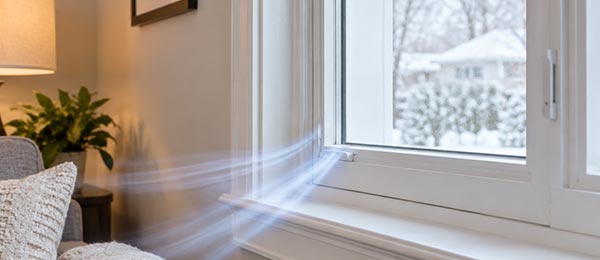
A draft around a closed window is a diagnostic signal, not simply a comfort issue. It indicates that the air seal between the window unit and the surrounding wall assembly has been compromised, whether at the frame-to-rough-opening junction, the weatherstripping perimeter, or within the glazing system itself.
Energy Efficiency and Heat Loss
Heat loss through windows occurs via three mechanisms: conduction through the glass and frame materials, convection within the glazing cavity, and radiation from the glass surface. Older single-pane windows offer almost no resistance to these pathways. Double-pane units filled with argon gas significantly reduce conductive and convective losses, while Low-E coatings address radiant heat transfer. When seals fail in double- or triple-pane units, the inert gas escapes and is replaced by ambient air, significantly reducing the unit’s thermal performance, in some cases approaching that of a single-pane window.
Rising heating and cooling bills, particularly when no other building systems have changed, are a direct consequence of this degradation. If your annual energy costs have increased despite similar usage patterns, your windows are a primary suspect.
Insulation Basics: How to Test for Air Leakage
A simple field test can confirm whether your windows are leaking air. Close and lock the window, then hold your hand near the frame edges and sash corners. Detectable airflow indicates a failed seal or deteriorated weatherstripping. A more sensitive method is to hold a lit incense stick near the frame perimeter: if the smoke stream deflects consistently toward or away from the wall, air is moving through a gap.
For a more quantitative assessment, a blower door test conducted as part of a home energy audit will measure the total air leakage rate of the building envelope and identify the specific locations of infiltration. This is particularly valuable before committing to a full window replacement program, as it confirms whether windows are the primary source of heat loss or whether other envelope components are equally or more responsible.
Why Is Condensation Between Panes a Warning Sign of Window Failure?
Condensation forming between the glass panes of a double- or triple-pane window is one of the clearest and most definitive indicators of window failure. Unlike surface condensation, which forms on the interior pane during cold weather due to high indoor humidity, inter-pane condensation is caused by a seal failure within the insulated glass unit (IGU) and cannot be resolved by adjusting ventilation or humidity levels.
How Windows Are Constructed
An insulated glass unit consists of two or more panes of glass separated by a spacer bar, with the cavity filled with argon or krypton gas and sealed at the perimeter with a primary and secondary sealant. The spacer typically contains a desiccant material that absorbs any residual moisture within the sealed cavity. This construction is what gives modern windows their thermal resistance: the sealed cavity prevents convective air movement, the gas fill reduces conduction, and the absence of moisture prevents internal fogging.
When the perimeter seal fails, ambient air enters the cavity, and the desiccant becomes saturated. At that point, temperature fluctuations cause the moisture-laden air inside the cavity to condense on the inner glass surfaces, producing the characteristic fogging or streaking that is visible from inside the home.
| Condition | Cause | Actionable Step |
| Condensation on the interior glass surface | High indoor humidity; low exterior temperature | Reduce indoor humidity; check ventilation |
| Condensation between panes (fogging) | IGU seal failure; desiccant saturation | Replace the insulated glass unit or the full window |
| Condensation on the exterior glass surface | Exterior temperature lower than the dew point | Normal in high-performance windows; no action needed |
| Water on the interior sill or framing | Frame seal failure; drainage blockage | Inspect installation; caulk or replace unit |
A failed IGU cannot be repaired by resealing the existing unit in the field. The desiccant is exhausted, and the gas fill has been lost. Replacement of the IGU or the complete window unit is the only effective remedy.
Window Force uses a dual-seal, metal-free warm-edge spacer system in all our insulated glass units — specifically because it outperforms traditional aluminum spacers in resisting the seal degradation described above. The warm-edge design reduces thermal stress at the glass perimeter, which is the primary failure point in most IGUs, extending the effective service life of the sealed unit in Ontario’s freeze-thaw climate.
A 25-year field study tracking over 2,400 insulated glass units across 14 cities, published in the Buildings journal (MDPI, 2023), found cumulative seal failure rates of 4.9% at 10 years, 7.9% at 15 years, and 9.2% at 25 years under real-world conditions. Units from lower-quality manufacturers or incorrectly installed showed substantially higher failure rates, underscoring why both manufacturing quality and installation precision determine long-term performance.
What Role Does Window Age Play in Deciding on Replacement?
Age alone does not determine when a window requires replacement, but it provides essential context for interpreting performance symptoms. A 25-year-old vinyl window showing seal failure is likely approaching the end of its service life; the same symptoms in a 10-year-old window of the same material type would indicate installation defects or accelerated degradation that warrants a warranty investigation.
Lifespan by Material
Window longevity varies significantly by frame material, each of which responds differently to thermal cycling, UV exposure, moisture, and mechanical stress over time.
| Frame Material | Typical Service Life | Key Degradation Factors | Maintenance Requirements |
| Vinyl (PVC) | 20 — 40 years | UV-induced brittleness; thermal expansion/contraction at joints | Low; periodic cleaning; no painting required |
| Wood | 30 — 50 years | Moisture absorption, rot, paint failure, and insect damage | High; annual inspection; repainting every 3 — 5 years |
| Aluminum | 20 — 30 years | Condensation on frames (thermal bridging); corrosion in coastal environments | Low to moderate; corrosion treatment if applicable |
| Fiberglass | 40+ years | Minimal; highly resistant to thermal and moisture stress | Very low; structurally stable over long service life |
| Composite (wood-clad) | 30 — 50 years | Dependent on cladding material and joint integrity | Moderate; inspect cladding seams periodically |
The service life ranges above represent windows that were correctly installed and adequately maintained. Windows installed without proper flashing, adequate shimming, or sufficient caulking at the rough-opening perimeter will degrade significantly faster, regardless of the frame material's quality.
From the perspective of a home's maintenance schedule, windows installed before 2000 almost certainly predate current Canadian energy-efficiency standards. Even if they remain structurally intact, they will not meet the thermal performance levels of current replacement windows, and their continued operation will incur higher ongoing energy costs than modern window systems.
Engineer Sergey Essipov, with 20 years of experience in window manufacturing, notes:
Vinyl windows are often dismissed as a lower-tier option, but at Window Force, our lead-free uPVC compound with UV stabilizers has proven its dimensional stability and seal integrity well into its third decade across thousands of installed units. The critical variables are compound quality and the precision of the frame welding — our fusion-welded corners, for example, create a seamless bond that mechanically joined frames simply cannot match for long-term seal integrity.
How Does Outside Noise Indicate Poor Window Performance?
Sound transmission through windows is directly related to the physical integrity of the glazing system and frame assembly. As windows age and seals degrade, both acoustic and thermal performance decline in parallel, because the same air gaps that allow heat transfer also allow sound transmission.
Sound is transmitted through windows by two distinct mechanisms: direct transmission through the glazing mass, and flanking transmission through gaps in the frame or sash seals. A window with an intact seal and appropriate glass configuration will effectively attenuate exterior sound. A window with a failed perimeter seal or degraded weatherstripping will transmit sound regardless of the glass specification because the acoustic path of least resistance is through the air gap rather than through the glazing.
The relevant performance metric for windows in acoustic applications is the Sound Transmission Class (STC) rating. Standard double-pane windows achieve an STC of approximately 26 — 30. Acoustic-grade double-pane units with laminated glass achieve STC 35 — 40. However, even a high-STC window will perform significantly below its rated value if the installation seal has been compromised.
In urban environments where exterior noise levels routinely exceed 60 — 70 dB, window acoustic performance is a significant factor affecting indoor comfort and sleep quality. Research published in environmental health literature has established links between chronic noise exposure in residential settings and sleep disruption, elevated stress hormone levels, and cardiovascular risk. The World Health Organization recommends that interior night-time noise levels in bedrooms remain below 40 dB, a target that is difficult to meet with degraded windows in high-traffic urban locations.
What Are the Benefits of Installing New Home Windows Today?
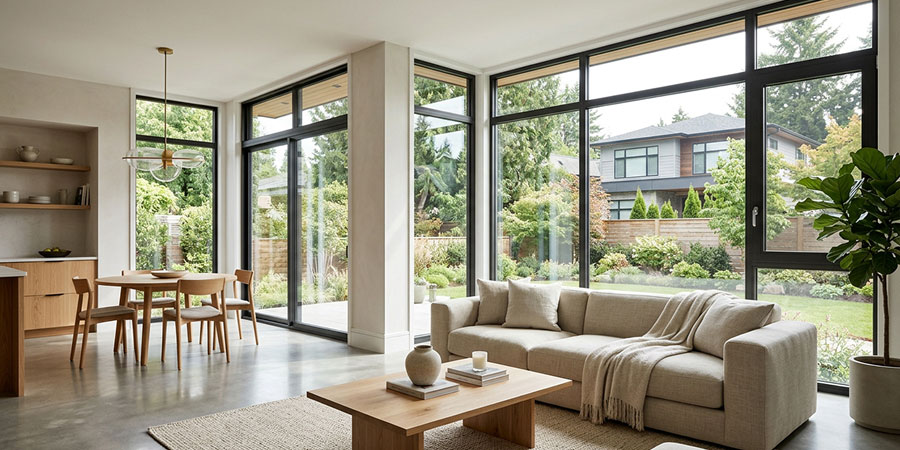
Replacing degraded windows should be evaluated as a long-term investment with a quantifiable return across multiple categories: energy operating costs, occupant comfort, interior asset protection, and home resale value.
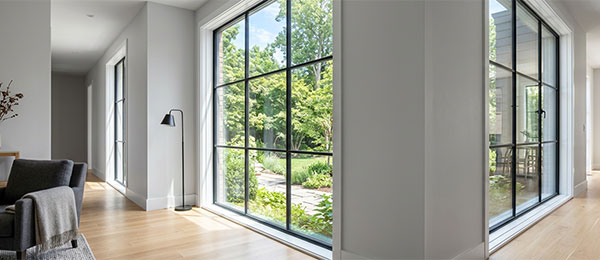
ROI Benefits
The financial case for window replacement rests on three concurrent streams of return. The first is energy savings: reduced heating and cooling loads translate directly to lower utility bills every month for the service life of the new windows. The second is maintenance cost avoidance: new windows, particularly vinyl windows, require minimal ongoing maintenance compared to aging wood or aluminum units that demand periodic refinishing, resealing, and hardware replacement. The third is property value: current real estate appraisal practice treats updated, energy-rated windows as a value-positive improvement, particularly in markets where energy efficiency features are increasingly weighted by buyers.
| Benefit Category | Estimated Improvement | Notes |
| Annual energy cost reduction | 10 — 25% of window-related losses | Varies by climate zone, existing window condition, and new product specification |
| Interior UV protection | Up to 99% UV reduction with Low-E glass | Reduces fading of flooring, furnishings, and finishes |
| Comfort (temperature delta near windows) | 3 — 6°C improvement in cold-weather comfort zone | Result of increased interior glass surface temperature with high-performance glazing |
| Resale value contribution | Commonly cited at 70 — 80% cost recovery | Dependent on the local market, energy-efficient upgrades are increasingly valued by buyers |
| Noise reduction (STC improvement) | +5 to +15 STC points over an aged single-pane | Depends on glazing specification and installation quality |
Mortgage Consumer Survey research on residential retrofit investments indicates that energy efficiency improvements, including window replacements, consistently rank among the top contributors to both buyer preference and appraised value in Canadian residential resale markets.
What Factors Affect the Cost of New Replacement Windows?
Window replacement costs vary considerably depending on a range of technical and project-specific factors. Understanding these variables will help you evaluate quotes accurately and avoid comparing non-equivalent specifications.
| Cost Factor | Low Range | Mid Range | High Range |
| Window size (per unit) | Small (up to 600 × 900 mm) | Standard (900 × 1,200 mm) | Large/custom (1,200 mm+) |
| Glazing configuration | Double-pane, standard | Double-pane, Low-E, argon | Triple-pane, Low-E, krypton |
| Frame material | Standard vinyl | Fibreglass or aluminum-clad | Wood or premium composite |
| Installation complexity | Standard retrofit, accessible | Upper storey, difficult access | Full frame-out, structural modification |
| Hardware and features | Basic tilt-in sash | Multi-point locking, custom finishes | Motorized operation, integrated blinds |
Beyond the unit cost itself, the scope of installation significantly affects the total project cost. A pocket installation, where the new window is inserted into the existing frame, is substantially less expensive than a full frame-out replacement, but it is only appropriate when the existing frame is structurally sound and dimensionally stable. If the rough opening shows signs of water damage, rot, or settling, a full frame-out replacement is necessary regardless of cost preference, as installing into a compromised frame will lead to the same failure in the new unit.
Regional labour rates, permit requirements for large projects, and the complexity of trim restoration after installation should also be factored into any cost comparison. Obtaining quotes from at least three qualified installers, with written specifications defining the product, installation method, and warranty terms, is standard practice before committing to a replacement program.
How Do Modern Windows Improve Energy Efficiency and Home Value?
The performance of modern glazing systems represents a substantial technical advancement over the windows installed in most Canadian homes built before the year 2000. Three specific technologies account for the majority of that improvement: Low-E coatings, inert gas fills, and thermally broken frame systems.
Low-emissivity (Low-E) glass coatings are microscopically thin metallic oxide layers applied to one or more glass surfaces within the IGU. They function by reflecting long-wave infrared radiation, heat, back toward its source while remaining transparent to visible light. In winter, they reflect interior heat back into the room; in summer, they reduce solar heat gain from the exterior. The specific type of Low-E coating (hard-coat or soft-coat) and its spectral selectivity determine whether the window is optimized for cold-climate heat retention or hot-climate solar control.
Argon gas fill between panes reduces thermal conductivity within the glazing cavity by approximately 34% compared to air, lowering the overall U-factor of the unit. Krypton gas provides greater resistance but at a higher cost, and is typically reserved for triple-pane configurations where the narrower cavity spacing limits the effectiveness of argon.
ENERGY STAR Certification
ENERGY STAR certification for windows in Canada is administered by Natural Resources Canada and is assigned by climate zone, reflecting the fact that optimal window performance specifications differ between the mild conditions of coastal British Columbia and the severe winter conditions of the Prairie provinces or northern Ontario. A window certified for Climate Zone C (most of southern Canada) must meet a maximum U-factor of 1.22 W/m²·K and a minimum Energy Rating (ER) of 34. A window certified for Climate Zone A (the most demanding) must achieve a maximum U-factor of 1.22 W/m²·K and a minimum ER of 29, with more stringent solar heat gain coefficient requirements to account for heating season solar contribution.
When engaging window installation services for a replacement project, specifying ENERGY STAR-certified products for your applicable climate zone ensures the investment meets recognized performance benchmarks and may qualify for federal or provincial energy retrofit incentive programs.
All Window Force windows are engineered to meet or exceed ENERGY STAR® requirements and carry CSA certification. As an ENERGY STAR Partner, we manufacture products across both our Ultraslim and Classic Series that qualify for applicable rebate programs — and our team can help you confirm eligibility for your specific climate zone and project scope.
What Should You Look For When Choosing New Windows for Your Home?
Selecting the right replacement window requires evaluating several interdependent factors: product performance, material quality, installation scope, and contractor qualifications. The following process provides a structured framework for making that decision.
Step-by-Step Selection Guide
- Select the appropriate frame material. For most Canadian residential applications, vinyl offers the best combination of thermal performance, durability, and maintenance requirements.
- Determine the installation method. Assess whether a pocket installation or full frame-out replacement is appropriate for each opening. If there is any evidence of water damage, rot, or dimensional distortion in the existing frame, full frame-out replacement is required.
- Specify the glazing configuration. Based on climate zone and orientation, specify the appropriate Low-E coating type, gas fill, and number of panes. Request the U-factor and Energy Rating values for any product under consideration.
- Evaluate warranty terms. Review the product warranty for the glazing unit, the frame, and the hardware separately. Understand what constitutes a warranty claim for seal failure, and whether the warranty is transferable to a subsequent owner of the home.
- Verify contractor qualifications. Confirm that the installer is certified, carries appropriate liability insurance, and provides a written installation warranty. Request references from comparable projects and confirm that the installation will comply with the National Building Code of Canada and applicable provincial building code requirements.
Engineer Sergey Essipov, with 20 years of experience in window manufacturing, explains:
A product warranty is only as valuable as the installation it covers. At Window Force, I’ve seen high-specification triple-pane units fail within five years because the rough opening was not properly prepared and the drainage plane was interrupted. The window itself was not the failure point — the installation was. That’s why we include detailed installation specifications with every order and train our authorized dealer network on proper flashing and drainage procedures. Always verify that your installer follows published flashing and drainage standards, not just generic manufacturer instructions.
What Are the Final Recommendations Before Replacing Your Windows?
The decision to replace windows should be based on a documented assessment of current performance rather than a reaction to a single symptom. The most defensible approach is to evaluate multiple indicators together, because the convergence of several performance failures within an appropriate age window makes a compelling case for replacement, whereas a single symptom in a younger window may indicate a repair opportunity rather than a full replacement requirement.
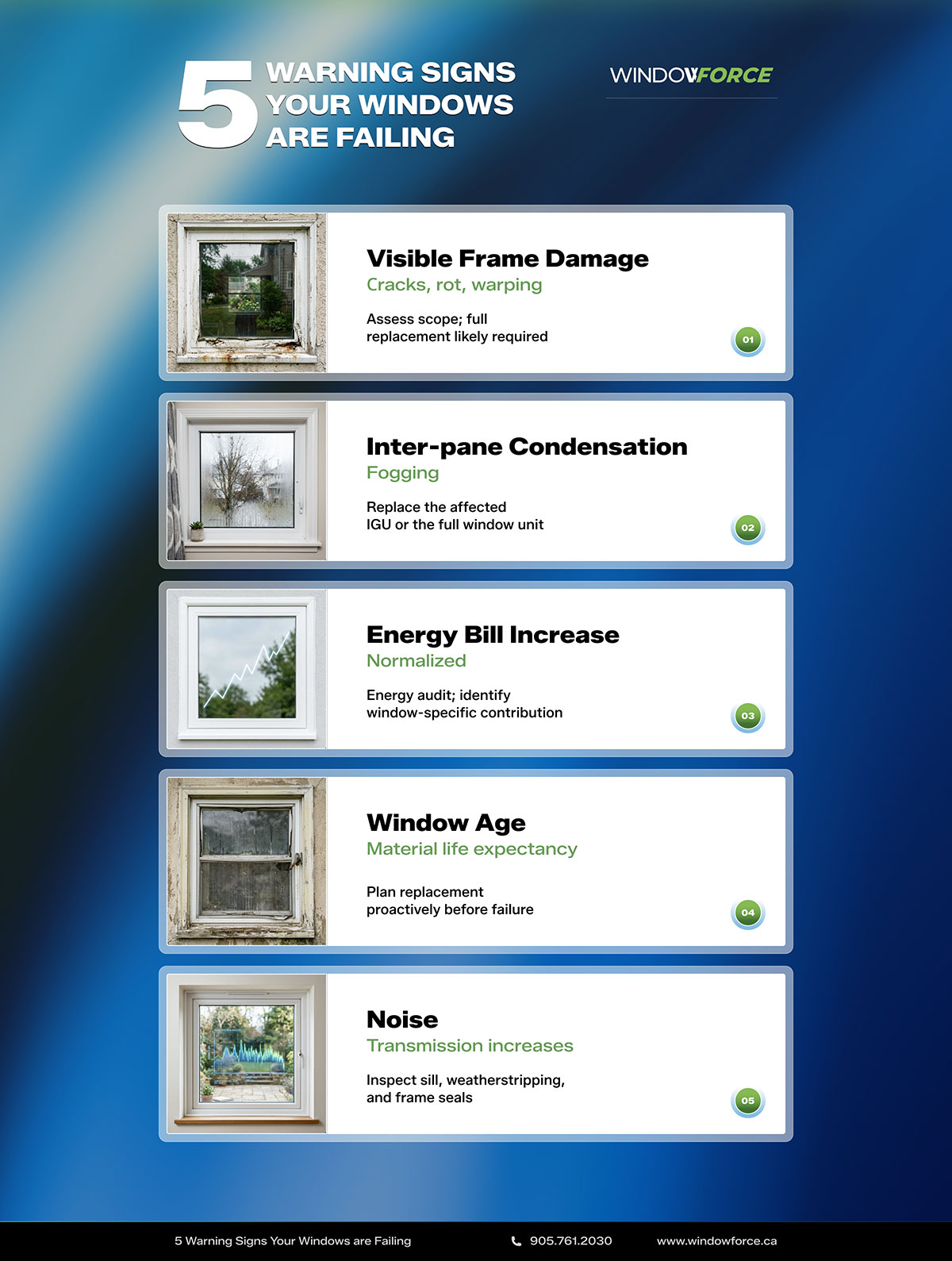
| Indicator | Threshold for Concern | Recommended Action |
| Visible frame damage (cracks, rot, warping) | Any structural compromise | Assess scope; full replacement likely required |
| Inter-pane condensation (fogging) | Persistent; present in multiple units | Replace the affected IGU or the full window unit |
| Detectable air infiltration when closed | Consistent; present at multiple points | Weatherstripping first; replace if the frame is damaged |
| Energy bill increase (normalized) | >10% increase over 3+ years, no other changes | Energy audit; identify window-specific contribution |
| Window age vs. material life expectancy | Within 5 years of the material's lifespan end | Plan replacement proactively before failure |
| Noise transmission increases | Noticeably worse over a 2 — 3 year period | Inspect sill, weatherstripping, and frame seals |
Before committing to a full replacement program, obtain an energy audit to establish a performance baseline and confirm that windows are the primary driver of your energy losses. This step ensures the investment is targeted and allows you to accurately forecast post-replacement savings.
When selecting products and contractors, treat ENERGY STAR certification as a minimum standard rather than a premium feature. Specify a complete written warranty covering both the product and the installation, and confirm that the installer is certified and carries adequate liability coverage. A qualified windows company will provide written documentation of the scope of installation, product specifications, and warranty terms before any work begins.
The combination of energy cost reduction, improved occupant comfort, and measurable contribution to resale value makes window replacement one of the highest-return envelope upgrades available to homeowners, provided it is executed with appropriate products, qualified installation, and a clear performance specification from the outset.
When Window Replacement Becomes the Right Decision
Replacing windows is not a discretionary upgrade, for many homes, it is a necessary investment in the building envelope's integrity and long-term operating efficiency. When multiple performance indicators converge in a window system that is approaching or has exceeded its material service life, replacement is the most cost-effective path forward.
The technologies available in today's market, thermally broken frames, Low-E coatings, argon gas fills, and multi-chamber PVC profiles, represent a significant performance gap relative to windows manufactured even 15 years ago. Closing that gap translates to lower energy bills, measurably improved interior comfort, better acoustic performance, and a higher appraised value for your property. Acting on the signs outlined in this guide, rather than waiting for complete failure, will always yield better financial and performance outcomes.
Window Force manufactures replacement windows at our Ontario facility for homeowners, builders, and contractors across Canada. Every unit is built to order, CSA certified, and backed by a 25-year transferable warranty. If you're seeing the signs described in this guide, contact our team at 905.761.2030 for a consultation — we'll help you determine whether repair or full replacement is the right path for your specific situation.
Frequently Asked Questions
How can I tell if my windows are no longer energy efficient, even if they look fine?
Windows can lose performance long before visible damage appears. If you notice persistent drafts, rising heating or cooling bills, or increased outside noise, those are strong indicators that the seals or glazing system is no longer performing properly, even if the frames still look intact.
Is it better to repair windows or replace them entirely?
Minor issues like worn weatherstripping or hardware can often be repaired, but problems such as condensation between panes, warped frames, or ongoing air leakage usually indicate structural failure. In those cases, replacement is the more reliable and cost-effective long-term solution.
How much can new windows actually reduce energy costs?
Modern energy-efficient windows with Low-E coatings and insulated glass units can significantly reduce heat loss, often lowering energy costs by 10 — 25 percent, depending on the home and climate. Older homes with outdated windows tend to see the greatest improvement.
What does condensation between window panes mean?
Condensation between panes is a clear sign that the insulated glass unit has failed. The seal has broken, allowing moisture to enter and insulating gas to escape. This cannot be fixed through cleaning or ventilation adjustments and typically requires replacing the glass unit or the entire window.
Do new windows really make a difference in noise reduction?
Yes, properly sealed modern windows can noticeably reduce outside noise. Older or degraded windows allow sound to pass through gaps in the seals, while newer units with improved glazing and airtight installation provide much better acoustic insulation.
Is it worth replacing windows in an older home?
In most cases, it is especially worthwhile. Older homes often have windows that predate modern energy standards, which means they allow significant heat loss. Upgrading them improves comfort, reduces utility costs, and brings the home closer to current performance expectations.
Should I replace all my windows at once or do it gradually?
Replacing all windows at once provides the most consistent performance and efficiency across the home, but a phased approach can work if budget is a concern. Starting with the most problematic windows is usually the most practical strategy.
Will replacing windows increase my home’s value?
Yes, new windows are considered a valuable upgrade. They improve energy efficiency, comfort, and curb appeal, and in many cases, homeowners can recover a significant portion of the investment when selling the property.
What type of windows offers the best value for most homes?
For many Canadian homeowners, vinyl windows provide the best balance of cost, durability, and energy efficiency. However, the ideal choice depends on the specific needs of the home, including climate, design preferences, and budget.
Should I get an energy audit before replacing my windows?
An energy audit is highly recommended because it identifies where heat loss occurs. This ensures that window replacement is the right investment and helps prioritize upgrades for maximum efficiency and return.
People Also Ask