

French windows have recaptured the attention of architects and homeowners alike, driven by a broader design shift toward light-filled, open-plan living that seamlessly connects interior spaces to the outdoors. Once associated primarily with European architecture, this window style now plays a central role in contemporary residential construction across North America, including Canada, where both aesthetics and thermal performance shape every fenestration decision.
As a Canadian vinyl window manufacturer operating from an 80,000 sq ft production facility in Ontario since 2007, Window Force produces casement-based window systems — including paired and French casement configurations — engineered for the thermal and structural demands of the Canadian climate. This guide draws on our direct manufacturing experience with double-leaf window systems.
Key Takeaways
- French windows are a double-leaf window system without a fixed central mullion between the sashes, creating a single, unobstructed opening that maximizes light and ventilation.
- Their popularity is rising in modern homes due to indoor-outdoor living trends and demand for larger glazed areas.
- Energy performance depends heavily on glazing specification, frame material, and proper installation.
- French windows carry a higher upfront cost than standard windows, but offer long-term aesthetic and functional value when correctly selected and installed.
What Are French Windows and How Do They Work in Modern Homes?
French windows are traditionally tall, full-height glazed units designed as operable window systems, despite their door-like proportions. To understand their value, it is important to look at how they are defined technically and how their opening system functions in practice.
Definition and Core Structure
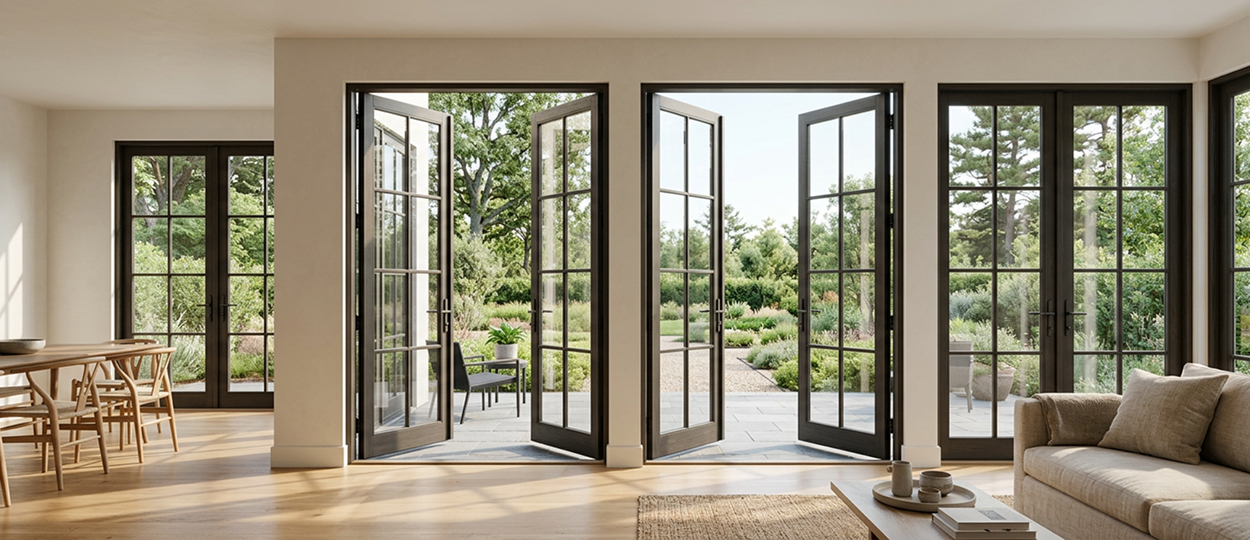
A French window is, at its most precise definition, a double-leaf window unit in which two sashes are hinged on opposite sides of the frame and open toward or away from each other, creating one large, unobstructed opening. The defining technical characteristic is the absence of a fixed central mullion between the two operating leaves. When both sashes are opened, nothing interrupts the view or airflow, a property that distinguishes this configuration from conventional paired casement windows, which retain a structural post between the two openings.
The term "French window" is sometimes used loosely to describe any tall, glazed unit that reaches toward floor level, but in technical terms it refers specifically to this double-leaf, flying-mullion configuration. In France, the product is called a porte-fenêtre, meaning a windowed door, acknowledging that its proportions place it between a conventional window and a door. Despite the name, the design traces its roots to Italian Renaissance architecture and was adopted and refined by French architects during the Baroque period before spreading across Europe and eventually North America.
How the Double-Opening System Works
Both leaves are independently operated and secured with multi-point locking hardware. The system typically functions as follows:
- One leaf serves as the primary operating sash used for daily opening and closing
- The second leaf is secured with top and bottom bolts (espagnolette system)
- When additional airflow or access is needed, the secondary sash can be released
- Both leaves can then swing open simultaneously to create a full-width opening
This configuration provides several functional advantages:
- A wide, unobstructed opening without a central mullion
- Improved airflow across the entire width of the window
- Enhanced natural ventilation compared to single-casement units
- The ability to function as both a window and an access point to outdoor spaces, such as balconies or terraces
Natural Light and the Glazing Advantage
Because the central mullion is absent, the glazed surface area of a French window is proportionally larger than that of a comparable paired-casement unit. This matters significantly in Canadian climates, where winter daylight hours are reduced, and natural light becomes a premium resource in interior design. A well-positioned French window facing south or east can increase solar gain during heating months, while a Low-E coating modulates heat transfer to prevent overheating in summer. This balance between light transmission and thermal control is one of the reasons the product has found renewed relevance in modern, energy-conscious home design.
Windows Near Me
Why Are French Windows Becoming Popular in Contemporary Home Design?
French windows are experiencing renewed popularity as architectural priorities shift toward openness, natural light, and stronger connections to outdoor spaces. Their design aligns closely with contemporary expectations, combining visual elegance with functional advantages that support modern living patterns.
The Indoor-Outdoor Living Trend
The resurgence of French windows is inseparable from one of the most consistent trends in residential architecture: the deliberate blurring of the boundary between interior living spaces and the outdoors. Open-plan layouts, covered patios, and landscaped gardens have become central to how Canadians conceptualize their homes, and fenestration products that facilitate this connection are in growing demand. Large sliding doors, French doors, and bi-fold doors are consistently cited among the most sought-after features by homeowners looking to create a seamless flow to outdoor spaces.
French windows serve this purpose with particular elegance. Their proportions, narrow profiles, and full-width opening capability allow them to function as the visual and physical threshold between a dining room and a terrace, or a living room and a garden, without the visual bulk associated with larger sliding or folding door systems. Modern French window designs create seamless transitions between indoor and outdoor spaces, with full-length glass panels for maximum light, double-opening panels for enhanced ventilation, and slim metal or wooden frames that align with contemporary interiors.
Market Demand and Design Relevance
Architects are increasingly specifying large-format French windows for living areas and master bedrooms, with narrow sightlines enabling larger glass panels that create brighter interiors and uninterrupted views. This specification preference reflects a broader design philosophy in which windows are no longer treated as secondary elements but as primary architectural features that define the character of a space.
In North American markets, French windows and doors are trending toward simple profiles with large glass panes to maximize interior lighting and promote indoor-outdoor flow, with manufacturers exploring aluminum and fibreglass framing to meet growing demand for energy efficiency and durability.
What Are the Main Types of French Windows Available Today?
This window type is available in several distinct configurations, each suited to different architectural contexts and performance requirements. The following table provides an overview of the primary types and their key characteristics.
Main Types of French Windows
French windows are available in several configurations depending on how they are used and where they are installed. Each type offers a different balance of ventilation, efficiency, and design flexibility.
- Outward-opening units for ground-level access and maximum airflow
- Inward-opening designs for upper floors and easier maintenance
- Fixed units for maximum light and thermal performance
- Tilt-turn systems for controlled ventilation and security
- Divided-light styles for traditional or heritage aesthetics
Choosing the right configuration depends on the room’s function and architectural context.
Engineer Sergey Essipov, with 20 years of experience in window manufacturing, explains:
Different French window configurations are not interchangeable solutions. Each type is engineered for a specific use case, and selecting the wrong opening system can compromise ventilation performance, usability, and even long-term durability. At Window Force, when we produce a French casement unit, the meeting stile seal profile, hardware placement, and weatherstripping are all specified for that particular configuration — there’s no universal assembly that covers every opening type.
Fixed vs. Operable Configurations
Fixed French windows provide the best air tightness and allow for very high glazing ratios due to the absence of operable sashes, making them the most thermally efficient option. They are appropriate where light and views are the primary objective and where ventilation can be achieved through adjacent operable units. Operable configurations prioritize airflow and access; outward-opening units generally offer better weather resistance due to compression sealing when closed, whereas inward-opening units are mechanically easier to operate and simpler to clean.
How Do French Casement Windows Differ from Traditional Casement Windows?
The standard casement window is a single-sash unit hinged on one side. It opens in one direction, either inward or outward, and the frame contains a fixed head, sill, and side jambs, with the sash operating within those boundaries. A French casement is a paired unit with two independently hinged sashes and no fixed central post between them. This structural distinction has direct consequences for both performance and appearance.
| Feature | Standard Casement | French Casement |
| Number of sashes | One | Two |
| Central mullion | Fixed structural post | Flying mullion (absent when open) |
| Maximum aperture width | Limited by a single sash | Full frame width, both leaves open |
| Locking mechanism | Single-point or multi-point | Espagnolette with top and bottom bolts |
| Glazed area ratio | High (single leaf) | High (two leaves, no central post) |
| Structural complexity | Lower | Higher (hardware at meeting style) |
| Weather sealing | Compression on the frame | Compression at meeting stile + frame |
| Ventilation volume | Moderate | High |
The meeting style, in which the two leaves of a French casement meet when closed, is a critical engineering consideration. In lower-quality products, this junction is a source of air infiltration and water intrusion. High-performance French casement addresses this with compression seals and interlocking meeting stiles, maintaining airtightness ratings comparable to those of well-made single-casement units.
Air leakage is a key performance metric in operable window systems, particularly those with multiple moving parts. Proper weatherstripping specification at the meeting style is therefore a quality indicator that distinguishes well-engineered French casements from commodity alternatives. Products certified under Canada's ENERGY STAR program must meet an air infiltration rate of 1.5 L/s/m² or less, as required by Natural Resources Canada's technical specification.
Window Force’s French casement configurations are built using the same lead-free uPVC multi-chamber profiles and fusion-welded corners as our standard casement line, with compression seals at the meeting stile designed to maintain air-tightness ratings consistent with ENERGY STAR requirements. The dual-seal warm-edge spacer system used in our insulated glass units further reduces heat transfer at the glass edge — a critical performance point in any operable window with multiple sealing surfaces.
What Are French Pane Windows and How Do They Affect Aesthetics?
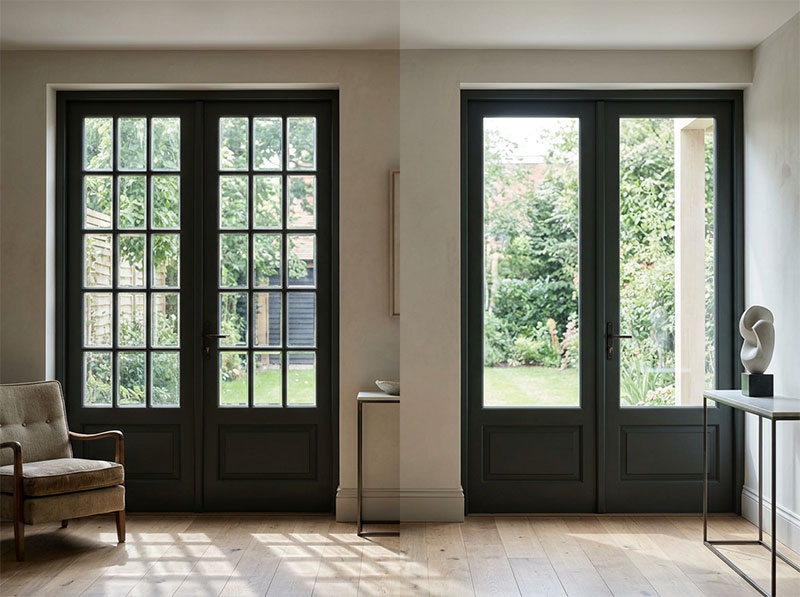
While the overall form of a French window defines how it operates, the configuration of its glazing plays a critical role in how it looks and feels within a space. Pane divisions, in particular, can significantly alter the visual character, shifting a window’s appearance from traditional to modern.

Pane Divisions and Their Design Function
The term "French pane window" refers to a window whose glazed surface is divided into a grid of smaller panes by structural or decorative bars called muntins or glazing bars. This configuration stems from the historical necessity of using small glass sheets, the largest units early glassmakers could consistently produce. As manufacturing advanced and larger panes became available, the divided-light aesthetic was retained for its visual character rather than structural need.
Today, French pane windows are available in two forms: true divided lights, where each pane is a separate piece of glass set into individual glazing bars, and simulated divided lights (SDL), where a single large insulated glass unit is overlaid with decorative bars on the exterior, interior, or both surfaces. True divided lights offer the most authentic appearance but introduce additional seal points and thermal bridges. SDL units preserve the visual effect while retaining the insulation performance of a continuous sealed unit.
Aesthetic Impact: Classic vs. Modern
The grid pattern created by glazing bars produces a fundamentally different visual character from that of an unobstructed glass panel. Divided-light French windows suit heritage, Georgian, Victorian, or traditional farmhouse architecture, where the proportioned grid adds period-appropriate detail and a sense of craftsmanship. In contemporary applications, the divided-light pattern can appear heavy or visually busy, which is why modern French windows overwhelmingly favour large, uninterrupted glazing panels that maximize transparency and minimalism.
The choice between divided and undivided glazing also affects light diffusion. Multiple small panes introduce subtle refraction at each bar, creating a slightly dappled quality in the incoming light, a characteristic valued in heritage interiors. Single-pane configurations deliver uniform, direct light transmission, which suits the clean, bright aesthetic of modern open-plan spaces.
How Energy-Efficient Are French Windows Compared to Other Window Types?
According to Natural Resources Canada's Keeping the Heat In guidance, windows, doors, and skylights can account for up to 35 percent of a home's total heat loss, making fenestration selection one of the most consequential decisions in a home's thermal envelope. French windows, because of their large glazed area and operable dual-leaf configuration, require careful specification to achieve the energy performance levels now expected of modern energy-efficient windows in Canadian residential construction.
Performance Metrics for Canadian Conditions
In Canada, window performance is evaluated using a few key energy metrics that determine how well a window retains heat and controls solar gain. These ratings are essential for meeting ENERGY STAR requirements.
- U-factor: measures heat loss (lower is better)
- SHGC (Solar Heat Gain Coefficient): measures how much solar heat enters the home
- Energy Rating (ER): combines heat loss, solar gain, and air leakage
- Visible Transmittance (VT): indicates how much natural light passes through
To qualify for ENERGY STAR in Canada, windows must meet minimum efficiency thresholds, such as a U-factor of 1.22 W/m²K or lower or an ER of 34 or higher, with stricter criteria for higher performance tiers.
Glazing Specification for French Windows
French windows achieve competitive energy ratings when specified with double- or triple-glazed insulated glass units (IGUs) filled with argon and coated with Low-E film. Low-E coatings can reduce heat loss in winter and heat gain in summer by up to 50 percent, and are available in passive (high SHGC) or solar-control (low SHGC) variants depending on the orientation and climate zone.
The meeting style in a French casement introduces an additional air-sealing challenge not present in single-casement or fixed windows. Well-engineered products use compression seals and interlocking style profiles to minimize infiltration at this junction. ENERGY STAR-certified fenestration products sold in Canada must achieve an air leakage rate of no more than 1.5 L/s/m².
ENERGY STAR-certified windows in Canada are generally more energy-efficient than standard windows, and can contribute to significant reductions in heating and cooling costs depending on building conditions and installation quality. These savings apply across window types, provided the product meets the certification criteria, meaning a properly specified French window can achieve the same efficiency tier as a fixed or single-casement unit.
At Window Force, we offer more than 15 glass configurations across our product line — including Low-E coatings optimized for different orientations and climate zones, argon gas fill, tempered and laminated options, and decorative privacy glass. For French casement applications, our team can recommend the optimal glazing specification based on window orientation, room function, and the homeowner’s performance priorities.
For replacement window projects where existing frames are damaged or aged beyond repair, a full-unit French window replacement with ENERGY STAR-certified products is the most effective way to restore both thermal performance and seal integrity.
What Are the Advantages and Disadvantages of Installing French Windows?
Understanding the trade-offs specific to French windows allows homeowners and specifiers to make informed decisions suited to their architectural context, climate zone, and budget.
Advantages and Limitations of French Windows
French windows combine strong visual appeal with practical performance, making them suitable for a wide range of home styles. However, their benefits come with specific considerations.
- Full-width opening for maximum ventilation
- High glazing ratio for increased natural light
- Strong architectural versatility
- Higher upfront cost than standard windows
- Dependence on proper sealing and installation quality
When properly specified and installed, their advantages typically outweigh the limitations.
How Much Do French Windows Cost and What Factors Affect Pricing?
Cost varies significantly based on size, material, glazing specifications, hardware, and installation complexity. The following table provides indicative ranges for the Canadian market; actual pricing from a windows company will vary by region and project-specific requirements.
As a manufacturer, Window Force controls pricing from raw material through finished product. French casement configurations are priced based on the actual production variables — frame dimensions, glazing specification, hardware, and colour — rather than through markup layers typical of multi-distributor supply chains. For project-specific pricing on French casement windows, contact our team or request a quote through an authorized Window Force dealer.
Key Cost Factors for French Windows
The cost of French windows varies depending on several technical and project-related factors. These variables influence both upfront pricing and long-term performance.
- Unit size and dimensions
- Frame material (vinyl, wood, fibreglass, aluminum)
- Glazing type (double or triple pane, Low-E coatings, gas fills)
- Hardware quality and locking systems
- Installation complexity and regional labour
A balanced specification helps ensure both cost efficiency and long-term durability.
Key Pricing Variables
Size is the dominant cost driver: French windows with heights above 2,100 mm or widths that require oversized structural lintels incur additional material and labour costs. Custom shapes or curved-head configurations add further premiums. Material choice affects both the unit cost and the long-term cost of ownership; vinyl windows have the lowest initial cost and maintenance expenditure, while wood commands a premium in both purchase price and ongoing upkeep.
Glazing specification also meaningfully affects price. Upgrading from a standard double-pane to a high-performance triple-pane unit can add 15 to 30 percent to the cost of the glass, but in colder Canadian climate zones, this investment is recoverable through reduced heating costs over a relatively short period.
Are French Windows Suitable for All Climates and Home Styles?
The suitability of French windows depends not only on personal design preferences but also on environmental conditions and the building's architectural language. Their performance and visual integration can vary significantly depending on climate demands and home style, making proper specification essential.
In practice, this often means working with a window supplier in British Columbia, where coastal moisture and milder temperatures shape product requirements, or choosing a window manufacturer in Alberta, where extreme cold demands higher thermal performance. Aligning product selection with regional expertise helps ensure consistent energy efficiency, durability, and long-term reliability.
Climate Adaptability in Canada
In colder zones, the priority is minimizing U-factor and air infiltration. Triple-pane IGUs with krypton or argon fill, high-performance Low-E coatings, and thermally broken or vinyl frames are the appropriate specification. The meeting style must be sealed with compression gaskets, and installation must be executed without thermal bridges between the window frame and the rough opening framing.
In milder coastal climates, moisture resistance becomes the primary specification concern alongside thermal performance. Aluminum-clad or fibreglass frames with marine-grade finishes perform well in these conditions, resisting the expansion and contraction cycles that degrade painted wood in high-humidity environments.
High-performance double-glazed windows can have U-factors of 1.2 W/m²K or lower, and triple-glazed windows can achieve U-factors as low as 0.8 W/m²K, providing guidance on what is achievable at each glazing tier for Canadian conditions.
Architectural Compatibility
French windows are among the most architecturally versatile window formats. Their proportioned, symmetrical design suits Georgian, Victorian, Edwardian, French Provincial, and traditional craftsman styles equally well. In contemporary architecture, slender-profile French casements with undivided glazing integrate naturally into clean, minimalist facades.
They are less appropriate in very small wall openings, where the paired-leaf configuration produces frames that are disproportionately wide relative to the glazed area, diminishing the visual clarity that makes the format appealing. They also require careful detailing at the threshold in taller configurations to prevent water ingress and trip hazards, particularly where the unit is designed to open onto a terrace at grade level.
Homes with a strong horizontal design emphasis, typical of mid-century modern or ranch-style architecture, may find that wide sliding units better complement the facade's language, while French windows suit vertically proportioned openings more naturally.
Final Thoughts on French Windows
French windows occupy a distinct position in the residential fenestration market: they are neither the most thermally simple nor the least expensive option, but they offer a combination of architectural character, light quality, and ventilation capability that few other window formats can match. When specified correctly for the climate zone, oriented appropriately, and installed with the precision that their dual-leaf configuration demands, they perform at the level of any certified high-efficiency product.
The decision to install French windows should ultimately be evaluated against the specific demands of the space, the building's architectural language, and the homeowner's long-term performance expectations. Where those factors align with what the format does best, French windows represent a considered, durable, and visually compelling investment in a home's quality.
Window Force produces French casement window configurations at our Ontario facility, with every unit custom-manufactured to order, CSA certified, and backed by our 25-year transferable warranty. Whether the project calls for a single statement French window or a full facade of paired casements, our team can help determine the right specification for the building’s orientation, climate zone, and design intent.

Frequently Asked Questions
What is the difference between a French window and a French door?
A French window is a double-leaf window unit with sills and a frame head, typically installed above floor level and operated with window hardware such as espagnolette locks. A French door reaches floor level, includes a threshold, and uses door handles. The key practical distinction is that a door is designed for passage, while a window, even a tall one, is designed primarily for light and ventilation.
Can French windows be installed in Canadian climates?
Yes, French windows are suitable for all Canadian climate zones when specified with the appropriate insulated glass unit, frame material, and air sealing. In colder provinces, triple-pane units with Low-E coatings and thermally broken or vinyl frames are recommended, and the unit must achieve an ENERGY STAR-compliant U-factor of 1.22 W/m² · K or lower.
Are French windows more expensive than regular casement windows?
Yes, typically. The paired-leaf configuration, flying mullion detail, and espagnolette hardware add cost relative to a single casement of equivalent height. Frame material and glazing specification further affect price. The premium is most justified in applications that actively benefit from the format's full-width opening capability and architectural presence.
How do I maintain French windows?
Maintenance requirements vary by material. Vinyl and fibreglass frames require only periodic cleaning. Wood frames must be inspected and refinished on a schedule appropriate to the local climate, typically every three to five years. All French windows should have their espagnolette hardware and meeting stile seals inspected annually to ensure air and water performance is maintained.
What glazing is best for French windows in Canada?
For most Canadian locations, double-pane argon-filled units with a passive Low-E coating are a strong baseline. In colder regions, triple-pane units with krypton fill and advanced Low-E coatings provide measurably better winter performance. The glazing specification should be confirmed against the ENERGY STAR criteria applicable to the installation location, using Natural Resources Canada's published searchable product list.
Can French windows improve ventilation in my home?
Yes. The double-leaf configuration, when both sashes are fully open, creates an unobstructed aperture equal to the frame's full width. This allows significantly greater airflow than a single casement with equivalent overall dimensions and is particularly effective in rooms that face prevailing breezes or in outdoor spaces.
People Also Ask