

Low-emissivity glass has become one of the defining technologies in modern building envelopes, yet many homeowners and builders still confuse it with standard double-pane glazing. Understanding what separates these products at a technical level is essential for making informed decisions about window replacement, new construction, or energy retrofit projects across Canada's demanding climate zones.
Key Takeaways
- Low-emissivity (low-e) glass features a microscopically thin metallic coating that reflects infrared radiation, significantly reducing heat transfer through the window.
- Two primary coating types exist: passive low-e (best for cold climates) and solar control low-e (suited for hot or mixed climates).
- Low-e windows can reduce heating and cooling energy losses through the glazing by 30 — 50% compared to standard double-pane glass.
- In Canada, pricing for low-e IGUs typically ranges from $400 to $1,200+ per installed window, depending on unit configuration, glazing specifications, and region.
- Selecting the correct low-e type for your climate zone is as important as selecting the coating itself; the wrong choice can worsen thermal comfort.
What is Low-E glass and why is it used in modern windows?
Glass, in its standard form, is a relatively poor insulator. It readily transmits solar energy, absorbs a portion of it, and re-radiates it as long-wave infrared heat, contributing to both heat gain in summer and heat loss in winter. Low-emissivity glass addresses this fundamental limitation by applying a microscopically thin, transparent metallic coating to one or more surfaces of the pane. The coating does not alter visible light transmission in any meaningful way but dramatically changes how the glass handles infrared radiation.
Emissivity is the property at the core of this technology. It describes how effectively a surface radiates thermal energy relative to an ideal radiating body. Ordinary float glass has an emissivity of approximately 0.84, meaning it radiates 84% of the thermal energy it absorbs. A quality low-e coating reduces that figure to between 0.02 and 0.15, depending on the product. The practical effect is that heat attempting to pass through the window via radiation is reflected back to its source rather than transmitted through the glazing system.
This property makes low-e glass particularly well-suited to energy-efficient windows intended for cold climates, where reducing radiant heat loss through the glazing envelope is a primary design goal. It is equally relevant in hot climates, where preventing solar heat gain from entering conditioned spaces reduces cooling loads. The technology is now standard in virtually every quality insulated glass unit (IGU) produced by any reputable window manufacturer operating in Canada or internationally.
Engineer Sergey Essipov, with 20 years of experience in window manufacturing, explains:
Emissivity is often misunderstood as a measure of how clear or tinted the glass appears, but it has nothing to do with visible light transmission. Two windows can look identical in a showroom and have vastly different emissivity values based solely on the coating applied to the interior surfaces of the IGU.
Windows Near Me
How does Low-E coating work on windows?
The mechanism behind low-e coatings involves the physics of electromagnetic radiation. Solar energy reaches a building in three forms: ultraviolet light (wavelengths of 310 — 380 nanometres), visible light (380 — 780 nm), and infrared radiation, both short-wave solar infrared and long-wave thermal infrared emitted by warm interior surfaces. Standard glass allows all three to pass through with varying degrees of absorption. A low-e coating is engineered to selectively intervene in this process.
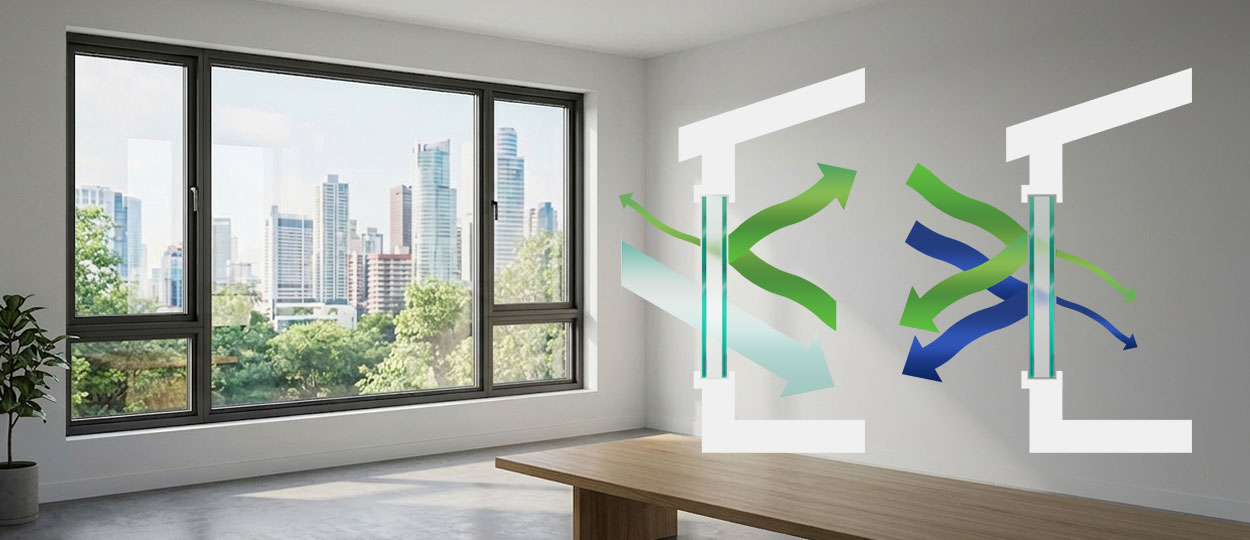
The coating itself consists of one to three layers of silver or other low-emissivity metallic compounds, deposited at a thickness roughly 500 times thinner than a human hair. These layers are transparent to visible light but highly reflective to long-wave infrared radiation. When interior heat attempts to escape to the colder outdoor environment in winter, the coating reflects the majority of it back into the room. In summer, a solar control variant prevents short-wave solar infrared from penetrating the glass and raising indoor temperatures.
A useful analogy is the inner lining of a vacuum flask. The reflective silver lining of a thermos does not generate heat; it reflects it back toward its source, maintaining temperature through constant re-radiation. Low-e coatings operate on the same principle, with the added advantage that the gas-filled space within a sealed IGU provides a secondary layer of insulation similar to the air gap in the thermos wall.
According to Natural Resources Canada's Office of Energy Efficiency, windows, doors, and skylights collectively account for up to 25 — 35% of residential heat loss in Canadian homes. In practical terms, for a household spending $2,400 annually on space heating, an unaddressed glazing heat loss pathway can represent $600—$840 per year in avoidable energy expenditure. This underscores why low-e coating specification is not a luxury upgrade but a baseline performance requirement for any window installation in Ontario, Alberta, or anywhere in Canada's heating-dominated climate zones.
What are the different types of Low-E coatings available?
The two primary categories of low-e coating, passive and solar control, reflect fundamentally different performance objectives. Choosing between them is one of the most consequential decisions in window specification.
Passive low-e coatings
Passive low-e coatings are designed to admit as much solar heat gain as possible while still reflecting long-wave infrared radiation from the interior back into the room. They are optimized for cold climates where free solar heating is beneficial during the heating season. These coatings typically have a higher Solar Heat Gain Coefficient (SHGC), meaning they allow more of the sun's energy to enter the building, contributing to space heating.
Historically, passive coatings were associated with the pyrolytic or "hard coat" process, in which the coating is applied to the glass ribbon while it is still hot during manufacturing. This produces a coating chemically bonded to the glass surface, making it durable enough for use on exposed surfaces, such as the number-one (exterior-facing) surface of a single-pane or the outermost pane of an IGU. Hard coat glass can be cut and handled more freely than soft coat glass and carries no risk of delamination from edge contact.
Solar control low-e coatings
Solar control coatings prioritize the rejection of short-wave solar infrared energy. They have a lower SHGC and are suited to buildings in cooling-dominated or mixed climates, where summer overheating is a concern alongside winter heat loss. In Canadian terms, these coatings are more relevant in southern Ontario or British Columbia than in northern Alberta.
Solar control coatings are typically produced using the Magnetron Sputtered Vacuum Deposition (MSVD) process, which deposits multiple ultrathin metallic layers at room temperature in a vacuum chamber. This produces a "soft coat" product that is significantly more thermally efficient than hard-coat equivalents but requires the coating to be applied to an interior-facing surface (surface two or three of a standard double IGU), where it is protected from moisture, abrasion, and oxidation by the sealed gas cavity.
| Coating type | Process | SHGC | Best climate | Surface placement |
| Passive low-e (hard coat) | Pyrolytic | Higher (0.40 — 0.65) | Cold (heating-dominated) | Surface 1 or 4 |
| Solar control low-e (soft coat) | MSVD | Lower (0.20 — 0.45) | Mixed or cooling-dominated | Surface 2 or 3 |
Engineer Sergey Essipov, with 20 years of experience in window manufacturing, notes:
The durability of hard coat and soft coat glass is frequently misrepresented. Soft-coat MSVD products, when properly sealed within a quality IGU, will outperform hard-coat glass in thermal performance over any comparable service life. The durability concern applies only when the seal is compromised, which is a manufacturing and installation quality issue, not a coating issue.
How do Low-E coating windows improve energy efficiency?
The energy-efficiency gains from low-e-coated windows operate through three distinct mechanisms: reduced radiant heat transfer, improved U-value of the IGU assembly, and reduced solar heat gain, when that is the design intent.
The U-value of a window measures the rate of heat transfer through the entire assembly per unit area per degree of temperature difference. A standard clear double-pane window with no low-e coating typically achieves a U-value of 2.7 to 3.0 W/m²·K. Adding a quality low-e coating and argon gas fill reduces this to 1.4 to 1.8 W/m²·K in a double-pane configuration, and further to 0.8 to 1.0 W/m²·K in a triple-pane assembly, both benchmarks being relevant to the Canadian residential energy code.
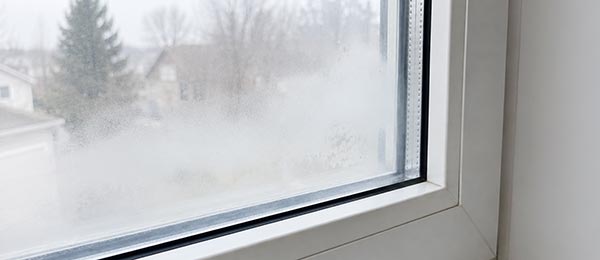
During winter, the low-e coating prevents the interior surface of the inner pane from becoming excessively cold, which has secondary benefits beyond raw energy savings. Cold glazing surfaces create radiant asymmetry, where occupants feel uncomfortably cold near the window even when the ambient air temperature is adequate. Low-e glass raises interior surface temperatures, improving perceived thermal comfort and reducing the likelihood of condensation on the glass.

During summer, a solar control coating reduces cooling load by blocking a meaningful portion of the solar heat gain that would otherwise need to be removed by air conditioning. In commercial buildings, where window-to-wall ratios are high and mechanical cooling costs are substantial, this effect can be significant. For residential applications, the benefit is more modest but still measurable, particularly in south- or west-facing glazing with high solar exposure.
How does Low-E glass compare to standard glass?
The comparison between low-e and standard clear glass is most usefully presented across the key performance metrics that govern window specification decisions.
| Performance metric | Standard clear double-pane | Low-e double-pane (passive) | Low-e double-pane (solar control) |
| U-value (W/m²·K) | 2.7 — 3.0 | 1.4 — 1.8 | 1.4 — 1.8 |
| SHGC | 0.70 — 0.76 | 0.40 — 0.60 | 0.20 — 0.45 |
| Visible light transmittance | 78 — 82% | 70 — 78% | 60 — 75% |
| UV transmittance | ~62% | 15 — 30% | 10 — 25% |
| Emissivity of the coated surface | 0.84 | 0.04 — 0.15 | 0.02 — 0.10 |
| Argon gas fill | Optional | Standard | Standard |
The UV-blocking capability of low-e glass is particularly relevant to interior finishes. Standard clear glass allows approximately 62% of ultraviolet radiation to pass through. According to Guardian Glass's technical documentation, low-e coatings can filter up to 78% of harmful UV radiation in a standard triple-insulating glass configuration. When low-e glass is combined with a laminated interlayer, UV blockage can reach up to 99%, substantially extending the service life of interior materials exposed to direct or indirect sunlight.
Low-e coatings reduce UV transmittance to 10 — 30%, significantly extending the service life of interior furnishings exposed to direct or indirect sunlight.
How much do Low-E coating windows cost in Canada?
The cost of low-e windows in Canada varies considerably depending on window size, frame material, glazing configuration, number of panes, and regional labour rates. For a standard double-pane low-e IGU in a vinyl casement or double-hung frame, retail prices from a quality window supplier in Toronto or other major urban centres typically range from $400 to $850 per unit before installation. Triple-pane low-e configurations for high-performance or Passive House applications can cost $900 to $1,400+ per installed unit.
Regional price variation is meaningful. The cost of window installation in Alberta is influenced by local labour markets, transportation costs to remote communities, and the heating climate, which often mandates triple-pane specifications. Homeowners in Calgary and Edmonton may find that the premium for triple-pane low-e units, while higher upfront, shortens payback periods relative to double-pane equivalents due to higher heating energy costs and greater temperature differentials.
How do you choose the right Low-E glass for your climate?

Canada's climate diversity means that the optimal low-e specification in Halifax differs from that in Kelowna or Yellowknife. The primary decision variable is the balance between winter heat retention and summer solar control.
Cold climate zones (most of Canada)
In climate zones corresponding to Energy Star Canada's zones 1 and 2, which encompass much of Ontario, Quebec, the Prairie provinces, and northern Canada, the priority is to minimize U-value and retain solar heat gain during the long heating season. Passive low-e coatings with SHGC values in the range of 0.40 to 0.60 are appropriate for south-facing glazing, where winter solar gain is beneficial. North-facing windows benefit from any low-e specification, as solar gain is minimal and thermal resistance is the dominant concern.
Mixed and moderate climate zones
Southern British Columbia and pockets of southern Ontario experience meaningful cooling seasons alongside cold winters. In these zones, a solar-control low-e coating with moderate SHGC reduction, typically in the 0.30 to 0.45 range, offers a better balance than a high-gain passive coating, which can cause overheating in well-insulated buildings with large south- and west-facing glazing areas.
Gas fill and spacer considerations
The low-e coating does not function in isolation. The thermal performance of the IGU also depends on the gas fill (argon or krypton, versus air in older or lower-grade units) and the spacer material separating the panes at the perimeter. Warm-edge spacers, typically made from stainless steel or polymer composites rather than aluminum, significantly reduce conductive heat loss at the frame/glass junction, which represents a meaningful portion of total window heat loss in cold climates.
Is Low-E glass worth the investment for homeowners?
For the majority of Canadian homeowners replacing windows in a home with older single-pane or early-generation double-pane glazing, low-e glass is unambiguously the appropriate specification. The cost premium over standard clear double-pane glass at the unit level is typically $40 to $80 per window at the manufacturing stage, a marginal increase relative to total installed cost that yields measurable thermal performance improvements over the product's service life.
The more nuanced question is whether double-pane or triple-pane low-e units are justified. Triple-pane products carry a cost premium of 20 — 35% over double-pane equivalents and achieve U-values below 1.0 W/m²·K. In most Canadian climates, this specification is defensible on energy grounds for new construction or whole-home replacement projects, where the incremental annual energy savings are multiplied across the full building envelope. For a partial replacement of two or three windows in an otherwise older home, the payback arithmetic is less straightforward, and double-pane low-e units represent a more proportionate investment.
Beyond energy savings, low-e glass provides comfort and material durability benefits that do not appear in simple energy payback calculations. The reduction in radiant discomfort near cold glazing surfaces, the elimination of condensation on interior glass faces during cold weather, and the protection of interior finishes from UV degradation all contribute to homeowner satisfaction and long-term maintenance savings. These qualitative factors make the investment case for low-e glass more robust than a pure energy ROI analysis suggests.
Conclusion: What should you know before choosing Low-E glass?
Low-e glass is not a single product but a broad category of glazing technologies united by the principle of emissivity reduction. Selecting the right coating type, glazing configuration, gas fill, and spacer system for a specific climate zone and building orientation is what determines whether a window replacement project delivers its full energy and comfort potential. A window manufacturer with technical knowledge of Canadian climate zones is better positioned to guide this specification than a general contractor or retail supply chain with limited glazing expertise.
For Canadian homeowners, the practical priority is straightforward: always specify a quality low-e coating on any window replacement project, verify that the IGU carries an Energy Star Canada certification appropriate to your climate zone, and confirm that installation meets the tolerances required by the manufacturer's warranty. The window installation itself is as consequential as the glazing specification; even the best-performing unit will underperform if air sealing and framing tolerances are not observed during installation.

Frequently Asked Questions
What does "low-e" mean on a window?
Low-e stands for low-emissivity. It refers to a microscopically thin metallic coating applied to the glass surface that reduces the amount of infrared radiation the glass emits or transmits. This lowers the rate of heat transfer through the window without significantly reducing visible light transmission.
Can you tell if a window has a low-e coating by looking at it?
Most low-e coatings are not visible to the naked eye under normal conditions. A simple field test involves holding a lit match or small flame near the glass and observing its reflection: a low-e coating produces a slightly different colour in one of the flame's reflected images. More reliably, the IGU label (typically on the spacer bar or etched into the glass edge) will identify the coating specification.
Does low-e glass block the sun?
Low-e glass does not block visible sunlight to any significant degree. It selectively reduces infrared radiation, both long-wave (interior heat) and, in solar control variants, short-wave (solar heat energy). Visible light transmittance remains high relative to tinted or reflective glass products.
Does low-e glass affect plants growing near windows?
Passive low-e glass has minimal effect on plant growth because it does not substantially reduce visible light, which plants use for photosynthesis. Solar control coatings with lower visible light transmittance may slightly reduce light levels for plants requiring high light intensity, but for most common houseplants, the effect is negligible.
How long does a low-e coating last?
The metallic layers of a low-e coating do not degrade under normal conditions when properly sealed inside an IGU. The coating is protected from oxidation, moisture, and abrasion by the sealed gas cavity. The practical service life of the coating is therefore tied to the seal integrity of the IGU; a failed seal that allows moisture into the unit will eventually cause the coating to degrade, which is why IGU warranty terms and manufacturer quality standards are relevant to long-term performance.
Does the position of the low-e coating matter?
Yes, significantly. Passive low-e coatings perform best on surface 3 of a double-pane IGU (the indoor-facing side of the inner pane). Solar control coatings perform best on surface 2 (the outdoor-facing side of the inner pane). Incorrect surface placement reduces coating effectiveness and can alter the window's thermal comfort characteristics in ways that are counterproductive to the intended climate application.
People Also Ask