

All prices on this page are market reference estimates for the Vancouver area as of 2026. Actual costs vary based on project specifications, dealer pricing, installation complexity, and customization. Window Force is a manufacturer; installation is completed by local dealers and contractors. For an accurate quote, contact Window Force and we will connect you with the most relevant dealer for your location and project.
Vancouver homeowners replacing windows in 2026 can expect to pay between $500 and $2,200 per window installed for standard vinyl windows, with whole-home projects for a typical three-bedroom house running $10,000 to $22,000. Vancouver sits at the higher end of Canadian installation pricing, driven primarily by local labour rates rather than the cost of the windows themselves.
This guide is written from a manufacturer's perspective. Window Force has been producing custom vinyl windows at our 80,000 sq ft Canadian production facility since 2007, and our windows reach the Lower Mainland through 80+ trade partners across British Columbia. We see every input that shapes a window quote, from glazing and spacer costs on the production line to the freight and dealer economics behind the price you see in Vancouver.
One thing worth understanding before you compare quotes: the manufactured cost of a quality vinyl window is broadly consistent across Canada, because it comes off the same production line regardless of destination. What changes in Vancouver is freight, local installation labour, and dealer overhead. Vancouver labour is among the most expensive in the country, which is why the installed prices below run roughly 10 percent above comparable projects in Ontario or the Prairies.
Key Takeaways
- Standard vinyl replacement windows in Vancouver typically cost $500 to $2,200 per window installed, with labour rates the main reason Vancouver prices exceed most Canadian markets.
- Moisture management matters more than extreme cold in coastal BC. Proper drainage, warm-edge spacers, and correct flashing during installation are the difference-makers.
- A three-bedroom Vancouver home generally costs $10,000 to $22,000 to fully re-window.
- CleanBC rebates offer $100 per window up to $2,000 for qualifying products (U-Factor 1.22 or lower), though standard-stream rebates are not available within the City of Vancouver itself. Income-qualified households can access up to $9,500.
- Local contractors typically charge $250 to $450 per window for retrofit installation and $450 to $900 for full-frame replacement.
Average Window Replacement Costs in Vancouver by Style (2026)
The table below summarizes typical price ranges for vinyl replacement windows in the Vancouver market. The Supply Only column reflects the approximate manufactured cost of the window unit itself; the Installed column includes the window plus typical local installation, removal of old windows, insulation, and basic finishing.
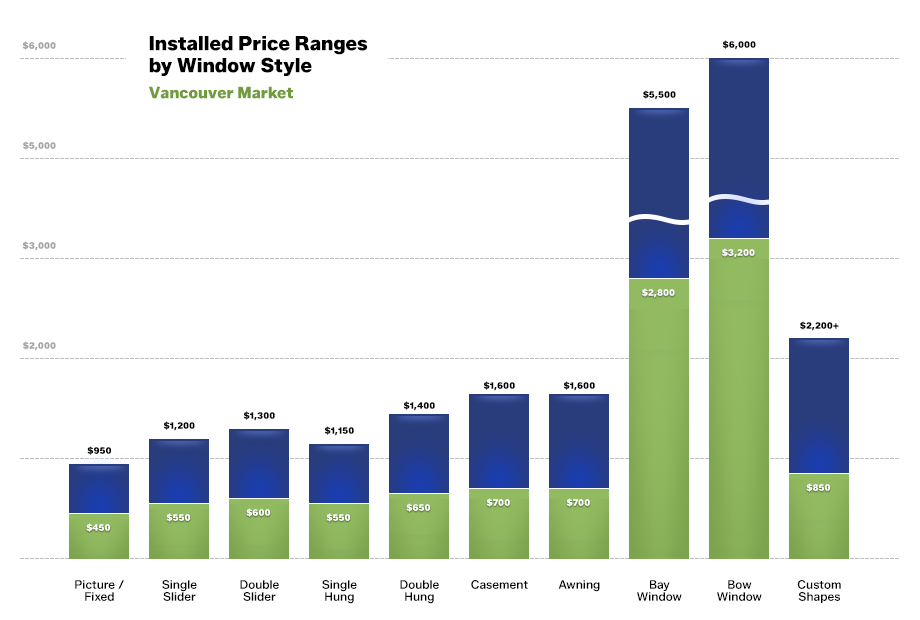
| Window Style | Supply Only | Installed | Best For |
| Picture / Fixed | $200 - $600 | $450 - $950 | Views, light |
| Single Slider | $300 - $700 | $550 - $1,200 | Compact spaces |
| Double Slider | $350 - $750 | $600 - $1,300 | Bedrooms, living areas |
| Single Hung | $350 - $700 | $550 - $1,150 | Traditional look |
| Double Hung | $400 - $800 | $650 - $1,400 | Ventilation, classic |
| Casement | $400 - $900 | $700 - $1,600 | Airtight sealing |
| Awning | $400 - $900 | $700 - $1,600 | Rain-friendly ventilation |
| Bay Window | $1,500 - $3,500 | $2,800 - $5,500 | Focal points |
| Bow Window | $1,800 - $4,000 | $3,200 - $6,000 | Panoramic views |
| Custom Shapes | $500 - $1,500+ | $850 - $2,200+ | Architectural detail |
*Prices reflect standard vinyl windows in the Vancouver market as of 2026. Premium glazing, custom colours, and non-standard sizing shift costs higher. Tax not included.
Supply-only pricing reflects the manufactured cost of the window unit before freight from our Canadian production facility and before local installation. The supply cost is consistent across Canada because every window ships from the same production line; the installed column reflects typical Lower Mainland dealer and contractor pricing, which runs above the national average due to local labour rates.
Windows Near Me
How Size and Customization Affect the Price
Size is one of the largest cost drivers in any window quote. A larger opening requires more glass, more frame material, heavier hardware, and more labour to handle and install safely. As a working rule for the Vancouver market, moving from a small opening (under 15 sq ft) to a large one (30 to 50 sq ft) roughly doubles the installed cost within the same window style.
Every Window Force window is custom manufactured to your exact opening dimensions at our Canadian production facility. Standard sizes are the most cost-effective; non-standard and architectural openings typically add 15 to 30 percent to the base cost of the window, plus additional manufacturing lead time. Because each unit is built to order, there is no penalty for the slightly-off dimensions common in older Vancouver homes; the premium applies only to unusual shapes and oversized units.
What Vancouver's Climate Means for Window Selection and Cost
Vancouver's coastal climate presents a different challenge than the rest of Canada. Winters are mild by national standards, but the region receives persistent rainfall from October through April, often wind-driven against building envelopes. For windows, the enemy here is not extreme cold. It is moisture.
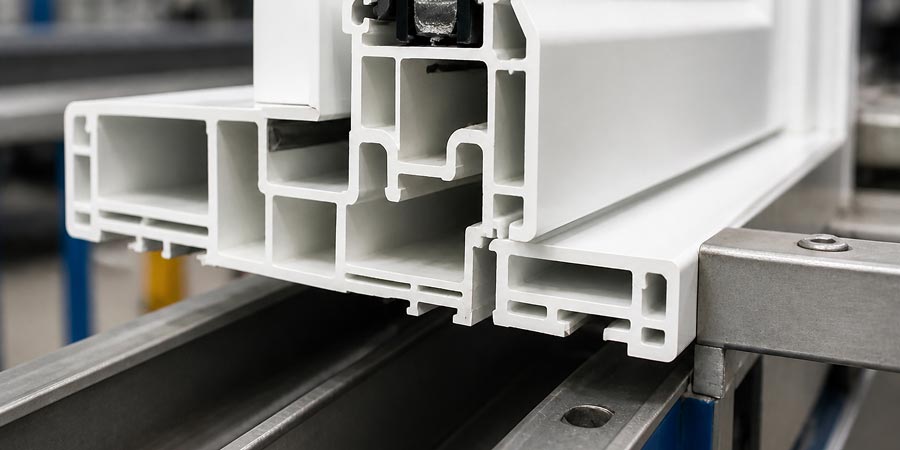
That shifts where your money should go. Drainage design, quality weatherstripping, correct flashing during installation, and warm-edge spacer systems that keep the interior glass surface above the dew point all matter more in Vancouver than an extra pane of glass. Condensation on the inside of windows is one of the most common complaints in Lower Mainland homes, and it is usually a spacer and humidity problem rather than a glazing problem.
Double-pane windows with Low-E coatings and argon fill are a strong fit for most Vancouver applications. Triple-pane earns its premium for noise reduction near arterial roads, SkyTrain corridors, or flight paths, and for homeowners targeting the highest efficiency tiers, including the U-Factor 1.22 threshold that CleanBC rebate streams have required. Natural Resources Canada notes that windows, doors, and skylights can account for up to 25 percent of a home's heat loss, and its guidance on window condensation points to spacer performance and indoor humidity as the controllable factors.
For coastal BC orders, drainage is everything. Every frame that leaves our line has its weep system checked, because a window in Vancouver sheds more water in one November than a Prairie window sees all year. If water cannot exit the frame, no glazing package will save you.
— Sergey Essipov, Production Engineering, Window Force, 20+ years in window manufacturing
What Else Affects the Cost of Replacement Windows?
Window style and operation type. Crank-operated windows such as casements and awnings use precision hardware and compression seals, making them roughly 15 to 25 percent more expensive to produce than slider styles, which rely on simpler track-and-roller mechanisms. Fixed and picture windows are the most affordable per square foot because they contain no moving parts. Bay and bow windows sit at the premium end because they combine multiple units with structural framing and angled mullions.
Glazing configuration. Triple-pane adds roughly 15 to 25 percent over an equivalent double-pane unit and delivers a lower U-Factor, better noise reduction, and two gas chambers instead of one. Window Force manufactures both configurations, and the right choice depends on exposure, room function, and local energy costs rather than a blanket rule.
Glass coatings and gas fills. Low-E coatings are standard on modern windows and typically add $30 to $75 per window over uncoated glass. Argon fill is the standard insulating gas; krypton offers better performance at a higher cost and is generally reserved for triple-pane units. Window Force offers more than 15 glass configurations, including tempered safety glass, laminated glass for security and sound, and decorative privacy glass.
Spacer technology. The spacer holds the panes apart and seals the gas chamber. Budget windows often use aluminum spacers, which conduct heat and create a cold, condensation-prone edge. Window Force builds a metal-free, dual-seal warm-edge spacer system into every window, which reduces edge condensation and extends the life of the sealed unit. It is one of the least visible and most consequential quality differences between windows that look identical on paper.
Colour and finish. Standard white vinyl is included in base pricing. Custom colours and dual-tone finishes typically add $40 to $120 per window.
Grills, hardware, and accessories. Decorative grills add $30 to $80 per window depending on pattern complexity; upgraded locking hardware adds $20 to $60.
Installation Costs in Vancouver: What Local Contractors Typically Charge
Window Force manufactures and supplies windows; installation in the Lower Mainland is carried out by the dealers and contractors who order from us or who we connect you with. Rates below are general market references for what Vancouver-area contractors typically charge. Note that moisture-related repairs discovered during removal are more common in coastal BC than elsewhere in Canada, so build contingency into your budget.
| Installation Factor | Typical Market Range |
| Standard retrofit (insert into existing frame) | $250 - $450 per window |
| Full-frame replacement (remove entire assembly) | $450 - $900 per window |
| Upper floors, view homes, difficult access | Add $75 - $200 per window |
| Rainscreen or stucco wall assemblies | Add $100 - $300 per window |
| Structural repairs (rot, moisture damage) | Add $150 - $600 per affected window |
| Old window removal and disposal | $30 - $80 per window (often included) |
| Interior/exterior trim and flashing work | $75 - $300 per window |
Retrofit vs. Full-Frame Replacement
Retrofit (insert) installation fits the new window inside the existing frame. The old sashes and hardware come out; the original frame stays. It is the more affordable method and works well when the existing frame is structurally sound. The Window Force Classic Series, with its 3-1/4 inch frame depth, is purpose-built for retrofit applications.
Full-frame replacement removes the entire window assembly down to the rough opening, followed by new insulation, flashing, and casing. It costs more in labour but is the only way to properly address rotted framing, moisture infiltration, or a change in opening size. The Ultraslim Series, with its deeper 4-9/16 inch frame and slimmer 2-7/8 inch sightline, is designed for new construction and full-frame projects.
Whole-House Window Replacement Cost in Vancouver
Replacing every window at once is the most cost-effective approach: volume pricing on the manufacturing side, a single freight shipment, and one installation mobilization. The ranges below reflect typical Vancouver projects across three quality tiers.
| Home Size | Typical # Windows | Budget | Mid-Range | Premium |
| 2-Bedroom / Townhome | 8 - 12 | $6,500 - $11,000 | $9,000 - $15,000 | $13,000 - $19,000 |
| 3-Bedroom | 10 - 16 | $10,000 - $15,000 | $13,000 - $22,000 | $18,000 - $28,000 |
| 4-Bedroom Two-Storey | 16 - 24 | $13,000 - $20,000 | $18,000 - $30,000 | $26,000 - $42,000 |
| Large / View Home | 24 - 35+ | $18,000 - $28,000 | $26,000 - $42,000 | $38,000 - $58,000+ |
*Budget = double-pane vinyl, retrofit installation. Mid-Range = upgraded glazing, Low-E, argon, standard colours. Premium = triple-pane, custom colours, full-frame replacement, premium hardware.
What You Are Paying For: A Manufacturer's Perspective
Price differences between window brands usually come down to construction details that are invisible in a product brochure. Here is what Window Force builds into every window that leaves our production line, and what to ask about when comparing Vancouver quotes:
Fusion-welded corners. Our vinyl frames are fusion-welded at all four corners into a single continuous structure that resists moisture infiltration and holds its rigidity for decades. Lower-cost windows sometimes use mechanical fasteners or solvent bonding, which weaken over time.
Multi-chamber frame profiles. The extrusion profiles in our frames contain multiple internal chambers that trap air for insulation and add structural strength. Simpler profiles cost less to produce and insulate worse.
Dual-seal warm-edge spacer system. Described in Section 4, this is the component that determines how a window handles condensation and how long the sealed unit lasts.
CSA certification and ENERGY STAR performance. Every Window Force window is engineered to meet CSA requirements, and our products are designed to meet or exceed ENERGY STAR efficiency benchmarks as an ENERGY STAR Partner. These certifications require ongoing testing and consistent manufacturing standards, not a one-time sticker.
In-house quality control. All windows are manufactured and inspected at our 80,000 sq ft facility, where we control extrusion processing, precision corner welding, drainage control, glazing, and final inspection in one place. That vertical integration is what keeps quality predictable across every unit shipped to Vancouver.
People assume mild winters mean glazing matters less on the coast. Not true. In BC the fight is against moisture, so we spec warm-edge spacers and the right Low-E to keep the inside glass surface above dew point. That is what stops the condensation complaints, not a third pane.
— Sergey Essipov, Production Engineering, Window Force, 20+ years in window manufacturing
BC Rebates and Incentives (2026)
CleanBC Better Homes window and door rebates
CleanBC rebates have been the main provincial support for window replacement in BC. Under the established framework, homeowners could receive up to $100 per window or door, to a maximum of 20 openings ($2,000 per home), for qualifying products with a metric U-Factor of 1.22 W/m2K or lower, installed by a licensed contractor, with the application submitted within 6 months of the invoice date. In 2026 the Better Homes program moved to a details-based eligibility system: rebate availability now depends on your home type, household income, household size, and heating fuel, confirmed through a questionnaire on the official Better Homes BC site. One nuance reported under previous program rules: standard-stream window rebates were not available within the City of Vancouver itself, while Burnaby, Surrey, Richmond, North Vancouver, Coquitlam, and other Metro Vancouver municipalities qualified. Confirm current eligibility for your municipality directly at betterhomesbc.ca before budgeting around the rebate.
CleanBC Energy Savings Program (income-qualified)
Households registered at income levels 1 or 2 can access substantially larger support: up to $9,500 total, with a maximum of $950 per window or door. The home must be a year-round primary residence with an assessed value at or under $1,230,000, pre-approval is required before installation, and the work must be performed by a program-registered contractor. These rebates cannot be combined with the standard CleanBC stream for the same upgrade.
FortisBC income-qualified rebates
Homes heated with FortisBC natural gas may alternatively qualify for up to $7,500 in income-qualified window and door rebates, with restrictions including a home size limit of 3,500 square feet. This program cannot be stacked with CleanBC income-qualified grants for the same upgrade.
Closed programs to be aware of
The Canada Greener Homes Grant closed to new applicants in 2024 and ended December 31, 2025, and the Greener Homes Loan stopped accepting applications October 1, 2025. Verify any advertising referencing these programs against official sources.
Program terms change and funding pools can close without notice. Confirm current eligibility at betterhomesbc.ca before budgeting around any rebate. Window Force windows can be manufactured to meet the U-Factor 1.22 threshold; confirm the specific glazing configuration with your dealer when rebate eligibility matters.
How to Keep Your Vancouver Project on Budget
Order all windows at once. Volume manufacturing pricing, one freight shipment to BC, and a single installation mobilization typically save 10 to 20 percent versus replacing in stages over several years.
Book off-season. Contractor availability improves and pricing softens outside the May-to-September peak. Manufacturing lead times at our facility are also typically shorter in winter months.
Stay near standard sizes. Custom dimensions add 15 to 30 percent. Every Window Force window is made to order, so ordinary size variation costs nothing extra. The premium applies to unusual shapes and oversized units.
Match glazing to the opening. Not every window needs the top glazing package. Spend on exposed elevations and living spaces; economize on sheltered or low-priority openings.
Compare itemized quotes. Get at least three quotes and insist each one separates window cost, labour, materials, and disposal. Then compare identical specifications: glazing, Low-E, gas fill, spacer type, frame construction, and warranty. A low headline price with an aluminum spacer and mechanically joined frame is not a bargain.
How Ordering Works with Window Force in Vancouver
Window Force supplies Vancouver through 80+ trade partners across British Columbia. Whether you are a homeowner, builder, or contractor, the process is straightforward:
- Request a quote through our website or call us at 778.657.0010 with your project details and rough opening sizes.
- We connect you with a Window Force dealer or contractor in the Lower Mainland, or work with you directly on a supply order.
- Your windows are custom manufactured to your exact specifications at our Canadian production facility, with full quality control at every stage.
- We arrange reliable freight delivery of your finished windows to your dealer, contractor, or job site in the Vancouver area.
For trade professionals:
Window Force supports builders, dealers, and contractors across British Columbia with consistent product quality, dependable lead times, and volume pricing. Contact our team to discuss a dealer application or project supply.
Frequently Asked Questions
How much does it cost to replace one window in Vancouver?
A single standard vinyl replacement window in Vancouver typically costs $500 to $1,600 installed, depending on size, style, glazing, and installation method. Vancouver labour rates push installed prices roughly 10 per cent above most other Canadian markets, even though the window itself costs the same to manufacture.
How much does it cost to replace all the windows in a Vancouver house?
For a typical three-bedroom home in the Lower Mainland, plan for $10,000 to $22,000 for most projects, with premium configurations reaching $28,000. Larger view homes with oversized picture windows and difficult access can exceed $40,000.
Do I need triple-pane windows in Vancouver?
Not necessarily. Vancouver's mild coastal winters mean quality double-pane windows with Low-E coatings and argon fill perform well for most homes. Triple-pane earns its 15 to 25 per cent premium for noise reduction near busy corridors and for reaching the U-Factor 1.22 threshold that CleanBC rebates require.
Does Window Force install windows in Vancouver?
Window Force is a manufacturer and supplier. For Vancouver projects, installation is carried out by the dealers and contractors we work with across BC. Contact our team and we will connect you with a trade partner in your area, or supply windows directly to your own contractor. Note that CleanBC rebates require installation by a licensed contractor, which the dealer model supports.
What is the CleanBC window rebate and do I qualify?
The standard CleanBC stream pays up to $100 per window, to a maximum of $2,000, for qualifying products with a U-Factor of 1.22 or lower installed by a licensed contractor. Standard-stream window rebates are not available within the City of Vancouver proper, but most Metro Vancouver municipalities qualify. Income-qualified households can access up to $9,500 through the Energy Savings Program, which requires pre-approval before any work begins.
Why is window condensation so common in Vancouver homes?
When humid coastal air inside the home contacts a cooler glass surface, condensation forms. Windows reveal the humidity; they do not create it. Warm-edge spacer systems, which Window Force builds into every unit, keep the glass edge warmer and substantially reduce condensation, alongside keeping indoor humidity between 30 and 50 per cent.
What should I know about replacing windows in a rainscreen wall?
Homes built or remediated with rainscreen assemblies require installers familiar with the drainage plane and flashing details. This adds $100 to $300 per window in typical labour but is essential to preserve the wall's moisture management. Always confirm your contractor has rainscreen experience before work begins on these homes.
How long does delivery to Vancouver take?
Manufacturing typically takes several weeks depending on order volume and customization, and freight from our Canadian production facility to BC adds transit time that we coordinate with your dealer. Your dealer will confirm the full timeline when the order is placed.
What is the best season for window replacement in Vancouver?
The drier months from May through September are the most predictable for exterior work in the Lower Mainland, though experienced coastal crews install year-round with proper weather protection. Booking in fall or winter often means better contractor availability.
What warranty comes with Window Force windows in BC?
Every Window Force window is backed by our comprehensive Lifetime Warranty covering manufacturing and material defects. In accordance with Canadian standards, lifetime refers to the product's expected service life under normal use, for as long as the original purchaser owns the home or for a maximum of 25 years, whichever comes first. Full terms are published on the Window Force warranty page.
Learn more about window prices in your city: