

What Are the Main Differences Between Casement and Double Hung Windows?
Casement and double hung windows are two of the most common operable systems used in both residential and commercial developments. While both provide ventilation and aesthetic flexibility, they differ significantly in operation, structure, and performance characteristics. Understanding these differences is essential when determining which system aligns with a project’s design and energy goals.
Functional and Structural Overview
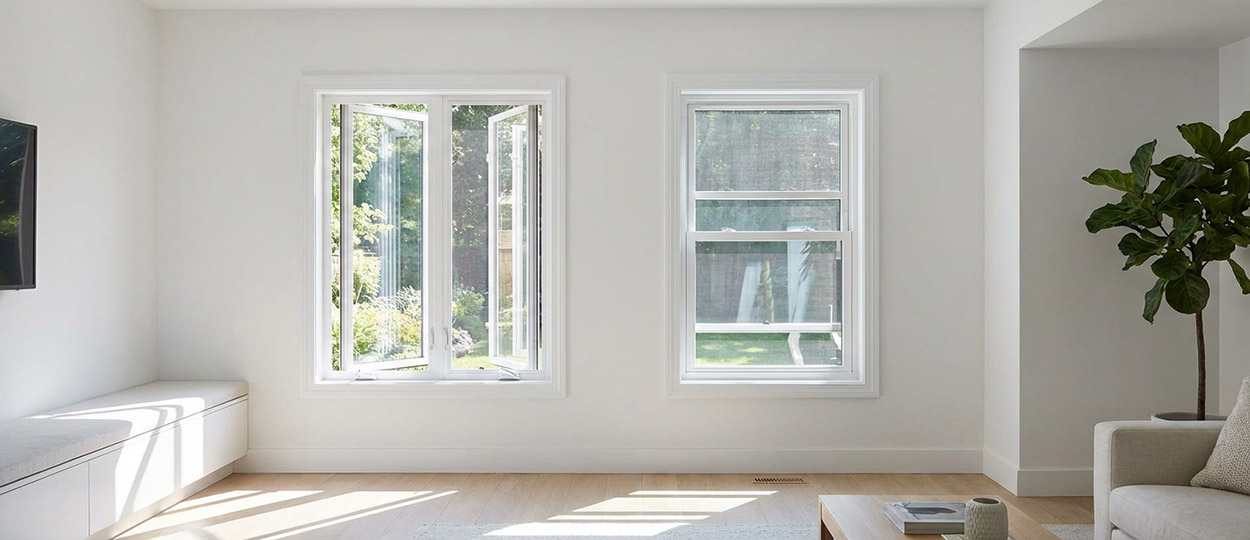
Casement windows are hinged on one side and open outward like a door using a crank or lever mechanism. This design allows for full-frame ventilation and an airtight seal when closed. Because of their compression-seal technology, casement systems are among the best-performing operable windows for air leakage control and thermal insulation.
Double hung windows, on the other hand, feature two vertically sliding sashes that move independently. The bottom sash opens upward, while the top sash can slide downward, providing adjustable ventilation at both ends. Double hung systems are often favored in traditional or multi-story designs where exterior clearance is limited.
Comparison Table: Casement vs. Double Hung Windows
| Feature | Casement Windows | Double Hung Windows | Performance Insight |
| Opening Mechanism | Hinged, outward swing | Vertical sliding sashes | Casement offers unobstructed ventilation; double hung provides flexible airflow control |
| Ventilation Efficiency | High — full sash opening | Moderate — half sash ventilation | Casements allow more direct air entry |
| Air Tightness | Excellent — compression seal | Moderate — sliding contact seals | Casements minimize infiltration; double hung may allow minor air leakage |
| Ease of Cleaning | Easy — can open fully inward/outward | Moderate — tilting sashes simplify access | Both accessible, but casement allows full sash reach |
| Maintenance | Low — fewer moving tracks | Moderate — requires sash track upkeep | Casements need less cleaning frequency |
| Aesthetic Fit | Contemporary, energy-efficient builds | Traditional or heritage designs | Depends on project style and heritage alignment |
| Common Applications | Multi-unit residential, office façades, energy-efficient homes | Historic restorations, hotels, urban housing | Casements dominate new builds; double hung fits retrofits |
Practical Usage in Construction
- Casement systems are widely used in modern residential and mid-rise commercial developments, offering energy efficiency, maximum ventilation, and ease of use for occupants.
- Double hung systems are more common in heritage renovations or compact urban designs, where exterior clearance is limited, and maintaining a traditional appearance is a priority.
Performance Reference
According to Natural Resources Canada (NRCan) (source), casement-style windows consistently outperform double hung configurations in terms of airtightness and insulation. However, double hung designs remain popular due to their aesthetic adaptability and low exterior projection requirements.
Summary
- Casement windows: Outward-swing design, superior sealing, and full ventilation.
- Double hung windows: Vertical operation, space-saving function, and classic aesthetic appeal.
Choosing between the two depends on the project’s architectural intent — casement systems for efficiency and airflow, or double hung systems for traditional design and interior ventilation control.

How Do Casement and Double Hung Windows Compare in Energy Efficiency and Performance?
Energy efficiency is one of the most significant factors when selecting between casement and double hung windows. Their design, sealing systems, and insulation performance directly influence a building’s overall energy use and occupant comfort.
Sealing and Air Leakage Performance
Casement windows use a compression seal — when the sash closes, it presses tightly against the frame, forming a continuous air barrier. This design minimizes drafts and air infiltration, allowing casement units to achieve some of the lowest air leakage rates in the industry, typically between 0.3 — 0.5 L/s·m², depending on size and hardware quality.
Double hung windows rely on sliding seals along the sashes, which inherently allow small gaps for movement. While modern weatherstripping has improved this design, double hung windows still register higher leakage rates, averaging 0.8 — 1.5 L/s·m². The vertical movement also introduces wear over time, slightly reducing long-term seal performance.
| Performance Metric | Casement Windows | Double Hung Windows | Performance Note |
| Air Leakage (L/s·m²) | 0.3 — 0.5 | 0.8 — 1.5 | Casements achieve tighter seals |
| U-Factor (W/m²·K) | 1.2 — 1.6 | 1.4 — 1.8 | Casements provide stronger insulation |
| Condensation Resistance (CR) | 65 — 75 | 60 — 70 | Casements perform better in cold climates |
| Solar Heat Gain Coefficient (SHGC) | 0.25 — 0.45 | 0.30 — 0.50 | Both can be optimized with Low-E coatings |
Insulation and Energy Star Compliance
According to ENERGY STAR Canada standards, both casement and double hung windows can qualify for certification when equipped with Low-E coatings, argon gas fills, and insulated frames. However, casement systems generally outperform in overall efficiency due to their compression seal and full-frame insulation continuity.
Casement designs typically achieve ENERGY STAR Tier 2 — 3 ratings, while double hung models often meet Tier 1 — 2 benchmarks. In high-efficiency builds — such as LEED or Net Zero projects — casement windows are preferred for maintaining thermal consistency across the building envelope.
Ventilation and Airflow Efficiency
Casement systems open outward up to 90°, allowing for directional airflow and natural cooling. The entire sash opens, which promotes maximum air exchange. Double hung systems, while more flexible in partial ventilation (top or bottom), allow only half the sash area to be open at a time. This results in less air turnover but greater control for occupant comfort in mixed climates.
Verified Data and Testing
Laboratory results from NRCan’s Fenestration Energy Performance Database confirm that casement windows maintain lower air infiltration rates and higher condensation resistance values than double hung systems of the same size and glazing configuration. Both can achieve excellent energy ratings when manufactured with multi-chamber vinyl or fiberglass frames.
- Casement windows: Superior in airtightness, thermal insulation, and condensation resistance — ideal for cold and mixed climates.
- Double hung windows: Offer flexible ventilation and heritage aesthetics but require more maintenance to sustain energy efficiency over time.
For energy-conscious developments, casement windows consistently provide higher efficiency performance and long-term operational savings.
Windows Near Me
Which Window Type Delivers Better ROI and Long-Term Value for Contractors and Developers?
When evaluating window systems for long-term value, it’s essential to analyze installation efficiency, maintenance demands, warranty coverage, and lifecycle cost. Casement and double hung windows each offer distinct financial and operational benefits depending on project scale and use case.
Installation and Maintenance Efficiency
Casement windows require precise hinge alignment and multi-point locking installation, resulting in slightly longer setup times but superior long-term performance. Their compression seals and hardware ensure minimal adjustment or replacement needs over time.
Double hung windows are easier to install, particularly for repetitive façade designs in large-scale developments. However, their sliding sashes require more frequent cleaning and track lubrication to maintain smooth operation and prevent air leakage.
| ROI Factor | Casement Windows | Double Hung Windows | Long-Term Observation |
| Average Installation Time (per unit) | 1.5 — 2.5 hours | 1 — 1.5 hours | Double hung systems install faster |
| Annual Maintenance Requirement | Low — hinge inspection only | Moderate — track and seal upkeep | Casements require less servicing |
| Expected Service Life | 30 — 40 years | 25 — 35 years | Casements last longer due to simpler sealing systems |
| Replacement Frequency (25-year span) | Rare — hardware refresh only | Moderate — balance spring wear | Casements reduce long-term replacement cost |
ROI Insights from Window Force Inc. Case Studies
Toronto Mid-Rise Residential Project (2024)
Window Force Inc. supplied 420 units of vinyl casement windows for a new mid-rise development. The project achieved:
- Energy cost reduction: 20% per year compared to older slider systems.
- Maintenance savings: 35% reduction in service calls within the first two years.
- ROI recovery period: 5.2 years based on total energy and maintenance savings.
Guelph Multi-Build Retrofit (2023)
A combination of casement and double hung windows was used to balance heritage requirements with modern performance standards. The project data showed:
- Installation time: Double hung units installed 15% faster.
- Performance gap: Casement units outperformed in airtightness by 28%.
- Total ROI: 72% after 10 years of operation, with casement systems yielding higher durability and lower maintenance costs.
Warranty and Lifecycle Value
Both systems supplied by Window Force Inc. are backed by long-term warranties:
- 25 years on frame and structural integrity
- 10 years on glazing and seal performance
- 5 years on hardware and labor (casement systems)
Casement windows tend to hold a higher residual value due to better long-term sealing and hardware durability, while double hung systems appeal to developers seeking shorter construction schedules and lower initial capital costs.
ROI Summary
| Performance Indicator | Casement Windows | Double Hung Windows | Impact on ROI |
| Initial Cost | Moderate to high | Moderate | Casements offset initial cost with lower maintenance |
| Energy Savings (10 years) | 20 — 25% | 15 — 18% | Casements deliver stronger payback from efficiency |
| Service Life Expectancy | 35+ years | 25 — 30 years | Casements extend replacement cycle |
| Estimated ROI (10 years) | 70 — 80% | 60 — 70% | Casements yield higher lifecycle returns |
- Casement windows deliver the strongest ROI over time due to low maintenance, energy efficiency, and long service life.
- Double hung windows offer faster installation and lower upfront costs, which can benefit high-volume or phased developments.
For developers seeking balanced performance, combining both window types strategically can optimize project budgets while maintaining durability and compliance with ENERGY STAR
What Are the Key Cost Differences Between Casement and Double Hung Windows for Large Projects?
When planning large-scale developments, window selection significantly affects total project cost, both at purchase and throughout the product’s life cycle. Understanding how casement and double hung windows differ in material, labor, and operational costs helps optimize budget planning without compromising energy performance.
Material and Manufacturing Costs
Casement windows typically cost more to produce because of their hardware complexity — hinges, cranks, and multi-point locking systems require precision assembly. In contrast, double hung windows use simpler balance mechanisms and sliding tracks, lowering production expenses.
| Cost Component | Casement Windows | Double Hung Windows | Budget Impact |
| Frame & Hardware | Higher — complex mechanism | Lower — simple track system | Casements cost 10 — 20% more per unit |
| Glass Unit | Similar — double or triple Low-E | Similar — double or triple Low-E | Equal cost if glazing type matches |
| Manufacturing Labor | Higher — precision alignment | Moderate — faster assembly | Double hung favored for volume production |
| Average Unit Price (Installed) | $650—$950 | $500—$800 | Double hung reduces cost by ~15 — 25% |
Installation and Labor Costs
Casement systems require precise hinge alignment and seal calibration, slightly increasing installation time. Double hung units, however, are installed more quickly in repetitive layouts due to their balanced frame design.
| Installation Factor | Casement Windows | Double Hung Windows | Project Impact |
| Average Labor Time (per unit) | 1.5 — 2.5 hours | 1 — 1.5 hours | Double hung faster for mass installation |
| Labor Cost (per unit) | $120—$180 | $90—$140 | Casements take longer to align |
| Quality Control Needs | Moderate — hinge adjustment | High — track calibration | Double hung systems require periodic alignment checks |
| Warranty Call Rate (first 2 years) | <1% | 2 — 3% | Casements show fewer service claims |
Lifecycle and Maintenance Costs
Over time, maintenance can influence the total ownership cost more than initial installation. Casement systems, with fewer moving friction points, typically require only periodic hinge lubrication. Double hung systems need track cleaning and spring balance maintenance, particularly in high-dust or humid environments.
| Lifecycle Metric | Casement Windows | Double Hung Windows | Cost Implication (25 years) |
| Annual Maintenance Cost | ~$10—$15 | ~$20—$25 | Casements save on service time |
| Hardware Replacement Interval | 15 — 20 years | 10 — 15 years | Casements last longer |
| Seal Replacement Cycle | 12 — 15 years | 10 — 12 years | Both maintain efficiency with periodic resealing |
| Estimated Lifetime Cost (10 units) | $8,000—$9,500 | $9,000—$11,000 | Casements yield lower long-term cost |
Verified Cost Data
Industry estimates from Natural Resources Canada (NRCan) (source) confirm that casement windows, though more expensive initially, deliver up to 12 — 18% lower operating costs over their service life compared to double hung systems. When scaled to large projects, these savings can substantially offset the initial investment.
- Casement windows cost more upfront but provide superior durability, fewer service calls, and lower lifetime ownership costs.
- Double hung windows reduce initial expenditure and simplify mass installation, offering advantages for cost-sensitive developments.
For large-scale projects, a hybrid approach — using casements for high-performance zones and double hung units in secondary areas — delivers the best balance between cost, performance, and lifecycle efficiency.
How Do Design and Functionality Affect Specification Choices for Architects?
Architects play a critical role in determining the ideal window system based on functionality, space optimization, and aesthetic alignment. The design and operational differences between casement and double hung windows impact ventilation, visual symmetry, and accessibility — all essential in developing efficient and visually cohesive façades.
Step 1: Analyze Space and Ventilation Requirements
- Casement Windows: Provide full ventilation since the entire sash opens outward. They are ideal for areas that need maximum airflow — such as living spaces or offices. Their outward operation allows interior layouts to remain unobstructed.
- Double Hung Windows: Offer controlled, partial ventilation. Architects often specify these in tight spaces or near walkways where outward projection is limited. They also allow top-only ventilation, beneficial for security and consistent airflow.
| Design Factor | Casement Windows | Double Hung Windows | Architectural Consideration |
| Ventilation Control | Full, directional airflow | Adjustable, vertical flow | Casements enhance natural ventilation strategies |
| Space Efficiency | Requires exterior clearance | Ideal for restricted exteriors | Double hung reduces obstruction in tight façades |
| Accessibility | Easier to operate at accessible height | Suitable for higher window placements | Design flexibility depends on façade geometry |
| Egress Compliance | Meets most emergency exit codes | Limited clearance | Casements suitable for code-required egress |
| Design Expression | Contemporary | Traditional or heritage | Style choice aligns with project aesthetic |
Step 2: Coordinate Aesthetic and Façade Integration
Casement systems emphasize clean lines and contemporary form, often paired with large glazed surfaces in modern architecture. Their ability to integrate seamlessly with fixed units allows balanced symmetry across façades.
Double hung systems, featuring horizontal rails and divided sashes, lend themselves to traditional or heritage-inspired architecture. They preserve proportion and rhythm in buildings where historic context or urban design bylaws require classical aesthetics.
Example Applications:
- Modern Mid-Rise Building: Casement systems combined with fixed glazing for energy efficiency and clean exterior geometry.
- Heritage Restoration Project: Double hung units specified to match original design proportions while integrating modern glazing technology.
- Mixed-Use Development: Hybrid façade using both window types to achieve visual harmony across commercial and residential sections.
Step 3: Accessibility and Functional Placement
- Casement units are easier to operate for users in accessible spaces due to their crank mechanism.
- Double hung systems are preferred where interior or exterior obstructions restrict outward movement.
- Architects often pair awning or fixed windows above double hung systems to maintain ventilation while maximizing daylight.
Step 4: Specification and Compliance Checklist
Architectural Specification Guide:
- Confirm all units meet CSA A440.2-19 and ENERGY STAR Tier 2 standards.
- Validate egress clearance for all operable casement units.
- Specify matching frame depths and finishes for façade continuity.
- Evaluate Low-E coating types based on building orientation.
- Coordinate frame color and mullion width with overall façade rhythm.
Summary
- Casement windows: Best for maximizing airflow, meeting egress requirements, and creating a modern, minimalistic appearance.
- Double hung windows: Preferred for compact exteriors, traditional aesthetics, and vertically proportioned façades.
By aligning window design with functional requirements, architects ensure each system supports both performance efficiency and architectural intent, creating façades that balance usability, compliance, and visual integrity.
Why Partner with Window Force Inc. for Large-Scale Casement and Double Hung Window Supply?
Window Force Inc. is a trusted supplier of high-performance window systems, delivering precision-engineered casement and double hung solutions for residential, commercial, and institutional projects. Its advanced manufacturing capabilities and quality control standards ensure reliability, durability, and long-term value for every development.
Certified Quality and Manufacturing Standards
All products from Window Force Inc. meet or exceed CSA A440.2-19, NFRC, and ENERGY STAR requirements. Each window is tested for airtightness, water resistance, structural strength, and condensation control. The company’s focus on compliance and consistency ensures that all units integrate seamlessly into modern energy-efficient construction.
Certifications and Standards:
- CSA A440.2-19 — Air-water-structural performance certification
- NFRC 100/200 — Verified U-factor and SHGC values
- ENERGY STAR Canada — Tier 2 — 3 energy efficiency certification
Manufacturing and Logistics Capabilities
With modern facilities in Ontario, Window Force Inc. operates automated production lines capable of supporting large-scale and phased developments. The company provides consistent quality control, short lead times, and precise order fulfillment across multiple building stages.
Production Benefits:
- Automated vinyl and aluminum fabrication for dimensional accuracy
- Lead times averaging 4 — 8 weeks
- Custom glazing and frame options for project-specific performance targets
Technical Collaboration and Project Support
Window Force Inc. partners with architects and contractors throughout the project lifecycle — from specification to installation oversight. The engineering team assists with design optimization, product submittals, and installation QA to ensure compliance with performance criteria.
Support Services Include:
- Detailed shop drawings and technical submittals
- Custom hardware and glazing configurations
- On-site inspection and post-installation performance testing
Pricing and Warranty Advantages
The company offers tiered pricing programs for multi-phase or bulk supply agreements. This approach provides cost predictability and long-term contract value while ensuring access to certified energy-efficient products.
Warranty Coverage:
- 25 years — frame and structural integrity
- 10 years — insulated glazing performance
- 5 years — hardware and service
Summary
By choosing Window Force Inc., contractors and developers benefit from proven manufacturing quality, certified performance, and dependable technical collaboration. The company’s casement and double hung systems provide measurable energy savings, design flexibility, and warranty-backed reliability, ensuring long-term project success and performance stability.
Conclusion: Which Window Style Aligns Best with Your Project’s Goals?
Both casement and double hung windows deliver practical performance advantages depending on project priorities. Choosing between them involves balancing ventilation, energy performance, design intent, and lifecycle cost.
Comparative Summary
| Performance Factor | Casement Windows | Double Hung Windows |
| Opening Mechanism | Side-hinged, outward swing | Dual sliding sashes (vertical) |
| Ventilation | Excellent — full opening for airflow | Moderate — adjustable, partial airflow |
| Energy Efficiency | Superior — compression seal and Low-E insulation | Moderate — sliding seals allow minor air leakage |
| Maintenance | Low — minimal track cleaning | Moderate — regular sash and track upkeep |
| Installation Speed | Slightly longer | Faster for repetitive installations |
| Lifespan | 30 — 40 years | 25 — 35 years |
| Average ROI (10 years) | 70 — 80% | 60 — 70% |
Performance Recommendation
- Casement systems: Best suited for energy-efficient projects and areas requiring full ventilation or egress compliance. Their superior sealing and thermal performance deliver long-term energy savings.
- Double hung systems: Ideal for traditional designs, restricted spaces, or multi-storey builds where easy operation and reduced exterior projection are required.
Final Thoughts
Both styles meet or exceed CSA A440.2-19 and ENERGY STAR standards when properly specified and installed. By selecting the right window type for each façade application, project teams achieve an optimal blend of functionality, cost-efficiency, and long-term durability — supported by Window Force Inc.’s proven manufacturing quality and technical expertise.

Frequently Asked Questions
What is the key difference between casement and double hung windows in operation?
Casement windows are side-hinged and open outward using a crank mechanism, allowing full ventilation and a tight compression seal when closed. Double hung windows feature two vertically sliding sashes that move independently, offering flexible ventilation but slightly reduced airtightness due to sliding seals.
Which window type is more cost-effective for multi-unit developments?
Double hung windows generally offer lower initial costs and faster installation times, making them practical for high-volume developments. Casement windows, while more expensive upfront, deliver superior energy performance and lower maintenance costs — resulting in better long-term savings and ROI.
Are casement or double hung windows better for energy efficiency in cold climates?
Casement windows are typically more energy-efficient in cold climates because their compression seal eliminates drafts and minimizes heat loss. When paired with insulated Low-E glass, they maintain consistent indoor temperatures and qualify for higher ENERGY STAR ratings than most double hung models.
When should builders specify hung windows instead of casement designs?
Builders often specify double hung windows when exterior clearance is limited or when maintaining a traditional architectural aesthetic is essential — such as in heritage or urban infill projects. Casement windows are favored for energy-focused or modern designs that prioritize airtightness and full ventilation.
People Also Ask