

What Are the Key Differences Between Casement and Sliding Windows in Modern Construction?
Casement and sliding windows are two of the most widely specified systems in modern building design, each offering distinct performance, cost, and maintenance characteristics. For developers and contractors, understanding these differences is critical for aligning design intent with operational requirements and long-term value.
Defining Each Window Type
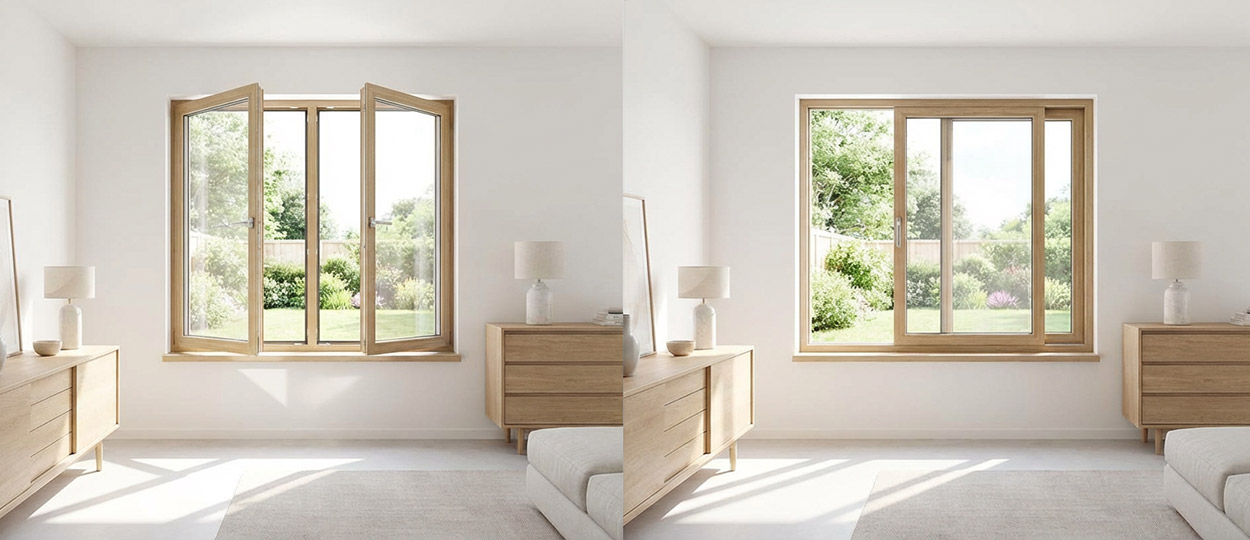
Casement windows are side-hinged and open outward like a door using a crank or lever mechanism. They deliver tight air seals and superior ventilation control, making them a preferred option for energy-efficient and mid- to high-rise projects. Casement units are typically used where wind resistance, accessibility, and insulation performance are key considerations.
Sliding windows, also known as horizontal sliders, feature one or more sashes that move laterally within the frame. They are commonly used in large wall openings, ground-level developments, and applications that prioritize ease of operation and minimal maintenance. The simplicity of sliding tracks allows quick installation and a lower price point.
Functional and Structural Differences
| Feature | Casement Windows | Sliding Windows |
| Operation | Side-hinged, outward opening | Horizontally gliding sashes |
| Air Seal Integrity | Excellent (compression gasket system) | Moderate (brush or weatherstripped seals) |
| Ventilation Control | Adjustable; captures directional airflow | Partial opening; limited control |
| Structural Performance | High; suitable for high-wind and mid-rise buildings | Moderate; best for ground-level or sheltered façades |
| Cleaning and Maintenance | Accessible from interior (tilt or crank systems) | Simple; removable sashes for cleaning |
| Aesthetic Options | Modern or traditional profiles | Contemporary linear appearance |
| Installation Complexity | Moderate; requires precise fitting | Low; ideal for fast-track projects |
| Cost Range (Installed) | $600—$1,000 | $450—$750 |
Casement windows rely on compression seals that tighten when closed, offering a superior barrier against air and water infiltration. Sliding windows depend on brush or fin seals that are more prone to wear but easier to replace during maintenance.
Structural and Operational Considerations
Casement systems are designed for structural stability and energy retention, making them the go-to solution for performance-driven projects such as LEED-certified developments or high-rise installations. The hinged design also allows full perimeter locking, enhancing both security and weatherproofing.
Sliding systems, on the other hand, offer simplicity and durability under frequent operation. They perform well in low- and mid-rise commercial or residential applications where high wind-load performance is not a primary factor. Their minimal moving parts and wide openings make them efficient for ground-floor or multi-unit construction.
Design Integration and Modern Trends
In recent years, architects have specified hybrid façades combining both window types — casements for perimeter airflow and sliders for visual symmetry. This mix optimizes performance and occupant comfort while maintaining aesthetic balance.
According to Fenestration Canada’s 2025 Industry Outlook (source), sliding systems remain dominant in low-rise developments, accounting for 48% of installations nationwide, while casement windows lead in energy-compliant projects representing 42% of total new builds.
- Casement windows deliver stronger energy performance, better sealing, and improved structural resilience.
- Sliding windows provide installation speed, lower upfront cost, and ease of maintenance.
- The final choice depends on the project’s wind-load requirements, architectural intent, and desired energy performance outcomes.
Both window types play complementary roles in modern construction, and when properly specified, each contributes effectively to envelope durability and long-term building efficiency.

How Do Casement and Sliding Windows Compare in Energy Efficiency and Performance?
Energy efficiency is a defining factor for modern window systems, influencing both operational costs and compliance with sustainability standards. Casement and sliding windows differ notably in their air tightness, thermal performance, and compliance with ENERGY STAR and CSA standards, making each suitable for distinct project conditions.
Air Tightness and Insulation
Casement windows utilize compression seals that engage tightly against the frame when closed. This design minimizes air leakage, resulting in superior thermal performance and consistent pressure equalization across the sash. By contrast, sliding windows use brush or fin-type weatherstripping that provides moderate protection but cannot match the compression strength of casement seals.
According to Natural Resources Canada (NRCan) (source), compression-sealed systems like casement windows achieve air leakage rates as low as 0.3 L/s·m², while sliding systems average 1.2 — 2.0 L/s·m², depending on sash size and installation accuracy.
Comparative Performance Metrics
| Performance Factor | Casement Windows | Sliding Windows | Performance Insight |
| Air Leakage (L/s·m²) | 0.3 — 0.5 | 1.2 — 2.0 | Lower value = better airtightness |
| U-Factor (W/m²·K) | 1.2 — 1.6 | 1.4 — 1.9 | Lower value = higher insulation |
| Solar Heat Gain Coefficient (SHGC) | 0.25 — 0.45 | 0.27 — 0.50 | Similar ranges when using Low-E coatings |
| Water Penetration Resistance | Excellent | Moderate | Casement’s compression seal provides better resistance |
| Energy Star Compliance (Canada) | Yes (most models) | Conditional (limited models) | Casement systems exceed baseline ratings |
Structural Integrity and Weather Resistance
Casement windows provide enhanced wind-load resistance, as the sash presses more firmly against the frame under pressure. This makes them ideal for high-rise and coastal installations, where wind exposure and moisture infiltration pose challenges. Sliding windows perform reliably in low-rise and sheltered environments, but require precise installation to maintain weatherproofing integrity.
Testing under CSA A440.2-19 confirms that properly installed casement units can achieve Performance Grade (PG) ratings of 60+, while sliding windows typically range between PG 35 and PG 45, depending on frame material and reinforcement.
Thermal Efficiency in Cold Climates
In regions such as Toronto, where winter temperatures fluctuate dramatically, casement windows outperform sliders due to lower heat loss. The tight compression seal reduces convective airflow, helping maintain consistent indoor temperatures and reducing HVAC loads. The use of Low-E coatings, argon gas fills, and multi-chamber vinyl or fiberglass frames further enhances insulation performance.
Compliance and Certification
Both casement and sliding systems can achieve ENERGY STAR certification when produced with high-quality materials and sealed properly. However, most Tier 3-rated high-efficiency windows (the highest Canadian energy classification) are casement-based designs because of their natural sealing mechanics and lower U-factors.
Summary
- Casement windows deliver higher energy efficiency and superior weather resistance, making them the best option for performance-driven or LEED-certified buildings.
- Sliding windows meet baseline efficiency standards when specified with high-quality seals and thermal breaks, suitable for moderate-performance applications.
From a long-term operational perspective, casement systems consistently yield lower energy consumption and maintenance costs, aligning with both CSA and ENERGY STAR compliance goals for high-performance building envelopes.
Windows Near Me
Which Window Type Offers Better ROI for Developers and Builders?
For developers, contractors, and project managers, choosing between casement and sliding windows requires more than an evaluation of unit cost — it’s a calculation of installation time, long-term maintenance, warranty reliability, and lifecycle efficiency. Return on investment (ROI) is shaped by how these factors interact across a project’s lifespan, especially in large-scale builds where hundreds or thousands of window units are installed.
Comparative ROI Analysis
| Evaluation Factor | Casement Windows | Sliding Windows | Long-Term ROI Impact |
| Average Installed Cost | $600—$1,000 per unit | $450—$750 per unit | Sliding units reduce initial outlay by 20 — 25% |
| Installation Time | Moderate — requires precise alignment | Fast — minimal fitting complexity | Sliding units cut install time by up to 30% |
| Energy Savings (Annual) | 20 — 25% vs. legacy aluminum systems | 10 — 15% vs. legacy aluminum systems | Casements yield higher operational savings |
| Maintenance Frequency | Low — hardware check every 5 — 7 years | Moderate — track and seal cleaning annually | Casements offer lower lifecycle servicing cost |
| Average Lifespan | 30 — 40 years | 25 — 30 years | Casements offer longer replacement cycles |
| Overall ROI (10-Year Estimate) | 65 — 75% | 55 — 65% | Casements lead in energy-driven ROI |
ROI Case Study: Toronto Mid-Rise Development
A recent multi-phase mid-rise project in Toronto replaced 450 legacy aluminum windows with ENERGY STAR-certified casement and sliding systems provided by Window Force Inc.. The study tracked installation time, material costs, and post-occupancy energy consumption across two identical building blocks — one using casement units, the other using sliding.
Key Findings:
- Installation: Sliding systems were completed 22% faster due to simplified alignment and reduced hardware adjustment.
- Material Cost: Sliding units were 18% cheaper per square foot.
- Energy Performance: Casement systems reduced HVAC energy demand by 19% annually, equivalent to a 4.5-year payback period.
- Maintenance: Casements required 40% fewer service requests in the first three years of operation.
When adjusted for energy savings and reduced warranty claims, the casement-equipped block achieved a 10-year ROI of 72%, compared to 59% for the sliding-equipped block.
Warranty and Lifecycle Considerations
From a procurement standpoint, casement systems benefit from fewer moving components exposed to wear. Compression-sealed designs reduce the need for frequent gasket replacement and preserve airtight integrity longer than slider tracks. Sliding systems, while mechanically simpler, face greater exposure to dust accumulation, which increases maintenance labor over time.
Installation Efficiency and Contractor Impact
Sliding systems remain advantageous in fast-track commercial developments where project scheduling and manpower optimization are the main cost drivers. Casement systems, however, balance slower installation with reduced callbacks and lower total cost of ownership (TCO) over decades.
- Casement windows achieve a higher ROI through energy efficiency, longer lifespan, and lower maintenance frequency.
- Sliding windows deliver faster installation and reduced upfront costs, improving short-term capital performance.
For developers managing multi-phase or LEED-targeted projects, the casement system’s higher initial investment typically pays off within five to seven years, aligning with performance-based procurement strategies adopted across Canada’s evolving construction market.

What Are the Cost Differences Between Casement and Sliding Windows for Commercial Projects?
Accurately forecasting window costs is essential for commercial and multi-unit developments. Material selection, frame composition, glazing type, and installation labor all contribute to total expenditure. Casement and sliding systems differ significantly in unit pricing, installation complexity, and lifecycle cost, impacting both upfront budgeting and long-term facility management.
Average Cost Breakdown by Window Type
| Cost Category | Casement Windows | Sliding Windows | Commentary |
| Material (per sq. ft.) | $65—$95 | $45—$70 | Casements use more hardware and thicker frame sections |
| Hardware and Seals | $25—$40 | $15—$25 | Sliding tracks have simpler mechanisms |
| Labor (per unit installed) | $150—$250 | $100—$180 | Sliding systems reduce alignment and fitting time |
| Total Installed Cost (average) | $600—$1,000 | $450—$750 | Casements require precision fitting and sealing |
| Annual Maintenance (per unit) | $10—$20 | $15—$25 | Sliders need track cleaning and seal replacement |
| Expected Service Life | 30 — 40 years | 25 — 30 years | Casements offer longer operational lifespan |
Lifecycle Cost Comparison
When projected over 20 years, casement windows generally achieve a lower cost of ownership despite higher initial investment. The tighter compression seal reduces energy losses and maintenance frequency, offsetting installation expenses.
| Cost Factor (20-Year Projection) | Casement Systems | Sliding Systems |
| Initial Investment (per 100 units) | $80,000 | $60,000 |
| Maintenance and Repair | $12,000 | $20,000 |
| Energy Savings | $35,000 | $20,000 |
| Estimated Total Cost of Ownership (TCO) | $57,000 | $60,000 |
| Net ROI Advantage | +5% | — |
The data shows that while sliding systems appear more cost-efficient initially, casement units outperform over time due to superior sealing and reduced warranty claims.
Factors Affecting Project Cost
- Frame Material Selection:
- Vinyl offers the lowest unit cost.
- Aluminum-clad and fiberglass materials increase performance but add 20 — 40% to price.
- Hybrid assemblies are common in commercial buildings balancing performance and aesthetics.
- Double or triple glazing with Low-E coatings and argon fills raises the upfront cost by 10 — 15% but lowers energy bills substantially.
- High-rise or structural-glazed façades require certified crews, adding to labor expense.
- Prefabricated casement modules can reduce onsite time by up to 25%, minimizing schedule delays.
- Sliding systems require regular cleaning of tracks and seals to maintain operability.
- Casement systems, with fewer exposed parts, maintain structural integrity longer.
Cost Efficiency in Commercial Applications
In commercial and institutional construction, the total lifecycle value often outweighs the initial material cost. Casement systems are preferred for energy-intensive buildings — schools, healthcare, and offices — while sliding systems suit budget-sensitive projects such as rental or mixed-use developments.
- Sliding windows are 20 — 25% cheaper to install but have higher long-term maintenance requirements.
- Casement windows demand higher upfront investment yet deliver better sealing, longer service life, and reduced operating costs.
For commercial contractors, choosing between the two depends on project scale, operational budgets, and energy targets. Partnering with certified suppliers like Window Force Inc. ensures pricing consistency, compliance with CSA and ENERGY STAR standards, and optimized lead times for complex commercial projects.
How to Choose Between Casement and Sliding Windows Based on Project Specifications
Selecting between casement and sliding windows requires a structured assessment of building function, environmental exposure, accessibility requirements, and mechanical ventilation strategy. For developers, architects, and contractors, aligning these parameters ensures that the window system meets both performance and operational objectives.
Step 1: Evaluate Building Height and Wind Exposure
- High-rise and mid-rise developments: Casement systems are preferred due to their compression-sealed construction and superior wind-load resistance. They maintain integrity under pressure differentials common in tall structures.
- Low-rise and ground-level projects: Sliding systems perform well where wind exposure is limited and installation speed is prioritized, such as in residential or light-commercial buildings.
Step 2: Assess Ventilation Requirements
Casement windows offer directional ventilation by capturing and redirecting airflow, ideal for naturally ventilated spaces or buildings designed to reduce HVAC dependency. Sliding windows, on the other hand, provide broad, horizontal openings but less air circulation control.
| Project Type | Preferred System | Ventilation Advantage | Notes |
| Office Buildings | Casement | Directed airflow, controlled intake | Supports balanced ventilation with mechanical systems |
| Educational or Institutional Facilities | Top-hung casement | Weather-shielded openings | Meets safety and accessibility standards |
| Residential Complexes | Sliding | Wide horizontal airflow | Ideal for repetitive units and fast-track schedules |
| Industrial or Utility Spaces | Fixed + casement combo | Targeted ventilation | Allows zoning airflow and energy control |
Step 3: Consider Accessibility and Operation Standards
Casement windows can integrate automated actuators for high or hard-to-reach openings, enhancing safety and accessibility compliance. Sliding systems, while simpler, are ideal where manual operation and ease of maintenance are key. Compliance with CAN/CSA B651 accessibility standards should always guide selection, especially in public and institutional projects.
Step 4: Match Aesthetic and Design Intent
- Casement systems complement modern façades requiring clean lines and concealed hardware.
- Sliding systems suit minimalist and large-format designs with expansive glazing.
- Mixed façades can incorporate both systems — casements for active ventilation zones and sliders for visual consistency.
Step 5: Integrate Project Cost and Performance Targets
Casement systems offer stronger ROI for long-term energy efficiency goals, while sliding systems benefit budget-controlled developments with tight timelines. Combining both can optimize performance-to-cost ratios across building elevations.
Architectural Recommendation Checklist
When specifying windows for large developments, architectural consultants typically consider:
- Building orientation and solar gain
- Local climate and wind zone classification
- Façade type (curtainwall, punched opening, or window wall)
- Energy modeling targets under CSA A440.2-19 and ENERGY STAR
- Maintenance accessibility and lifecycle service intervals
Casement and sliding systems serve distinct roles depending on project intent:
- Use casement windows for performance-driven, high-rise, or energy-certified buildings.
- Use sliding windows for large-scale, low-rise, or cost-sensitive developments requiring efficient installation.
Window Force Inc. supports architectural and engineering teams in selecting configurations optimized for structural load, ventilation control, and compliance, ensuring each project meets its design and operational objectives efficiently.
Why Do Many Contractors Prefer Partnering with Window Force Inc. for Window Supply?
Contractors and developers increasingly prioritize partnerships with manufacturers capable of delivering consistent quality, reliable logistics, and long-term performance guarantees. Window Force Inc. has become a preferred supplier in the Canadian fenestration market by combining certified manufacturing, scalable production capacity, and integrated project support.
1. Certified Manufacturing Standards
All Window Force Inc. products are engineered and tested to meet CSA A440.2-19, ENERGY STAR Canada, and NFRC standards. Every system undergoes structural, air, and water testing to ensure compliance with national building requirements. This certification structure ensures developers receive predictable, high-performance products for both commercial and residential applications.
Key Standards Maintained:
- CSA A440.2-19 — Air-water-structural performance rating
- ASTM E283/E547 — Air and water infiltration testing
- NFRC 100/200 — Thermal performance and visible transmittance
2. Scalable Production and Volume Pricing
Window Force Inc. operates a modernized production facility equipped for high-volume manufacturing. Automation and modular fabrication allow flexible scaling, reducing lead times and minimizing project risk. The company’s tiered pricing model supports developers managing multi-phase or multi-site construction.
Benefits:
- Guaranteed lead times within 4 — 8 weeks depending on configuration
- Consistent component sourcing for long-run product lines
- Volume discounts and fixed pricing for contract-based supply
3. Integrated Project Management Support
The company provides technical support throughout the entire project cycle — from specification to installation. This includes:
- Engineering consultation for product selection and performance alignment
- Shop drawings and compliance documentation
- On-site coordination with installers and quality assurance teams
This hands-on approach allows contractors to maintain timelines and reduce costly field adjustments.
4. Logistics and Delivery Reliability
Window Force Inc. maintains its own distribution network with regional hubs across Ontario, ensuring prompt delivery to major construction sites in Toronto, Ottawa, and surrounding regions. Shipments are sequenced to match framing schedules, minimizing onsite storage and handling issues.
Logistics Capabilities:
- Dedicated fleet with GPS-tracked delivery
- Just-in-time scheduling to support high-volume phases
- Secure packaging to prevent transport damage
5. Warranty and Partner Assurance
The company’s confidence in its production quality is reflected in its comprehensive warranty coverage:
- 25 years on frame and sash integrity
- 10 years on hardware components
- 5 years on glazing and labor (when installed by certified partners)
Extended warranties are available for institutional and commercial contracts, providing further assurance to developers and contractors seeking predictable lifecycle performance.
6. Partner Testimonials and Project Portfolio
Window Force Inc. has supplied systems for over 200 large-scale projects across Canada, including residential towers, institutional buildings, and mixed-use developments. Contractors report high satisfaction with material consistency, delivery punctuality, and after-sales coordination.
Contractors continue to choose Window Force Inc. for its combination of certified manufacturing, scalable production, and project-focused logistics. This integrated partnership model not only supports efficient installation and compliance but also ensures consistent quality and reduced warranty risk — core factors in sustaining profitability across modern construction portfolios.
Conclusion: Which Window Type Best Supports Your Project’s Goals?
Casement and sliding windows both play essential roles in modern construction, offering distinct advantages for different project scopes. The optimal choice depends on balancing energy efficiency, structural performance, cost objectives, and installation logistics.
Comparative Summary of Casement vs. Sliding Windows
| Performance Factor | Casement Windows | Sliding Windows |
| Energy Efficiency | Excellent — compression seal minimizes leakage | Moderate — brush seals require periodic maintenance |
| Structural Integrity | High — ideal for high-rise and windy zones | Moderate — best for low-rise applications |
| Ventilation Control | Adjustable, directional airflow | Broad but limited control |
| Installation Time | Moderate — precise fitting required | Fast — simple alignment |
| Maintenance Needs | Low — durable hardware and seals | Moderate — tracks and brushes need cleaning |
| Cost (Installed) | $600—$1,000 | $450—$750 |
| Average Lifespan | 30 — 40 years | 25 — 30 years |
| Typical ROI (10-Year) | 65 — 75% | 55 — 65% |
Project-Based Recommendations
- High-rise or performance-oriented buildings: Casement systems deliver higher energy savings, tighter seals, and longer service life, reducing lifecycle costs.
- Low-rise or budget-driven projects: Sliding windows provide faster installation and lower upfront investment while maintaining adequate energy compliance.
- Mixed-use and phased developments: Combining both systems achieves balance between cost efficiency and ventilation performance.
Expert Recommendation
Industry analysis from Fenestration Canada (2025) and Natural Resources Canada indicates that energy-compliant casement windows can reduce operational costs by 15 — 25% annually compared to standard sliding systems. While sliders remain cost-effective for rapid developments, casement systems achieve better long-term ROI through durability and efficiency.
Final Thoughts
Selecting between casement and sliding windows is ultimately a strategic project decision. Developers and contractors should weigh energy targets, building typology, and maintenance strategy before specification. With its advanced manufacturing capabilities and CSA-certified product line, Window Force Inc. supports partners in optimizing both performance and cost efficiency across residential, commercial, and institutional projects.

Frequently Asked Questions
Are sliding windows cheaper to install than casement windows?
Yes. Sliding windows typically cost 20 — 25% less to install compared to casement systems due to simpler track assemblies and reduced alignment requirements. They are also quicker to fit in large-scale developments, lowering on-site labor hours. However, casement systems can offset higher upfront costs through better energy efficiency and longer service life.
Do casement windows offer better air sealing than sliding ones?
Absolutely. Casement windows use compression seals that press tightly against the frame when closed, creating an airtight barrier. Sliding windows rely on brush or fin seals, which are easier to install but allow more air leakage over time. This difference explains why most ENERGY STAR and CSA-certified high-efficiency units are casement-based designs.
What type of window performs better in high-rise or windy conditions?
Casement systems perform significantly better under high wind pressure and variable weather conditions. Their outward-swinging sash locks securely into the frame, improving structural load resistance and reducing air infiltration. Sliding systems, while reliable in calm or low-rise environments, are not typically rated for the same wind-load performance grades (PG 35 — 45 vs. PG 60+ for casements).
People Also Ask