

What Is the Difference Between Fixed Casement and Picture Windows in Modern Construction?
In modern architecture, both fixed casement and picture windows serve as non-operable glazing systems designed to maximize light and visual appeal. Although they share functional similarities, their design intent, frame construction, and performance applications differ significantly. Understanding these differences helps builders and architects specify the right system based on project requirements, building codes, and lifecycle expectations.
Definition and Core Design
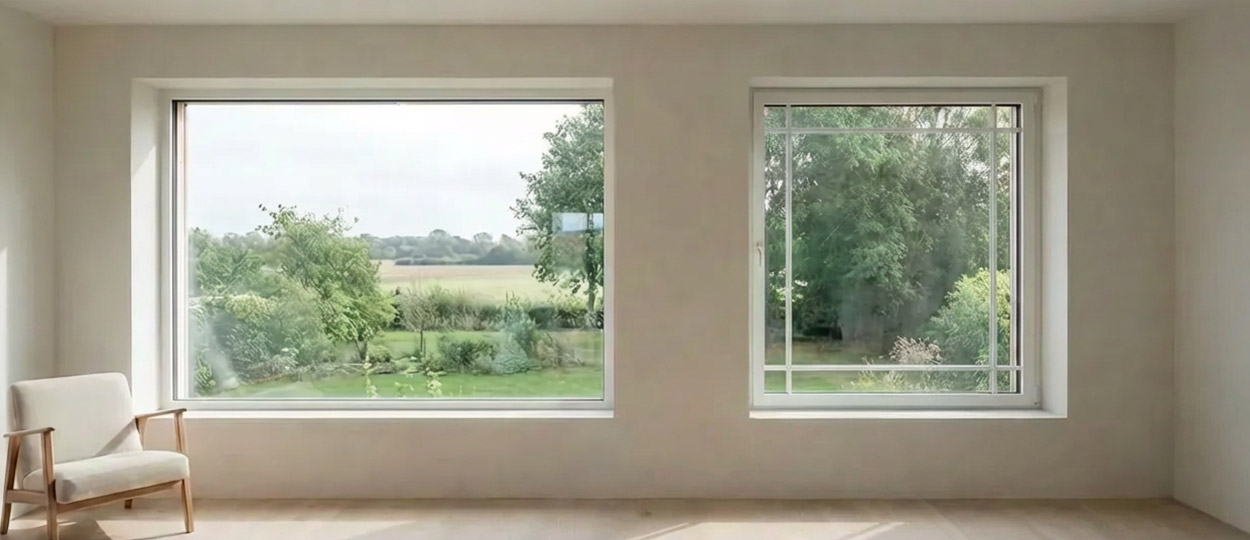
Fixed casement windows are built using the same frame and sash profile as operable casement units, but without hinges or hardware. This approach allows them to match operable windows seamlessly within a façade system, maintaining consistent sightlines and performance ratings. Because they use casement-grade components, fixed casement windows achieve superior air-tightness and structural integrity, making them ideal for mixed façades that combine fixed and operable units.
Picture windows, on the other hand, are large, single-pane glazed units installed directly into a minimal frame or sash-less structure. They are engineered primarily for aesthetic and daylighting purposes, not for air-tightness or operability. Picture windows are commonly specified in residential or commercial spaces where expansive, unobstructed views are prioritized over ventilation.
Structural and Performance Differences
| Feature | Fixed Casement Windows | Picture Windows |
| Operability | Non-operable; uses casement frame system | Non-operable; often frameless or minimal frame |
| Air & Water Resistance | Excellent — compression-sealed design | Moderate — depends on glazing method |
| Frame Construction | Reinforced, multi-chamber vinyl or aluminum-clad | Simplified, minimal frame or direct-glazed system |
| Energy Performance | High — uses insulated casement profiles | Variable — depends on glass thickness and spacer type |
| Aesthetic Impact | Matches operable windows for façade uniformity | Maximizes visible glass and outdoor view |
| Common Use | Mixed façade assemblies, commercial curtainwall integration | Residential and design-focused commercial spaces |
Application in Commercial and Residential Projects
In commercial construction, fixed casement units are typically used alongside operable casements or awnings to maintain consistency in sightlines while meeting strict performance requirements for air and water infiltration under CSA A440.2-19. Their robust frame profiles support larger insulated glazing units (IGUs) while maintaining structural integrity.
In residential or mixed-use developments, picture windows dominate in living areas, lobbies, or upper-level façades where the architectural objective is maximizing daylight and panoramic visibility. Because these systems are often direct-glazed, they require less hardware and can accommodate larger single panes for an unobstructed aesthetic.
Performance in Building Envelope Design
Fixed casement systems contribute to the overall envelope performance by maintaining uniform sealing pressure and reducing heat loss through frame continuity. They often achieve lower U-factors and superior air leakage ratings compared to picture windows.
According to Fenestration Canada’s 2025 Market Survey (source), fixed casement windows represent 38% of all non-operable installations in multi-unit developments, primarily due to their compatibility with ENERGY STAR-rated operable systems. Picture windows account for roughly 28%, reflecting their popularity in architectural design-focused applications.
Summary
- Fixed casement windows provide superior performance, structural strength, and design consistency within mixed façade systems.
- Picture windows prioritize view and natural light, offering a clean aesthetic but lower insulation and air-sealing performance.
For architects and developers, the choice depends on whether the project emphasizes energy performance and compliance or aesthetic minimalism and visual continuity. Partnering with certified manufacturers like Window Force Inc. ensures both systems meet rigorous construction and energy standards across commercial and residential applications.

How Do Picture and Fixed Casement Windows Perform in Energy Efficiency and Ventilation?
Energy efficiency and ventilation capacity are two of the most defining performance indicators for non-operable window systems. While both picture and fixed casement windows are designed to optimize natural light and visual connection, they differ in their thermal insulation, air leakage resistance, and system integration with operable units.
Energy Efficiency and Thermal Performance
Fixed casement windows use the same insulated frame profile as operable casement systems, creating a continuous thermal barrier around the glazing unit. The multi-chambered vinyl or aluminum-clad frames provide excellent U-factor performance, often matching or exceeding that of fully operable windows. Because these systems employ compression seals, they achieve minimal heat transfer at the frame junction.
Picture windows, by contrast, rely primarily on the glass unit’s performance rather than the frame assembly. Their simpler construction reduces material bridging but can lead to higher edge losses unless paired with advanced Low-E coatings, warm-edge spacers, and argon gas fills. Direct-glazed picture units tend to perform slightly below fixed casement systems in cold-climate energy tests.
| Performance Metric | Fixed Casement Windows | Picture Windows | Performance Insight |
| U-Factor (W/m²·K) | 1.1 — 1.4 | 1.3 — 1.8 | Casements provide better insulation with multi-chamber frames |
| Solar Heat Gain Coefficient (SHGC) | 0.25 — 0.45 | 0.27 — 0.50 | Both benefit from Low-E glazing options |
| Air Leakage (L/s·m²) | 0.2 — 0.4 | 0.8 — 1.5 | Fixed casements outperform due to compression seals |
| Condensation Resistance (CR) | 65 — 75 | 55 — 65 | Casements minimize cold-edge thermal bridging |
According to Natural Resources Canada (NRCan) (source), window systems achieving U-factors below 1.4 W/m²·K and air leakage below 0.5 L/s·m² qualify for ENERGY STAR Tier 2 or 3 ratings, benchmarks typically reached by fixed casement systems.
Ventilation Considerations
Both picture and fixed casement windows are non-operable, meaning they do not provide direct ventilation. However, their design flexibility allows integration with operable casement, awning, or sliding units to achieve balanced airflow within a façade system. In mixed assemblies, fixed casement units preserve insulation continuity while operable components manage ventilation.
In commercial applications, fixed casement windows often accompany automated or restricted-opening systems to meet mechanical ventilation and safety codes. Picture windows, due to their size, are frequently used as static light panels within curtainwall or atrium designs.
Compliance and Energy Certification
Fixed casement systems routinely meet CSA A440.2-19 and ENERGY STAR Canada standards, qualifying them for use in high-performance and LEED-certified buildings. Picture windows can also meet compliance targets if equipped with high-performance IGUs (Insulated Glass Units), but performance depends more heavily on the glazing specification.
Summary
- Fixed casement windows deliver superior thermal performance, minimal air leakage, and high condensation resistance.
- Picture windows provide broader glazing areas and design versatility but slightly lower insulation values.
For developers and architects, the ideal approach often involves combining both systems — fixed casements for performance continuity and picture windows for architectural emphasis — ensuring full compliance with CSA and ENERGY STAR efficiency benchmarks.
Windows Near Me
Which Window Type Offers Greater Design Flexibility for Architects and Builders?
Design flexibility is a critical consideration for architects and builders working on mixed-use, institutional, and custom residential projects. Both picture and fixed casement windows can be engineered to achieve specific architectural goals, but they differ in frame structure, sightline continuity, and adaptability to curtainwall or window-wall systems.
Structural and Aesthetic Integration
Fixed casement windows maintain consistent frame profiles with operable units, allowing seamless integration across façades that combine fixed and functional glazing. This uniformity simplifies design detailing, especially in multi-unit buildings where visual rhythm and modular repetition are essential. The matching sightlines also reduce design variance when combining fixed and operable panels in one elevation.
Picture windows, conversely, provide unmatched visual impact. Their minimal frames or frameless configurations emphasize uninterrupted views and daylight penetration. For architects designing modern façades or high-end residential interiors, picture windows are often the centerpiece element used to enhance spatial openness and exterior visibility.
| Design Parameter | Fixed Casement Windows | Picture Windows | Architectural Relevance |
| Frame Depth | 75 — 100 mm multi-chamber | 50 — 80 mm slim frame or direct-glazed | Picture units optimize visible glass area |
| Visual Sightlines | Consistent with operable casements | Minimalistic, frameless look | Fixed casements support modular grid continuity |
| Integration with Operable Units | Full compatibility | Limited, requires mullion separation | Casements enable hybrid façade systems |
| Maximum Size | Up to 72" × 84" typical | Up to 120" × 96" typical | Picture units allow large-scale openings |
| Architectural Application | Window-wall and multi-unit façades | Feature glazing, atriums, lobbies | Both adaptable depending on function |
Use in Commercial and Multi-Unit Projects
In commercial developments, fixed casement systems are often specified for their frame rigidity and compliance with CSA A440.2-19 structural load ratings, enabling uniform performance across repetitive façade modules. They’re widely used in mid-rise buildings, schools, and healthcare facilities where consistency and envelope integrity are priorities.
Picture windows dominate in design-driven applications such as retail spaces, hotel lobbies, or custom residential developments, where visual transparency and maximized light are primary goals. Their direct-glazed construction supports oversized panes that create architectural focal points, reducing the need for visible mullions.
Architectural Design Examples
- Multi-Unit Residential Project — Toronto (2024): A 14-storey mixed-use building used fixed casement units paired with operable vents to maintain a consistent façade rhythm while meeting ENERGY STAR Tier 2 compliance.
- Custom Lakefront Home — Muskoka: Large picture windows were installed in key living zones to maximize lake views and natural lighting, combined with narrow aluminum mullions for structural stability.
- Commercial Atrium Retrofit — Ottawa: Hybrid façade featuring alternating fixed casement and picture units achieved both energy performance and architectural transparency goals.
Design Considerations for Architects and Builders
When selecting between the two systems, architects should consider:
- Façade uniformity vs. visual openness
- Structural support for oversized glazing
- Compatibility with operable systems
- Energy model performance targets
- Daylight factor (DF%) and solar heat gain control
Summary
- Fixed casement systems offer superior modular coordination and uniform sightlines for large-scale façades.
- Picture windows excel in visual impact, large spans, and daylight optimization.
Most architectural firms combine both solutions in a single elevation — using fixed casement windows to preserve thermal performance and picture units as focal glazing elements — to achieve a balance of aesthetic ambition and building performance.
How to Choose Between Fixed Casement and Picture Windows Based on Project Goals
Selecting between fixed casement and picture windows requires a structured evaluation of performance objectives, budget, and architectural vision. For contractors, developers, and architects, the goal is to specify the most efficient system that aligns with the building’s energy targets, ventilation plan, and façade design.
Step 1: Identify Project Priorities
Determine whether the project emphasizes energy efficiency, aesthetic openness, or cost optimization.
- Energy-Driven Projects: Prioritize fixed casement systems for superior sealing and insulation continuity.
- Design-Focused Projects: Choose picture windows to achieve maximum daylight and minimal framing.
- Budget-Controlled Projects: Evaluate both systems’ lifecycle costs — picture units may save on initial investment but not necessarily on long-term performance.
Step 2: Evaluate Ventilation Strategy
While both systems are non-operable, they are often paired with operable casement or awning units to meet ventilation codes and occupant comfort standards.
- Use fixed casement units in zones where airflow balance and consistent pressure seals are essential.
- Use picture windows where natural ventilation is handled mechanically, or where fixed glass is part of a larger curtainwall assembly.
Step 3: Assess Light and View Requirements
| Design Factor | Fixed Casement Windows | Picture Windows |
| Daylight Penetration | Moderate to high (with mullions) | Maximum (minimal mullions) |
| View Continuity | Consistent across façade grid | Uninterrupted visual connection |
| Glare Control | Easier to integrate with shading systems | May require external control devices |
| Aesthetic Alignment | Matches operable systems | Best for feature glazing or panoramic views |
Projects emphasizing panoramic or full-height glazing benefit from picture systems, while fixed casements integrate better into mixed façades that require both operable and non-operable sections.
Step 4: Balance Cost and Performance
While picture windows are generally 10 — 20% less expensive than fixed casements, the latter offer improved air and water tightness — key factors in long-term operational efficiency. In climates with significant temperature fluctuations, fixed casements provide measurable energy savings over time.

Step 5: Specification and Compliance Guidelines
Architectural and engineering teams should:
- Reference CSA A440.2-19 performance grades for air, water, and structural resistance.
- Verify U-factor and SHGC values through ENERGY STAR or NFRC certified data.
- Include thermal break continuity and installation details in specification packages.
- Align performance data with project energy modeling outcomes.
Step 6: Apply a Selection Framework for Construction Bids
| Project Goal | Recommended System | Rationale |
| High Efficiency / LEED Compliance | Fixed Casement | Superior air sealing and insulation values |
| Architectural Showcase / Aesthetic Priority | Picture Window | Expansive glazing and visual impact |
| Budget Optimization / Large Volume Builds | Picture or Hybrid | Simplified manufacturing and installation logistics |
| Mixed-Use or Institutional Developments | Combination | Balances energy performance and façade uniformity |
Choosing between fixed casement and picture windows depends on aligning project goals with energy modeling, façade continuity, and operational strategy. Fixed casements deliver the best long-term efficiency and compliance performance, while picture windows maximize architectural transparency and design freedom.
What Are the Key Cost and Maintenance Differences for Large-Scale Installations?
For developers and general contractors, understanding the cost and maintenance implications of fixed casement versus picture windows is essential for accurate budgeting and long-term asset management. Although both systems are non-operable, they differ significantly in frame complexity, installation labor, and lifecycle performance.
Initial Cost Comparison
| Cost Component | Fixed Casement Windows | Picture Windows | Commentary |
| Frame and Hardware | $60—$90 per sq. ft. | $45—$70 per sq. ft. | Casements use reinforced profiles and seals |
| Glazing Unit | $25—$35 per sq. ft. | $30—$40 per sq. ft. | Picture windows often use larger panes |
| Installation Labor (per unit) | $150—$250 | $100—$180 | Picture systems install faster due to simpler fitment |
| Average Installed Cost (per unit) | $600—$900 | $450—$700 | Casements require alignment for seal compression |
In large-scale developments, picture windows can reduce upfront installation costs by 15 — 20% compared to fixed casement systems. However, the latter’s superior sealing and durability often lead to lower long-term operational costs.
Maintenance and Service Life
| Maintenance Factor | Fixed Casement Windows | Picture Windows | Lifecycle Observation |
| Cleaning Access | Comparable to operable systems | Easier due to large single pane | Minimal difference for interior access |
| Seal Durability | 25 — 30 years | 15 — 20 years | Casement profiles maintain pressure seals longer |
| Frame Maintenance | Low — multi-chamber, insulated | Moderate — potential sealant reapplication | Direct-glazed units may require perimeter re-sealing |
| Replacement Frequency | 25 — 40 years | 20 — 30 years | Casements last longer in temperature-variable climates |
| Service Cost Over 25 Years (per unit) | $250—$350 | $350—$500 | Fixed casements yield 25 — 30% lower lifecycle cost |
Long-Term Cost Efficiency
Over a 20 — 30 year lifecycle, fixed casement systems typically offer better total cost of ownership (TCO) due to reduced air leakage, fewer resealing cycles, and lower energy consumption. In energy-intensive buildings, these savings can offset initial cost differences within 5 — 7 years.
Maintenance Best Practices
To ensure longevity of both systems:
- Conduct annual inspection of glazing seals and frame joints.
- Reapply perimeter sealant every 10 — 12 years for picture systems.
- Maintain proper drainage and weep hole clearance to prevent moisture retention.
- Schedule thermal imaging assessments every 5 years to detect insulation degradation.
Summary
- Picture windows offer lower upfront installation costs and faster assembly.
- Fixed casement systems deliver longer service life, higher seal integrity, and reduced total maintenance costs.
For large-scale developments, combining both systems — picture units in low-exposure façades and fixed casements in high-performance zones — can optimize both budget allocation and building envelope durability.
Why Do Contractors and Developers Choose Window Force Inc. for Commercial Window Supply?
Window Force Inc. has established itself as a leading partner for commercial and multi-unit window supply in Canada, thanks to its manufacturing precision, product certification, and project-oriented service model. Contractors, developers, and architects consistently choose the company for its ability to deliver consistent quality, reliable timelines, and long-term performance assurance.
1. Certified Manufacturing and Quality Standards
All Window Force Inc. systems — including fixed casement and picture windows — are tested to meet or exceed CSA A440.2-19, ENERGY STAR Canada, and NFRC performance criteria. These certifications ensure that each window assembly achieves optimal thermal efficiency, air-water resistance, and structural integrity under commercial load conditions.
Quality Highlights:
- CSA A440.2-19 testing for air, water, and structural performance
- NFRC labeling for verified U-factor and SHGC values
- ENERGY STAR certification for Tier 2 — 3 energy compliance
The company’s manufacturing facilities utilize automated equipment to maintain dimensional precision and consistent frame fusion, ensuring minimal variability across large-volume orders.
2. Scalable Production and Reliable Supply Chain
Window Force Inc. operates advanced production lines capable of supporting high-volume commercial projects without compromising lead time or product quality. Scalable scheduling enables developers to synchronize deliveries with framing and glazing phases.
Operational Advantages:
- Lead times of 4 — 8 weeks, depending on material type and order size
- Dedicated production capacity for ongoing multi-phase contracts
- Local material sourcing to minimize supply chain delays
3. Engineering and Technical Support
The company provides in-house engineering consultation for façade integration, thermal modeling, and specification compliance. This support extends from design through installation, reducing coordination time between architectural, structural, and procurement teams.
Technical Capabilities:
- Shop drawing development and performance data sheets
- Custom extrusion and glazing configurations for unique façade designs
- Field inspection and QA services during installation
4. Competitive Volume Pricing and Contract Terms
For large-scale developments, Window Force Inc. offers structured pricing programs that reward contract continuity and order volume. Developers benefit from predictable pricing, consolidated billing, and long-term partnership terms.
Pricing Advantages:
- Tiered discounts for high-volume or multi-year agreements
- Fixed pricing for approved long-term supply contracts
- Value engineering support to reduce overall project costs
5. Warranty and After-Sales Service
The company backs all products with a comprehensive warranty framework:
- 25 years on frame and sash components
- 10 years on glazing and seal performance
- 5 years on installation workmanship (when installed by certified partners)
Warranty terms are supported by in-house service teams that handle on-site assessments and component replacements, ensuring minimal downtime for property management firms.
6. Proven Project Success and Industry References
Window Force Inc. has supplied systems for more than 250 commercial and institutional projects across Ontario and other Canadian provinces. Its client portfolio includes major mid-rise residential complexes, healthcare institutions, and office redevelopments.
Example Projects:
- Toronto Midtown Tower (2024): 12-storey residential building featuring fixed casement assemblies with Low-E IGUs, achieving a 20% improvement in energy modeling.
- Ottawa Tech Campus: Integrated picture and casement systems for daylight optimization and façade rhythm consistency.
- Mississauga Business Park: Over 1,000 fixed units installed under a 6-month delivery schedule, maintaining zero warranty claims within the first two years.
Developers and contractors partner with Window Force Inc. for its combination of technical reliability, certified quality, and predictable delivery performance. Through strong engineering collaboration, scalable manufacturing, and transparent pricing models, the company supports every stage of construction — from specification to installation — ensuring consistent results and measurable ROI for commercial window projects.
Conclusion: Which Window Type Provides Better Long-Term Project Value?
Both fixed casement and picture windows play crucial roles in contemporary construction, and their value depends on project objectives, energy performance requirements, and design intent. For developers and builders, the most effective choice balances aesthetic appeal, lifecycle cost, and compliance standards.
Comparative Summary of Long-Term Performance
| Performance Factor | Fixed Casement Windows | Picture Windows |
| Thermal Efficiency (U-Factor) | 1.1 — 1.4 W/m²·K | 1.3 — 1.8 W/m²·K |
| Air Leakage Resistance | Excellent (compression-sealed) | Moderate (direct-glazed or gasket-based) |
| Design Flexibility | High — compatible with operable systems | Very High — expansive glass and frameless options |
| Installation Cost | Moderate | Lower |
| Maintenance Requirements | Minimal | Moderate (sealant reapplication) |
| Average Lifespan | 30 — 40 years | 25 — 30 years |
| Typical ROI (10-Year Estimate) | 70 — 75% | 55 — 65% |
Choosing the Right System for Project Value
- Fixed casement systems deliver superior thermal performance, lower air leakage, and longer service life. They are ideal for high-performance and energy-certified buildings where lifecycle cost and operational efficiency drive the specification process.
- Picture windows provide visual openness, reduced installation costs, and unmatched architectural flexibility. They are best suited for projects where design transparency and aesthetic emphasis take priority.
Integration Strategy for Maximum ROI
Many architectural and development teams now specify hybrid façades — combining fixed casement and picture systems to balance visual design with performance efficiency. This approach allows buildings to achieve CSA and ENERGY STAR benchmarks while maintaining expansive daylight zones and panoramic views.
Example:
A commercial retrofit in Toronto using a mixed façade achieved 22% energy cost savings compared to its original glazing configuration while reducing installation time by 15%. The combination of fixed casement windows on high-load elevations and picture units on sheltered façades provided optimal ROI and occupant comfort.
Expert Recommendation
Data from Fenestration Canada (2025) and Natural Resources Canada (NRCan) confirms that fixed casement systems outperform picture units in thermal resistance and long-term sealing performance. However, picture windows remain invaluable for projects prioritizing architectural design and view enhancement.
Final Thoughts
For long-term project value, the optimal strategy is often not a choice between the two systems, but rather a strategic combination. Fixed casements ensure compliance and efficiency, while picture windows elevate design and occupant experience.
By sourcing through Window Force Inc., developers and contractors gain access to CSA-certified window assemblies, customizable configurations, and lifecycle-tested solutions — delivering measurable performance and reliability across all scales of commercial and residential construction.

Frequently Asked Questions
Is a picture window more cost-effective than a fixed casement window?
Generally, picture windows offer a lower initial investment because of their simpler construction and reduced hardware requirements. They are typically 10 — 20% less expensive to produce and install compared to fixed casement systems. However, fixed casement windows often outperform in energy savings and lifespan, leading to lower operational costs over time — an important factor in large-scale developments and long-term ownership models.
Which window type is easier to specify in architectural drawings?
Picture windows are typically easier to specify in architectural documentation due to their simplified geometry and standard size flexibility. They can be drawn as fixed glazed panels within a continuous framing system. Fixed casement windows, however, offer advantages in detailed coordination with operable sections, ensuring consistent sightlines and façade alignment — preferred in mixed-use and modular developments.
Can fixed casement or picture windows be combined with operable units?
Yes. Both systems are often used as hybrid configurations in commercial and residential construction. Fixed casements are commonly paired with operable casement or awning sections to provide controlled ventilation within energy-rated façades. Picture windows are frequently integrated as center panels flanked by operable units, achieving panoramic views while maintaining functionality and energy compliance.
People Also Ask