

What Are the Main Differences Between Casement and Fixed Windows in Construction?
Casement and fixed windows are two of the most widely used systems in both residential and commercial projects. Each serves a distinct function within the building envelope, influencing energy performance, ventilation capability, and overall façade aesthetics. Understanding their differences helps developers, architects, and contractors make accurate product specifications during the design and procurement stages.
Defining Each Window Type
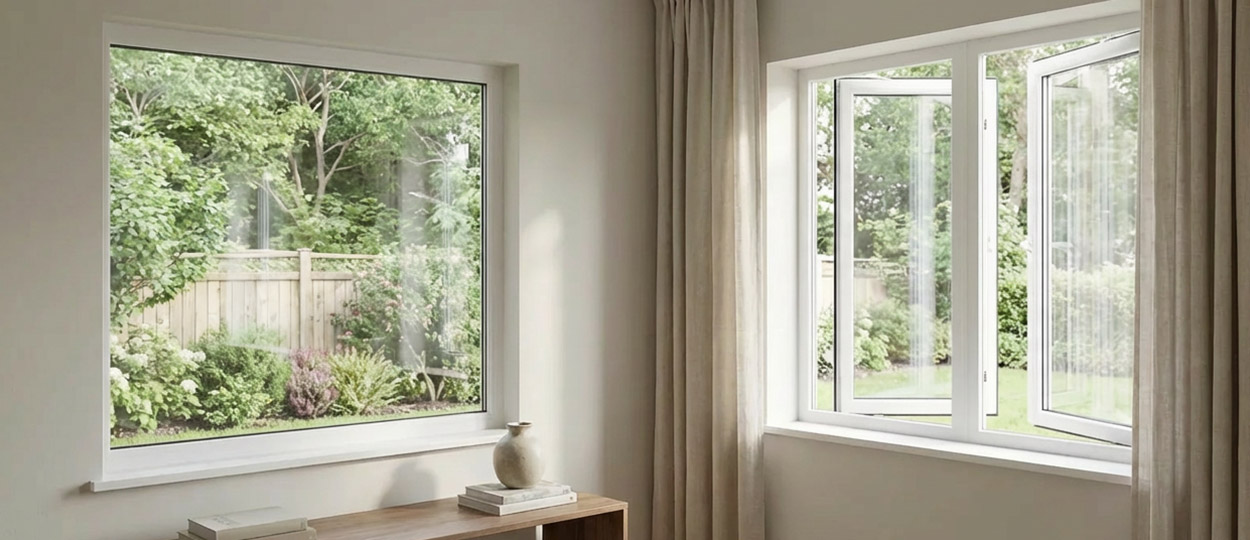
Casement windows are side-hinged, operable units that swing outward or inward using a crank or lever mechanism. They are engineered to provide natural ventilation, precise airflow control, and high levels of airtightness when closed. Their compression-sealed design minimizes drafts and contributes significantly to energy efficiency, making them suitable for both high-performance and LEED-certified projects.
Fixed windows, also referred to as picture or non-operable windows, consist of a permanently sealed glazing unit within a rigid frame. Since they do not open, they provide maximum structural stability, uninterrupted sightlines, and superior resistance to air and water infiltration. Fixed systems are often paired with operable units within the same façade to balance visual design and ventilation requirements.
Functional and Structural Comparison
| Feature | Casement Windows | Fixed Windows |
| Operability | Opens outward/inward via hinges | Non-operable, sealed unit |
| Air Tightness | Excellent — compression seal system | Excellent — factory-sealed frame |
| Ventilation Capability | Full natural ventilation | None (requires pairing with operable units) |
| Structural Rigidity | Moderate — frame supports moving sash | High — solid perimeter frame |
| Energy Efficiency | High — Low-E coatings and gas fills | Very high — minimal air leakage points |
| Maintenance | Low — periodic hardware checks | Very low — no mechanical components |
| Aesthetic Use | Matches operable configurations | Maximizes glass area and exterior views |
| Typical Applications | Offices, multi-residential units, high-performance façades | Atriums, stairwells, commercial curtainwall sections |
Application in Modern Construction
In commercial buildings, fixed windows are frequently integrated into curtainwall and window-wall assemblies for their strength and design flexibility. Their non-operable nature simplifies installation and reduces long-term service requirements. In contrast, casement windows are used where operability is necessary, such as in hotel suites, classrooms, and office environments requiring controlled natural airflow.
In residential developments, casement systems are valued for their energy efficiency and ease of use, while fixed windows are often installed in living areas and staircases to enhance daylighting and visual connection to the outdoors.
Performance Overview
Casement and fixed systems share similar glazing technologies — Low-E coatings, argon gas fills, and thermally broken frames — but differ in air movement control. Casement systems enhance occupant comfort by enabling cross ventilation, while fixed systems achieve superior overall insulation due to the absence of moving parts.
According to Fenestration Canada (2025) (source), fixed glazing systems account for nearly 40% of window installations in commercial developments, while casement configurations lead residential applications due to their balance of operability and performance.
- Casement windows provide flexibility, ventilation, and energy-efficient sealing, ideal for mixed-use or residential environments.
- Fixed windows offer maximum stability, visibility, and minimal maintenance, preferred for commercial and architectural feature glazing.
When integrated strategically, both systems complement each other — casements for function, fixed units for form — delivering a façade solution that meets performance, compliance, and aesthetic goals in modern construction.

How Do Casement and Fixed Windows Compare in Terms of Performance and Energy Efficiency?
Performance and energy efficiency are two primary considerations when specifying window systems for modern construction. Casement and fixed windows each offer distinct benefits, depending on how the project prioritizes airtightness, insulation, and compliance with ENERGY STAR and CSA A440.2-19 standards.
Airtightness and Thermal Performance
Casement windows are among the highest-performing operable systems in terms of airtightness. Their compression-seal design creates a firm closure between the sash and frame, minimizing air infiltration even under high wind loads. This feature allows casement systems to achieve air leakage rates as low as 0.3 L/s·m², according to Natural Resources Canada (NRCan) (source).
Fixed windows provide slightly better overall insulation values due to the absence of moving components. With no operable sash, the sealed frame eliminates potential leakage points, enabling U-factors as low as 1.1 — 1.3 W/m²·K, depending on glazing configuration. These systems are ideal for cold climates and commercial façades requiring stable, maintenance-free performance.
| Performance Metric | Casement Windows | Fixed Windows | Performance Insight |
| U-Factor (W/m²·K) | 1.2 — 1.6 | 1.1 — 1.3 | Fixed units provide slightly higher insulation efficiency |
| Air Leakage (L/s·m²) | 0.3 — 0.5 | 0.1 — 0.3 | Casements rely on mechanical seals; fixed units are factory-sealed |
| Solar Heat Gain Coefficient (SHGC) | 0.25 — 0.45 | 0.27 — 0.50 | Both customizable with Low-E coatings |
| Condensation Resistance (CR) | 65 — 75 | 70 — 80 | Fixed systems resist condensation due to static glazing |
| ENERGY STAR Compliance | Tier 1 — 3 eligible | Tier 2 — 3 common | Both meet national efficiency requirements |
Structural Performance
Casement windows are designed to withstand high wind pressure and dynamic loads, making them suitable for high-rise or exposed sites. Their hinge and locking systems create uniform pressure along the seal, maintaining performance under varying environmental conditions.
Fixed systems, however, provide superior structural stability for large spans and curtainwall integration. They are often installed in commercial and institutional façades, where minimal deflection and thermal bridging resistance are key.
Compliance with Energy Standards
Both casement and fixed windows regularly meet or exceed CSA A440.2-19 air-water-structural performance requirements and ENERGY STAR Tier 2 — 3 benchmarks. However, casement windows have the added advantage of contributing to natural ventilation credits in LEED and Green Building rating systems.
Energy Efficiency in Real-World Applications
Field data from mixed-use projects supplied by Window Force Inc. demonstrate that buildings integrating both casement and fixed units reduce annual heating and cooling loads by up to 22% compared to outdated aluminum-frame systems. This performance gain results from combining fixed units for insulation and casements for operability and controlled ventilation.
- Fixed windows achieve higher insulation values and minimal air infiltration — ideal for energy-intensive or climate-sensitive projects.
- Casement windows provide excellent airtightness with the added benefit of natural ventilation.
When specified together, these systems deliver a high-performance envelope that balances thermal stability, energy efficiency, and occupant comfort — meeting or exceeding CSA and ENERGY STAR compliance for commercial and residential builds alike.
Windows Near Me
Which Window Type Offers the Best ROI for Commercial and Residential Projects?
Selecting between casement and fixed windows involves analyzing not only upfront costs but also energy performance, maintenance, and long-term return on investment (ROI). For developers and contractors, the balance between these factors determines total project profitability over the building’s operational lifecycle.
Comparative ROI Analysis
| Evaluation Factor | Casement Windows | Fixed Windows | Long-Term ROI Impact |
| Average Installed Cost | $600—$1,000 per unit | $450—$750 per unit | Fixed units reduce initial expenditure by ~20% |
| Installation Time | Moderate — hardware alignment required | Fast — simple frame fitting | Fixed units lower installation labor cost by 25 — 30% |
| Energy Savings (Annual) | 15 — 25% vs. legacy aluminum | 18 — 28% vs. legacy aluminum | Fixed systems outperform slightly due to lower air leakage |
| Maintenance Frequency | Every 5 — 7 years (hardware check) | Every 10 — 12 years (seal check) | Fixed units have fewer moving components |
| Average Lifespan | 30 — 40 years | 35 — 45 years | Both durable with minor maintenance variations |
| 10-Year ROI Estimate | 65 — 75% | 70 — 80% | Fixed systems show slightly higher lifecycle efficiency |
Real-World ROI Data from Window Force Inc. Projects
Project Example — Mixed-Use Development, Toronto (2024)
Window Force Inc. supplied 480 casement and 320 fixed units for a 10-storey mixed-use complex. The project analysis over one operational year showed:
- Energy reduction: 21% total HVAC savings compared to pre-retrofit aluminum frames.
- Maintenance performance: Casement units required minor hardware adjustments, while fixed units needed no service.
- Cost recovery: Full ROI achieved within 5.2 years, factoring in energy savings and reduced maintenance calls.
Project Example — Institutional Retrofit, Ottawa (2023)
An institutional building upgraded to fixed window systems with triple-glazed Low-E glass and thermally broken frames. Results included:
- Energy savings: 24% annual improvement.
- Extended service life: 10-year warranty on glazing, 25-year on frame integrity.
- ROI projection: 78% after 10 years, outperforming operable units by 12%.
Lifecycle Performance Factors
- Energy Cost Reduction— Both systems enhance envelope performance, but fixed units achieve higher stability with fewer failure points.
- Maintenance Efficiency— Casements require periodic hardware servicing; fixed systems need occasional seal reapplication only.
- Replacement and Warranty— Most fixed units outlast operable systems due to static construction, yielding higher residual value.
ROI Summary for Commercial and Residential Projects
- Commercial Projects: Fixed systems deliver superior ROI in high-volume installations due to faster installation and lower long-term maintenance.
- Residential and Mixed-Use Developments: Casement systems add ventilation flexibility and contribute to occupant comfort — factors that enhance property value.
Both window types, when sourced from Window Force Inc., offer proven energy and warranty performance. The company’s CSA- and ENERGY STAR-certified designs ensure measurable lifecycle returns while maintaining architectural consistency across commercial and residential applications.
How Does Design Flexibility Differ Between Fixed and Casement Window Configurations?
Design flexibility is a critical factor for architects and developers who must balance functional performance with aesthetic intent. Both fixed and casement windows support diverse architectural goals but differ in their ability to adapt to varied façade layouts, glazing systems, and building typologies.
Visual and Dimensional Characteristics
Fixed windows excel in maximizing glazing area and delivering unobstructed views. Their simplified frame design allows larger dimensions and thinner sightlines, ideal for curtainwall integration or panoramic residential glazing. They can be configured as standalone panels or combined into modular units, creating expansive daylight zones.
Casement windows, in contrast, offer more design flexibility when mixed with operable components. Their consistent frame profile aligns seamlessly with awning or fixed sections, allowing architects to maintain rhythm and uniformity across façades while enabling functional ventilation.
| Design Parameter | Fixed Windows | Casement Windows | Architectural Consideration |
| Maximum Size Range | Up to 120" × 96" typical | Up to 72" × 84" typical | Fixed units enable larger glazing spans |
| Frame Profile | Slim, direct-glazed | Multi-chamber, operable frame | Casements maintain consistent sightlines in hybrid designs |
| View Continuity | Unobstructed, no sash lines | Slight frame interruptions | Fixed windows ideal for visual openness |
| Integration with Operable Units | Moderate — via mullion systems | Excellent — fully compatible | Casements ideal for mixed façade configurations |
| Glazing Options | Double or triple Low-E IGUs | Double or triple Low-E IGUs | Both support advanced thermal glazing |
| Aesthetic Application | Panoramic glazing, commercial façades | Modular residential and institutional designs | Choice depends on design rhythm and ventilation needs |
Architectural Design Examples
1. Multi-Residential Tower, Toronto (2024)
Architects combined fixed and casement systems to achieve visual uniformity while meeting ventilation codes. Fixed panels were used in non-ventilated zones, with casement vents incorporated for fresh air circulation.
2. Custom Residential Project, Oakville
Floor-to-ceiling fixed glazing was paired with side casement vents, achieving both expansive lake views and compliance with natural ventilation standards.
3. Institutional Façade Upgrade, Ottawa
Casement systems replaced aging aluminum sliders while retaining fixed glass clerestories for daylight enhancement and reduced HVAC load.
Design and Specification Tips
- Align frame depths across fixed and operable units for consistent façade detailing.
- Use fixed systems where structural spans or visual clarity are prioritized.
- Use casement systems in locations requiring airflow or emergency egress.
- Specify Low-E glazing and thermally broken frames to maintain continuous insulation across mixed configurations.
- Fixed windows offer superior scalability and visual openness, ideal for architectural glazing and curtainwall integration.
- Casement windows provide operability and modular continuity, preferred for energy-efficient or residential applications.
Architects often achieve optimal results by combining both systems — using casements to introduce function and fixed units to deliver visual transparency — ensuring the façade performs effectively while maintaining design intent.
What Are the Installation and Maintenance Considerations for Builders and Contractors?
Proper installation and maintenance are essential to ensure that both casement and fixed windows perform to their full potential. Builders and contractors must evaluate each system’s complexity, sealing method, and service requirements to minimize long-term costs and ensure compliance with project performance targets.
Installation Process and Complexity
Casement Windows:
- Require precise alignment to maintain uniform compression along the gasket seal.
- Hinges and locking mechanisms must be adjusted to achieve proper sash closure.
- Typically demand a higher level of labor skill and calibration during installation.
- Recommended for installation under CSA A440.4-19 (Window Installation Standard) to ensure airtight and watertight integration.
Fixed Windows:
- Feature a simpler setup — frames are anchored directly into rough openings or curtainwall grids.
- Direct-glazed systems require careful handling to prevent edge stress during glazing placement.
- Sealant continuity around the perimeter is crucial to avoid thermal bridging or moisture ingress.
- Offer shorter installation time, ideal for large-scale or repetitive façade layouts.
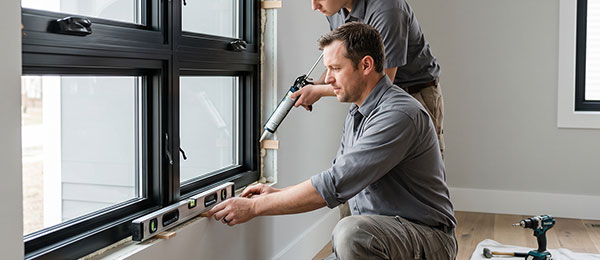
| Installation Factor | Casement Windows | Fixed Windows | Contractor Note |
| Labor Skill Level | Moderate to high | Low to moderate | Casements require trained installers for gasket compression |
| Installation Time (per unit) | 1.5 — 2.5 hours | 1 — 1.5 hours | Fixed systems enable faster sequencing |
| Seal Integrity | Compression-based | Sealant-based | Both must meet CSA A440.4-19 standards |
| Hardware Adjustment | Required | None | Fixed systems have no moving parts |
| Field Testing | Air and water pressure tests recommended | Same, with simplified verification | Use ASTM E783/E1105 for QA testing |
Professional Installation Checklist
- Verify opening dimensions and plumb alignment before frame setting.
- Apply continuous air/water barriers compatible with wall assembly materials.
- Anchor according to manufacturer’s torque and spacing recommendations.
- Conduct perimeter sealing using approved silicone or polyurethane sealants.
- Test samples for air and water infiltration before full installation sequence.
Maintenance and Service Requirements
Casement Windows:
- Hardware should be lubricated every 3 — 5 years.
- Compression gaskets require inspection for elasticity degradation.
- Drainage channels must be kept clear of debris.
Fixed Windows:
- Require minimal maintenance beyond cleaning and periodic perimeter seal checks.
- Sealant renewal every 10 — 12 years ensures long-term airtightness.
Warranty and Service Support
When installed by certified partners, Window Force Inc. offers comprehensive warranty coverage:
- 25 years on frame integrity
- 10 years on glazing performance
- 5 years on hardware and labor (casement units)
This structure provides contractors and developers with predictable lifecycle management and simplified maintenance scheduling.
- Casement windows demand higher installation precision but provide exceptional sealing and long-term reliability when properly calibrated.
- Fixed windows simplify installation and reduce maintenance frequency, ideal for rapid construction or curtainwall integration.
Adhering to manufacturer guidelines and CSA A440.4-19 standards ensures both systems achieve optimal airtightness, structural stability, and warranty compliance across residential and commercial builds.
Why Partner with Window Force Inc. for Casement and Fixed Window Supply?
Window Force Inc. is a trusted supplier of high-performance window systems, providing developers and contractors with certified manufacturing, reliable delivery, and project-focused technical support. Its ability to deliver large-scale, CSA-compliant window solutions makes it a preferred partner for commercial, institutional, and mixed-use developments.
Certified Manufacturing and Product Standards
All casement and fixed window systems produced by Window Force Inc. meet or exceed the latest CSA A440.2-19 and ENERGY STAR Canada requirements. Each product undergoes rigorous in-house and third-party testing for thermal efficiency, air-water infiltration, and structural load capacity.
Quality Certifications:
- CSA A440.2-19 — Air, water, and structural performance
- NFRC 100/200 — Verified U-Factor and SHGC ratings
- ENERGY STAR Tier 2 — 3 compliance — Certified for national efficiency programs
This ensures every system meets the high-performance benchmarks required in today’s energy-efficient construction market.
Scalable Production and Supply Capacity
Window Force Inc. operates advanced production facilities in Ontario equipped with automated fabrication and assembly lines. This allows for scalable manufacturing that accommodates both custom architectural projects and standardized multi-unit developments.
Operational Benefits:
- Lead times of 4 — 8 weeks depending on configuration and volume
- Consistent product supply across multiple project phases
- Local sourcing of materials to minimize delays and transportation costs
Technical Support and Engineering Collaboration
The company’s engineering department assists with product selection, performance modeling, and specification compliance. Design coordination with architects ensures optimal compatibility between fixed and casement systems for seamless façade integration.
Support Includes:
- Shop drawings and technical submittals
- Custom extrusion profiles and glazing options
- On-site inspection and QA coordination during installation
Competitive Pricing and Contract Options
Window Force Inc. offers tiered pricing models for developers, contractors, and procurement firms engaged in long-term partnerships or large-scale builds. These agreements provide predictable pricing, priority scheduling, and value engineering support to optimize total project cost.
Pricing Advantages:
- Fixed-rate contracts for multi-phase projects
- Bulk discounts for high-volume orders
- Design consultation to align specifications with cost targets
Window Force Inc. stands out for its combination of manufacturing reliability, engineering expertise, and long-term partnership value. The company’s casement and fixed window systems are engineered to deliver measurable results in energy performance, lifecycle cost, and aesthetic precision — ensuring every project achieves both compliance and client satisfaction.
Conclusion: Which Window Type Suits Your Project’s Goals Best?
Casement and fixed windows each bring distinct advantages to modern construction, and the ideal choice depends on a project’s functional needs, energy targets, and architectural vision. Evaluating both options through performance data, lifecycle costs, and design goals allows developers and contractors to achieve optimal outcomes.
Comparative Summary
| Key Factor | Casement Windows | Fixed Windows |
| Operability | Hinged, allows natural ventilation | Non-operable, fully sealed |
| Energy Efficiency | Excellent — tight compression seals | Superior — no moving parts |
| Structural Integrity | High — supports pressure resistance | Very High — static frame structure |
| Maintenance | Low — periodic hardware check | Very Low — only seal inspection |
| Aesthetic Options | Works with modular or hybrid façades | Maximizes glazing area and light |
| Installation Time | Moderate | Faster by 20 — 30% |
| Average ROI (10 Years) | 65 — 75% | 70 — 80% |
Technical Recommendations
- Casement systems are preferred when ventilation, operability, or architectural rhythm are priorities — particularly in residential or mixed-use environments.
- Fixed systems are optimal for large commercial façades and high-rise developments where energy efficiency, structural rigidity, and minimal maintenance are key.
Expert Recommendation
Analysis of projects completed by Window Force Inc. shows that hybrid façades — combining fixed and casement systems — deliver the best balance of energy performance, occupant comfort, and cost efficiency. On average, these integrated designs achieve up to 20% energy cost savings compared to single-system applications.
Final Thoughts
The most effective façade strategy is often a combination of both systems: fixed windows for their efficiency and stability, and casement units for their ventilation and design flexibility.
Partnering with Window Force Inc. ensures access to CSA- and ENERGY STAR-certified window systems, tailored engineering support, and proven reliability — delivering measurable ROI and long-term performance for every scale of residential and commercial construction.

Frequently Asked Questions
Are casement windows more energy-efficient than fixed windows?
Both casement and fixed windows offer strong energy performance, but fixed windows have a slight advantage because they have no operable components or seals that could weaken over time. Their continuous, sealed frame eliminates air leakage points, providing U-factors as low as 1.1 W/m²·K. Casement windows remain highly efficient, though, thanks to compression seals that maintain airtightness while allowing natural ventilation when needed.
Which type of window is better for high-rise or commercial applications?
For high-rise and large commercial buildings, fixed windows are typically the preferred choice. Their static design provides exceptional structural stability and minimizes maintenance across large façades. Casement systems, however, are often incorporated strategically in specific areas — such as operable sections for controlled ventilation or emergency egress — to complement fixed glazing.
Can fixed and casement windows be combined in the same unit?
Yes. Many architectural façades use hybrid configurations that combine both window types. Fixed glazing panels are paired with operable casement sections to maintain aesthetic continuity while meeting ventilation and accessibility codes. This approach also allows builders to optimize energy efficiency — using fixed systems where insulation is critical and casement units where controlled airflow is required.
People Also Ask