

Choosing the right kitchen windows is a critical decision that directly impacts comfort, efficiency, and daily functionality. Beyond aesthetics, the ideal solution must balance ventilation, natural light, and energy performance while integrating seamlessly into the kitchen layout. A well-selected window system not only enhances the usability of the space but also contributes to long-term durability and overall home value.
Key Takeaways
- Kitchen windows must balance ventilation, natural light, and ease of operation within the space's workflow.
- Casement and sliding windows are among the most practical for kitchens due to functionality and accessibility.
- Window selection should reflect kitchen size, layout, and orientation to maximize efficiency and comfort.
- Modern designs prioritize energy efficiency, durable materials, and minimal maintenance.
- The best results come from combining technical performance with cohesive interior design.
- Proper placement and glazing technology significantly improve energy performance and indoor comfort.
- High-quality products from a trusted window manufacturer ensure long-term durability, especially in demanding kitchen conditions.
Selecting the right window type is not only about appearance but also about how the unit performs under daily kitchen conditions, such as humidity, temperature fluctuations, and frequent use. Each window style offers distinct advantages depending on placement and function.

Casement Windows
Casement windows are hinged on the side and open outward, typically operated with a crank mechanism. They are widely regarded as one of the most effective options for kitchens. They provide excellent ventilation because the sash can fully open and catch airflow. This is particularly valuable when cooking produces heat, steam, or odours. From an engineering perspective, casement windows also offer strong sealing performance, which improves energy efficiency during colder Canadian seasons.
Advantages:
- Maximum ventilation due to full opening
- Tight seal when closed, reducing air leakage
- Easy operation, even over sinks or counters
Limitations:
- Require exterior clearance space
- Hardware components need periodic maintenance
Casement windows are best suited for areas where airflow is a priority, especially near cooking zones.

Sliding Windows
Sliding windows operate horizontally along a track. Their simplicity makes them a common choice in modern kitchens. They are particularly practical in tight spaces where outward-opening windows may not be feasible. However, only half of the window area can be opened at a time, which limits ventilation compared to casement designs.
Advantages:
- Space-efficient, no outward projection
- Simple mechanism with fewer moving parts
- Suitable for wide openings
Limitations:
- Reduced ventilation capacity
- Tracks require regular cleaning to prevent debris buildup
Sliding windows work well in compact kitchens or areas facing walkways or patios.
Bay Windows
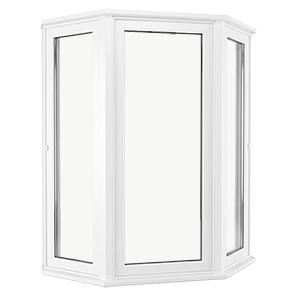
Bay windows extend outward from the exterior wall, creating additional interior space. In kitchens, they are often used to form breakfast nooks or decorative focal points. They significantly increase natural light penetration due to multiple glass panels angled in different directions. Structurally, they require proper support and insulation to maintain performance.
Advantages:
- Expands interior space visually and physically
- Enhances daylight exposure
- Adds architectural value
Limitations:
- Higher installation complexity
- Increased cost compared to standard windows
Bay windows are ideal for larger kitchens where both aesthetics and functionality are priorities.
Picture Windows
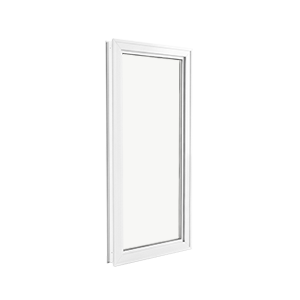
Picture windows are fixed units that do not open. Their primary function is to maximize natural light and provide unobstructed outdoor views. While they do not contribute to ventilation, they can be effectively combined with operable windows to achieve a balanced solution.

Advantages:
- Maximum light transmission
- High energy efficiency due to fixed design
- Minimal maintenance
Limitations:
- No ventilation capability
- Requires pairing with operable units for airflow
Picture windows are best used in kitchens with alternative ventilation sources or as part of a multi-window configuration.
Comparison Table: Kitchen Window Types
| Window Type | Ventilation | Energy Efficiency | Best Use Case | Maintenance |
| Casement | High | Excellent | Near sinks, cooking areas | Moderate |
| Sliding | Moderate | Good | Tight or modern layouts | Low |
| Bay | Moderate | Good | Large kitchens, feature areas | High |
| Picture | None | Excellent | Light-focused designs | Very Low |
Key Factors to Consider When Choosing Kitchen Windows
Window selection must align with how the kitchen functions daily. Poor placement or incorrect sizing can disrupt workflow, reduce efficiency, and negatively impact comfort.
Kitchen Size and Layout
The size of the kitchen directly influences window dimensions and type. In smaller kitchens, oversized windows can overwhelm the space, while insufficient glazing may result in poor lighting.
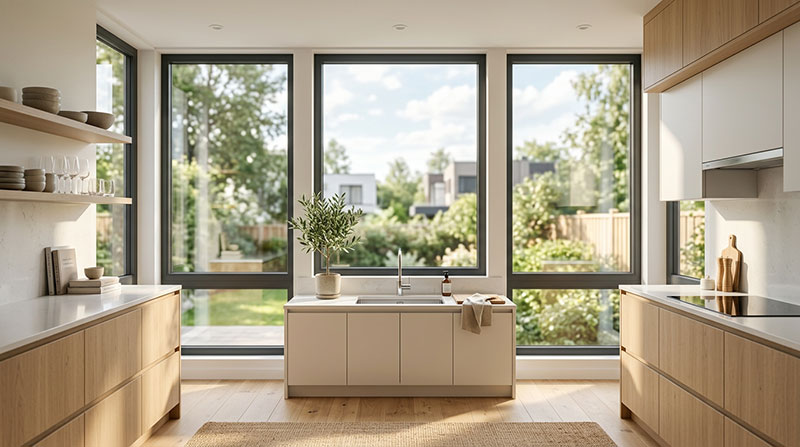
In larger kitchens, multiple windows or combinations of styles often deliver better results. For example, pairing a picture window with operable casement units allows both visibility and ventilation.
Layout also determines accessibility. Windows positioned behind sinks or countertops must be easy to operate without strain.
Ventilation Requirements
Ventilation is one of the most critical considerations in kitchen design. Cooking generates moisture, grease particles, and odours that must be effectively removed.
According to building performance principles, natural ventilation should complement mechanical systems such as range hoods. Windows that open fully, such as casement models, significantly improve air exchange rates.
As noted by seasoned engineer Sergey Essipov, who has 20 years of experience in window manufacturing, "In kitchen environments, the ability to control airflow precisely is just as important as insulation performance. A well-chosen operable window can reduce moisture buildup and extend the lifespan of surrounding materials."
A 2025 study published in Building and Environment (Journal of Building Engineering) confirmed that without proper natural ventilation or exhaust systems, cooking residues can cause total volatile organic compound (TVOC) levels to spike from approximately 146 ppb to over 2,000 ppb within 10 minutes of cooking. The research reinforces that operable kitchen windows play a measurable role in limiting occupant exposure to hazardous airborne compounds.
This highlights the importance of integrating a ventilation strategy into window selection rather than treating it as an afterthought.
Natural Lighting
Adequate daylight improves both functionality and comfort in the kitchen. Properly positioned windows reduce reliance on artificial lighting and enhance visibility during food preparation.
Orientation plays a key role:
- South-facing windows provide consistent daylight throughout the day
- East-facing windows offer strong morning light
- North-facing windows deliver softer, more diffused illumination
Balancing light levels prevents glare while maintaining a bright working environment.
Workflow and Ergonomics
Kitchen workflow follows a logical sequence involving preparation, cooking, and cleaning. Windows should support, not interfere with, this flow.
According to the 2025 Kitchen Trends Report by the National Kitchen & Bath Association (NKBA), presented at KBIS 2025, 67% of professional kitchen designers identify large windows as the primary method to increase natural light, and 53% of respondents predict that kitchens will become increasingly oriented toward healthy, nature-connected living within three years.
For example:
- Windows above sinks should allow easy opening without excessive reach
- Units near cooking areas should not obstruct ventilation systems
- Clearance must be maintained for cabinets and appliances
A poorly placed window can create operational friction, while a well-integrated one enhances efficiency.
Windows Near Me
Modern Kitchen Window Ideas: Combining Function and Aesthetics
Contemporary kitchen design combines performance with visual appeal. Windows are no longer purely functional elements; they contribute significantly to the overall design language.
Frame Materials and Finishes
Material selection affects durability, maintenance, and thermal performance. In Canadian climates, materials must withstand temperature extremes and humidity variations.
Common options include:
- Vinyl: Good energy efficiency when combined with modern insulated glazing, low maintenance, and cost-effective
- Aluminum-clad wood: Combines structural strength with interior warmth
- Fibreglass: Excellent durability and dimensional stability
Finish choices should align with cabinetry and interior design. Neutral tones remain popular, but darker frames are increasingly used to create contrast.
Trim and Detailing
Trim design influences the visual integration of windows within the kitchen. Minimalist trims support modern aesthetics, while more detailed profiles suit traditional interiors.
Consistency is essential. Window trims should complement:
- Cabinet finishes
- Countertop materials
- Backsplash design
This creates a cohesive visual environment rather than a collection of fragmented elements.
Functional Design Combinations
Modern kitchens often use combinations of window types to achieve optimal performance.
Examples include:
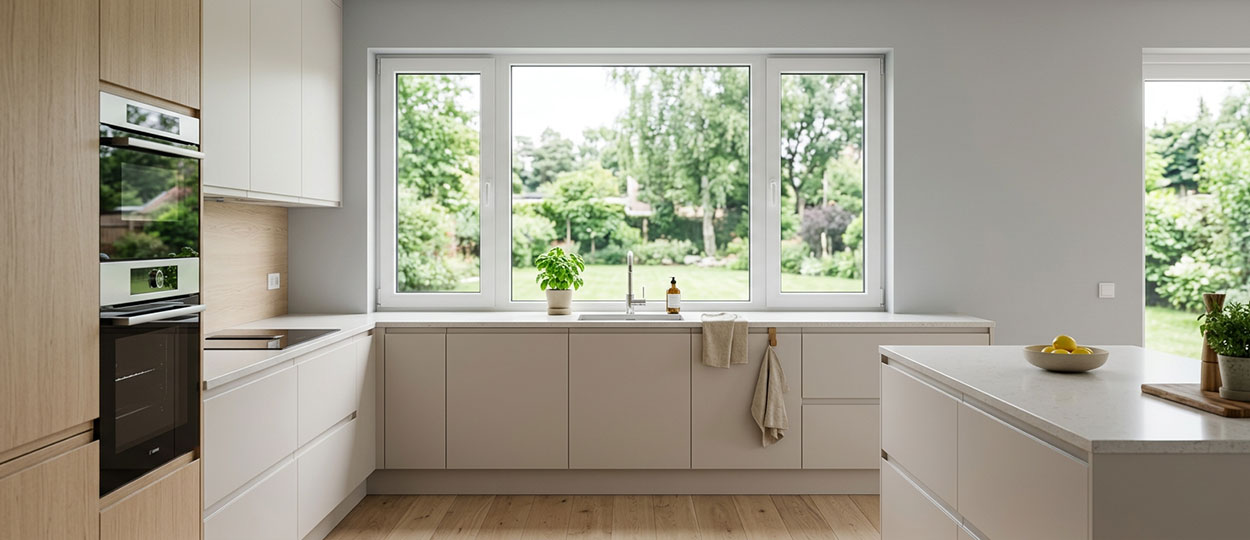
- Picture window centred above the sink with casement units on each side
- Sliding windows paired with fixed panels in compact layouts
- Bay windows incorporating seating or storage solutions
These combinations allow homeowners to address multiple needs simultaneously, including lighting, ventilation, and spatial enhancement.
Integration with Energy Efficiency Standards
Energy efficiency remains a central requirement in window manufacturing. High-performance glazing, multi-chamber frames, and advanced sealing systems contribute to reduced heat loss.
In Canada, energy-efficient windows reduce heat loss and help maintain stable indoor temperatures during winter. Features such as low-emissivity coatings and argon gas fills are now standard in quality products.
Proper installation is equally important. Even the best window will underperform if sealing and insulation are not executed correctly.
When is a Kitchen Bay Window the Right Choice for Your Home?
Choosing a bay window for a kitchen depends on both spatial conditions and intended functionality. This option is most effective when there is sufficient room to accommodate the projection without disrupting workflow or structural balance.
Functional Benefits of Bay Windows in Kitchens
A bay window is not simply a design feature. From a construction and performance standpoint, it is a structural extension that alters how space, light, and airflow interact within the kitchen. In larger layouts, this type of window creates a transition zone between interior and exterior, improving both usability and perception of space.
One of the most notable advantages is the ability to increase usable square footage without altering the home's core footprint. This becomes particularly relevant in kitchens where circulation paths must remain unobstructed. By projecting outward, a bay window frees up interior wall space that would otherwise be occupied by cabinetry or appliances.
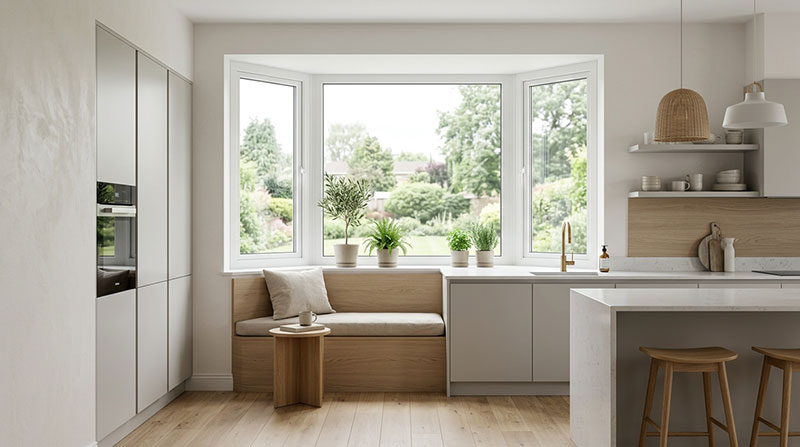
In practical terms, homeowners often integrate the following within a bay window configuration:
- Built-in seating for informal dining
- Storage compartments beneath bench seating
- Extended countertop areas for preparation or display
These integrations must be planned carefully to maintain insulation continuity and prevent thermal bridging, especially in colder Canadian climates.
Spatial Expansion and Design Integration
The perception of space is as important as the actual dimensions. Bay windows introduce multiple viewing angles, which increases daylight penetration and reduces shadow zones within the kitchen. This contributes to a more balanced lighting environment throughout the day.
However, installation complexity should not be underestimated. Structural support, proper flashing, and insulation detailing are critical. This is why projects involving bay windows are often considered during window replacement, when existing openings can be modified to accommodate new configurations.
Cost considerations also vary by region and scope. For example, factors influencing the cost of window installation in Edmonton projects include structural reinforcement, glazing specifications, and labour requirements. These variables highlight the importance of precise planning before selecting this window type.
In summary, a bay window is most appropriate when the kitchen can accommodate outward expansion and when the goal includes both functional enhancement and architectural value.

Which Window Styles Provide the Best Ventilation in Kitchens?
Selecting the right window style for ventilation requires an understanding of how airflow behaves in the kitchen. The goal is to support consistent air exchange without compromising comfort or usability.
Airflow Efficiency and Practical Performance
Kitchen ventilation must address moisture, airborne grease, and heat. While mechanical systems handle a portion of this load, natural ventilation remains essential for maintaining indoor air quality.
Different window types contribute to airflow in distinct ways. The effectiveness of ventilation depends not only on the size of the opening but also on how the window interacts with external air currents.
Casement and awning windows are often preferred in professional assessments due to their ability to fully open and direct airflow into the interior. Sliding windows, while convenient, provide more limited air exchange because only one sash moves.
Ventilation is not simply about opening a window, but about controlling how air enters and exits the space.
Comparison of Ventilation Performance
| Window Type | Opening Mechanism | Ventilation Efficiency | Best Placement in the Kitchen |
| Casement | Side-hinged, outward | High | Above sinks, near cooking areas |
| Awning | Top-hinged, outward | High (even in rain) | Above eye level, tight spaces |
| Sliding | Horizontal track | Moderate | Wide wall sections |
| Bay (operable panels) | Combination | Moderate | Feature areas |
Selecting the Right Option for Your Layout
The choice of window style should align with how the kitchen is used daily. In compact kitchens, where space is limited, sliding windows may be practical despite reduced airflow. In contrast, larger kitchens benefit from operable units that maximize air exchange.
For projects involving window installation in Ontario, building code requirements and climate conditions often favour high-performance operable windows that can maintain airtightness when closed while providing strong ventilation when needed.
A balanced solution may include combining fixed and operable units. This approach ensures consistent natural light while maintaining effective airflow where it is most required.
How Can Kitchen Windows Improve Natural Light and Energy Efficiency?
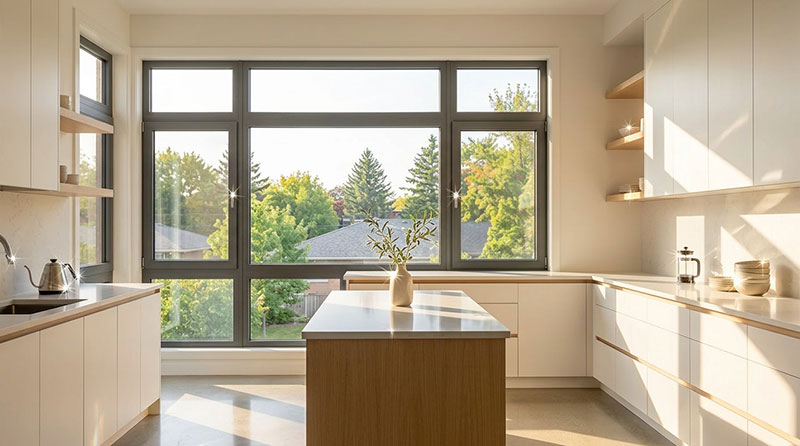
The impact of kitchen windows on light and energy performance depends on how effectively design elements work together. Proper planning allows homeowners to enhance brightness while also improving insulation and reducing overall energy consumption.
Optimizing Daylight Through Window Placement
Natural light plays a critical role in kitchen usability. Proper window placement reduces dependence on artificial lighting and enhances visibility for food preparation tasks.
Orientation remains one of the most influential factors:
- South-facing windows provide the most consistent daylight throughout the year
- East-facing windows introduce strong morning light, which is beneficial for early kitchen use
- North-facing windows offer softer, diffused light with minimal glare
Strategic placement ensures that light is distributed evenly, avoiding excessive contrast between bright and shaded areas.
Picture windows are often used to maximize daylight, particularly when paired with operable units that provide separate ventilation. This combination allows for uninterrupted views while maintaining functional performance.
Energy Efficiency and Modern Window Technologies
Energy efficiency in kitchen windows is determined by glazing technology, frame construction, and installation quality. Modern energy-efficient windows incorporate features such as low-emissivity coatings and insulated glazing units, which reduce heat transfer, improving thermal stability and lowering energy consumption.
From a manufacturing standpoint, precision in frame design and sealing systems is essential. A reputable window supplier in Toronto or other major markets typically offers products that meet or exceed Canadian energy performance standards.
Key performance factors include:
- U-value, which measures heat transfer
- Solar Heat Gain Coefficient, which determines how much solar energy enters the space
- Airtightness ratings, which affect drafts and heat loss
When these elements are optimized, kitchen windows contribute to lower energy consumption and improved thermal stability.
According to Natural Resources Canada's official guidance on residential building envelopes, windows, doors, and skylights can account for up to 35% of a house's total heat loss. Natural Resources Canada. The federal ENERGY STAR program requires certified windows sold in Canada to achieve a U-factor of 1.22 W/m²K or lower and an Energy Rating of 34 or higher — thresholds that apply uniformly across all Canadian climate zones since the 2020 national standard update.
Modern energy-efficient windows from a trusted window manufacturer or supplier in Toronto are designed to meet strict Canadian performance standards, offering improved insulation, reduced heat loss, and long-term durability in demanding kitchen environments.
Integrating Performance with Design
Modern kitchen design requires that performance and aesthetics work together. Window frames, finishes, and proportions must align with cabinetry, countertops, and overall architectural style.
At the same time, installation quality remains a decisive factor. Even the most advanced window system will underperform if improperly installed. This is why professional expertise and adherence to best practices are critical during both new construction and renovation projects.
Ultimately, well-designed kitchen windows enhance not only the visual character of the space but also its efficiency, comfort, and long-term durability.
Are Custom Kitchen Windows Worth the Investment?
Deciding between custom and standard windows depends on the level of precision and performance required for the space. In kitchens with unique layouts or non-standard openings, tailored solutions can deliver more effective long-term results.
Custom vs Standard Windows: Technical and Functional Differences
The distinction between custom and standard windows begins at the manufacturing level. Standard units are produced in predefined sizes, which simplifies production and reduces cost. However, they are not always aligned with the exact dimensions or structural conditions of an existing kitchen opening.
Custom windows, by contrast, are engineered to match precise measurements and project requirements. This allows for better integration with the building envelope, reducing gaps and minimizing the need for structural adjustments during installation.
From a performance standpoint, custom solutions often deliver superior results in terms of airtightness and insulation. This becomes particularly relevant in kitchens, where temperature fluctuations and humidity levels are consistently higher than in other areas of the home.
Cost vs Value and Long-Term ROI
The higher upfront cost of custom windows is often the primary concern for homeowners. However, evaluation should extend beyond initial pricing and consider lifecycle performance.
Custom windows can provide measurable value in several areas:
- Reduced air leakage, which lowers heating and cooling costs
- Improved durability due to precise manufacturing tolerances
- Enhanced aesthetics that align with modern kitchen design standards
In renovation scenarios, especially those involving structural modifications, custom units often reduce the need for additional framing work. This can partially offset the initial cost difference.
Return on investment is also influenced by property value. High-quality, well-installed windows contribute to overall home performance and market appeal, particularly in regions with strict energy efficiency expectations.
When Custom Windows Are the Right Choice
Custom windows are most appropriate in the following situations:
- Non-standard wall openings or architectural constraints
- High-performance requirements, including advanced glazing systems
- Design-driven projects where visual alignment is critical
In contrast, standard windows remain suitable for straightforward replacements where openings are uniform, and performance requirements are moderate.
The decision should be based on a balance between technical requirements, budget, and long-term performance expectations, rather than initial cost alone.
How Much Do Kitchen Windows Typically Cost in Canada?
Understanding the cost of kitchen windows involves more than just comparing base prices. Final expenses depend on material selection, performance features, and installation complexity.
Price Ranges and Market Overview
Kitchen window pricing in Canada varies significantly depending on product specifications and installation conditions. As of the most recent market data, standard kitchen windows typically fall within a broad range, while custom solutions can extend beyond these limits.
Average cost ranges:
- Standard vinyl kitchen windows: approximately CAD $300 to $800 per unit
- Mid-range energy-efficient models: CAD $800 to $1,500
- Custom or large-format windows: CAD $1,500 to $3,500+
These figures reflect product costs only. Installation, finishing, and structural adjustments are calculated separately.
Factors Affecting Cost
Several technical and logistical factors influence final pricing. Understanding these variables allows for more accurate budgeting and informed decision-making.
Key cost drivers include:
- Window size and configuration
- Frame material, such as vinyl, fibreglass, or wood-clad systems
- Type of glazing, including double or triple-pane units
- Hardware quality and operational mechanisms
- Installation complexity, especially in retrofit projects
Regional differences also play a role. Labour rates, climate requirements, and building codes vary across provinces, affecting total project cost.
Installation Considerations
Installation quality has a direct impact on window performance and longevity. Improper installation can lead to air leaks, moisture infiltration, and reduced energy efficiency.
Projects involving window replacement require careful assessment of the existing structure. In some cases, additional work is needed to ensure proper sealing and alignment.
Professional installation typically includes:
- Removal of existing window units
- Preparation of the opening and structural inspection
- Installation with appropriate insulation and sealing materials
- Interior and exterior finishing
For homeowners evaluating costs, it is essential to consider both product quality and installation expertise. Lower upfront costs may lead to higher long-term expenses if performance is compromised.
What Are the Key Takeaways When Choosing Kitchen Windows?
Choosing kitchen windows involves a combination of technical evaluation and design alignment. The process requires attention to ventilation, lighting, energy efficiency, and structural compatibility.
From a manufacturing perspective, precision and material quality are critical. Windows must withstand daily exposure to moisture, temperature changes, and operational use without degradation.
As emphasized by seasoned engineer Sergey Essipov, who has 20 years of experience in window manufacturing:
"Consistent performance in kitchen windows depends on the accuracy of production and the quality of installation. Even minor deviations can affect long-term efficiency and durability."
This reinforces the importance of selecting products that meet rigorous manufacturing standards.
Decision Checklist for Homeowners
To simplify the selection process, the following checklist can be used as a structured guide:
- Determine the primary function of the window: ventilation, lighting, or both
- Evaluate the kitchen layout and identify optimal placement
- Select a window type that supports airflow and accessibility
- Assess energy performance ratings and insulation properties
- Consider whether standard or custom sizing is required
- Ensure professional installation aligned with Canadian building standards
Each of these factors contributes to the overall effectiveness of the window system.
Summary: Kitchen Window Selection Guide
Choosing kitchen windows requires a balanced approach that considers performance, practicality, and design integration. The most effective solutions are those that align with the kitchen’s layout and workflow while delivering reliable ventilation, natural light, and energy efficiency in demanding daily conditions. Prioritizing quality materials and proper installation ensures consistent long-term performance and comfort.
Ultimately, the right window system is not defined by a single feature but by how well all elements work together. By combining suitable window types, thoughtful placement, and high-performance glazing, homeowners can create a kitchen environment that is both functional and visually cohesive, while also supporting durability and energy savings over time.

Frequently Asked Questions
What type of kitchen window is best for ventilation?
Casement windows are generally the most effective for ventilation, as they can fully open and direct airflow into the kitchen. Awning windows also perform well, especially when ventilation is needed during rain.
Are sliding windows a good choice for kitchens?
Sliding windows are practical for compact layouts or areas with limited exterior clearance. However, they provide moderate ventilation since only one sash opens, making them less efficient than casement designs.
How do kitchen windows impact energy efficiency?
Energy efficiency depends on glazing technology, frame materials, and installation quality. Features such as low-emissivity coatings, insulated glass units, and airtight sealing significantly reduce heat loss and improve indoor comfort.
Should I choose custom or standard kitchen windows?
Custom windows are ideal for non-standard openings or high-performance requirements, offering a better fit and insulation. Standard windows are more cost-effective and suitable for straightforward replacements with uniform dimensions.
What is the best way to maximize natural light in a kitchen?
Using larger or strategically placed windows — such as picture windows — helps increase daylight. Combining fixed units with operable windows allows you to maintain both light and ventilation.
Are bay windows suitable for all kitchens?
Bay windows are best suited for larger kitchens where additional space, light, and architectural value are desired. They require more complex installation and greater investment than standard window types.
How much do kitchen windows typically cost in Canada?
Costs vary based on size, material, and specifications. Standard vinyl windows typically range from CAD $300 to $800, while custom or large-format solutions can exceed CAD $3,500, excluding installation.
Why is professional installation important?
Even high-quality windows can underperform if installed incorrectly. Proper installation ensures airtight sealing, prevents moisture issues, and maintains long-term energy efficiency and durability.
People Also Ask