

Black windows have moved well beyond a passing design trend. Across modern, farmhouse, and traditional Canadian homes alike, dark-framed windows have become a defining architectural choice, valued for their sharp contrast, visual weight, and ability to elevate an entire faсade. This guide covers everything from design concepts and home-style pairings to energy performance, installation considerations, and long-term maintenance, giving homeowners and contractors a single authoritative resource on the subject.
This guide draws on Window Force's experience as a Canadian vinyl window manufacturer. Since 2007, we have produced custom windows at our 80,000 sq ft Ontario facility for builders, dealers, contractors, and homeowners across Canada. The design, performance, and maintenance guidance described here reflects what our production and installation teams observe firsthand, including how dark frame finishes behave under real Canadian climate conditions throughout the unit's full service life.
Key Takeaways
- Black window frames work across a wide range of architectural styles, from modern farmhouse to contemporary and transitional, providing strong visual contrast and curb appeal.
- Frame colour does not determine energy efficiency; glazing quality, Low-E coatings, gas fills, and proper installation are the critical factors.
- In Canadian climates, finish durability is a key consideration: high-quality powder-coated or co-extruded dark finishes resist UV degradation and temperature cycling far better than painted alternatives.
- Homeowners can choose black exterior only, black interior only, or dual black frames; each option suits different décor goals and resale strategies.
- Routine cleaning and seasonal seal inspection are the cornerstones of keeping black frames looking sharp and performing correctly over time.
What Are the Best Black Window Ideas for Modern Homes?
Black windows are most effective when the design choice is deliberate rather than decorative. The strongest applications share a common principle: the frame creates a visible, purposeful boundary that sharpens the relationship between the interior and the exterior. Below are the design directions that consistently deliver the best results.
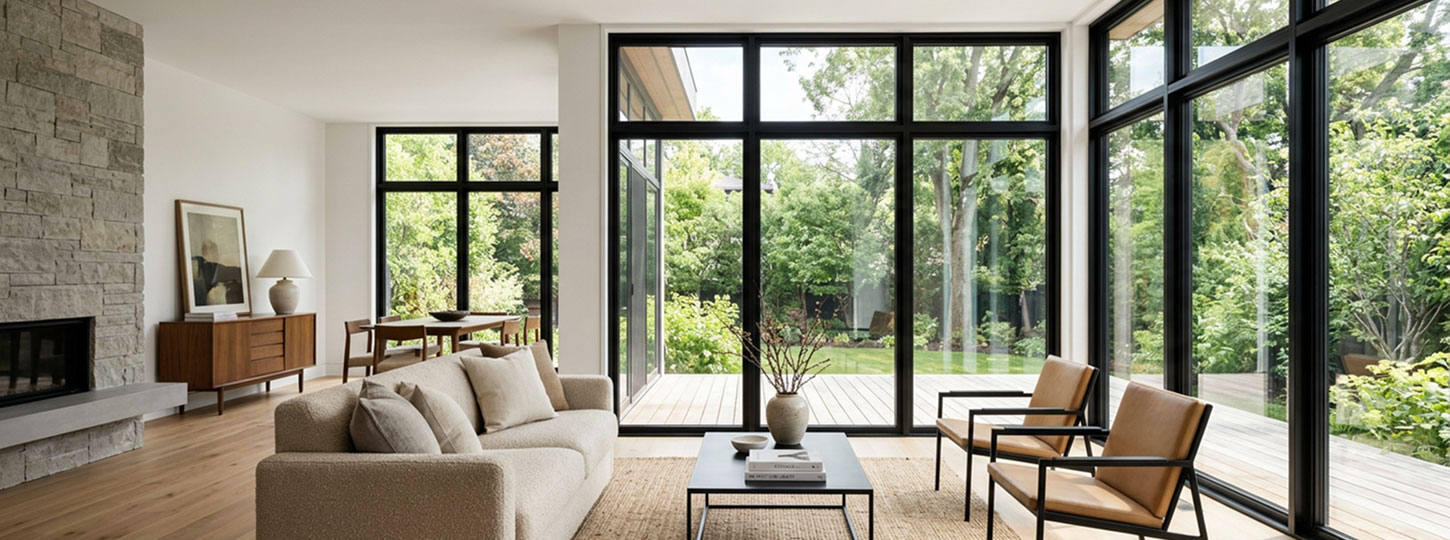
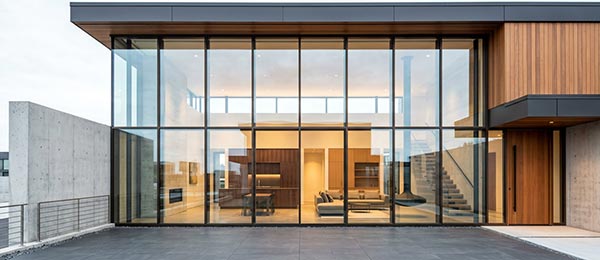
Full black frames on both the interior and exterior deliver the most cohesive, architectural look. This approach suits modern and contemporary builds where a unified material palette is a design priority. Paired with large glass areas, full black frames act as a structural grid, defining the faсade without relying on additional ornamentation.
A black exterior combined with a white interior is one of the most practical choices for homeowners who want curb appeal without committing to dark tones inside. The white interior keeps rooms feeling open and works with virtually any interior colour scheme, while the exterior profile reads as bold and intentional from the street.
Black trim on white windows is a lower-cost approach that achieves comparable visual contrast. Rather than replacing the entire frame, this option involves applying a dark exterior casing or trim around white-framed windows. It works well on homes with traditional proportions where a full dark frame might feel too heavy.
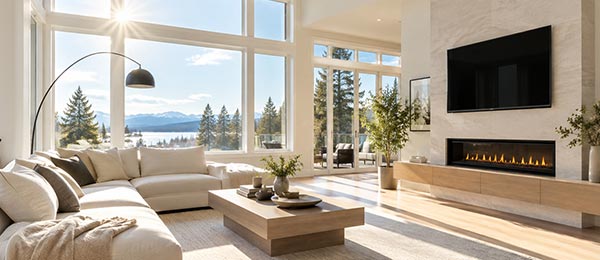
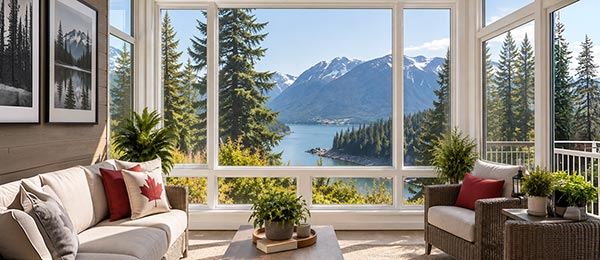
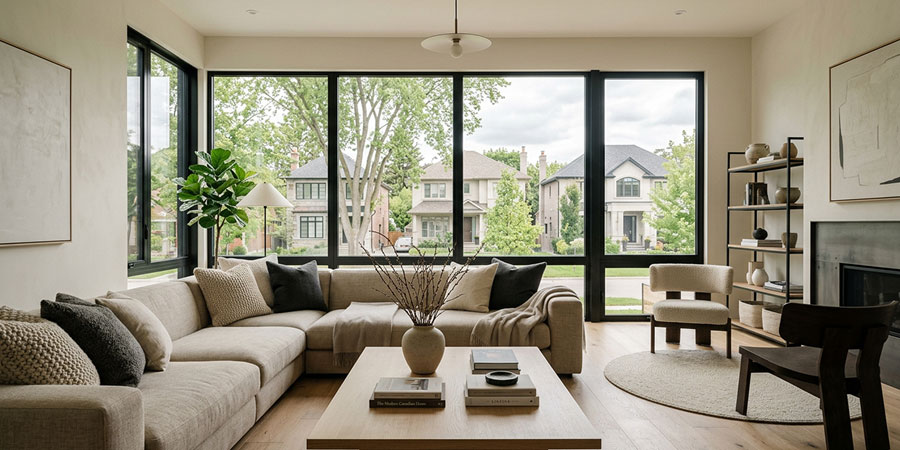
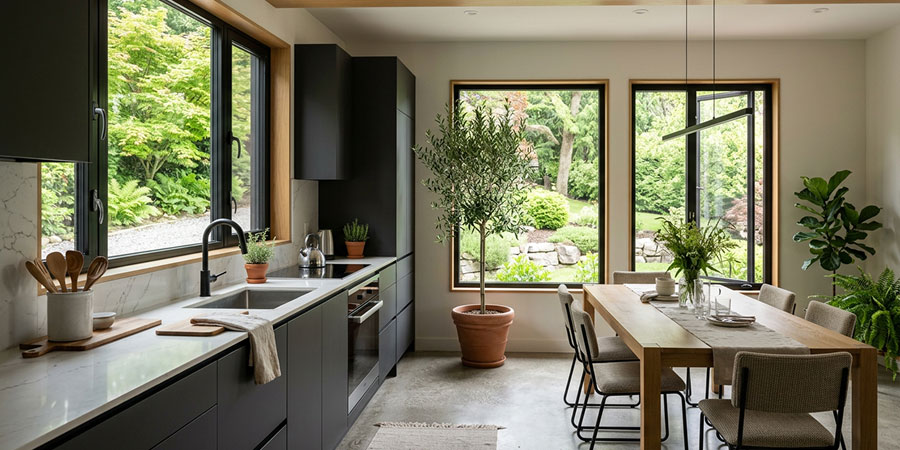
Large picture windows with black frames are particularly effective in contemporary construction. Without grilles or dividers, the glass area is maximized, and the frame functions as a clean border, much like a picture frame around an outdoor view. This is especially impactful in properties with strong landscape features.
Black-framed patio doors extend the visual language of the windows into the transition between indoor and outdoor living spaces. Sliding or French-style patio doors with matching black frames create a continuous line along the rear façade and integrate the doors into the overall window design rather than treating them as separate elements.
Bay and bow windows in black frames are an increasingly popular choice for homeowners who want both architectural projection and strong visual contrast. The multi-faceted geometry amplifies the picture-frame effect of dark profiles, and the angled configuration creates natural shadow lines that define the façade without requiring additional ornamentation.
Modern Farmhouse Black Windows
The modern farmhouse style relies on contrast between rustic and refined materials. Black windows fit naturally into this context: they provide a crisp industrial element that grounds exposed wood, shiplap, and white-painted exteriors. Double-hung windows with true divided lites (or simulated divided lites) in black are a signature detail of this style. The grille pattern adds visual texture while the dark frame keeps the elevation sharp.
Minimalist Black Windows
Minimalist applications prioritize large glass areas and thin frame profiles. Here, the goal is to minimize the visual interruption between the interior space and the view. Casement and fixed windows with slimline black frames serve this purpose well, particularly in homes with flat or low-pitch rooflines and smooth cladding materials. The frame colour provides sufficient definition without adding visual weight.
Casement windows in black also offer a practical sealing advantage in minimalist applications: when closed, the sash compresses the weatherstrip around the full perimeter, making them among the most airtight operable window styles available — a relevant consideration for Canadian climates regardless of aesthetic preference.
Traditional Homes with Black Accents
In traditional architecture, full black frames can feel out of proportion if not carefully scaled. Black accent windows used selectively on dormers, gable ends, or flanking a front entrance add contrast without overwhelming classical proportions. Black grilles in a colonial or prairie pattern on otherwise white windows are a subtle way to introduce the trend while keeping the overall palette consistent.
| Design Direction | Best Application | Frame Configuration |
| Full black frames | Modern/contemporary homes | Black interior + exterior |
| Black exterior, white interior | All styles, resale-friendly | Dual-tone profile |
| Black trim on white windows | Traditional and heritage homes | White frame, black casing |
| Large picture windows | Contemporary with landscape views | Fixed, no grilles |
| Black-framed patio doors | Rear faсades, transitional spaces | Matching a full-black profile |
| Farmhouse with grilles | Modern farmhouse | SDL or TDL in black |
Windows Near Me
Why Are Black Windows So Popular in Exterior and Interior Design?
The rise of black window frames is closely tied to broader shifts in residential architecture toward clean lines, material honesty, and high-contrast palettes. Where earlier decades favoured wood grain or white vinyl for their warmth and neutrality, current design sensibility increasingly rewards windows that actively contribute to the architectural composition by helping define space rather than simply filling an opening.
From the exterior, black frames create what designers and architects call a picture-frame effect. In larger openings, black frames can define the overall geometry of the faсade while simultaneously emphasizing the glass area, making windows appear larger and more intentional. This is particularly effective when windows are paired with light cladding materials such as white or light grey siding, where the contrast is sharp and immediate. According to research and design commentary published by the American Institute of Architects, architectural contrast in fenestration is one of the most consistent drivers of perceived curb appeal in residential projects.
From the interior, black frames anchor the room without closing it. They function as a grounding element in transitional interiors, spaces that mix modern and traditional furnishings, where a strong vertical or horizontal line is needed to organize the composition. Design publications, including Architectural Digest and industry trend reports, have consistently highlighted black window frames as a lasting residential design trend since the late 2010s.
Black frames also photograph extremely well. In an era when listing photos drive significant buyer interest, dark-framed windows create stronger, more defined images than white or beige frames. High-contrast exterior features often create stronger visual definition in listing photography.
Are Black Window Frames a Good Choice for Canadian Homes?
Canada's climate creates specific demands on exterior building products, and window frames are no exception. Temperature swings from -30°C in winter to +35°C in summer, combined with UV exposure, freeze-thaw cycling, and precipitation, test the long-term performance of any exterior finish. Black frames absorb more solar radiation than lighter colours and therefore experience additional thermal stress, particularly on south- and west-facing elevations.
Canadian building standards, particularly the CSA A440 framework for window performance and installation, account for extreme temperature cycling as well as air and water tightness requirements. As a result, products designed for the Canadian market are tested for resistance to thermal expansion and freeze — thaw cycles, which are critical factors in long-term durability regardless of frame colour.
The critical question for Canadian homeowners is not whether black frames can perform in this climate, but whether the specific product they are purchasing is engineered to do so. High-quality vinyl window manufacturers use co-extrusion technology to integrate dark colourants throughout the outer layer of the profile, rather than applying a surface finish that can fade, chip, or peel. Powder-coated aluminum frames offer similar durability thanks to a factory-applied finish chemically bonded to the substrate.
Window Force black vinyl frames are produced using co-extrusion technology, integrating dark colourants throughout the outer layer of the lead-free uPVC profile rather than applying a surface film. Combined with UV stabilizers formulated for Canadian exposure conditions, this construction resists the fading and delamination that affect lower-quality painted or foiled alternatives across the full range of Canadian seasonal temperature cycling.
According to Natural Resources Canada's Office of Energy Efficiency, windows, doors, and skylights can account for up to 25 to 35 percent of a home's total heating and cooling energy loss. This makes the quality of the entire window unit, not just the frame colour, the primary energy performance variable.
Do Black Frames Fade Faster?
Frame colour durability is directly tied to manufacturing method and product quality, not frame colour alone. A co-extruded or factory powder-coated black finish from a reputable window manufacturer will hold its colour significantly longer than a painted or foiled alternative. The risk of fading is real in cheaper products that use applied films or surface paints, which break down under sustained UV exposure. When evaluating a black window product, homeowners should ask specifically about the finishing method and whether the colour warranty matches the overall product warranty.
Window Force backs its black frame finish with the same 25-year transferable warranty that covers the full window unit. Because the colour is co-extruded rather than applied to the surface, the finish warranty is not a separate or shorter-term document, but part of the same product guarantee that covers glazing, seals, and frame integrity.
Expert Installer Checklist: Choosing Exterior Frame Colours in Canadian Climates
- Confirm the black finish is co-extruded (vinyl) or powder-coated (aluminum), not a surface film or paint
- Verify that the colour warranty covers UV fading and delamination for a minimum of 10 years
- Assess window orientation: south- and west-facing units absorb the most solar heat and require the most durable finish
- Confirm the frame profile is rated for the local climate zone under CSA A440 or equivalent standard
- Request documentation on the thermal expansion characteristics of the frame material at the expected temperature range
- Confirm that the installer's labour warranty covers the full installation, including sealants, flashing, and air barrier integration
What Home Styles Look Best with Black Windows?
Black windows are remarkably versatile, but they perform differently depending on the architectural style, exterior materials, and the home's proportions. Understanding which combinations work best helps homeowners make a choice they will be satisfied with in the long term.
Black Windows on Brick Homes
Brick exteriors pair exceptionally well with black frames. The textural contrast between the rough masonry surface and the clean geometry of a dark frame creates visual interest without requiring additional design elements. Red and orange-toned brick is softened by black frames, which read as neutral against warm masonry tones. Grey and charcoal brick achieve a more monochromatic, contemporary result. In both cases, black frames unify the window openings and give the elevation a more considered appearance.
Black Windows on White Houses
This is among the most popular combinations in current residential design. The contrast is immediate and high-impact, and it requires little additional design work to achieve a polished result. White or light grey siding, board-and-batten, or stucco exteriors all benefit from the definition that black frames provide. The risk in this pairing is monotony: homeowners should consider varying window sizes and configurations to ensure the elevation has compositional depth rather than a repetitive grid of identical openings.
Black Windows with Wood Accents
Natural wood elements such as cedar siding, timber accents, wood soffits, and exposed structural members combine well with black frames. The warmth of the wood prevents the dark frame from feeling cold or industrial, while the black profile provides a sharp counterpoint to the organic variation of wood grain. This combination is common in West Coast contemporary architecture and is increasingly seen across Canada in homes where timber accents are used as a secondary cladding material.
For homeowners selecting windows in British Columbia, where cedar cladding and timber-frame construction are particularly prevalent, black casement and fixed frames in this material pairing are among the most consistently requested configurations through our dealer network.
| Exterior Material | Black Frame Effect | Recommended Window Type |
| Red brick | Softens warm tones, strong contrast | Double-hung, casement |
| White/light grey siding | Maximum contrast, modern look | Large fixed, casement |
| Dark grey/charcoal siding | Tonal, sophisticated, layered | Minimalist fixed or casement |
| Stone exterior | Grounds natural texture | Large picture or fixed |
| Board and batten (white) | Farmhouse character | Double-hung with SDL grilles |
| Cedar / natural wood | Warm contrast, West Coast style | Fixed, casement |
| Stucco (light) | Clean, contemporary contrast | Large fixed or casement |
Should You Choose Black Windows Inside, Outside, or Both?
Modern vinyl and aluminum window profiles can be manufactured in different colours on the interior and exterior faces, giving homeowners significant flexibility. Understanding what each configuration achieves helps narrow the decision based on practical goals rather than assumptions.
A black exterior with a white interior is the most widely chosen configuration. It delivers strong curb appeal from the street while keeping the interior flexible. White interior frames pair with virtually any wall colour and trim profile, which is particularly relevant for homeowners who plan to sell. Resale data consistently shows that neutral interior finishes reduce buyer hesitation, and a white interior frame supports that principle without sacrificing exterior design impact.
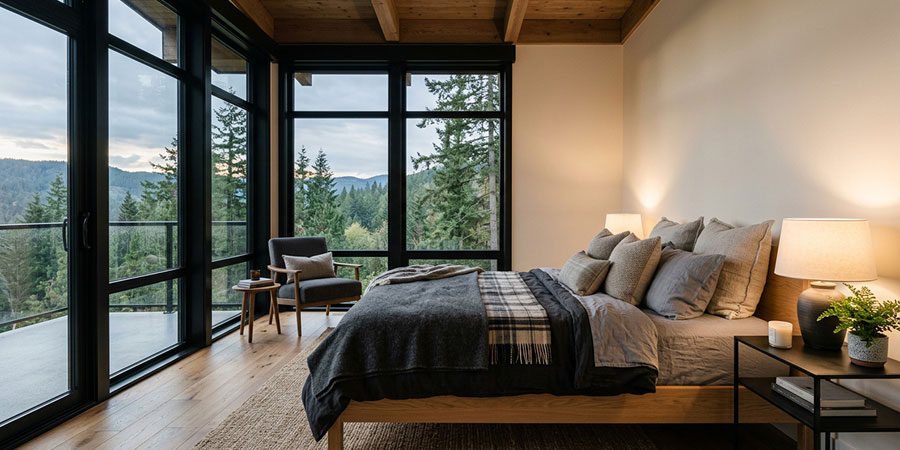
Full black frames with black finishes on both interior and exterior surfaces are appropriate when the interior design supports this choice. Dark frame colours work well against white or light neutral walls, echoing the exterior treatment and creating a cohesive design language throughout the home. In rooms with dark accent walls or highly saturated colours, the black frame may be visually lost rather than serving as a design element.
A black interior with a white exterior is an uncommon configuration, but one that works in specific contexts. Homeowners in heritage neighbourhoods or with HOA colour restrictions may face limitations on exterior colours, but can still incorporate dark tones in the interior. A white or light exterior frame also reduces solar heat absorption, which can be a practical consideration in climates with high summer cooling loads.
| Configuration | Best For | Resale Flexibility | Interior Impact |
| Black exterior / white interior | Most homes have mixed décor styles | High | Neutral, adaptable |
| Full black (both sides) | Design-forward interiors, new builds | Moderate | Bold, architectural |
| White exterior / black interior | HOA restrictions, heritage areas | High | Moody, intentional |
| White exterior / white interior | Traditional, resale focus | Highest | Classic, recedes visually |
When Do White Windows with Black Trim Work Better Than Full Black Windows?
White windows with black exterior trim occupy a specific and practical design position. Rather than replacing entire window units, this approach applies a contrasting casing or exterior trim around standard white-framed windows. For homeowners working within a renovation budget or replacing only part of their window inventory, this is a cost-effective way to introduce visual contrast without a full window replacement.
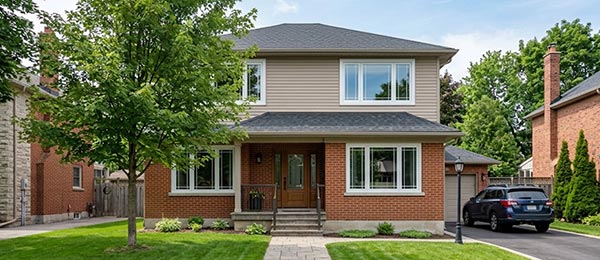
On traditional homes with established proportions, full black frames can feel disproportionate, particularly on homes with smaller window openings or heavily ornamented faсades. Black trim on white windows allows the frame itself to recede while the casing does the visual work. The result is a more measured contrast that respects the building's architectural character.
There are also cases where full black frames would create excessive visual weight on lighter or more delicate cladding materials. A narrow cottage-style home with white-painted wood siding, for example, may benefit more from black trim details than from full dark frames, which could compress the apparent scale of the elevation.
| Scenario | Full Black Frames | White Frames with Black Trim |
| New construction or full replacement | Preferred, cohesive, and purpose-built | Possible but rarely chosen |
| Partial renovation budget | May require staged replacement | Practical and lower-cost |
| Traditional / heritage architecture | Risk of visual heaviness | Better proportional fit |
| Small or narrow home elevations | Can reduce apparent scale | Preserves proportion |
| Maximizing resale flexibility | Strong curb appeal, minor risk | Very versatile |
Design note: When balancing contrast with siding and roof colour, the key principle is tonal separation. Black frames or trim work best when they are the darkest element on the faсade not competing with a dark roof or dark cladding. For homes with charcoal or black roofing, consider a deep charcoal grey frame rather than full black, which can blend into the roofline and fail to anchor the windows as intended.
How Can Black Window Frames Improve Curb Appeal?
Curb appeal is driven by visual contrast, symmetry, and the sense that a home has been deliberately designed rather than built from standard selections. Black window frames contribute to all three. The dark frame sharpens the boundary of each opening, making the window a defined element of the faсade rather than a background feature. This level of visual clarity can significantly influence how a home is perceived from the street and in listing photography.
Engineer Sergey Essipov, with 20 years of experience in window manufacturing, explains:
The proportion of glass to frame is the factor that most affects how a window reads from the exterior. A thinner black frame profile increases the perceived glass area, making the window appear larger and more premium, even when the actual glass size has not changed. This is why slimline profiles in black consistently score higher in client feedback than bulkier profiles in the same colour.
Research on Canada’s residential housing market indicates that exterior visual condition and façade contrast significantly influence buyers' perceptions of property value. Canada Mortgage and Housing Corporation (CMHC) notes that exterior upgrades, including window and faсade improvements, are among the most effective renovation types for increasing overall home appeal in the housing market.
Black frames create stronger compositional lines on the faсade. On homes where multiple windows are visible from the street, the dark frame unifies the openings into a coherent pattern rather than a series of disconnected holes. This effect is amplified when window placement is symmetrical, such as balanced windows on either side of an entry, or when a strong horizontal line of windows runs across the first floor.
Are Black Windows Energy Efficient?
Window energy performance depends primarily on glazing configuration, gas fills, frame construction, spacer technology, and installation quality. Frame colour has only a minor indirect influence through solar heat absorption. ENERGY STAR certification, administered in Canada through Natural Resources Canada, identifies products that meet or exceed the thermal performance thresholds for each of Canada's four climate zones. The most energy-efficient certified products are listed under the ENERGY STAR Most Efficient designation, recognizing the top tier of certified windows and sliding glass doors
Frame colour has one indirect effect on energy performance: darker frames absorb more solar radiation, increasing the frame's surface temperature. In cold climates, this can marginally reduce the risk of condensation on the interior of the frame during winter, but it also increases the thermal load on the window unit in summer. The net effect is negligible in a well-insulated, properly installed unit with quality glazing. The difference in heating or cooling cost attributable to frame colour alone is not a meaningful factor in the purchase decision.
For example, for homeowners ordering windows in Alberta, where the heating season is among the longest in Canada, the characteristics of the glazing unit carry much more weight than the frame colour in determining annual energy efficiency.
Engineer Sergey Essipov, with 20 years of experience in window manufacturing, notes:
Homeowners frequently ask whether a black frame will make their home warmer in winter or hotter in summer. At our facility, we address this through our dual seal, metal-free warm edge spacer system, which eliminates the aluminum thermal bridge at the glass edge, the point where temperature differentials are greatest, regardless of frame colour. The honest answer is that frame colour contribution to heat transfer is marginal compared to the glass specification; directing budget toward triple-pane glazing, high-quality Low-E coatings, and warm-edge spacers delivers far more measurable thermal performance than any frame colour decision.
What Should Homeowners Know Before Buying a Black Window?
Purchasing a single black window, whether as a feature unit or as the first replacement in a staged renovation, requires the same technical diligence as a whole-home project. The decisions made at this stage determine both performance and long-term satisfaction.
Accurate measurement is the starting point. Rough opening dimensions must be taken at multiple points across the opening's width and height, since openings in older Canadian homes are frequently out of square. The replacement window should be specified to the smallest measured dimension, with appropriate tolerances confirmed with the window manufacturer before ordering.
Step-by-Step Buying Guide for a Black Window
- Measure the rough opening at three points for both width and height; note the smallest dimension.
- Confirm the frame profile: vinyl, aluminum-clad wood, or aluminum, and verify that the black finish is co-extruded or powder-coated.
- Select the glass package based on the window's climate zone, orientation, and the home's heating/cooling load.
- Specify the grille style (simulated divided lites, between-the-glass, or no grilles) and confirm compatibility with the frame profile.
- Review the exterior finish warranty: confirm minimum coverage period and specific exclusions related to UV fading.
- Confirm the installation method: nail-fin for new construction, insert replacement for existing frames, or full-frame replacement.
- Obtain a written installation warranty from the installer, separate from the product warranty.
- Verify that the window meets or exceeds the ENERGY STAR specification for the applicable Canadian climate zone.
How Should You Match Black Windows with Doors, Siding, and Trim?
An exterior palette works when its elements are coordinated rather than simply matching. Black window frames are an anchor point in the composition because they provide the highest contrast element on the façade, and other exterior components should be chosen in relation to that anchor rather than independently.
The front door is the most direct pairing decision. A black front door with black window frames creates a unified, intentional exterior. Matte black or satin black finishes work better in most applications than gloss black, which reflects light unevenly and can highlight surface imperfections in door panels. If a black door feels too heavy for the overall palette, a dark charcoal or navy provides a related tone without fully duplicating the window frame colour.
Eavestroughs, fascia, and soffits are often overlooked, but they have a significant effect on the overall reading of the exterior. Black or dark grey gutters and fascia extend the dark frame language to the roofline and prevent the windows from appearing isolated within a palette of light materials. This detail is particularly effective on homes with wide overhangs, where the fascia board is prominently visible from the street.
How Do You Maintain Black Windows So They Keep Their Colour and Finish?
Black frames show dust, water spots, and mineral deposits more clearly than white frames. A consistent maintenance routine keeps the finish looking sharp and extends the life of the seals and hardware. The good news is that high-quality black frames require no more maintenance effort than any other colour, provided the correct cleaning methods are used.
Cleaning frequency depends on exposure. Windows on south- and west-facing elevations in dusty or urban environments may need cleaning two to three times per year. Shaded or north-facing windows typically require one thorough cleaning annually. The goal is to remove accumulated deposits before they bond to the finish surface.
Step-by-Step Cleaning and Maintenance Guide for Black Window Frames
- Rinse the frame surface with clean water to remove loose dust and debris before applying any cleaning solution.
- Wash with a mild soap solution (dish soap diluted in water) using a soft microfibre cloth. Do not use abrasive pads, steel wool, or scouring compounds.
- Rinse thoroughly with clean water to prevent soap residue, which can attract dust and leave streaks on dark finishes.
- Dry with a clean microfibre cloth to prevent water spots caused by mineral deposits, which are more visible on black frames than on light-coloured ones.
- Inspect the perimeter caulking and exterior sealant bead at each seasonal cleaning. Look for cracking, gaps, or separation from the frame or surrounding cladding.
- Check the weatherstripping on operable units (casement, awning, hung) for compression, tearing, or displacement.
- Lubricate operating hardware (hinges, locks, cranks) annually with a silicone-based lubricant. Avoid petroleum-based products that attract dust.
- After winter, inspect the frame corners and sill area for moisture accumulation or frost damage. Report any seal failures (fogging between glass panes) to the manufacturer under warranty.
Expert Maintenance Checklist (Window Installation Specialist)
- Do not use bleach, ammonia-based cleaners, or citrus solvents on black vinyl or powder-coated finishes, as they degrade the surface over time.
- Check that drainage slots at the window sill are clear of debris each spring to prevent water pooling inside the frame.
- Inspect the exterior flashing above and beside each window after the first frost cycle of the season.
- If the black finish shows any chalking or fading within the warranty period, document it with photographs and contact the manufacturer before the warranty expires.
- Never use a pressure washer directly on window frames because the force can displace weatherstripping and force water past seals.
Window Force frames are extruded from lead-free uPVC with UV stabilizers and feature fusion-welded corners that form a continuous, sealed joint at every frame angle. This construction means there are no mechanically fastened corner joints where moisture or cleaning solutions can penetrate, simplifying maintenance and reducing the conditions that lead to finish separation or frame deterioration over time.
Final Thoughts: Making the Right Choice with Black Windows
Black windows deliver genuine value in both design and function when selected and installed correctly. The strongest outcomes come from treating the frame colour as one element in a coordinated exterior decision rather than an isolated upgrade. Matching the frame to doors, roofline details, and cladding colour ensures that the dark profile anchors the faсade rather than competing with it.
For Canadian homeowners planning a window replacement, the priority sequence should be: glass package performance first, frame quality and finish durability second, and colour third. A well-specified, properly installed energy-efficient window in black will outperform a poorly installed unit of any colour in both thermal performance and long-term finish retention. Working with an experienced window manufacturer and a qualified installer ensures that the chosen product matches the climate demands of the installation location.
Window Force manufactures every window to order at our Ontario facility and distributes through an authorized dealer network across Canada. Our black vinyl frames are CSA certified and engineered to meet or exceed ENERGY STAR® requirements across all Canadian climate zones, so the performance specifications, finish durability, and warranty coverage are documented and consistent regardless of where the installation takes place. Because we control the product from raw materials through dealer installation, warranty claims are resolved within a single system, with no ambiguity regarding the responsibilities of the manufacturer, distributor, and installer.

Frequently Asked Questions
Do black window frames cost more than white?
In most cases, yes, though the premium varies by manufacturer and product line. Co-extruded black vinyl or powder-coated aluminum finishes involve additional manufacturing steps compared to standard white vinyl, which is reflected in the unit price. The price difference typically ranges from 5 to 15 percent, depending on the profile and glass specification. Some manufacturers offer black as a standard colour option at no extra cost.
Are black windows harder to keep clean?
Black frames show dust and water spots more readily than white, which means they require more frequent attention to maintain a sharp appearance. The cleaning process itself is not more complex, but the standard of "clean enough" is higher because any residue is visible against the dark surface. Using a microfibre cloth to dry the frame after washing eliminates most visible marks that accumulate on dark finishes.
Do black window frames get too hot in summer?
Dark frames absorb more solar radiation than light-coloured frames, which increases their surface temperature during direct sun exposure. In a well-manufactured unit with a proper thermal break, this does not translate into significant heat transfer into the home. However, for south-facing installations in climates with high summer sun, it is worth confirming that the frame profile includes an adequate thermal break and that the overall glass package includes a solar-control Low-E coating to manage heat gain through the glass.
What is the best material for black window frames in Canadian climates?
Co-extruded vinyl and thermally broken aluminum are both appropriate for Canadian climates, with different performance profiles. Vinyl expands and contracts with temperature change and requires a stable installation to avoid distortion at extreme temperatures. Thermally broken aluminum is more dimensionally stable and better suited to larger-format windows.
Do black windows affect home resale value?
Black exterior frames with white interiors are generally considered a neutral-to-positive feature in the current resale market, particularly in urban and suburban markets where contemporary design is in demand. Full black interior frames are more polarising and may require a buyer who shares that design preference. Homeowners planning to sell within a few years are best served by the black exterior with a white interior, which maximizes curb appeal while keeping the interior adaptable.
People Also Ask