

For homeowners near busy roads, rail corridors, or urban centres, outdoor noise is not a minor inconvenience but a persistent factor affecting sleep, concentration, and quality of life. Soundproof windows are engineered to attenuate noise at the building envelope, using specific glass configurations, acoustic interlayers, and precision frame sealing to reduce the amount of external noise entering the home. Understanding how they work and whether they suit your situation is the first step toward making an informed decision.
Key Takeaways
- No window eliminates noise entirely, but high-performance soundproof windows can reduce sound transmission by up to 35 — 45 dB, making intrusive noise barely perceptible indoors.
- Sound Transmission Class (STC) is the primary measurement for acoustic performance. Windows rated STC 45 — 55+ offer meaningful noise reduction in urban and high-traffic environments.
- Glass configuration, lamination, pane spacing, gas fill, and frame sealing all contribute to acoustic performance. Weakness in any one component limits the overall result.
- Soundproof windows deliver dual performance: the same construction that reduces noise also improves thermal insulation, lowering heating and cooling costs.
- Professional installation is critical. Even the highest-rated acoustic glazing underperforms if the frame is poorly sealed or improperly fitted.
- The investment pays back through energy savings, improved comfort, better sleep quality, and increased resale value, particularly in high-noise locations.
What Are Soundproof Windows and How Do They Differ from Regular Windows?
Soundproof windows, more accurately described as acoustic or noise-reducing windows, are designed to impede the transmission of sound waves through the building envelope. Unlike standard windows, which prioritize basic thermal performance and structural function, acoustic windows incorporate additional engineering layers designed to disrupt sound energy before it enters the living space.
The core difference lies in construction. A standard double-pane window consists of two glass panes separated by a uniform air gap, typically filled with argon gas for thermal performance. A soundproof window adds complexity to every component: the glass itself may be laminated with an acoustic interlayer, the air gap is wider and asymmetric, and the frame includes compression seals that eliminate the micro-gaps through which sound travels even when the sash is closed.
Structural Comparison
The following table illustrates the key construction differences between standard and soundproof windows:
| Feature | Standard Window | Soundproof Window |
| Glass type | Basic double-pane | Laminated or triple-pane |
| STC rating | 26 — 32 | 45 — 60+ |
| Pane spacing | 12 — 16 mm (uniform) | 19 — 25+ mm (often asymmetric) |
| Gas fill | Argon or air | Argon or krypton |
| Acoustic interlayer | None | PVB or SGP laminate |
| Frame sealing | Standard weatherstrip | Multi-point compression seals |
| Additional benefits | Basic insulation | Enhanced UV protection, security |
The term "noise-proof windows" is sometimes used in consumer contexts, but no window can achieve complete noise elimination. The goal is a significant, measurable reduction in noise.
Engineer Sergey Essipov, with 20 years of experience in window manufacturing, explains:
The distinction between a standard window and a true acoustic window is not just the glass. It is the sum of every component working together. A laminated glass unit in a frame with poor compression seals will never achieve its rated STC performance in real-world conditions.
Windows Near Me
How Do Soundproof Windows Actually Reduce Outside Noise?
Sound travels as mechanical vibrations through air. When those vibrations reach a window, they cause the glass to vibrate sympathetically, transmitting acoustic energy into the interior. Soundproof windows are engineered to interrupt this process at multiple stages: absorbing vibration within the glass, scattering energy across air gaps, and preventing flanking transmission through the frame.
The Role of STC Ratings
The Sound Transmission Class rating is an internationally recognized single-number metric that describes how well a building assembly reduces sound transmission. It is measured across a standardized frequency range and condensed into a single number for comparison. Higher STC values indicate greater noise reduction.
For residential applications, the following ranges provide practical guidance:
- STC 25 — 30: Standard single-pane windows; conversations at normal volume are audible through the glass.
- STC 30 — 40: Basic double-pane windows; loud speech is audible, but not intelligible.
- STC 40 — 50: Acoustic-grade windows; most speech and mechanical noise is significantly reduced.
- STC 50 — 60+: High-performance acoustic windows; loud exterior noise is reduced to barely perceptible levels.
A study published in the National Library of Medicine found that residents in areas with high road traffic noise reported significantly higher rates of sleep disturbance, including difficulty falling asleep, frequent nighttime awakenings, and poorer overall sleep quality, compared with those in quieter environments. The study also notes that environmental noise levels above approximately 55 dB(A) are widespread in urban settings and are associated with documented impacts on sleep and well-being.
These findings underscore the health rationale for acoustic upgrades beyond simple comfort. Appropriate acoustic glazing can reduce interior noise levels by 35 — 45 dB, which corresponds to making external noise subjectively several times quieter to the human ear.
Acoustic Dampening Materials
Laminated glass is the most effective single-component upgrade for noise reduction. A standard laminated unit bonds two glass panes with a polyvinyl butyral (PVB) interlayer using heat and pressure. When sound energy strikes the assembly, the PVB layer converts a portion of that energy into negligible heat rather than allowing it to pass through as vibration. The result is a measurable reduction in mid- and high-frequency noise.
Gas fill also plays a role. Argon gas, being denser than air, slightly reduces sound transmission through the cavity. Krypton, being denser still, offers a marginal additional benefit. Neither gas is primarily used for acoustic performance, but both contribute to the overall performance of the insulated glass unit.
What Types of Soundproof Windows Are Available on the Market Today?
The acoustic window market has expanded significantly, offering solutions ranging from full-replacement units to retrofit inserts that fit within existing frames. Each type suits different budgets, renovation scopes, and performance requirements.
Double-Glazed Acoustic Windows
Double-glazed acoustic windows use two panes of glass, at least one of which is laminated, separated by a wider-than-standard air gap. They represent the entry point for meaningful acoustic performance and are typically specified for homes in suburban environments with moderate noise exposure. When manufactured by a reputable window manufacturer, these units can achieve STC ratings of 40 — 48.
Triple-Glazed Windows
Triple-pane windows add a third glass layer and a second insulating cavity. This configuration not only improves acoustic performance but also delivers substantially better thermal resistance, making it a strong candidate for Canadian climates where heating costs are a significant consideration. STC ratings for quality triple-pane acoustic units typically fall in the 48 — 56 range.
Laminated Glass Units
Laminated glazing can be incorporated into either double or triple configurations. The acoustic interlayer, most commonly PVB but increasingly also SentryGlas (SGP) for enhanced performance, is the primary contributor to high-frequency sound absorption. Laminated units also offer secondary benefits: resistance to breakage, UV filtering, and improved security, as the interlayer holds glass fragments in place upon impact.
Acoustic Window Inserts
Acoustic inserts are interior secondary panels mounted within the existing window frame, creating an additional air gap without replacing the primary window. They are a lower-cost retrofit solution that can add 10 — 15 STC points to an existing window's performance. Their limitations include fewer ventilation options, added interior depth, and dependence on the existing frame's condition.
Comparison Table
| Window Type | Typical STC Range | Thermal Benefit | Best Use Case | Relative Cost |
| Standard double-pane | 26 — 32 | Moderate | Low-noise environments | Low |
| Acoustic double-pane | 38 — 48 | Moderate — Good | Suburban traffic, schools | Moderate |
| Triple-pane acoustic | 48 — 56 | Excellent | Urban cores, highways | High |
| Laminated triple-pane | 52 — 62 | Excellent | Airports, rail corridors | Premium |
| Acoustic inserts | +10 — 15 STC (relative) | Minimal | Retrofit, rental properties | Low — Moderate |
When Should You Consider Professional Soundproof Window Installation?
Not every home requires acoustic-grade glazing. The decision depends on the severity and frequency of noise exposure, the occupants' sensitivity, and the long-term plans for the property. There are, however, clear scenarios where professional soundproof window installation offers a return that justifies the investment.
High-Noise Environments
Homes within 200 — 300 metres of arterial roads, rail lines, LRT corridors, or airports are the most obvious candidates. Sustained exposure to traffic noise above approximately 50 — 55 dB(A) has been associated with adverse health outcomes, including sleep disturbance, cognitive impairment in children, and elevated cardiovascular risk. In Canadian urban centres, ambient noise levels on residential streets adjacent to collector roads routinely exceed this threshold during peak hours.
Engineer Sergey Essipov, with 20 years of experience in window manufacturing, notes:
In my practice, the most common oversight is underestimating how much noise enters through the frame rather than the glass. Professional installation means the rough opening is properly prepared, the frame is mechanically fastened without racking, and every penetration point is sealed before finishing. That work cannot be replicated by a DIY replacement.

Shift Workers and Light Sleepers
For individuals who sleep during daylight hours, whether due to shift work, health conditions, or infant care schedules, the acoustic performance of bedroom windows directly affects sleep quality. Research published in Scientific Reports indicates that even moderate noise events above 40 dB(A) cause measurable sleep-stage disruptions, even when the sleeper does not fully awaken.
Home Offices and Recording Environments
Remote work has elevated the acoustic requirements of residential spaces. A standard window with an STC rating of 28 does little to prevent street noise from appearing in video calls or recordings. Acoustic-grade windows, combined with appropriate interior treatments, can create a measurable reduction in background noise levels that affects perceived professionalism and concentration.
Long-Term Return on Investment
Professional installation by an established, qualified local window contractor or in your local market protects the warranty, ensures code compliance, and prevents the air infiltration that degrades both acoustic and thermal performance over time. A poorly installed high-performance window will underperform a competently installed mid-grade unit within a few years as seals compress unevenly or frames shift.
How Much Do Soundproof Windows Cost and Are They Worth It?
Cost varies significantly based on glass configuration, window size, frame material, and installation complexity. The following figures reflect typical Canadian market pricing for supply and installation, not materials alone.
Cost Breakdown
| Window Type | Cost Per Unit (Installed) | Whole-Home Estimate (15 — 20 Units) |
| Acoustic double-pane | $550—$900 | $8,000—$15,000 |
| Triple-pane acoustic | $850—$1,400 | $13,000—$22,000 |
| Laminated triple-pane | $1,100—$1,800 | $16,000—$28,000 |
| Acoustic inserts (retrofit) | $200—$600 per window | $3,000—$10,000 |
Several factors influence where a specific project falls within these ranges: window size and operability type, frame material (vinyl windows are typically the most cost-effective option that still delivers strong acoustic and thermal performance), site accessibility, and the condition of the existing rough openings.
Are They Worth the Investment?
The financial case for soundproof windows is built on several compounding benefits rather than a single factor.
First, there are energy savings. According to Natural Resources Canada’s Office of Energy Efficiency, windows, doors, and skylights can account for up to 25 — 35% of a home’s total heat loss. Upgrading to high-performance acoustic glazing helps reduce that loss, lowering the overall heating demand. In many cases, the resulting energy savings alone can offset the initial investment over roughly 8 to 15 years, depending on the fuel type and local climate conditions.
Equally important, though harder to measure, are the benefits to health and productivity. Improved sound insulation contributes to better sleep quality, lower stress levels, and enhanced concentration. While these outcomes don’t appear directly on a utility bill, they are consistently supported by research in occupational and environmental health and add meaningful long-term value to the investment.
Can Soundproof Windows Improve Energy Efficiency as Well?
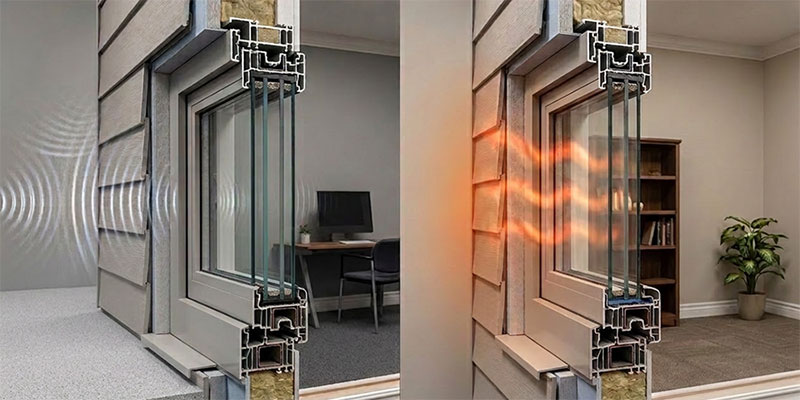
The acoustic and thermal performance of windows are not competing priorities. They are largely achieved through the same construction choices, meaning a window optimized for sound reduction will also deliver meaningful energy-efficiency gains.
Multi-pane construction increases the number of insulating barriers between the conditioned interior and the exterior environment. Each additional glass layer and gas-filled cavity adds thermal resistance (R-value). A standard double-pane argon-filled window achieves an R-value of approximately R-3 to R-4. A triple-pane acoustic unit with krypton fill and low-e coating can reach R-6 to R-9, depending on configuration.
Laminated glass also contributes to thermal performance. The PVB interlayer provides only marginal additional resistance, but more importantly, it blocks 99% of ultraviolet radiation, reducing solar heat gain and protecting interior finishes. In summer, this means less cooling load; in winter, it helps manage solar gain on south-facing elevations.
Energy-efficient windows certified to ENERGY STAR standards for the Northern Canadian climate zone must meet minimum U-factor and Solar Heat Gain Coefficient (SHGC) thresholds. Many acoustic window configurations meet or exceed these thresholds as a byproduct of their construction, meaning buyers often receive ENERGY STAR qualification without specifically targeting it. This qualification may also support eligibility for federal or provincial rebate programs, which can meaningfully offset the initial purchase cost.
The dual-purpose nature of acoustic glazing is one of the strongest arguments for the investment. Rather than addressing noise and energy separately, a single window replacement achieves both objectives simultaneously.
How Do You Choose the Best Soundproof Windows for Your Home?
Selecting acoustic windows requires balancing performance targets, budget constraints, and compatibility with the existing structure. The following guide outlines the key decision points in sequence.
Fibreglass frames offer good dimensional stability across temperature changes, but typically come at a higher cost and offer fewer advantages in everyday residential applications. Wood-clad frames provide visual appeal but entail ongoing maintenance and potential moisture-related vulnerabilities. Aluminum frames, while structurally strong, are highly conductive and generally underperform in both thermal and acoustic applications unless enhanced with complex thermal breaks.
Conclusion: Are Soundproof Windows the Right Investment for Your Home?
Soundproof windows are a well-engineered solution to a problem that affects a significant portion of Canadian homeowners, particularly those in urban centres, near transportation corridors, or in densely built neighbourhoods. Their value is clearest when noise is a consistent daily factor rather than an occasional nuisance, and when the occupants' work, sleep, or health is measurably affected by exterior sound.
The financial case is strengthened by the dual performance of acoustic glazing: the same construction that reduces noise also improves thermal efficiency, supports energy savings, and may qualify for government rebate programs. For homeowners who commit to the investment with professional installation and appropriate product selection, soundproof windows deliver returns across comfort, health, utility costs, and long-term property value.

Frequently Asked Questions
What STC rating do I need for my home near a busy road?
A: For homes adjacent to urban collector or arterial roads, a minimum STC rating of 45 is the practical starting point. For highways or roads with sustained heavy-vehicle traffic, targeting STC 50 — 55 will yield a more satisfactory result. The specific rating required depends on your baseline exterior noise level, which can be measured with a smartphone decibel meter during peak traffic hours.
Is there a difference between "soundproof" and "acoustic" windows?
A: These terms are used interchangeably in the consumer market, but neither is technically precise. No window is fully soundproof. "Acoustic window" is the more accurate term, describing a window engineered to provide measurably improved sound attenuation compared with standard glazing. Always evaluate by STC rating rather than marketing terminology.
Can I soundproof only specific rooms instead of replacing all windows?
A: Yes. A room-by-room approach is common and practical. Bedrooms and home offices are the most frequent priority. Acoustic inserts are a lower-cost option for targeted rooms, though full replacement units provide better long-term performance, proper warranty coverage, and energy efficiency benefits that inserts cannot match.
Do soundproof windows require special maintenance?
A: No, maintenance requirements are similar to standard quality windows. Annual inspection of weatherstripping and frame seals is advisable. The PVB laminate within the glass unit requires no maintenance. Keep tracks and sill pans clear of debris to prevent water infiltration that could compromise the frame seal over time.
Will soundproof windows also reduce heat loss in winter?
A: Yes, meaningfully so. Triple-pane acoustic units in particular offer thermal resistance values significantly higher than standard double-pane windows, making them relevant to energy performance beyond noise reduction. Many configurations qualify for ENERGY STAR certification under the Canadian Northern climate zone criteria.
How long does installation take, and is it disruptive?
A: A standard window replacement takes 30 — 60 minutes per window once the rough opening is prepared. A whole-home replacement of 15 — 20 windows is typically completed in one to two days. The process involves temporarily exposing the rough opening, so scheduling exterior work around forecast dry weather is advisable.
Do soundproof windows help with low-frequency noise like bass or truck engines?
A: Low-frequency noise is the most difficult to attenuate because longer sound waves pass more easily through building assemblies. Heavier glass, wider asymmetric air gaps, and mass-loaded configurations improve low-frequency performance, but no residential window eliminates it entirely. Triple-pane units with at least one thick laminated pane (6 mm or greater) provide the best available low-frequency performance in residential applications.
People Also Ask