

Brown window frames pair with more exterior materials than any other coloured finish because the colour family ranges from warm honey and walnut to cool espresso and mocha, but the frame shade alone does not determine whether the result looks coordinated or mismatched. The undertone of the brown, its relationship to the surrounding brick, stone, or siding, and the trim profile and colour chosen alongside it are the three variables that control the final appearance.
Since 2007, Window Force has produced brown frames in multiple undertones across our full product line — casement, slider, hung, awning, and picture windows— at an 80,000 sq ft Ontario facility, shipping each unit with the colour finish factory-applied to match the specific profile ordered. Our authorized dealers across Canada routinely walk homeowners through outdoor sample comparisons before an order is placed, so the undertone and trim pairing guidance in this article reflects the selection process our network uses on actual projects rather than theoretical colour theory.
Key Takeaways
- Brown window frames appear differently depending on undertone: warm browns pull toward red and orange, while cool browns lean toward grey, and matching that colour temperature to brick, stone, or siding is what makes the exterior look intentional rather than accidental.
- Trim is not a finishing touch on a brown window: width, profile depth, and colour contrast do as much to shape curb appeal as the frame colour itself.
- Whether trim should blend with or contrast against a brown frame depends on the scale of the facade, the amount of direct sun the elevation gets, and how much architectural detail is already present.
- Vinyl, composite, and aluminum-clad trim each entail different maintenance and climate trade-offs across Canadian winters and summers, and the right choice depends more on exposure and upkeep tolerance than on looks alone.
- A short pre-decision sequence, comparing samples outdoors, confirming trim profile against window size, and checking maintenance expectations, prevents most of the mismatches homeowners run into after installation.
Why Are Brown Windows Becoming a Popular Choice for Stylish Homes?
Brown has evolved from a secondary frame colour into one of the most popular choices for homeowners seeking a warmer alternative to white or black window frames. Unlike black, which reads as a strong architectural statement, brown frames soften a facade while still making window openings clearly defined against siding, brick, or stucco. That middle position is part of why the colour works across such a wide range of home styles, from a craftsman bungalow to a contemporary infill build.
The appeal is also practical. Brown frames generally hide dust, pollen, and water spots better than white frames, which matters for a material that sits outdoors year-round. According to Natural Resources Canada, windows, doors, and skylights can account for up to 25 percent of a home's total heat loss, and ENERGY STAR-certified windows perform about 20 percent more efficiently than the average window on the market. Frame colour has no bearing on that figure (glazing, spacer type, and installation quality do), which means anyone selecting brown for its appearance need not sacrifice performance to get it.
Benefits of Brown Window Frames
Brown frames offer three practical advantages beyond aesthetics. They mask everyday grime more effectively than lighter finishes, so the frame keeps a clean appearance between washings. They also tend to maintain a more consistent appearance over time and are generally more forgiving in photographs than very dark colours. Finally, the colour family is broad enough, spanning honey and walnut tones through espresso and chestnut, that most exterior palettes have a workable brown option rather than a single fixed shade.
Where Brown Works Best in Exterior Design
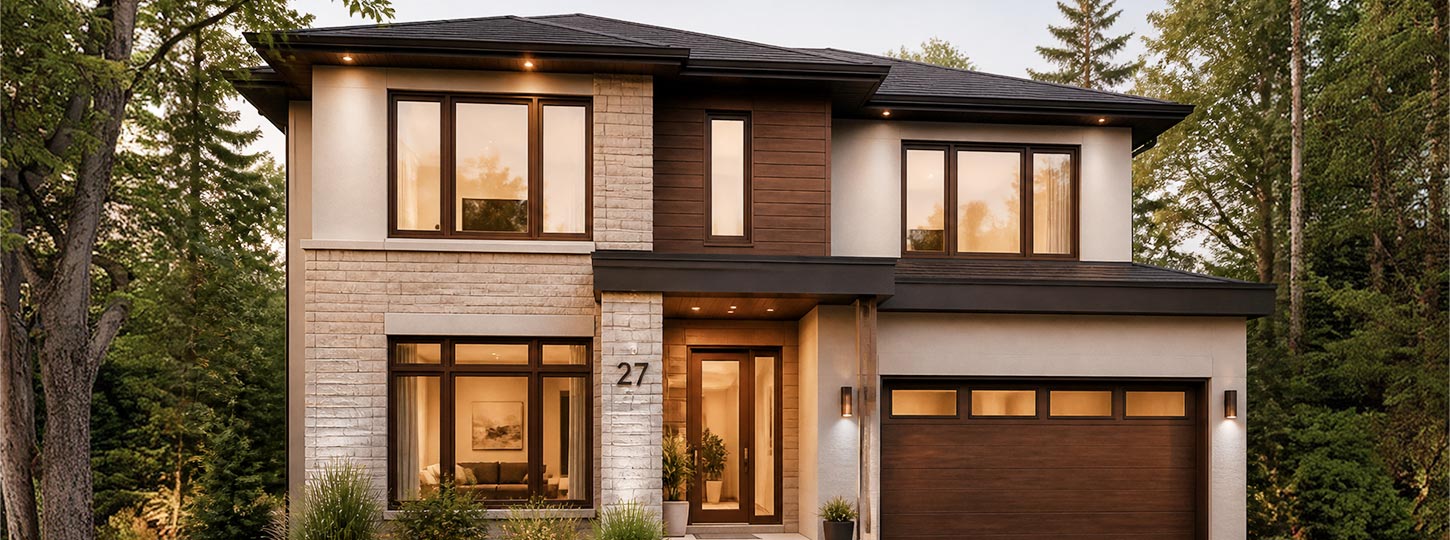
Brown performs most consistently on homes with visible natural materials: red or brown brick, stone foundations, cedar accents, or wood-look siding. It also suits homes where the goal is a warm, settled look rather than a high-contrast statement. On a light stucco or pale vinyl-siding home, a mid-tone brown frame creates enough contrast to define the window openings without the starkness of black trim against a pale wall.
“At our facility, dark frame colours are treated as a thermal engineering question from the beginning of the order, not just a colour preference. The UV stabilizer concentration we compound into an espresso or dark walnut profile is measurably higher than what a white or mid-tone frame requires, because a darker surface absorbs more solar radiation and the stabilizer package has to compensate for that additional thermal load across twenty Canadian summers. When a homeowner chooses brown for how it looks on the facade, the specification behind it is what determines whether it still looks that way in year fifteen,” explains Sergey Essipov, Production Engineer with 20 years of experience in window manufacturing. Dark and mid-tone finishes absorb more solar radiation than white, which places greater thermal stress on the underlying profile with every heating-and-cooling cycle. Window Force brown frames are extruded from lead-free uPVC with UV stabilizers engineered to resist the chalking and colour shift that untreated vinyl develops under sustained sun exposure, with every corner fusion-welded into a continuous joint rather than mechanically fastened — a construction detail that matters most on south- and west-facing elevations where the frame absorbs direct radiation for hours each day, because mechanically fastened corners develop microscopic gaps as the profile expands and contracts through temperature cycles, and those gaps are where moisture and UV degradation enter first.
Windows Near Me
What Design Advantages Do Brown Windows Offer on Different Home Exteriors?
The way a brown frame looks against a facade depends heavily on the colour characteristics of both the window and the surrounding material. A brown with a red or orange base will either harmonize with red brick or clash with it if the two undertones pull in different directions, while a cooler, greyer brown tends to sit more neutrally against most brick and stone.
Brown with stone. Fieldstone and limestone exteriors generally carry cool, grey-leaning tones, so a brown frame with a similarly muted, less orange undertone tends to blend more naturally. Warmer honey-toned browns can still work on stone homes, but they read as a deliberate contrast instead of matching directly, which suits a more rustic or farmhouse-style build.
Brown with vinyl siding. Light and neutral siding colours, such as cream, soft grey, or pale taupe, give a brown frame room to stand out as a defining architectural line. Because vinyl siding rarely has the textural variation of brick or stone, the frame colour does more of the visual work, which is why undertone matching matters even more on these homes.
The dominant siding palette also varies by region. A window company in Burlington works primarily with the soft greys and creams common in lakefront subdivisions, where a cooler espresso brown reads as intentional, while a vinyl window manufacturer in Brantford more often matches warmer walnut tones to the earth-toned siding prevalent in that market's newer developments.
Brown with wood-inspired exteriors. Cedar shakes, wood-look composite panels, and timber accents pair naturally with brown frames because both materials share the same colour family. The main risk with these exteriors is over-matching: when the frame and the wood accents are nearly identical in tone, the window openings can lose definition. A frame one or two shades darker or lighter than the wood accents keeps the opening legible from the street.
Which Window Trim Ideas Work Best With Brown Windows?
Trim style changes how a brown window reads even when the frame colour stays the same. A minimalist trim keeps the emphasis on the glass and the frame itself, while a bolder trim treatment turns the window into a standalone architectural feature.
Minimal trim ideas rely on a flat casing profile with little or no decorative moulding, which suits contemporary and transitional homes where the goal is clean lines instead of ornamentation. A flat stock trim in a colour close to the siding lets the brown frame become the primary design feature without competing details.
Statement trim ideas use a wider casing, a layered build-up, or a contrasting colour to turn the window into a focal point. This approach is especially effective on farmhouse and craftsman exteriors, where a chunkier trim profile is consistent with the rest of the home's detailing: deep window returns, exposed rafter tails, and similar architectural cues.
Clean vs. decorative trim is ultimately a matter of scale. Larger facades with more wall area between windows can absorb a decorative, multi-piece trim without looking busy, while smaller or closely spaced windows usually read better with a simpler profile. Window Force's vinyl exterior casing profiles are available in a colonial build-up with a rosette detail, as well as a flat casing option that covers both directions without requiring a custom millwork order.
How Do Exterior Window Trim Ideas Change the Look of a Home?
Regardless of the window itself, trim influences three key aspects of the home's appearance: how large the opening appears, how much shadow line the facade has, and how strongly the window reads against the wall.
A wider trim profile with more depth creates a visible shadow line that makes the window opening look larger and more substantial from the street, even when the glass size hasn't changed. Homes with smaller window openings often benefit from this effect, since the extra trim width compensates for the modest glass area.
| Trim Approach | Visual Effect | Works Best On |
| Narrow, flat trim | Subtle framing, minimal shadow line | Contemporary homes, smaller elevations |
| Medium colonial trim | Balanced definition, moderate shadow line | Traditional and transitional homes |
| Wide, layered trim | Strong shadow line, larger apparent window size | Craftsman, farmhouse, larger facades |
Contrast plays a similar role. A trim colour that's noticeably lighter or darker than both the siding and the frame creates the strongest definition, while a trim that closely matches the siding lets the brown frame itself carry the contrast. On facades that are already busy with brick detailing, stone accents, or multiple rooflines, a lower-contrast trim usually keeps the overall look balanced rather than adding another competing element.
Should Brown Windows Blend In With the Exterior or Create Contrast?
There isn't a single correct answer here; it depends on the home's scale, its sun exposure, and the amount of architectural detail already on the facade.
Homes with a lot of existing detail, such as multiple gables, stone accents, or decorative shutters, often look calmer with trim that blends closely with the siding, letting the brown frame provide the only real point of contrast. On simpler, flatter facades with fewer competing elements, a higher-contrast trim (a lighter cream or warm white against a darker brown frame, for example) adds architectural interest that the home would otherwise lack.
Planning your approach step by step:
- Stand across the street and count the distinct materials and colours already on the facade: siding, brick, roof, garage door, front door.
- If that count is three or more, lean toward blended trim; if it's one or two, contrast has more room to work.
- Check how much direct afternoon sun the elevation receives, since strong, consistent sun exposure tends to wash out subtle contrast; higher-contrast combinations read better on shaded or north-facing walls.
- Confirm the choice against a full-size sample outdoors before ordering, since paint chips and small swatches consistently look lighter and less saturated than the finished product.
A facade with too many competing high-contrast elements, dark frames, bright white trim, and a contrasting front door all at once tends to look busy rather than intentional. Picking one primary contrast point, whether that's the frame or the trim, usually produces a cleaner result than layering contrast everywhere at once.
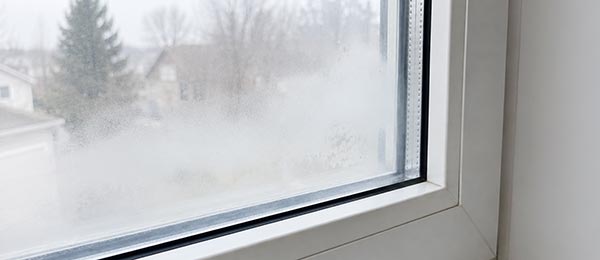
While the colour and trim decision shapes how the window looks from the street, the sealed glass unit behind the frame determines how it performs through Canadian seasons. Window Force pairs every brown-frame unit with a dual-seal, metal-free warm-edge spacer at the glass perimeter, reducing the edge-of-glass condensation that becomes visible sooner on darker frames because moisture droplets contrast more sharply against a brown surface than a white one.
What Trim Colours Pair Best With Brown Windows?
Trim colour selection comes down to matching undertone, not just matching lightness or darkness. Cream and off-white trims generally pair well with warmer, honey- or walnut-toned browns, while cooler, greyer browns sit more comfortably next to soft grey or taupe trim.
| Trim Colour | Undertone Match | Best Paired With |
| Cream / warm white | Warm | Honey, walnut, chestnut browns |
| Soft grey | Cool | Espresso, mocha, grey-brown tones |
| Taupe | Neutral | Most mid-tone browns |
| Bronze / dark metal accents | Warm-neutral | Darker espresso frames, modern facades |
| Charcoal | Cool-strong | Lighter honey or tan browns, for contrast |
Soffits and fascia should generally follow the trim colour rather than the frame colour, since they sit at the roofline and read as part of the home's overall trim package. Introducing a third distinct colour at the roofline, separate from both the frame and the main trim, usually adds visual clutter rather than cohesion.
Which Exterior Window Trim Materials Should You Choose?
Trim material affects maintenance far more than it affects appearance, since most materials can be finished to look similar from the street.
Wood trim offers the most flexibility for custom profiles and can be painted to match virtually any colour, but it requires the most upkeep in a Canadian climate: periodic repainting, caulking, and moisture monitoring, particularly on south- and west-facing walls. PVC and vinyl trim require little more than occasional washing and retain their factory finish for years without repainting, though colour options are typically limited to those the manufacturer offers. Composite trim splits the difference: it resists moisture better than solid wood while still accepting paint, at a higher material cost. Aluminum-clad trim wraps a wood or composite core in a metal shell, giving strong weather resistance with a lower long-term maintenance burden, though it carries the highest upfront cost of the group.
| Material | Maintenance | Moisture Resistance | Design Flexibility | Typical Cost |
| Wood | High (repaint every 3 — 5 years) | Moderate, needs sealing | Highest, any profile or colour | Lower upfront, higher lifetime |
| PVC / Vinyl | Low | High | Limited to manufacturer profiles | Lower |
| Composite | Moderate | High | Good, paintable | Moderate |
| Aluminum-clad | Low | Very high | Good, factory colour range | Higher |
Climate exposure should weigh into this decision as much as the budget. A window supplier in Winnipeg typically specifies PVC or composite trim as the default on exposed elevations because Manitoba's extreme freeze-thaw cycling punishes wood trim faster than the same profile would deteriorate in a milder climate such as Victoria's. Reserving wood trim, if desired, for the sheltered or less weather-exposed sides of the house is a practical compromise that balances aesthetics with local maintenance realities.
How Can Exterior Window Trim Ideas Improve Curb Appeal Without Overwhelming the Facade?
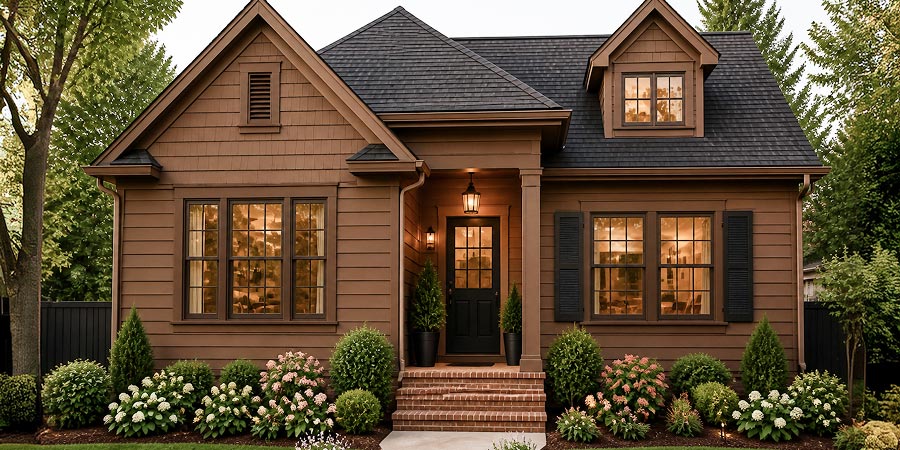
Trim width and repetition are the two variables most likely to tip a design from balanced into overdone. A single window with a bold, wide trim can be a strong feature; the same trim repeated across eight windows on one elevation often reads as heavy rather than intentional.
Choosing trim width should scale with window size and wall area; a rule of thumb many designers use is keeping trim width proportional to roughly one-eighth to one-tenth of the window's narrowest dimension, so a 36-inch-wide window suits a trim in the 3.5- to 4.5-inch range rather than something dramatically wider.
Keeping the design balanced means limiting the facade to a single dominant trim treatment rather than mixing several different widths or profiles on the same wall. Consistency across all the windows on an elevation reads as considered; variation window to window usually reads as unplanned.
Matching trim to exterior features, garage doors, entry doors, and shutters, if present, ties the whole facade together. Repeating the trim's colour or profile depth in at least one other exterior element provides the eye with a consistent reference point throughout the home.
What Mistakes Should You Avoid When Choosing Brown Windows and Trim?
The most common issues with brown window projects fall into three categories: colour mismatch, proportion errors, and material choices unsuited to the site.
Colour mistakes most often come from selecting a frame and trim colour from small swatches indoors rather than comparing them outdoors in daylight, where colour perception changes noticeably. A brown that looks neutral under indoor lighting can read distinctly orange or grey once installed and viewed in full sun. “The most common phone call our dealer network gets after installation is about a brown frame that reads differently on the wall than it did on the sample. Almost every time, the sample comparison happened indoors. A 2-inch chip under a showroom light tells you almost nothing about how that colour will look when it is three inches wide, running across an entire elevation, and being hit by afternoon sun at a low angle in late October. At our facility, we tell every dealer the same thing: show the homeowner a full-size frame section against the actual wall material, outside, in the same light the installed window will face. That single step eliminates most of the mismatch complaints we see,” notes Sergey Essipov, Production Engineer with 20 years of experience in window manufacturing.
Proportion mistakes happen when a trim profile scaled for a large facade gets applied to a smaller home, or vice versa: an oversized trim on a modest bungalow can make the whole elevation look top-heavy, while an undersized trim on a large facade disappears rather than framing anything.
Material mistakes typically involve choosing a finish or trim material without accounting for sun exposure. Peer-reviewed research on PVC window profiles has found that dark-coloured surfaces absorb significantly more solar radiation than light ones, and that repeated heating and cooling cycles on south- and west-facing exposures can produce measurable thermal deformation in unreinforced profile sections over time.
Design tip: before finalizing a spec, installers who work with dark and mid-tone frames regularly flag heavy sun exposure on an elevation as a reason to confirm the trim material is rated for the darker colour range, rather than assuming any finish will perform identically regardless of exposure or shade.
How Do You Choose the Right Trim Width and Profile for Your Window Size?
Trim sizing is one of the few parts of this decision that follows a fairly reliable formula rather than pure preference.
Trim sizing basics: narrow profiles, roughly 2 to 3 inches, suit smaller windows and contemporary facades where a subtle frame is the goal. Medium profiles, around 3.5 to 4.5 inches, work for most standard residential windows and traditional home styles. Wider profiles, above 5 inches, are generally reserved for larger picture windows, bay configurations, or facades with substantial existing architectural detail.
Profile depth, how far the trim projects from the wall surface, has as much architectural presence as width. A deeper profile casts a stronger shadow line and reads as more substantial even at the same width as a shallower option, which is why two trims of identical width can look quite different once installed.
| Window Width | Suggested Trim Width | Suggested Profile Depth |
| Under 30 inches | 2 — 3 inches | Shallow to moderate |
| 30 — 48 inches | 3.5 — 4.5 inches | Moderate |
| Over 48 inches/bay or picture windows | 5 inches or more | Moderate to deep |
Matching trim to window proportion also means checking the trim against the full window assembly, not just the glass, since a window with a wide brickmould already in place needs a different trim allowance than a window installed with a minimal jamb extension.
Can Brown Windows Work for Both New Builds and Renovation Projects?
Brown frames are equally viable on new construction and on renovations, though the practical considerations differ.
The installation method often has a greater effect on long-term window performance than the frame colour or material choice alone. Canadian standards such as CSA A440.4 emphasize that proper installation must address alignment, sealing, drainage, and integration with the surrounding wall assembly to maintain expected performance.
Brown windows in new homes allow the frame colour, trim, and siding to be planned together from the start, which avoids most of the undertone-matching issues that arise in existing homes. New-construction window frames, such as Window Force's Ultraslim Series, are also typically installed with a narrower visible profile, which changes how much of the frame colour is actually visible from the street compared with a bulkier retrofit frame.
Brown windows in remodels require matching or replacing existing trim, and renovators typically choose between three approaches: keeping the existing trim as-is if the colour still works with the new frame, repainting the existing trim to better match the new brown frame, or replacing the trim entirely when the existing profile is too narrow, damaged, or stylistically inconsistent with the new windows. In practice, those planning a phased renovation often achieve a more cohesive result by updating one elevation at a time, starting with the most visible facade and phasing the rest of the home over subsequent seasons, often get a more considered result than replacing every window and all the trim in one pass, since it allows the first installation to be evaluated in daylight before committing the rest of the home to the same choice.
Updating trim without redoing the whole facade is realistic when the existing trim is structurally sound; a fresh coat of exterior paint in a colour that complements the new brown frame can bridge the gap until a full trim replacement is planned.
Darker frames on sun-exposed walls undergo more aggressive thermal cycling than white ones, which makes dimensional stability a functional requirement rather than a spec-sheet detail. Window Force's multi-chamber profile design distributes thermal load across multiple internal walls within the frame cross-section, preventing the localized bowing that single-chamber profiles can develop after several seasons of repeated expansion on a west- or south-facing elevation. For a brown frame sitting in direct afternoon sun, that internal structure is the difference between a window that still closes and seals properly in year ten and one that has shifted enough to bind.
What Steps Should You Follow Before Finalizing Brown Windows for Your Home?
A short, deliberate process before ordering prevents most of the mismatches covered above.
Start by reviewing your home's exterior colours, including the siding, brick, roofline, and existing trim. Determine whether the overall palette leans toward warm or cool undertones, as this will narrow your colour options.
Next, compare window colour samples outdoors rather than relying on indoor lighting or online renderings. View them in both morning and afternoon light, since natural light can significantly change how brown finishes appear throughout the day.
Before making a final decision, consider the maintenance requirements of your chosen materials. Some trim materials require periodic repainting, while others offer a lower-maintenance solution that may justify a higher upfront investment.
Then, confirm that the trim style and width are proportional to your window sizes. A profile that works well on large picture windows may overwhelm smaller openings, while overly narrow trim can look out of place on larger façades.
Finally, make sure your selection aligns with both your budget and your home's architectural style. The most successful projects prioritize a frame and trim combination that complements the overall design rather than choosing colours that look attractive only as standalone samples.
Homeowners in Oakville working with established brick exteriors and those in Barrie planning a more rustic, wood-accented build often arrive at very different combinations by following this same process. That illustrates the key principle: the evaluation steps remain consistent, but the right choice depends on the character of each individual home.
What Should You Remember When Comparing Brown Windows, Trim Options, and Final Design Choices?
Brown windows offer long-term design flexibility because they complement a wide variety of architectural styles and exterior materials. The most successful projects come from viewing the window frame, trim, siding, and surrounding details as one coordinated design rather than making each choice independently.
There is no single "best" shade of brown or trim style for every home. The right combination depends on the character of the property, the desired level of contrast, maintenance expectations, and how all exterior elements work together. Taking a balanced, whole-home approach will almost always produce a more cohesive and timeless result than focusing on any single design feature in isolation.
Window Force manufactures brown-frame windows on a custom-to-order basis across our full product line, with the colour finish, trim profile, and glazing package specified per unit before production begins. Every unit is CSA-certified and ENERGY STAR® qualified across all Canadian climate zones, and the 25-year transferable warranty covers both the structural performance and the factory-applied finish. Our authorized dealer network coordinates the outdoor sample comparison, trim selection, and installation to the standard the warranty assumes — a single accountable chain from the production floor to the finished facade.
Frequently Asked Questions
Do brown windows cost more than white windows?
Colour finishing can add a modest premium over a standard white frame, since coloured and woodgrain finishes involve an additional production step. The difference is generally smaller than the cost gap between standard and custom window sizes or upgraded glazing packages.
Will a brown vinyl frame fade over time?
Quality factory-applied finishes are formulated to resist UV fading far better than field-applied paint, and most manufacturers back solid colour finishes with a defined warranty period. Confirm the specific fade warranty terms before ordering, since coverage can differ from the base window warranty.
Can I paint an existing white window frame brown instead of replacing it?
Field-painting vinyl is possible but carries real risk: standard paints are not formulated to flex with vinyl's expansion and contraction, and many manufacturers void the frame warranty if the factory finish is altered. A factory-applied colour finish on a replacement or new window avoids this issue entirely.
Do dark trim colours make a room feel smaller inside?
Trim colour is an exterior consideration and has no direct effect on interior room size, since most of the trim discussed here refers to the exterior casing rather than interior window trim. Interior sightlines depend far more on window size and interior finishes than on the exterior frame or trim colour.
How do I know if my brown frame and my brick have matching undertones?
Hold a sample of the frame finish directly against the brick in daylight rather than comparing them from a distance or under artificial light. If the brown frame looks distinctly more orange or more grey than the brick when held close, the undertones are likely to clash once installed.
Is brown a safe long-term choice, or does it risk looking dated?
Because brown spans such a wide range of undertones, from warm honey to cool espresso, it has remained in consistent use across multiple design eras rather than following a single short-lived trend, as some accent colours do. Choosing a shade that matches the home's existing materials, rather than chasing a specific current trend, is the more durable strategy.
People Also Ask