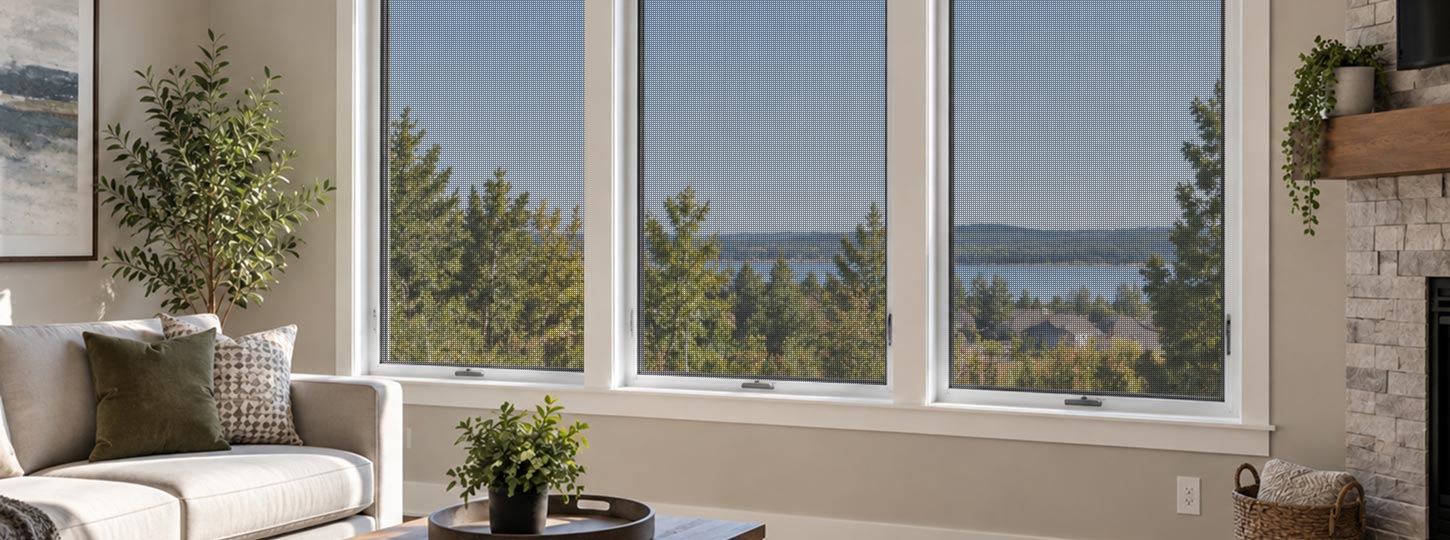


A window screen is a simple component, yet a poor fit lets insects through the gaps, a bent frame makes it rattle in its channel, and the wrong mesh dims the room or tears at the first push from a pet. Choosing well comes down to four points: which windows need a screen at all, what type and mesh suit each opening, how the screen is measured and held, and when a damaged screen is worth repairing rather than replacing.
On our production line, the screen isn't an accessory added at the end. The channel that holds it is extruded into the frame profile of every operable window we build, so its width, height and depth are set at the factory and recorded on each custom order before the unit ships through our authorized dealer network. Working that way since 2007 at our 80,000 sq ft Ontario plant, we see firsthand how the sash style of each window decides where its screen sits, how it is held and how much of the opening it needs to cover, and this guide follows the same sequence our dealers use: decide which sash needs a screen, match the frame and mesh to the opening, then measure and fit.
Key Takeaways
- A window screen is a mesh held in a frame by a spline; it lets air through and stops insects and debris, but it is not a lock, a child barrier or a weather seal.
- Only a sash that opens needs an insect screen, and an insect screen on a window that stays closed simply costs light and view.
- Fixed-frame, retractable and stock adjustable screens differ in fit, view and storage, and a half screen is enough when only part of the sash opens.
- Mesh choice is a trade-off: a tighter weave stops smaller insects but lets in less air and offers a less clear view, while solar screens control sun rather than blocking fine insects.
- Measuring the channel rather than the glass, and recording depth as well as width and height, prevents most fit problems.
- A tear in a straight frame is a repair, while a bent frame, loose corners or a missing screen call for a replacement screen, which is still a far smaller job than a new window.
What Do Window Screens Actually Keep Out?
A window screen consists of woven mesh stretched across a lightweight frame and secured in a perimeter groove, usually with a spline. The frame, mesh and mounting hardware work together to keep the screen in place and close gaps around the opening. Everything else about a screen, from the weave to the frame profile and the holders, exists to perform that one task without gaps.
The screen is a separate component from the rest of the window. The sash is the moving part of the window that carries the glass and opens and closes, and the glass is the sealed glazing inside it. The screen sits in its own channel in the frame, in front of or behind the sash, and plays no role in the window's thermal or structural performance. When the sash is closed, the glass and the weatherstripping do the work, and the screen only affects how much light and view come through.
The limits matter as much as the function. A screen is not a lock, because it lifts or pushes out of its channel with little force. It is not a child barrier, since the mesh and holders are designed to resist wind and insects rather than a person's weight. It is not a weather seal either, because rain, wind-driven snow and cold air pass through the mesh freely. A homeowner who treats the screen as an insect barrier only and relies on the sash, the lock, and proper opening controls for everything else will choose and maintain screens correctly.
The screen is also separate from the window's weather seals and insulated glass unit. Weatherstripping between the sash and frame limits air and water infiltration, and the sealed edge of the glass unit keeps moisture out of the cavity between the panes; Window Force builds every unit with a dual-seal, metal-free warm-edge spacer for that purpose. Neither depends on the screen, so a missing or damaged screen doesn't affect the window's thermal performance.
Windows Near Me
When Does an Operable Window Need a Screen?
A screen is useful on an operable sash when you open the window for ventilation and need insect protection. A fixed pane doesn't need a screen because it cannot be opened, and a sash that is rarely or never opened may not need one either. The decision follows from insect and debris pressure, not from insulation or security, since a screen adds neither.
The practical questions for each operable window are straightforward:
- Will this sash be opened regularly during the insect season?
- Does the room face vegetation, standing water or a garden that attracts insects?
- Is the window near a source of debris such as trees, a lawn or a construction site?
- Does the room depend on natural ventilation, as bedrooms and kitchens often do?
Regional conditions shift the answers. Public health guidance treats screens as basic mosquito control: the Government of Nova Scotia advises residents to ensure door and window screens have no holes and fit tightly as part of protection against West Nile virus. A homeowner ordering through a window supplier in Ontario, where humid summers and lakes, wetlands and river valleys produce a long mosquito season in many communities, will usually want screens on every operable sash in bedrooms and living areas.
The opposite case also deserves attention. A screen left on a window that is never opened, for example, a basement awning kept closed or an upper sash in a hung window that stays shut, only reduces daylight and blurs the view. Removing and storing those screens costs nothing and brings more light into the room.
What Changes Across Types of Window Screens?
The main types of window screens differ in how the frame sits in the opening, how much view it blocks when it is not needed, and where it goes when the season ends. The mesh can be the same in each, so the decision mostly comes down to the frame and how you use it.
| Screen type | Fit | View when not in use | Storage |
| Fixed-frame screen, built to the channel | Exact fit to one opening, no gaps at the edges | Stays in place and always covers the opening | Removed and stored flat off-season, or left installed all year |
| Retractable (roll-away) screen | Runs in side tracks fitted to the opening; fit depends on accurate installation | Rolls into a cassette, leaving the opening clear | Stores itself in the housing |
| Stock adjustable screen | Slides to fit a range of openings; edge gaps are common | Usually removed when not needed | Removed and stored |
What Does the Window Screen Frame Have to Match?
The window screen frame must match the channel it sits in on three dimensions: width, height and depth. A fixed frame built to the measured channel matches all three dimensions and helps close perimeter gaps that could let insects through, which is why it remains standard on many operable windows. A retractable screen trades a little precision for a clear view when the screen is rolled away, and it suits wide openings, frequently opened windows, and situations where the view matters more than storage space. A stock adjustable unit matches only a range of sizes, so it fits a temporary, rented or unusual opening but rarely closes every gap along the edges.
The frame profile must also suit the holders in the opening. A fixed screen designed for tension springs will not stay in a channel built for plunger pins, and a screen meant to sit inside a casement window will not mount on the exterior of a sliding window. The frame type therefore follows the window itself, not just preference.
Frame material matters as much as frame size. Most residential screen frames are aluminum, either roll-formed from thin strip, which is light and inexpensive but bends easily when you carry or remove a large screen, or extruded, which is thicker, stays straight on wide openings, and holds its corners tight longer. Vinyl screen frames are also available, but they flex more on large sizes. On any frame, the corner keys that join the four sides are the usual weak point: once they loosen, the frame goes out of square even when the mesh is still intact.
Engineer Sergey Essipov, with 20 years of experience in window manufacturing, explains:
A screen only fits well if the channel it sits in stays square. Because our frame corners are fusion-welded into one piece, the channel does not rack out of square the way a mechanically joined frame can after years of thermal movement, so a screen built to the original channel dimensions keeps fitting. When a screen starts to bind in one corner and rattle in the other, check the screen frame first: loosened corner keys are the usual cause, not the window.
Screen channels on lower-grade vinyl frames often chalk, soften and distort after years of direct sun, and a channel that has changed shape will not hold a screen built to its original dimensions. Window Force frames are extruded from lead-free uPVC compounded with UV stabilizers, which keep the profile from degrading on south- and west-facing walls where screens see the most sun. The channel measured on installation day stays the channel the screen has to fit years later.
When Is a Half Screen Enough?
A half screen covers only the part of the opening that the sash actually exposes. On a single-hung window, only the lower sash moves, so a screen over the lower half provides full protection while leaving the fixed upper glass unobstructed. On a horizontal sliding window, the screen covers only the operable half.
A full screen makes sense only when the full opening can be exposed, as on a double-hung window where the upper sash also lowers for ventilation. Limiting the mesh to the part of the window that opens keeps more glass clear and reduces the screen size that must be stored and maintained.
Engineer Sergey Essipov, with 20 years of experience in window manufacturing, notes:
Many screen problems start with a mismatch between the frame and the window channel. Measuring the channel and identifying the correct mounting hardware before ordering helps prevent gaps, rattling and installation problems. A properly fitted screen should stay securely in place during normal use.
Which Window Screen Mesh Fits the Opening?
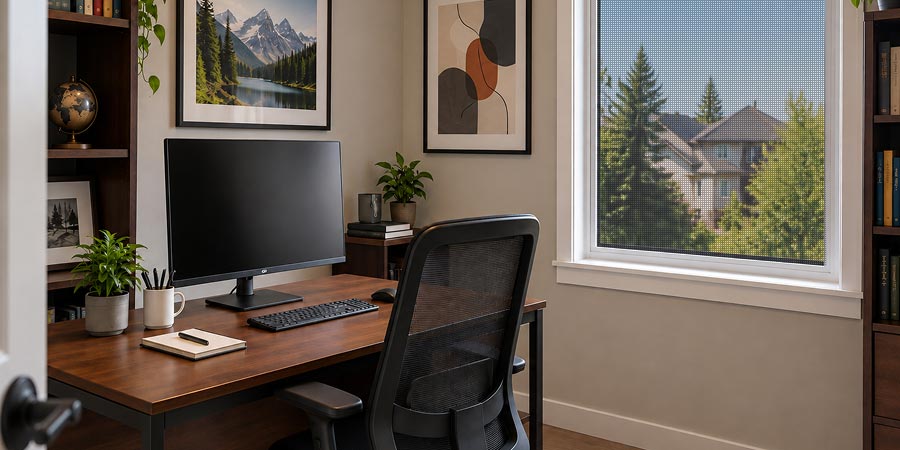
Window screen mesh is chosen by balancing three properties that pull against one another: how small an insect the weave stops, how much air it lets through and how clearly the view reads through it. Every step toward a tighter or heavier cloth improves one of these and costs some of the others.
What Does a Standard Weave Stop?
Standard residential insect mesh is typically woven at around 18 by 16 strands per inch, which stops flies, mosquitoes and most flying insects. A tighter weave, often sold as 20 by 20, also stops very small insects such as biting midges, but it also reduces airflow and makes the view noticeably less clear.
| Mesh material | Strengths | Limitations | Typical use |
| Fibreglass | Flexible, does not corrode, easy to install and re-screen | Tears more easily than metal under a sharp impact | Most residential windows |
| Aluminum | Stiffer and more puncture-resistant, holds its shape | Dents and creases permanently; can corrode in salt air | High-contact openings away from the coast |
| Heavier vinyl-coated polyester ("pet" mesh) | Resists claws and pushing, much stronger than standard cloth | Thicker strands reduce view and airflow | Low windows and openings where pets lean on the screen |
Climate influences the material as much as the insect load. Near salt water, a homeowner working with a window supplier in British Columbia on a coastal property will generally avoid aluminum mesh because salt air corrodes it, and use fibreglass instead.
Several specialty meshes sit outside these three common types. High-transparency mesh uses thinner strands to keep the view clearer than standard fibreglass, but with lower tear resistance. Stainless steel and bronze mesh resist corrosion and impact, which suits coastal homes where aluminum fails, but cost noticeably more. Pollen screens use a very fine fabric that traps much of the airborne pollen for allergy sufferers, with a clear loss of airflow. Reinforced security screens, built from heavy stainless steel mesh in a rigid frame, are a separate product designed to resist forced entry, unlike any standard insect screen.
Airflow through any mesh also falls over time. A field study published in CSIC's Spanish Journal of Agricultural Research measured insect-proof screens after three to four years of service and found that their porosity had fallen by 26.8% in total: about 6.5% from deterioration of the threads and about 20.3% from dirt accumulated in the pores, with lower ventilation rates as a result. Although the screens studied were agricultural, the same mechanism likely applies to residential insect mesh. Dirt in the weave caused most of the loss, so regular washing restores much of the airflow, and a finer weave with smaller openings is likely to clog sooner than standard mesh.
When Are Solar Window Screens a Different Product?
Solar window screens are shade cloth, a dense woven fabric designed to absorb or reflect some incoming sunlight before it reaches the glass. They fall under sun control, alongside awnings and exterior blinds, rather than insect screening. Their purpose is to reduce heat and glare on exposed west- or south-facing windows, and that density inevitably reduces daylight and view.
Don't choose solar screens for clearer or finer insect screening. Because the cloth is denser, it passes noticeably less air than standard mesh, and it is usually mounted on the exterior of the window, even on window types where the insect screen sits inside. A room that overheats in the afternoon and also needs ventilation may need both products, each doing its own job.
What Drives Window Screen Cost?
Window screen cost depends on a short list of factors, most of which are set by the opening rather than by the homeowner's preference:
- Opening size: larger screens need longer frame sections, more mesh and, past a certain size, a reinforcing cross-bar to keep the frame straight.
- Mesh grade: standard fibreglass costs the least, while aluminum, heavier pet mesh and solar cloth cost progressively more.
- New frame versus new spline in the old frame: re-screening a straight existing frame with new mesh and spline uses far less material than building a new frame.
- Custom fit versus a stock adjustable unit: a screen built to one channel takes measurement and fabrication, while a stock adjustable unit is produced in volume for a range of sizes.
- Number of screens in the order: setting up to measure and build one screen takes nearly as long as setting up for several, so per-screen cost generally falls as the order grows.
- Who does the work: a homeowner re-screening at home pays only for materials and tools, while a screen shop or installer adds labour and, where needed, a site visit.
Screens are frequently supplied with new windows rather than ordered separately, so when they are part of a larger project, it is worth confirming whether they are included in the quote. Window replacement companies don't always list screens as a separate line item, and asking early helps you avoid discovering a missing screen after installation.
How Do You Measure for Window Screens?
The order of measurement matters as much as the numbers. Measuring for window screens means measuring the channel that holds the screen, not the glass, which is always smaller and can cause the screen to fall out of the opening. Where an old screen is still present and fits well, the outside edges of its frame provide a useful cross-check.
A custom screen must be sized to fit the specific channel, with enough clearance for the frame to slide into place and sit securely without binding. The required deduction from the channel measurements depends on the screen system and its mounting hardware, so follow the supplier's measuring instructions. Recording the smallest width and height protects against frames that are slightly out of square, while the depth measurement prevents the most common fit problem: a screen that fits the opening but rattles in a channel that is deeper than its frame.
Because Window Force manufactures each unit to order, the original order records can help authorized dealers identify the screen channel dimensions when a replacement is needed. This is particularly useful when the original screen is missing or no longer fits.
How Does a Screen Lock Into the Opening?
A screen stays in place with holders fixed to its frame or the window, and the holder must suit the channel. The common types are the following:
- Tension springs: flat leaf springs on one edge of the frame compress as you push the screen into the channel, pressing it against the opposite side.
- Plunger pins: spring-loaded pins on the frame edge retract when pulled and extend into holes or a groove in the window frame.
- Clips and turn buttons: small fasteners on the window frame that rotate or snap over the screen frame edge.
- Gasket or spline-mounted interior screens: on casement and awning windows, the screen frame often presses into the interior channel with a compressible edge or is held by clips on the inside of the frame.
If a screen rattles, slides or falls out, check the frame depth and mounting hardware first. Replace or adjust the incompatible components rather than tightening the mesh, which does not secure the frame in the channel. A frame thinner than the channel will move with every gust of wind, and a screen built for one holder type will not stay put in a channel designed for another. Pulling the mesh tighter, adding tape, or forcing the screen deeper into the channel will not tighten a loose fit, because the mesh doesn't hold the frame; it can only distort the frame or pull the spline out of its groove. The correction is a frame of the correct depth or the correct holder for the channel.
When Is Window Screen Repair Enough?
Window screen repair is enough when the damage is limited to the mesh or the spline, and the frame is still straight, its corners are tight, and it still springs into the channel as it should. In that case, reuse the frame and replace only the cloth and the spline that holds it.
The work follows a fixed order:
The new spline has to match the groove. Splines are sold in several diameters that differ by fractions of a millimetre: one that is too thin lets the mesh pull free, and one that is too thick will not seat or will bow the frame inward. Besides the spline and mesh, the job needs a spline roller, a utility knife, and a flat work surface; clamping or weighting the long sides of the frame keeps them straight while the mesh is tensioned.
A self-adhesive patch over a small hole is a reasonable stopgap, but it is temporary on a hole a pet will hit again, because the same claws or the same push will tear the patch or the mesh beside it. Where a dog or cat regularly leans against a particular screen, re-screening that frame with a heavier pet mesh is a more lasting repair than a series of patches.
When Is Window Screen Replacement the Smaller Job?
Window screen replacement is the right choice when the frame itself has failed, or when there is no frame to repair. The usual triggers are the following:
- The frame is bent or bowed and no longer lies flat.
- The corner keys have loosened, so the frame racks out of square.
- The screen is missing, has been lost or was never supplied.
- The old unit no longer enters the channel or no longer holds once it is in place.
A new screen is a small job compared with anything involving the window itself. It is not a new window and does not touch the sash, glass, or frame, so the cost and disruption are limited to a single component. The steps are short: measure the channel as described above, build or order a screen to that opening, and install it with the existing holders on the window.
The distinction matters when a screen problem is mixed up with a window problem. A sash that will not close, fogged glass, or a soft frame is a separate issue, and the window replacement cost that comes with it belongs to a different decision than the price of a missing screen.
How Does Screen Placement Change With the Window Type?
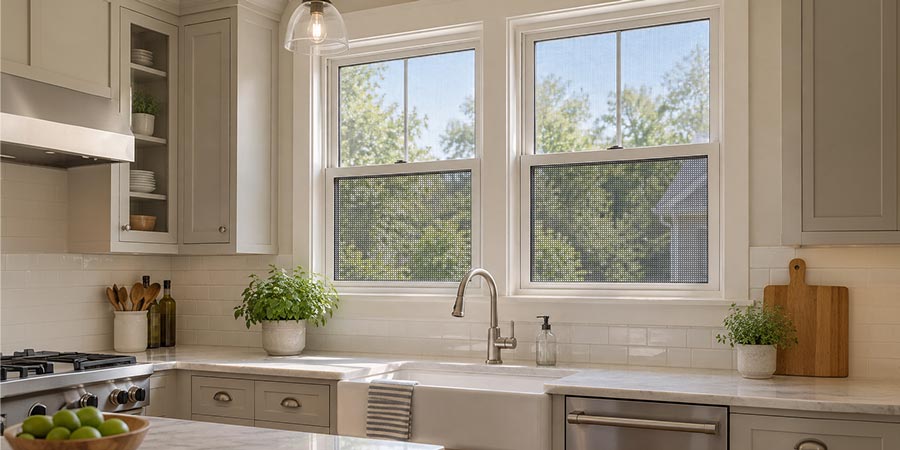
Screen placement follows the way the sash moves. When the sash swings outward and is operated from the room, the screen sits inside; when the sash slides within the frame, the screen sits outside. On many common vinyl window systems, outward-opening casement and awning sashes use interior screens, while sliding and hung windows commonly use exterior screens. The exact position depends on the window design and screen-mounting system. Inward-opening sashes reverse the rule: on tilt-and-turn windows and inward-opening French windows, the sash swings into the room, so the screen sits on the exterior, usually as a fixed frame, a pleated (plissé) screen, or a retractable roll screen.
| Window type | How the sash opens | Screen position | Half or full screen |
| Single-hung | Lower sash slides up | Exterior | Half, over the lower sash |
| Double-hung | Both sashes slide | Exterior | Full, if the upper sash is lowered for ventilation |
| Sliding | One or both sashes slide sideways | Exterior | Covers the operable sash |
| Casement | Swings outward on side hinges, operated by a crank | Interior | Full |
| Awning | Swings outward on top hinges, operated by a crank | Interior | Full |
| Tilt-and-turn / inward-opening | Swings into the room on side hinges, or tilts in at the top | Exterior | Full, or a pleated or roll screen |
On casement and awning windows, the crank operator and the lock are mounted on the interior frame, so they must remain within reach once the interior screen is in place. A wicket is a small hinged opening in the screen that lets you access a handle, latch, or other hardware without removing the entire screen. Whether you need one depends on the window hardware's position and the screen system's design. On most modern casement windows, the operator sits below the screen, so a plain screen without a wicket is the simpler and tighter choice.
Which Mistakes Make the Same Screen Fail Again?
A replacement screen that fails like the one before it usually repeats one of a short list of mistakes:
- Measuring the wrong part of the window or overlooking channel depth, which can leave the screen loose or prevent it from fitting.
- Bridging a tear with tape, which peels in sun and rain and leaves a larger tear behind.
- Painting the mesh, which clogs the openings, stiffens the cloth and cuts airflow.
The most serious misunderstanding concerns what a screen can hold. The City of Calgary states plainly that window screens do not prevent falls. Screens give way under very little force, and the same page recommends window opening control devices that restrict the opening to four inches. Even heavier insect mesh is not a substitute for window-opening controls or guards designed to reduce fall risks, and you should not rely on it as a security barrier.
Safety also works in the other direction. A bedroom window that serves as an emergency exit must open fully from the inside without tools or special knowledge, so you should be able to remove the screen by hand from inside the room. Interior casement screens and screens held by tension springs or plunger pins meet that need; a screen fastened with screws or fixed clips does not.
Who Should Order a Measured Screen, and Who Can Stop at a Stock Unit?
A stock adjustable screen suits a short-term need or an odd opening, such as a rented home or a window that is rarely opened, because it covers a range of sizes without fitting any one channel exactly. A measured screen is built for one channel and seals its edges, so it is the better choice for any window opened regularly through the insect season.
Before ordering, confirm the mesh requirements, the condition of the existing frame, the channel dimensions and mounting system, and whether the sash swings outward, swings inward or slides. A custom screen is preferable when a close fit is important, while a stock adjustable unit may be adequate for a temporary application.
Conclusion: How to Choose the Right Window Screen for Each Window
A well-chosen window screen should do more than keep insects out. It needs to fit the window opening properly, stay securely in place during everyday use and provide the right balance of airflow, visibility and durability for the room. Mesh type, frame material, dimensions, and mounting hardware all affect performance, so choosing based on appearance or price alone can lead to a poor fit and unnecessary replacements.
The best choice depends on how the window is used, the conditions around the opening and the state of the existing screen. A damaged mesh does not always require a new frame, while a bent frame or incompatible mounting hardware may make replacement the more practical option. Matching the screen to the window helps maintain insect protection, comfortable ventilation and a clear view without replacing components that are still in good condition.
Window Force builds its windows to order at its 80,000 sq ft Ontario plant, with the screen channel extruded into the frame profile of each operable window. The frames are made from lead-free uPVC with UV stabilizers in multi-chamber profiles, every corner is fusion-welded so the channel stays square, and the units are CSA certified. Window Force is an ENERGY STAR Partner whose windows are engineered to meet ENERGY STAR requirements, and the 25-year transferable warranty applies to the frame, sash and hardware. Need the screen channel details for a Window Force window, or planning new custom vinyl windows? Send a request through our website, and an authorized dealer will help identify the channel and screen details for your windows, confirm what a window quote includes, and give you the production timeline for units built to your openings.
Frequently Asked Questions
Do window screens reduce energy efficiency?
A standard insect screen does not provide meaningful insulation or replace the window's air seals. However, it can slightly reduce daylight and alter the amount of solar heat reaching the glass. The effect depends on the screen material and weave.
Should window screens be removed in winter?
Removing screens from operable windows in winter lets more daylight and low-angle winter sun through the glass and protects the mesh from ice and snow. Screens left in place are usually not harmed, but they collect dirt and ice and slightly reduce light. Before storing screens, wash and dry them, label each one with the window it came from, and keep them upright or flat with nothing resting on the frames.
What mesh keeps out the smallest insects?
A tighter weave, often sold as 20 by 20 strands per inch, stops smaller insects such as biting midges that pass through standard mesh. It also reduces airflow and view, so it is best reserved for rooms or locations where small insects are a real problem.
How often should window screens be cleaned?
Clean at least once or twice a season with a soft brush, mild soap, and a gentle rinse. Dirt that collects in the weave reduces the mesh's open area and airflow, so regular cleaning keeps the screen performing as intended. Screen care also fits into a wider routine for the frame, seals and hardware, covered in our window maintenance tips.
Can a screen be installed on a fixed window?
You can install a standard insect screen on a fixed window, but it usually offers little practical benefit because the pane doesn't open. It may reduce light and clarity without providing ventilation. Solar screens are different because they can help control sunlight and glare.
Why does my screen rattle in the wind?
A rattling screen is usually thinner than the channel it sits in, or is held by the wrong type of holder. The fix is a frame of the correct depth or the correct holder for that channel, not tightening the mesh.
People Also Ask