

A retractable screen door is a mesh panel housed inside a spring-loaded cassette that mounts to a door or window frame, pulls across the opening when needed, and rolls back out of sight when it is not. Unlike a fixed hinged screen door, it does not occupy the opening permanently and does not compete with the architecture of the entryway. That distinction matters more than it sounds — it changes how the screen wears, how long the mesh lasts, and how the system behaves through Canadian freeze-thaw cycles. Most homeowners who contact us for a quote assume a screen is a screen. It is not. The cassette material, the mesh grade, the track alignment on an uneven door frame — each of these determines whether the unit still operates smoothly after two winters or starts jamming by the second spring.
Every retractable screen ultimately depends on the frame it mounts to, and that interface is something Window Force engineers into each window and door unit before it leaves the production line. Since 2007, we have manufactured custom vinyl windows and patio doors at our 80,000 sq ft Ontario facility and coordinate installations through an authorized dealer network across Canada, so the frame tolerances, mounting surfaces, and seasonal movement patterns discussed in this guide are conditions our team documents on every order rather than estimates taken from industry averages.
Key Takeaways
- Retractable screen doors roll into a slim cassette when not in use, so there is no fixed frame permanently blocking the doorway or the view.
- A properly sealed retractable screen provides the same insect protection as a fixed screen, but only if the mesh fits flush against the frame with no gaps.
- Three configurations exist for residential use: door screens for daily entry traffic, patio screens for wide openings, and window screens for openings where a fixed frame would obstruct the glass.
- Installation quality, not just product quality, determines how the screen performs; the most common failures trace back to inaccurate measurement or uneven tracks rather than the hardware itself.
- Mesh grade and spacer or track material both affect how a screen holds up through Canadian freeze-thaw cycles, and homeowners should compare these details rather than assume one screen equals another.
- Retrofitting an existing door or window opening is standard practice in Canada and does not require replacing the window or door itself.
What Is a Retractable Screen Door and How Does It Work?
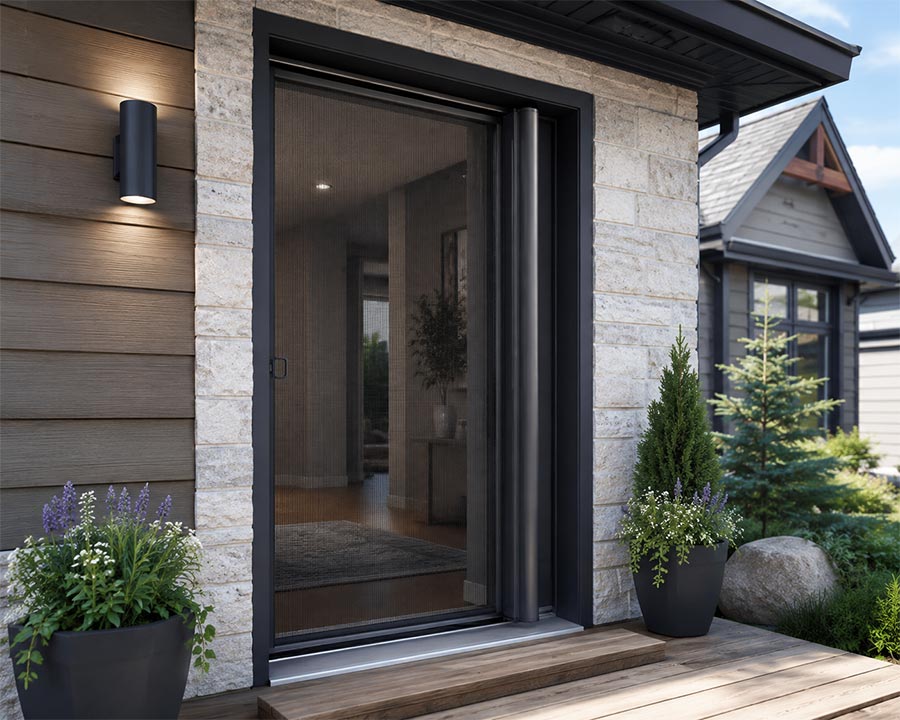
A retractable screen door is a screen panel inside a spring-loaded cassette mounted to the side, top, or bottom of a door or window frame. Pulled across the opening, the screen locks into a track on the opposite side; released, it retracts back into the housing under spring tension. The result is insect protection that exists only when it is needed, instead of a fixed frame that sits in the doorway year-round.
This distinguishes retractable screens from traditional hinged screen doors, which remain mounted in the opening at all times and are subject to constant sun, wind, and physical wear. Because the mesh spends most of its life protected inside the cassette, a retractable unit tends to show less UV degradation and fewer dents or tears over a comparable number of years in service.
Main Components
The system relies on four core parts working together: the cassette housing, which contains the tensioned roller and protects the mesh when retracted; the mesh panel itself, typically fibreglass or polyester weave; the guide track, which runs along the top and bottom (or side) of the frame to keep the mesh aligned; and the pull bar or handle, which the mesh locks into for a sealed fit. Hardware quality in the roller mechanism and track largely determines how smoothly the screen operates over years of daily use.
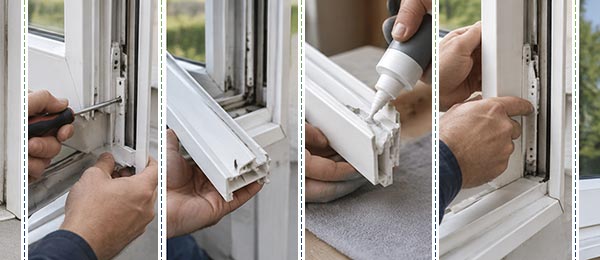
A detail that rarely appears in screen product literature is how much the mounting frame's dimensional stability affects the track alignment over time. Vinyl frames that lack internal reinforcement or use single-chamber extrusions can shift enough through seasonal thermal cycling to pull the guide track out of true, even if the screen hardware itself is rated for the temperature range. Window Force builds its door and window frames with multi-chamber uPVC profiles and fusion-welded corners, which means the mounting surface a screen cassette anchors to holds its geometry through expansion and contraction cycles rather than gradually drifting out of square.
How the System Opens and Closes
Opening the screen means drawing the pull bar across the opening until the screen locks into the receiving track or magnetic strip on the opposite jamb. Closing it is a release, not a pull: a light tug on the handle disengages the lock, and the spring-loaded roller draws the mesh back into the cassette automatically. A correctly tensioned unit requires only one hand to operate and should retract cleanly without bunching against the housing.
| Component | Typical Material | Function |
| Cassette housing | Aluminum or reinforced vinyl | Stores the mesh and protects it from weather when retracted |
| Mesh panel | Fibreglass or polyester weave | Provides insect protection while allowing airflow |
| Guide track | Extruded aluminum | Keeps the mesh aligned and sealed against the frame |
| Pull bar/handle | Aluminum with weatherstrip edge | Locks the mesh into place and seals the opening |
Windows Near Me
Why Are Retractable Screens Becoming a Popular Choice for Modern Homes?
The appeal is largely about what a retractable screen does not do: it does not sit in a doorway competing for visual space, and it does not require homeowners to choose between an open view and open air. For entryways where curb appeal matters, or for patio doors where an unobstructed sightline to the backyard is part of the point, a screen that disappears when not deployed solves a real design tension that fixed screens never fully address.
There is also a seasonal-use argument behind the trend. According to Natural Resources Canada's guidance on home cooling, running central air only when natural ventilation is inadequate, and relying on airflow through the house during cooler periods, is an effective way to manage indoor temperature without added energy cost. A retractable screen makes that strategy practical on a daily basis, since a homeowner can open a door for a cross-breeze in the evening and retract the screen out of the way once the house has cooled, without leaving the opening unprotected in between.
Design Benefits
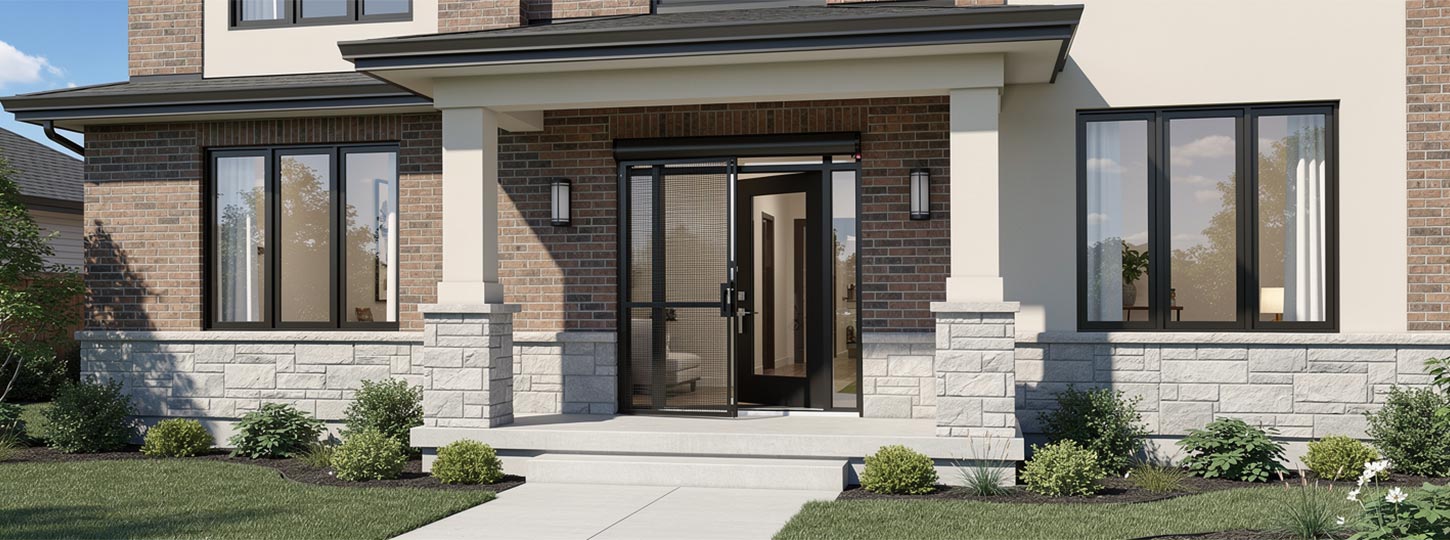
A retracted screen leaves the door or window opening visually clean, with no permanent mesh panel, hinge hardware, or frame competing with the architecture of the entryway. This matters most on higher-end front doors and on patio or garden doors where the opening is a design feature in its own right, not just a functional passage.
Lifestyle Advantages
Beyond appearance, the day-to-day advantage is flexibility. A household can leave a door screen retracted through the cooler shoulder seasons and deploy it only through the warmer months, or open it for a few hours each evening rather than living with a screen in place around the clock. Pet owners and families with young children moving in and out of the house also benefit from a mechanism that opens and closes in seconds rather than a hinged door that must be propped or held.
Where Can a Retractable Screen Door Be Installed in a Home?
Retractable screens are not limited to the front entry. Any opening where a homeowner wants airflow without a permanently fixed screen is a candidate, provided the frame and opening size fall within standard hardware ranges or can accommodate a custom cassette.
Common locations include front entry doors, back and side doors, sliding patio doors, French and garden doors, and larger deck or balcony openings. Casement and other operable windows can also take a retractable window screen where a fixed exterior screen would interfere with cleaning or block part of the view when the window is closed. Homeowners still deciding which window type suits each opening can review the full range of available window styles and configurations before confirming which screen type will fit. Homeowners comparing screen placement against their existing casement windows should note that the swing direction and hardware clearance of the window affect which screen configuration will fit without interference.
Single-Door Openings
A single-door opening is the simplest and most common installation: one cassette, one mesh panel, one track run across the doorway width. This configuration suits most front entries, back doors, and single sliding patio doors, and it is generally the most straightforward to retrofit onto an existing frame.
Double-Door Openings
French doors and wide double-patio configurations require two independent screens, each retracting into its own housing on the opposite jambs and meeting at the centre of the opening. This setup demands tighter tolerances, since the two panels have to align precisely where they meet or the seal fails at the centre seam, and it is the configuration most likely to need professional measurement and fitting rather than a do-it-yourself approach.
How Does Retractable Screen Door Installation Actually Work?
Installation looks simple from the outside: a cassette on the jamb and a track on the sill, but the sequence has to be followed precisely for the screen to retract smoothly and seal properly for years instead of only a few months.
Pre-Installation Checks
Before any hardware goes up, the installer measures the opening at multiple points, confirms the frame is square using a level, and checks that the mounting surface is solid enough to anchor the cassette securely. Skipping this step is the single most common source of problems that surface weeks or months after installation, once temperature fluctuations expose any misalignment that was not caught at the outset.
Installation Steps
A standard installation follows a defined order: mounting the cassette housing plumb and level, installing the guide rail along the sill or jamb, threading the mesh and pull bar into the track, adjusting spring tension so the screen retracts cleanly without bunching, and running a full open-close cycle test before the job is considered complete.
Engineer Sergey Essipov, with 20 years of experience in window manufacturing, explains:
The frame has to hold its geometry for any add-on hardware, screens included, to seat correctly. We build our sashes with multi-chamber uPVC profiles specifically so the opening stays square through seasonal temperature swings. A retractable screen mounted to a frame that has shifted out of square will bind or gap no matter how well the screen itself is made.
Post-Installation Inspection
After installation, the mesh should be cycled several times to confirm smooth, even retraction with no dragging at either edge, and the seal along the pull bar should be checked for gaps at the top, bottom, and latch point. A screen that catches, drags, or leaves a visible gap on day one will only get worse with use, so this final check is the point at which any adjustment is cheapest to make.
What Are the Main Benefits of Choosing a Retractable Screen Over a Traditional Screen Door?
A traditional hinged screen door stays in the opening permanently, which means it is exposed to sun, wind, and physical contact around the clock, whether or not anyone actually needs insect protection at that moment. A retractable screen is deployed only when needed and otherwise sits protected inside its housing, which changes both how it wears and how it looks.
Everyday Usability
Traditional screen doors add a second door to operate every time someone enters or exits, often with a self-closing hinge that can catch fingers or slam in the wind. A retractable screen opens and closes with a single motion and does not add a second physical door to manage, which matters most on high-traffic entries used dozens of times a day.
Appearance and Maintenance
Because a fixed screen door sits exposed year-round, its mesh accumulates dirt, pet hair, and UV exposure continuously, and its frame is a permanent visual element whether or not it suits the entry's design. A retracted screen disappears from view between uses, which both preserves the intended look of the doorway and limits the mesh's total exposure to the elements over its service life.
| Factor | Retractable Screen | Traditional Hinged Screen Door |
| Visibility when not in use | Fully retracted, out of sight | Always visible in the opening |
| UV and weather exposure | Protected inside cassette when retracted | Continuous, year-round exposure |
| Operation | Single-motion pull and release | Full second door to open and close |
| Best suited to | High-traffic entries, patios, wide openings | Openings where a fixed secondary door is acceptable |
Which Materials and Features Should Homeowners Compare Before Buying?
Not all retractable screens are built to the same standard, and the differences show up in how the product performs after a few Canadian winters rather than in the showroom. Mesh weave, frame material, and track hardware all affect long-term durability more than the surface finish does.
Best Mesh Options
Fibreglass mesh is the standard choice for most residential applications, offering good UV resistance and enough flexibility to retract cleanly without kinking. Polyester mesh with a reinforced or vinyl-coated weave holds up better against pets and higher-traffic use, since it resists stretching and tearing more effectively than a basic fibreglass weave. Pet-resistant mesh, a heavier reinforced polyester, is worth the upgrade for households with dogs that push against or scratch at the screen.
Frame and Finish Choices
Aluminum cassette housings and tracks are standard for their combination of strength and corrosion resistance, and powder-coated finishes extend that resistance further in coastal or high-humidity regions. Latch and magnetic-closure systems vary in how tightly they seal the mesh against the frame at the point of closure, which directly affects both insect protection and how much of a draft the screen lets through when closed.
Homeowners evaluating these details for a Canadian climate should weigh two conditions specifically: freeze-thaw cycling, which stresses hardware and seals through repeated expansion and contraction, and UV exposure during long summer daylight hours, which degrades lower-grade mesh faster than manufacturers' general warranties often assume. Track and roller components rated for a wide temperature range, rather than for a moderate climate, hold their tension and alignment more consistently through a full Canadian year. One specification almost no homeowner thinks to ask about is the spring cycle rating — yet it is arguably the single most useful number for predicting how long a retractable screen will function. Spring cycle ratings on residential units typically range from 15,000 cycles on entry-level hardware to 50,000 or more on commercial-grade mechanisms. At a realistic rate of three open-close cycles per day during a seven-month active season, a 15,000-cycle spring has a service life of roughly 14 years before tension loss becomes noticeable, while a 50,000-cycle spring could outlast the door it mounts to. No marketing material highlights this number, but a supplier who cannot or will not state the spring cycle rating for a quoted unit is almost certainly selling the lower end of the range. Ask before ordering.
Standard industry practice is to treat the window or door frame as a fixed surface and evaluate only the screen hardware for climate suitability. That approach overlooks the frame's own contribution to seal performance at the mounting points. Window Force specifies lead-free uPVC compounded with UV stabilizers across its frame lineup, with every unit built on a dual-seal, metal-free warm-edge spacer system at the glass perimeter and fusion-welded corners throughout, so the surface a screen cassette anchors to resists the same long-summer UV exposure that degrades lower-grade screen mesh — rather than softening or chalking underneath the mounting hardware while the screen components are still intact.
How Much Does a Retractable Screen Door Cost and What Affects the Price?
Pricing for retractable screens varies by opening size, mesh and frame material, and installation complexity, and there is no single number that applies across products or regions. What can be said reliably is which factors move the price, so homeowners can evaluate a quote against the actual scope of their project rather than against a number pulled from an unrelated job.
Basic vs Custom Systems
A standard single-panel door screen in a common size, installed on a straightforward rectangular frame, sits at the lower end of the pricing range. Custom sizing, non-standard openings, double-door configurations, and upgraded mesh or hardware all move a project toward the higher end, since each adds either material cost, fabrication time, or installation complexity.
Labour and Add-On Costs
Installation labour scales with the complexity of the opening rather than simply the size of the mesh panel: an out-of-square frame, a multi-panel configuration, or a mounting surface that needs additional reinforcement all add time on site. Add-ons such as pet-resistant mesh, upgraded latching hardware, or a custom powder-coat finish are typically priced separately from the base installation.
What Common Problems Can Happen With Retractable Screens and How Can They Be Prevented?
Most retractable screen problems are gradual rather than sudden, and catching the early signs prevents a minor adjustment from turning into a full mesh or unit replacement.
Maintenance Warning Signs
A screen that starts to drag, retract unevenly, or require extra force to open is signalling a tension or track issue before it fails outright. Visible fraying at the mesh edges, gaps appearing at the latch point that were not there when the unit was new, and grit visibly built up in the track are all early indicators worth addressing rather than ignoring until the screen stops working altogether.
- Debris in the track is the single most common cause of a screen that no longer retracts smoothly, and it is also the easiest to fix with routine cleaning.
- Spring tension that has loosened over time produces a screen that retracts sluggishly or not fully; this typically requires a technician adjustment rather than a full parts replacement.
- Seasonal misalignment, caused by materials expanding and contracting with temperature, can shift a previously well-fitted screen enough to open small gaps at the seal.
Repair vs Replacement
In the large majority of cases, only the mesh needs replacing; the cassette housing and track hardware are built to outlast the mesh itself by a considerable margin under normal use. A full unit replacement becomes the more sensible option only when the housing is cracked or warped, the track has separated from the frame, or the mechanism no longer holds tension after adjustment. A quick inspection is usually enough to determine whether replacing the mesh or the entire unit is the better option.
The practical outcome for homeowners is that a screen replacement decision should be independent of the door or window frame decision, provided the frame itself is structurally sound. Window Force backs its window and door units with a 25-year transferable warranty covering the frame, hardware, and sealed glass unit, which means a homeowner replacing only the screen mesh is working on a frame that carries its own long-term performance guarantee rather than one that may be approaching its own end of service.
How Do You Maintain a Retractable Screen Door for Long-Term Performance?
Retractable screens require comparatively little upkeep, but the maintenance that is required has a direct and measurable effect on how long the unit lasts before parts wear out.
Monthly Care Checklist
During the months a screen is in active use, the track should be wiped or vacuumed clear of grit and debris, and the mesh should be checked for early fraying or loosening at the edges where it locks into the frame. A soft brush and mild detergent are sufficient for cleaning the mesh itself; pressure washing directly at the weave can stretch or dislodge it from the roller.
Seasonal Maintenance
At the start and end of each season of use, the full open-close cycle should be tested to confirm smooth operation before the screen sees regular daily traffic. Manufacturer-approved lubrication of the roller mechanism, where specified, helps maintain consistent spring tension through the temperature swings of a Canadian year, and hardware should be inspected for any corrosion or loosening at mounting points before the screen goes back into heavy seasonal use.
Are Retractable Screen Doors Worth It for Homeowners?
The value case for a retractable screen in Canada rests on two climate-related factors: the country's mosquito season is short but intense, and homeowners in much of the country have a genuine window each year where natural ventilation is preferable to running air conditioning.
Climate Considerations
According to Public Health Agency of Canada surveillance data, Ontario and Quebec recorded the highest provincial rates of West Nile virus infection in the most recent reporting year, with the large majority of cases concentrated in a roughly seven-week stretch of peak mosquito activity during late summer. That concentrated window is exactly the period when an open door without a screen carries the most practical risk, and it is also the period when a retractable screen sees the heaviest use.
Return on Comfort and Function
Outside of insect season, a retractable screen supports the kind of evening cross-ventilation that reduces reliance on mechanical cooling, without requiring the door or window to be left fully unprotected. For households in Ontario, Quebec, the Prairie provinces, and other regions with meaningful summer insect activity, a well-installed screen on a main entry or patio door tends to become one of the more consistently used features of the home rather than an occasional convenience. Homeowners searching for a window supplier in Hamilton, Mississauga, or Kitchener can coordinate screen installation alongside a window or door project through the same dealer network.
How Do You Choose the Right Company for Screen Door Installation?
Even a high-quality retractable screen performs best when it is accurately measured, aligned, and adjusted during installation.
Questions to Ask Before Hiring
Homeowners should ask about the installer's experience with similar projects, whether the quote includes post-installation adjustments, what warranty applies to both the product and workmanship, and whether the installer has experience with the specific door configuration involved.
Engineer Sergey Essipov, with 20 years of experience in window manufacturing, notes:
Frame geometry is something we control from the manufacturing stage onward, but an installer still has to measure and mount accurately on site. A cassette that goes in a fraction of an inch out of level will cause a screen to drag within weeks, even on a perfectly square frame. Ask an installer how they check for square and level before they commit to a job, not after.
Red Flags to Avoid
A quote that skips an in-person measurement, an installer unwilling to specify warranty terms in writing, or pricing that seems significantly below comparable quotes for the same scope of work are all worth treating with caution. Local experience matters as well; an installer familiar with the frame types common in a given region, including older housing stock with irregular openings, is better positioned to flag complications before they turn into callbacks.
Because Window Force manufactures every window and door unit to order rather than shipping from pre-built inventory, the measurement data collected on site feeds directly into the production specification for each opening. An installer working within this system is matching the screen to a frame built to documented dimensions, not to a nominal size that may or may not reflect the actual rough opening. That precision at the frame stage reduces the most common source of screen callbacks: a cassette that fits the spec sheet but not the wall.
What Should You Know Before Ordering a Custom Retractable Screen?
Getting accurate information together before placing an order prevents the most common and most costly mistake in a screen project: a unit built to the wrong dimensions.
Pre-Order Checklist
Before ordering, homeowners should confirm the exact opening dimensions measured from the frame itself rather than estimated by eye, note the direction the door or window swings, check the condition of the threshold or sill the track will mount to, and decide on mesh grade based on pet ownership and traffic volume. Colour matching to the existing frame or trim is a cosmetic decision but one that is easier to settle before ordering than after installation.
Questions for Your Supplier
Ask the supplier to confirm lead time for custom sizing, whether the mesh and hardware carry separate warranties, and whether the quoted price includes adjustment or service visits if the tension needs rebalancing after the first few months of use. A supplier that documents these details in writing before production begins removes most of the uncertainty from the ordering process.
What Is the Best Way to Compare Retractable Screen Options Before Making a Final Decision?
With multiple products and installers to weigh, the decision comes down to matching function, fit, and long-term durability against the specific opening and household needs, instead of focusing only on price.
Feature Comparison Checklist
A useful comparison covers mesh grade and pet resistance, frame and track materials suited to a wide temperature range, whether the configuration is single- or double-door, installer experience with the specific opening type, and warranty terms covering both hardware and workmanship. Comparing quotes on these terms, rather than on total price alone, surfaces the differences that actually affect how the screen performs five years in.
When to Request a Quote
A quote is worth requesting once the opening has been roughly measured and the intended location, whether a high-traffic front entry, a wide patio opening, or a French door pair, has been identified, since installers price differently based on configuration. Getting two or three quotes against the same specifications makes it possible to compare like for like rather than comparing unrelated scopes of work.
What Should Homeowners Remember When Choosing a Retractable Screen Door?
A retractable screen door delivers lasting value when it is matched to the opening and installed correctly. Selecting durable materials, choosing the right configuration, and performing routine maintenance will help ensure reliable operation and a long service life.
For Canadian homeowners weighing the decision, the strongest case is seasonal: a concentrated window of insect activity in late summer, paired with a genuine opportunity for natural ventilation in the shoulder seasons, makes a well-fitted screen one of the more consistently used upgrades a home can get. Homeowners planning a broader window or door project can review replacement window options alongside any screen installation, since coordinating both at once often simplifies measurement and fit; those working with installers across the country can confirm coverage through Window Force's service areas across Canada.
Window Force supports this approach through a manufacturing and distribution model built for project-level coordination. Every window and door unit is CSA certified and meets ENERGY STAR requirements across all Canadian climate zones, with each order custom-manufactured at our Ontario facility and delivered through an authorized dealer network. The 25-year transferable warranty covers the frame, hardware, and sealed unit — so when a retractable screen is added to a Window Force opening, both the screen and the frame it mounts to carry documented, long-term performance coverage.
Frequently Asked Questions
Can I add a retractable screen to my existing door without replacing the door?
Yes. Retrofitting is standard practice in Canada, with the cassette mounted to the existing frame and the track attached to the threshold or opposite jamb. Door replacement is not required for the large majority of standard residential openings.
My door frame is not perfectly square. Will a retractable screen still work?
Minor irregularities can usually be compensated for with adjustable hardware and careful track positioning. Frames that are significantly out of square may require a custom-cut cassette or shimming, so professional installation is usually recommended.
How well do retractable screens block insects compared to fixed screens?
A properly sealed retractable screen using standard mesh grades blocks the same insects as a fixed screen does. The seal at the edges is what determines effectiveness, not the fact that the screen retracts.
Is a retractable screen suitable for a front door with heavy daily traffic?
Yes, provided the mechanism is rated for high-cycle use. Quality hardware designed for residential entry doors is built to handle dozens of open-close cycles a day without premature wear.
What happens to the screen in winter? Do I need to remove it?
No. Retracted mesh is protected inside the cassette housing, shielded from snow, ice, and direct UV exposure. Hardware built for Canadian conditions is designed to handle thermal expansion and contraction without warping.
How do I know if the mesh needs replacing or the whole unit does?
Mesh replacement is appropriate when the weave itself is torn or losing tension, but the housing and tracks still operate correctly. Full replacement becomes necessary when the housing is cracked, the tracks have separated from the frame, or the mechanism no longer holds tension after adjustment.
People Also Ask