

Most window faults begin in a single component: a sealed glass unit that has lost its edge seal, a balance that no longer holds the sash, or weatherstripping that has flattened after years of compression. Whether that component can be replaced on its own depends on the frame around it, because a square, solid frame will accept a new part while a racked or rotten one will not. This guide sets out where that line falls, what each repair keeps and leaves unchanged, and how to inspect the opening before you request a quote.
Window Force sees the repair-or-replace decision from the production side. Every custom order that reaches our line begins with measurements of an existing opening, which shows us, unit by unit, which frames were still square enough to take a new part and which had moved too far to hold one. We have manufactured custom vinyl windows for Canadian homes since 2007 at our 80,000 sq ft Ontario facility, and we apply the same limits in this guide when we assess an opening before placing an order.
Key Takeaways
- Repair is usually practical when the fault is isolated, and the frame remains structurally sound.
- Common component repairs include glass replacement, hardware servicing and new weatherstripping.
- The repair method depends on the glazing type, the frame's condition, and the cause of the fault.
- Repeated failures or structural damage warrant a broader assessment before ordering more parts.
- Repairing an existing window does not automatically upgrade its energy performance.
Can windows be repaired instead of replaced?
Yes, when a single part has failed, and the frame is still square, solid and holding the sash where it belongs. In that situation, the faulty part is removed and replaced, while the frame, the trim and the rest of the window remain in the opening.
A window is best understood as a set of serviceable components mounted in a frame that is far harder to change. The frame carries the sash, keeps the hardware aligned and holds the glass in its stops. As long as it stays square and structurally sound, you can service each component on its own schedule.
Which single part can be fixed and left in the opening?
The components below are held by screws, glazing stops, or a channel, so each one can come out without disturbing the frame:
- One pane of glass in a single-glazed sash or a storm panel, when the crack is confined to that pane.
- A sealed glass unit, removed from its glazing stops and replaced with a new unit made to the same dimensions.
- A lock, keeper or operator that no longer engages.
- A balance, spring, hinge or roller that no longer supports the sash.
- Weatherstripping that has flattened, torn or pulled out of its groove.
The same logic applies across the types of vinyl windows found in Canadian homes, from casements and awnings to sliders and hung units, and to most wood windows as well. What differs between styles is how you reach the part, not whether you can replace it.
Which failures mean the frame and the glass have to go together?
The limit is reached when the frame itself stops doing its job. Replacement may be justified when rot compromises a frame member or the opening is too distorted for reliable repair. Multiple failed components warrant a broader assessment but do not automatically mean the entire window needs replacing. In each case, a new component would be installed into a carrier that cannot hold it in position, and the original fault would return.
Windows Near Me
When is keeping the existing window the better choice?
Keeping an existing window can also make sense when replacement would disturb original trim or architectural details worth preserving.
- Before replacing hardware or glass in a newer window, check whether the warranty covers the failed component.
- In older homes, retaining the original frame and trim can avoid unnecessary disruption to the surrounding finishes.
- Historic preservation guidance recommends repairing character-defining features where practical and replacing only parts that are too deteriorated to repair.
For the third case, a published national reference supports the recommendation. The Standards and Guidelines for the Conservation of Historic Places in Canada direct owners to repair rather than replace character-defining elements, and to replace in kind only those parts too deteriorated to repair. That principle of minimal intervention works equally well for homes without heritage designation, because it protects the opening, the casing and the interior finishes from avoidable disturbance.
A unit that already shows several faults at once belongs to a different category. Whether you can still keep such a window is a question of limits, which the section on repeated faults addresses later in this guide.
What do you keep, and what do you give up, by staying with the old unit?
You keep the opening, the trim and the glass package already installed, and you give up any thermal upgrade the original window never had.
On the side of what stays, the repair leaves the window's size, sightlines and exterior profile unchanged. Interior casings, drywall returns and exterior cladding around the opening are not disturbed, and an intact perimeter seal between the frame and the wall remains as it is. For many homeowners, this is the main reason to repair, since it avoids the finishing work that follows removal of a unit.
Repairing hardware or weatherstripping can restore operation and reduce air leakage around the sash, but it does not change the existing glass configuration. If you replace a sealed unit, the new unit must fit the glazing pocket, which limits available glass and spacer options. Judge the repair by whether it resolves the original fault, not by whether it upgrades the entire window's thermal performance.
What drives window repair cost?
The size of a repair depends on which part failed, how much of the window must be taken apart to reach it, and whether the frame can accept the new part once it arrives.
Public technical guidance describes the same escalation. The U.S. National Park Service's Preservation Brief 9 on the repair of wooden windows sorts work into three classes, routine maintenance, structural stabilization and parts replacement, and notes that each successive class involves more difficulty, expense and working time. The practical takeaway for a homeowner is that the key question is not the symptom, but the class of work it leads to.
What keeps a glass or hardware job small?
A repair stays at the lower end of that scale when most of the following conditions apply:
- The failed part is a stock component, or one you can measure and order to size.
- The work can be done with the sash in place, or the sash lifts out without dismantling stops and trim.
- You can reach the opening from inside the room or from grade, without ladders or staging on an upper storey.
- Only one pane is cracked, rather than a sealed unit that must be measured, ordered, and set.
- The frame is firm, so the new part goes into a carrier that needs no preparation.
Local market conditions also shape the same job. Labour rates and travel costs can vary by market, so homeowners comparing repair quotes in Markham and Brantford should compare the scope of work, materials and installation requirements rather than the total price alone.
What makes the same opening a new unit instead?
The calculation changes when the frame can no longer be used as-is. Rot that has to be cut out of several members, a glazing pocket that cannot take a sealed unit of a currently manufactured thickness, or hardware that is no longer made and has no compatible substitute all push the work into the third repair class and beyond. At that point the comparison is no longer between two repairs; it is between a repair that may not hold and the window replacement cost for that opening, which is quoted on a different basis altogether.
How do you inspect a window before you choose?
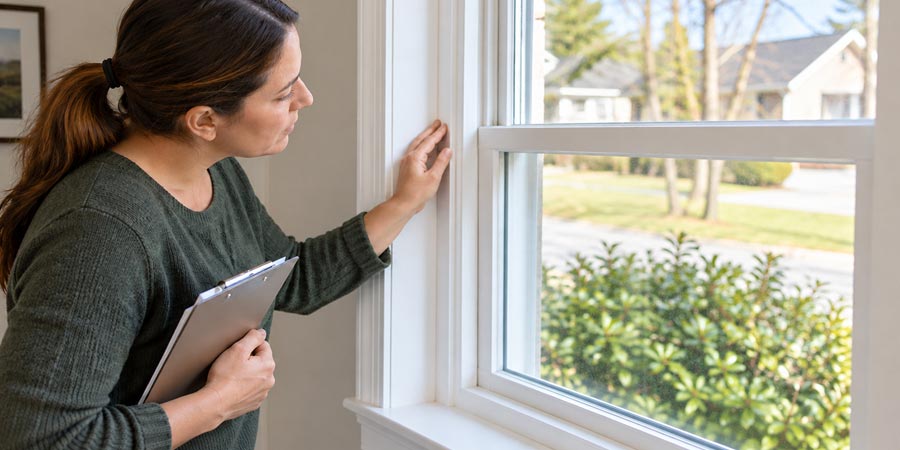
A short, ordered inspection separates glass faults from frame and hardware faults, so you know what kind of job you are describing before anyone quotes it. Work through the glass first, then the frame, so each finding narrows the next.
What should you check on the glass and the seal?
Start by checking whether the moisture or damage is on the glass surface or inside the sealed unit. This distinction helps you determine whether you are dealing with indoor condensation, a failed edge seal, or a cracked pane, since each requires a different response. Follow these steps before deciding whether the glass needs repair or replacement.
The three findings lead to three different jobs, so it is worth confirming which one you have before describing the problem to an installer:
| What you see | Where it sits | What it indicates |
| Mist that wipes off | Room-side surface of the inner pane | Indoor humidity condensing on cold glass; a ventilation issue, not a window repair |
| Fog or film that does not wipe off | Between the panes | Failed edge seal on the sealed glass unit |
| A line that catches a fingernail | One surface of one pane | Crack confined to a single pane |
Timing matters for the first finding. Room-side condensation peaks in the coldest weeks of a continental winter, so a homeowner who calls a window supplier in Ontario in January about wet glass should first check whether the moisture wipes away before assuming the unit has failed.
What should you check on the frame and the hardware?
The frame check takes a blunt probe, such as an awl or a small screwdriver, and a few cycles of the sash:
- Press the probe into the sill, the lower corners and the bottom rail of the sash. Wood that yields or feels spongy is soft, while firm wood with peeling paint is a finish problem.
- Raise a hung sash halfway and let go. A sash that drifts down or drops points to the balance or its cord.
- Close and lock the window without leaning on it. A latch that does not reach its keeper, or only reaches it under pressure, needs to be traced to the hardware or to the frame.
- Check the gap between the sash and frame on both sides. An even gap means the opening is square, while a tapering gap means it is not.
Engineer Sergey Essipov, with 20 years of experience in window manufacturing, notes:
I ask homeowners to write down what they find on each window before they request a quote. A note that says the bedroom casement lock no longer catches, while the frame is firm and the glass is clear, describes a parts job. A note that says the sill is soft and the sash rubs at one corner describes a frame problem, and that changes the whole conversation.
How does window repair vs replacement change what stays?
A repair replaces a failed component while leaving the rest of the window in place. Replacement involves removing the existing sash and glass, and may also require removing the frame if it is damaged or unsuitable for reuse. The method chosen determines how much of the existing assembly can remain and whether the surrounding finishes need additional work.
What stays in the opening when only one part is swapped?
In a single-part repair, the frame, sash, interior and exterior trim, perimeter seal to the wall, and remaining hardware all stay. The work is generally confined to the failed component and the fasteners or stops that hold it. Depending on the repair method, you may still need minor finishing work around the glazing or trim. The other side of that advantage is that whatever was true of the window before the repair, apart from the failed part, is still true afterwards.
What comes out when the whole unit is changed?
A replacement removes the sash and, at minimum, the glass. A new unit can be set into a sound existing frame, or the frame can be removed with it so that the new window goes into the rough opening. Which applies depends on the condition of the frame, and window replacement companies that recommend one method should be able to explain what they found in the frame to justify it.
Because Window Force builds each unit to order at its 80,000 sq ft Ontario facility, it manufactures a replacement to the dimensions taken from the actual opening, including openings that have drifted from their original size over decades. An authorized dealer takes the measurements and enters them directly into the production specification, so the choice between an insert and a full-frame replacement is made on site, based on the frame's actual condition, before the window is built.
The table compares the three scopes on what stays, what is removed and what each job leaves unchanged:
| Scope of work | What stays | What is removed | What the job does not upgrade |
| Single-part repair | Frame, sash, trim, perimeter seal, other hardware and glass | The failed component only | Glass package (unless the part is the sealed unit), frame performance, frame-to-wall seal |
| New unit in the existing frame | Existing frame, its perimeter seal to the wall, most trim | Sash, glass and operating hardware | The retained frame and its connection to the wall |
| New unit including the frame | Rough opening and wall structure | Entire window assembly down to the rough opening | Wall assembly beyond the rough opening |
Can double pane window repair clear moisture between the panes?
Yes, but only by replacing the sealed glass unit, because you can't wipe, dry, or seal out moisture trapped between the panes in the existing unit.
A sealed glass unit consists of two panes separated by a spacer and joined by a perimeter seal. When that seal fails, moisture enters the cavity and condenses between the panes, where wiping the accessible glass surfaces cannot remove it.
Maintenance Matters No. 13 from BC Housing, the provincial housing agency's bulletin on window and door replacement, is a further reference for homeowners weighing a sealed-unit replacement against a full window.
What does foggy window repair replace?
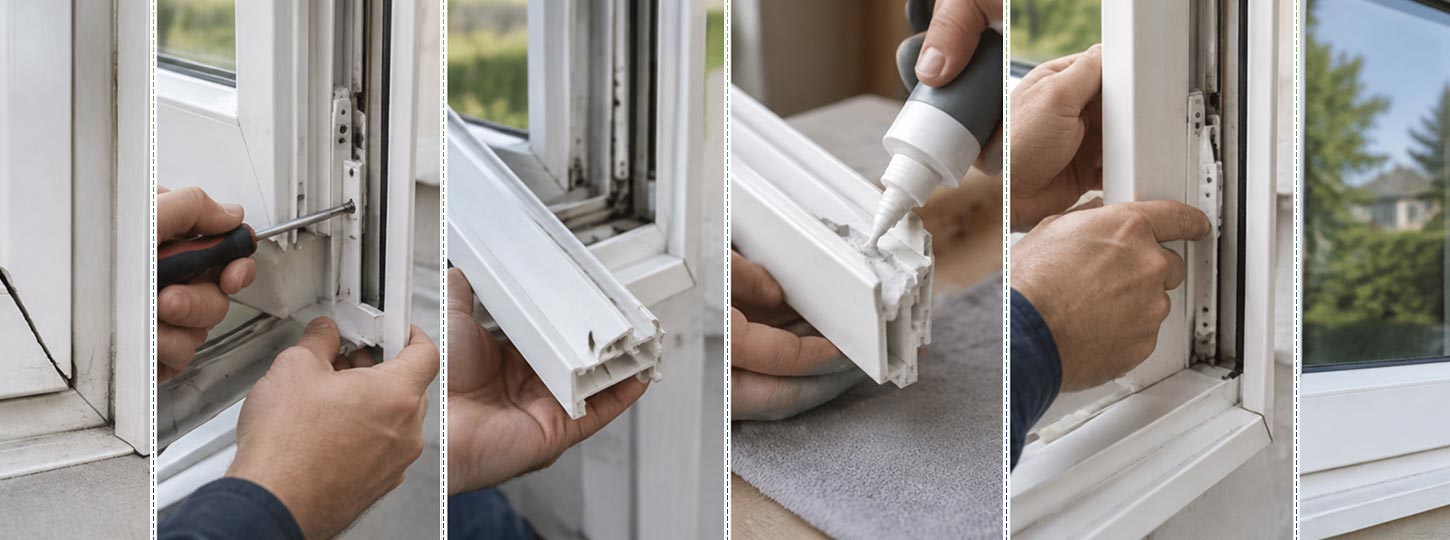
It replaces the sealed glass unit and nothing else. The glazing stops are removed, the failed unit comes out, a new unit made to the measured size is set on its blocks, and the stops go back in. You can order the new unit from the current range of sealed glass unit options, within the thickness the glazing pocket accepts. Smearing sealant along the edge of the old unit does not reverse the failure: it neither restores the gas fill that has escaped nor revives the saturated desiccant.
The detail that decides how long a replacement sealed unit stays clear is the edge seal behind the spacer, which nobody sees once the stops are back in place. Window Force builds every sealed unit with a dual-seal, metal-free warm-edge spacer: an inner seal that limits gas and vapour movement and an outer seal that bonds the panes structurally, so moisture following the route that fogged the original unit has two barriers to cross instead of one. With no metal in the spacer, the glass edge also runs warmer, reducing the temperature swings that can loosen an edge seal over successive winters.
When does window seal repair still leave the frame in place?
The frame stays when it is square, firm and has an undamaged glazing pocket to receive the new unit. Frame problems such as open mitres or cracking are not solved by a new sealed unit, so a soft or rotten frame is not this job; it belongs in the frame assessment covered further down.
When does window glass repair stop at one pane?
One-pane replacement is possible when the cracked pane is glazed separately and the surrounding sash and frame remain sound. The other pane or storm panel must be intact, and the glazing stops, or putty must be removable without damaging the sash. If the crack is in a sealed double-pane unit, the entire sealed unit generally needs replacement.
A single-pane replacement is the right scope when the following hold:
- The crack is confined to one pane and does not run under the stops into the frame.
- The other pane, or the storm panel, is intact.
- The glazing stops or putty bed, can be removed without damaging the sash.
- There is no moisture between panes.
Homeowners comparing symptoms across several windows can use this checklist alongside the overview of common double-pane window problems to sort each opening into the right category before requesting work.
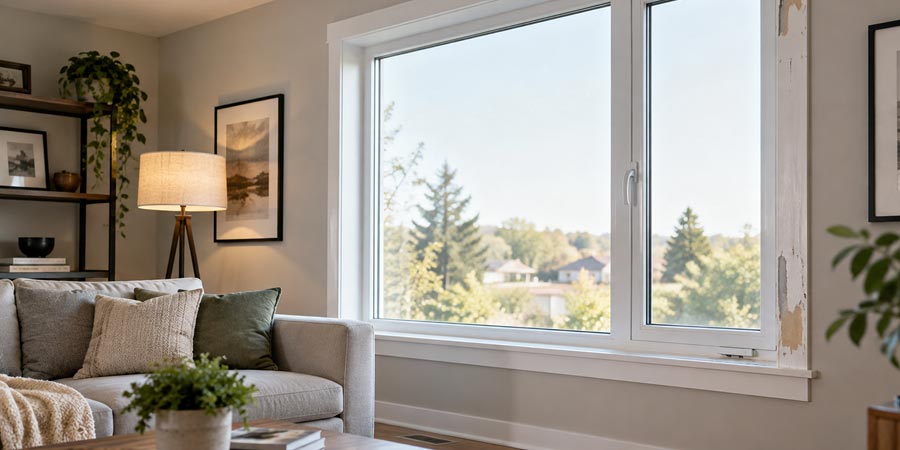
When does window frame repair hold?
The repair method depends on the type and location of the damage. The following examples show when a surface treatment, a local patch or a replacement section is appropriate.
The cases where a patch is the right answer are fairly narrow:
- Paint failure over sound wood. Preservation Brief 9 cautions that failed paint should not be read as proof that the wood beneath is in poor condition; preparation, priming and repainting address it.
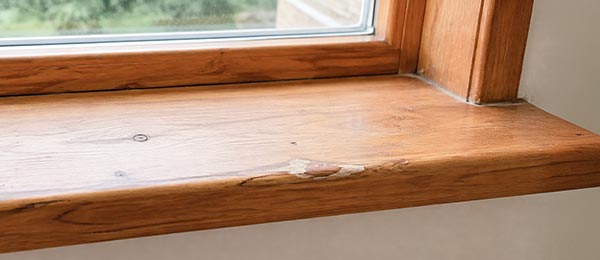
- A small soft spot that has not spread through the member or reached into the sill. Decayed fibres can be consolidated with a penetrating epoxy and the missing section rebuilt with an epoxy patching compound, or, for a larger local area in wood, a new piece can be spliced in.
- A loose casing. Refastening the trim and resealing its joint restores it without touching the window itself.
A patch won't hold when the sill is gone, the frame corners are soft, or the opening has moved out of square, and the sash no longer fits. In those cases, the repair would be anchored to material that cannot carry it. A fresh coat of paint is also not a frame repair: it covers the surface and can hide decay that continues underneath.
Exposure decides how long a sound local repair lasts. Sills on rain-exposed elevations stay wet for longer than those on sheltered walls, so homeowners comparing assessments from a window supplier in British Columbia with those from a drier region should expect sill condition to carry more weight on the coast. The article on window sill repair covers detailed guidance on that component.
What can be fixed when the sash will not stay open or the lock will not catch?
Both faults are usually parts jobs, because the components that hold a sash up and pull it closed are designed to be replaced.
The parts involved depend on how the window operates:
- Balances or springs in hung sashes, which carry the weight of the sash in the jamb. When one loses tension, the sash drifts down. In older wood windows, cords and weights do the same job, and Preservation Brief 9 lists replacing sash cords among the most common window repair tasks.
- Rollers on sliding sashes, which wear flat and make the sash drag or jump its track.
- Hinges and operators on casement and awning windows, which can loosen or wear until the sash no longer pulls tight to the frame.
- The latch and its keeper can wear, bend, or shift so they no longer meet.
On double-hung windows, a sash that sticks is often a separate fault from one that drops. A sash glued shut by layers of paint is a parts-and-preparation job: cutting the paint line along the stops and removing the build-up frees it. A sash that binds because the frame has twisted is not, and the frame section above explains why that case is assessed differently.
Engineer Sergey Essipov, with 20 years of experience in window manufacturing, explains:
A lock that will not catch is usually a keeper that has shifted slightly or a sash that has dropped. At our facility, we build sashes and frames on multi-chamber profiles, whose internal walls give hardware screws more material to bear on than a single skin of vinyl, so a keeper set at the factory stays where it was set. When a new keeper or a re-tensioned balance brings the latch back into line, the window is fine; when the latch only lines up while you lean on the sash, the frame is the problem, and no hardware part will fix it.
When to replace windows if the same fault keeps coming back?
Window replacement becomes worth considering when repeated repairs fail to address the underlying cause. A recurring fault may indicate frame movement, deterioration, or another issue that replacing a single component can't fix. Before deciding, determine whether the same part is failing again or whether the frame and opening condition is responsible.
Which frame and opening failures end a patch?
Rot running through a frame member, a sill that has lost section, and an opening that has racked out of square all end the case for repair. A patch fixes the part it touches; it doesn't straighten an opening that has moved, and it doesn't restore a frame member that has lost its strength. Climate can make this pattern easier to spot. Calgary's chinook winds can lift winter temperatures sharply within hours, which works frame joints and perimeter seals harder than a steadier climate does, so a homeowner who calls a window supplier in Alberta for a second adjustment to the same sash should ask for the opening to be checked rather than the hardware alone.
Which repeated faults mean the unit is done?
Look for patterns that suggest the previous work did not resolve the cause:
- The same lock or latch repeatedly loses alignment after adjustment.
- Water returns after you've checked the leak source and the drainage path.
- Several unrelated components need repair within a short period.
A single-glazed window also cannot be converted into a sealed unit through component repair alone; it requires different glazing or a replacement solution.
Preservation Brief 9 reaches the same conclusion from the repair side: when parts replacement becomes extensive, and the job turns prohibitively expensive, replacing the sash is a reasonable consideration. Age matters only in combination with these faults; an old window with one worn part is still a repair, while a newer one with a racked frame is not.
Once you make the case for a new unit, the next risk is replacing one uncertain window with another. The usual market route separates the product from the people who measure and install it, whereas Window Force keeps them in one chain: each window is manufactured to order and placed through an authorized dealer network that assesses the frame before production begins. Window Force windows are CSA certified, and Window Force is an ENERGY STAR Partner whose windows are engineered to meet ENERGY STAR requirements. Each replacement model should be specified with verified performance ratings and certification appropriate to its intended use and Canadian climate zone. The 25-year transferable warranty on the frame, sash and hardware stays with the house if it is sold, and a separate 10-year non-prorated warranty covers sealed glass units, so the decision to replace rests on a documented product rather than on the hope that the next window will outlast the last.
How does the frame material change what can be patched?
Wood frames often allow localized repairs through consolidation, filling or splicing. A crack at a welded corner of a vinyl frame is generally not suitable for the same type of repair and may require frame or window replacement. A failed sealed glass unit can often be replaced separately if the surrounding frame and glazing pocket remain sound.
A wood frame tolerates repair at the scale of the damage. A small area of rot in a sill or rail, surrounded by sound wood, can be consolidated and filled, or a short new section can be spliced in, and the rest of the frame continues in service. A vinyl frame is built differently: its corners are fused into a single welded profile, and a crack at that corner cannot take a splice in the way a wood joint can. A cracked welded corner is therefore generally treated as a frame failure, not a repair candidate. Both materials share that the sealed unit is an independent component, so a fogged unit is replaced the same way whether the frame around it is wood or vinyl.
Housing stock determines which of these materials a homeowner is likely to deal with. A window company in Quebec City working in the older districts still meets original wood windows set in masonry walls, where splicing and consolidation can preserve the opening, while newer subdivisions in Saskatoon more often have welded vinyl units whose repair options are limited to components and glass.
| Frame material | Fault | Patch that fits | When the patch is not enough |
| Wood | Small rot in a sill or rail, surrounding wood sound | Epoxy consolidation and filling, or a spliced-in section | Rot through the member or soft corners |
| Wood | Failed paint over sound wood | Preparation, priming and repainting | Wood beneath is soft when probed |
| Vinyl | Cracked welded corner | No local patch for the corner itself | The crack itself marks a frame failure |
| Vinyl | Worn weatherstripping, balance or lock | Replacement of that component | Frame distorted so the sash no longer seats |
| Wood or vinyl | Fog between the panes | New sealed unit in the existing frame | Frame unsound or glazing pocket damaged |
A homeowner wants a vinyl corner to never become the repair question in the first place. Window Force fusion-welds every frame and sash corner, melting the profile ends into one continuous joint instead of joining them with screws and corner keys, so no mechanical seam loosens as the frame cycles through Canadian winters. The profiles are made from lead-free uPVC compounded with UV stabilizers, which slows the sun-driven embrittlement that, in lower-grade vinyl, tends to show up first as a crack at a stressed corner.
Who should keep the existing window, and who should put in a new one?
Before approving a quote, ask which component has failed, what the proposed work will replace, and which parts of the existing window will remain. A clear explanation of those three points helps you judge whether the repair addresses the fault or whether the scope of work needs to be broader.
If you are unsure which option fits your window, contact Window Force to arrange an assessment. Our team can help determine whether you can keep the existing frame or whether a custom replacement is the better choice for your opening.
Frequently Asked Questions
Can a fogged window be fixed without replacing the whole window?
Yes, if the frame is sound. Fog between the panes means the edge seal of the sealed glass unit has failed, and the standard repair is to remove that unit and install a new one in the existing frame. Products that claim to clear fog by drilling or sealing the old unit do not restore its gas fill or desiccant.
Does repairing a window make it more energy efficient?
It can reduce air leakage if the repair fixes a failed seal or worn weatherstripping. However, repairing a component does not automatically improve the thermal performance of the existing glass unit.
How can I tell whether condensation is a window problem?
Wipe the glass on the room side. If the moisture comes off, it is surface condensation caused by indoor humidity, which you can address with ventilation. If you can't wipe it off from either side, the moisture is between the panes and the sealed unit has failed.
Can a cracked vinyl window frame be repaired?
A crack at a welded corner of a vinyl frame is generally treated as a frame failure, because the fused corner cannot be spliced the way a wood joint can. Components mounted in an otherwise sound vinyl frame, such as hardware, weatherstripping and the sealed unit, remain replaceable.
Is an old window always a candidate for replacement?
No. Age alone does not determine whether replacement is necessary. The decision depends on the type of fault, the feasibility of repair and whether the proposed work offers a practical long-term solution.
Why does my sash keep dropping after it has been adjusted?
A worn balance or spring may need replacement. If the sash still drops after you install the correct part, check whether the frame or sash is misaligned.
Can rotted wood around a window be patched?
Yes, if the damage is localized and sound wood remains around it. Extensive decay that compromises the frame's strength requires a broader repair or replacement assessment.
People Also Ask