

Fusion-welded corners are stronger because there is no joint. The two vinyl profiles are heated until their polymer chains interdiffuse and re-solidify as a single continuous mass. Mechanically fastened corners rely on brackets, screws, or crimped connectors that create discrete attachment points, each of which is a potential failure site under thermal cycling and load. Replacement window buyers across Canada frequently focus on glass specifications and frame colour while overlooking this manufacturing detail, yet it is the corner construction method that most determines whether a window maintains its geometry and seal integrity across decades of Canadian freeze-thaw cycles.
Key Takeaways
- Fusion welding heats vinyl profiles to approximately 230 — 260°C, causing the PVC to soften and intermingle at a molecular level; the resulting joint becomes continuous with the parent material, not merely attached to it.
- Mechanically fastened corners rely on screws, brackets, or crimped connectors that create discrete attachment points; over time, thermal cycling and vibration gradually loosen those connections.
- Research published in the peer-reviewed journal Materials (MDPI) confirms that corner weld strength in PVC window profiles is directly tied to welding parameters and that optimal fusion conditions produce joints whose failure load matches that of the surrounding profile rather than breaking at the interface.
- According to Natural Resources Canada, windows and skylights can account for up to 35% of total residential heat loss. Corner integrity is a primary variable in whether that figure worsens over time.
What Are Fusion-Welded Corners in Modern Window Manufacturing?
Fusion welding is a thermal joining process in which two vinyl profiles are pressed together at elevated temperature until their surfaces soften, intermingle, and re-solidify as a single continuous mass. In window manufacturing, this technique is applied at each of the four corners of both the outer frame and the inner sash, producing what the industry describes as a seamless, monolithic construction.
This guide reflects the manufacturing perspective of Window Force, a Canadian vinyl window producer that has used fusion-welded construction as its baseline standard since its founding and has observed its performance under Canadian climate conditions over nearly two decades of production.
Fusion Welding Process
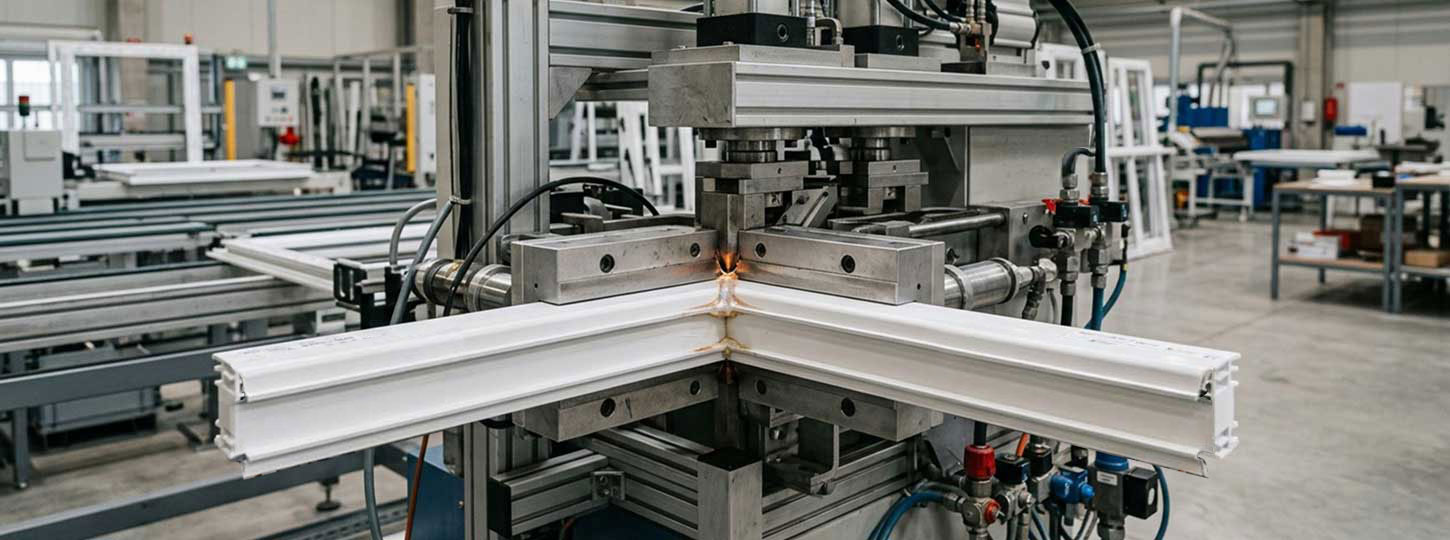
The process begins with two extruded PVC profiles cut at a 45° mitre angle. A heated platen — typically aluminum, coated with a non-stick release surface — is inserted between the two profile ends and brought to a temperature between 230°C and 260°C. Both ends are pressed against the platen simultaneously for a controlled dwell time, softening the vinyl to a semi-molten state. The platen is then withdrawn, and the two profiles are immediately driven together under controlled pressure. As the softened vinyl from each piece contacts the other, the polymer chains at the interface interdiffuse and entangle. When the material cools, no adhesive, fastener, or bracket is present at the joint; only solidified PVC that has bonded at the molecular level remains.
A crucial feature of this process is that no foreign material is introduced. The bond is homogeneous: vinyl to vinyl, with continuity through the joint.
Window Force frames are manufactured from lead-free uPVC with integrated UV stabilizers that preserve both the profile's mechanical properties and the integrity of the weld zone over decades of sun exposure. Unlike standard PVC formulations, UV-stabilized uPVC does not become brittle at the surface over time — a factor that directly affects how the material performs at the corner joint under repeated thermal stress.
Materials Used
Rigid PVC (polyvinyl chloride) is the material that makes fusion welding viable for window profiles. PVC is a thermoplastic, meaning it softens reversibly when heated and re-solidifies when cooled without undergoing chemical degradation at the temperatures used in welding. This property allows the material to flow and intermingle under pressure. Profiles used in quality window manufacturing are typically multi-chambered, meaning the extrusion contains several sealed air cavities along its length, which both increases thermal resistance and provides additional wall thickness at the welding surface, supporting stronger fusion joints.
Windows Near Me
How Do Mechanically Fastened Window Corners Work?
Mechanically fastened corners join vinyl profiles with physical connectors rather than fusing the material. The profiles are not softened; instead, they are held together by hardware inserted at the corner location.
Common Fastening Methods
Several methods are used in mechanically fastened window construction. Corner keys or L-shaped brackets made of rigid PVC or aluminum are inserted into the hollow chambers of each profile, then secured with screws driven through the outer wall. In some systems, the profiles are crimped rather than screwed by a mechanical deformation process that flares the vinyl outward to grip the insert. Others use adhesive bonding in combination with a corner key, relying partly on chemical adhesion and partly on the insert's mechanical locking.
In each case, what holds the frame together at the corner is the friction, compression, or fastener engagement between the profile wall and the connector, not any bonding of the vinyl itself.
Typical Applications
Mechanically fastened construction is used primarily in lower price-point residential windows and in certain commercial glazing systems where field assembly is required. It is also common in aluminum window frames, where the metal's distinct thermal characteristics make heat fusion impractical. In the vinyl window segment, mechanical fastening is sometimes employed to reduce production equipment costs, since fusion welding requires dedicated welding machines for each profile geometry. For high-performance residential applications where long-term structural integrity under thermal stress is a primary requirement, mechanically fastened vinyl construction has meaningful limitations.
Why Does Fusion Welding Create a Stronger Structural Bond?
The strength advantage of fusion welding is not a marketing claim; it is a physical consequence of how thermoplastic materials behave at the molecular level when heat and pressure are applied simultaneously.
Structural Integrity
When a mechanically fastened corner is loaded by wind pressure, sash weight, or thermal expansion, the force travels through the vinyl wall, across the interface to the bracket, through the bracket, and back across the interface to the adjacent profile wall. Each interface is a potential failure point. The fastener can pull out. The bracket can deform. The vinyl wall can crack around the screw head. These are distinct material boundaries under stress.
In a fusion-welded corner, no such boundaries exist. The joint is continuous: the polymer network that constitutes one profile extends, without interruption, into the other. Loading is distributed across the entire cross-section of the joint rather than concentrated at discrete attachment points. This is the structural principle behind the technology: continuity of material equals continuity of load path.
Sergey Essipov, a window manufacturing specialist with over 20 years of experience in vinyl window production, explains:
At our facility, we weld every corner of both the frame and the sash using controlled temperature, dwell time, and pressure parameters — because in multi-chamber uPVC profiles, even a half-degree variance in platen temperature affects how deeply the polymer chains interdiffuse. When the process is right, you don't have a joint. You have one continuous piece of material. The weld doesn't fail — the profile wall fails first, and that's exactly the benchmark we work to.
Strength Testing
Independent research confirms this. A study published in Materials, a peer-reviewed journal of the MDPI academic publishing group, examined the relationship between processing parameters and the structural performance of welded corners in PVC window profiles. The research found that under optimized welding conditions, the failure load of the welded joint approached that of the unmodified profile material, meaning the weld itself was not the weak point. The study also identified that processing variables, specifically milling depth where composite reinforcement inserts are trimmed back from the weld zone, had a measurable effect on corner strength, with even a 1.5 mm excess in milling depth introducing a visible reduction in joint integrity.
How Do Welded Corners Improve Resistance to Weather and Moisture?
A window frame is a sealed enclosure. Its ability to keep water out depends entirely on whether every joint in that enclosure remains closed under real-world conditions. The corner is the most demanding location in that structure.
Canadian Climate Challenges
Canadian climates place different demands on window frames, but all of them reward durable corner construction. A homeowner considering replacement windows in British Columbia faces a different environment than someone purchasing energy-efficient windows in Alberta or working with a window supplier in Ontario. The common factor is that window corners must remain sealed despite years of thermal movement, moisture exposure, and weather-related stress.
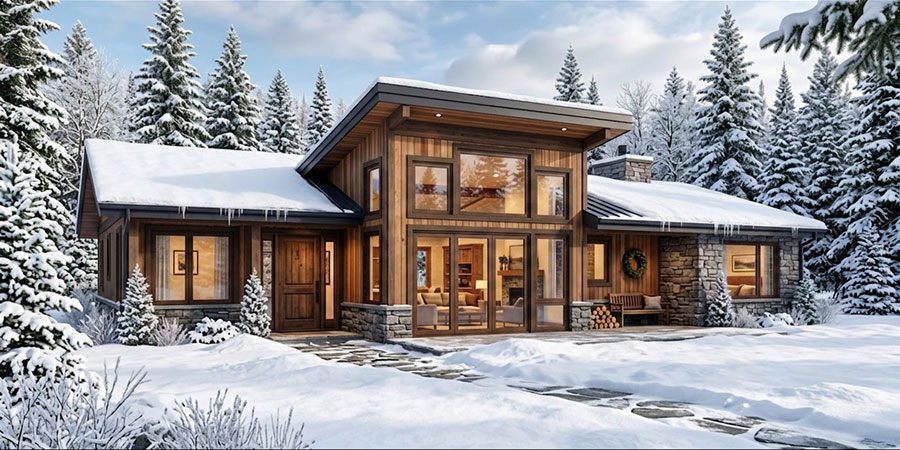
In Ontario, window systems are exposed to frequent freeze-thaw cycles and large seasonal temperature swings. In Alberta, extreme winter cold and rapid temperature fluctuations can create significant expansion and contraction forces within vinyl profiles. In British Columbia, particularly in coastal regions, prolonged exposure to moisture and wind-driven rain imposes continuous demands on corner integrity and water resistance.
Mechanically fastened corners respond to these conditions through the hardware that holds the frame components together. Over time, repeated movement and environmental stress can alter the engagement between the fasteners and the vinyl profile, creating opportunities for micro-gaps to develop at the joint faces.
Fusion-welded corners behave differently. Because the vinyl profiles are permanently fused into a single continuous structure, there is no mechanical joint that can loosen or separate. Whether the window is installed in a cold Alberta winter, a wet British Columbia climate, or an Ontario home experiencing decades of freeze-thaw cycling, thermal expansion and contraction occur throughout the frame as a unified body. As a result, the corner remains structurally stable and resistant to air and water infiltration over the long term.
Moisture Protection
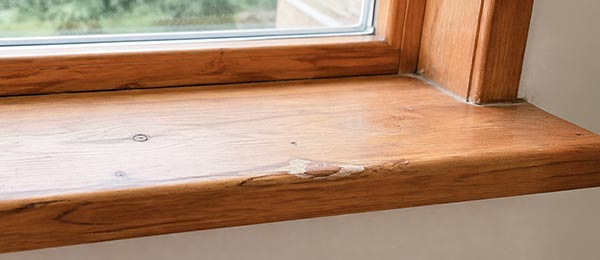
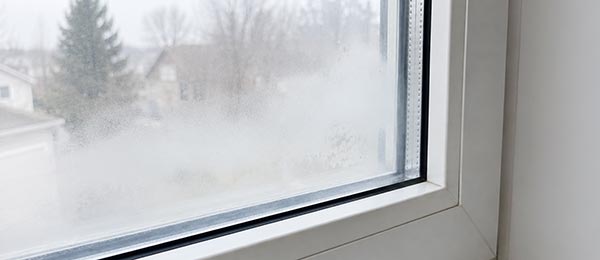
Once a micro-gap opens at a mechanically fastened corner, water infiltration follows a predictable sequence. Capillary action draws water into the gap. In cold weather, that water freezes, expanding by approximately 9% in volume and widening the gap further. When it melts, the now-larger gap admits more water. The cycle accelerates corner deterioration and, in multi-chambered profiles, can cause water to accumulate in the frame cavities, where it remains invisible until staining or warping becomes apparent.
Fusion-welded corners eliminate this initiation point entirely. Because no gap exists at the manufacture, there is no capillary entry pathway. The seal at the corner is the same material as the surrounding profile, not a filled void, not a compressed joint, but a continuous surface.
According to Natural Resources Canada's Keeping the Heat In guide, a residential energy efficiency publication covering window selection and performance standards, air and water leakage pathways in window assemblies are identified at the rough framing interface, the shim space, the sash junction, and around the frame itself. Corner construction quality directly determines whether the frame contributes to or resists those pathways.
Can Fusion-Welded Frames Help Improve Energy Efficiency?
Structural integrity and thermal performance are not separate categories. A corner that maintains its geometry maintains its seal, and a maintained seal is the basis of any meaningful energy performance rating.
Heat Loss
The U-factor of a window assembly, the primary metric used by ENERGY STAR Canada and Natural Resources Canada to evaluate thermal resistance, accounts for the entire assembly: glass, spacer, and frame. Frame performance contributes to the whole-window U-factor, and any air pathway through the frame, including through a failed corner joint, degrades that value. A window marketed with a U-factor of 1.2 W/m²·K will not sustain that rating if the corner seal deteriorates.
Natural Resources Canada notes that better-performing double-glazed windows achieve U-factors of 1.2 W/m²·K or lower, and triple-glazed windows as low as 0.8 W/m²·K, but those figures are measured on intact, sealed assemblies. Frame joint integrity is a precondition of achieving and sustaining those values in service.
Air Infiltration
Under CSA A440, the Canadian standard governing the performance requirements for windows, doors, and skylights, air leakage is assessed under positive and negative pressure differentials and reported in litres per second per square metre (L/s·m²). High-performance vinyl windows manufactured with fusion-welded corners and multi-point compression weatherstripping routinely achieve the lowest classification tiers under this standard. The seamless corner is one reason: there is no internal pathway for air to bypass the weatherstripping and enter through the frame structure itself.
| Performance Variable | Fusion-Welded Frame | Mechanically Fastened Frame |
| Corner air seal — new condition | Continuous, no gap | Adequate if hardware is tight |
| Corner air seal — after 10 years | Unchanged — no hardware to loosen | Dependent on continued hardware engagement |
| CSA A440 air leakage rating potential | Lowest classification achievable | May degrade over time |
| Whole-window U-factor stability | Maintained through service life | Risk of degradation if the corner fails |
| ENERGY STAR compliance over time | Sustained | Cannot be guaranteed beyond the initial test |
What Happens to Mechanically Fastened Corners Over Time?
The performance gap between fusion-welded and mechanically fastened corners is smallest when the window is new and widest after several years in service.
Aging Materials
Vinyl, like all thermoplastics, changes dimensionally with temperature. A standard residential vinyl window profile will expand and contract by roughly 1 mm per metre of length for every 10°C change in ambient temperature. A 1.2-metre frame section, therefore, moves approximately 1.2 mm across a 10°C swing. During a Canadian winter, temperature differentials between the frame's interior and exterior surfaces can reach 40°C or more, producing proportionally greater movement in the frame material. This movement is entirely predictable; it is a material property of PVC, not a manufacturing defect, and fusion-welded construction accommodates it without consequence because the material moves as a unit.
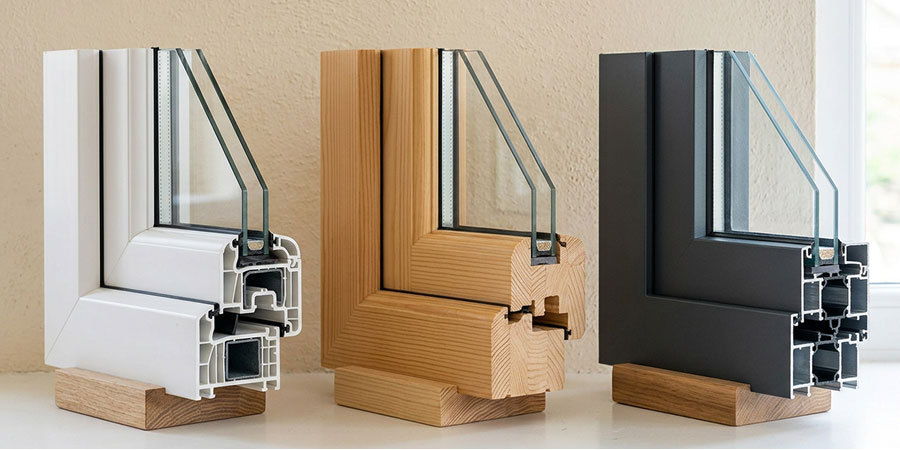
In a mechanically fastened frame, the same dimensional movement translates into micro-displacement between the vinyl profile walls and the insert hardware. Aluminum brackets, whose coefficient of thermal expansion differs from PVC, expand and contract at a different rate than the surrounding frame. The repeated differential movement across the window's service life works against the engagement between the insert and the vinyl.
Long-Term Wear
Over ten or fifteen years, the cumulative effect of this differential cycling is detectable. Screws that were snug at installation develop minor looseness. Corner keys that were flush with the profile cavity develop micro-gaps visible at the joint face. In most cases, no single event causes visible failure; the degradation is gradual, and its effects (draught, condensation at the sill, reduced sash operation) are often attributed to installation issues or wear in weatherstripping rather than corner joint fatigue.
Fusion-welded corners do not have this failure mode. There is no hardware to loosen, no differential movement between dissimilar materials, and no engagement that can be gradually worked out by thermal cycling.
How Do Welded Corners Perform During Temperature Changes?
Thermal cycling is the governing stress condition for window frames in Canadian climates, and it is where the structural difference between welding and mechanical fastening is most consequential.
Seasonal Stress
Vinyl windows experience two distinct seasonal stress regimes. In winter, the outside face of the frame can reach temperatures well below freezing, while the interior face, warmed by indoor air, remains significantly warmer. This temperature differential creates a gradient across the frame thickness, with the material attempting to expand and contract at different rates along its depth. In summer, direct solar exposure of a south- or west-facing dark-framed window can raise surface temperatures dramatically, producing significant thermal expansion relative to the cooler interior face.
Research on PVC frame welding, including the MDPI Materials study cited earlier, establishes that weld quality affects not only peak strength but also the consistency of material properties across the joint zone. A properly fused corner maintains the multi-chamber geometry of the profile through the joint; the internal walls that provide both structural stiffness and thermal resistance continue uninterrupted from one profile to the other. A crimped or screw-fastened corner, by contrast, fills the corner space with a bracket insert that interrupts the chamber geometry and creates a thermal bridge at the corner.
Multi-chamber profile geometry is central to Window Force's approach to both thermal resistance and weld quality. The chamber walls that run continuously through the profile provide additional vinyl mass at the weld zone, which supports deeper polymer interdiffusion during fusion. Where a bracket insert would interrupt those chambers and create a localized conduction path, the welded joint maintains them, preserving both the structural and thermal function of the profile geometry through the corner.
Frame Stability
Frame squareness, the preservation of 90° geometry at each corner, directly determines whether a sash seats correctly against its weatherstripping when closed. Casement and awning sashes use compression sealing: the sash is pulled hard against a perimeter seal by the locking hardware. If the frame has racked even fractionally out of square, the compression is uneven, and gaps appear at the corners of the sash-to-frame interface. In hung and slider windows, out-of-square frames cause sash binding, uneven gap spacing, and premature wear on weatherstripping.
Fusion-welded corners, by maintaining a rigid, permanently bonded geometry, preserve frame squareness through the service life of the window. The corner cannot rack because there is no pivot or compliance point at the joint.
Why Is Corner Strength Important for Window Longevity?
Corner integrity determines not just how long a window lasts but also how consistently it performs throughout its service life.
Window Lifespan
A vinyl window's rated service life, the period over which it is expected to maintain its structural and thermal performance, assumes that all components, including corner joints, retain their specified properties. Window Force provides a Lifetime Warranty covering manufacturing and material defects for the original purchaser, for as long as they own the home or up to 25 years, whichever comes first. That warranty reflects the performance expectation of fusion-welded construction: there is no fastener to fail, no bracket to loosen, and no adhesive joint to delaminate.
The warranty terms are meaningful because they are backed by the manufacturing method. A window manufacturer using mechanical fastening at the corners is, structurally speaking, introducing time-dependent failure modes into the assembly. Offering equivalent warranty terms for a mechanically fastened product requires confidence that the hardware will remain engaged over decades of exposure to the Canadian climate, a more difficult standard to meet.
Sergey Essipov, window manufacturing specialist with over 20 years of experience in vinyl window production, notes:
We have been manufacturing fusion-welded windows since the company's founding, and we have never had a corner joint fail under normal service conditions. The material simply doesn't have a mechanism for that type of failure. Bracket-based corners, by contrast, ask you to trust the hardware, and the hardware does loosen over time.
Structural Support
The corner is also the primary load transfer point in an operable window. Every time a casement is cranked open, the hinge force is transferred through the frame at the corner nearest the hinge. Every time a hung sash is raised, the sash weight loads the frame corners as the balances bear on the frame stiles. These are live loads, applied repeatedly across the window's service life. The corner joint must absorb those loads without plastic deformation or creep, or gradual distortion under sustained or repeated loading.
How Do Fusion-Welded and Mechanically Fastened Windows Compare Side by Side?
Homeowners evaluating replacement windows benefit from a direct comparison across the performance categories that matter most in demanding climates. Understanding how different corner construction methods perform over time makes it easier to identify products that will maintain their structural integrity, energy efficiency, and appearance for decades after installation.
Pros and Cons
Both construction methods produce functional windows. The difference is in how their performance evolves over time and how they respond to the specific conditions of Canadian residential use.
Fusion-welded frames are more expensive to produce because they require dedicated welding equipment, and because each profile geometry requires a matched set of tooling. The capital cost is passed on to some degree in the product price. For the homeowner, the relevant question is not the upfront cost differential but the total cost over the expected service life, accounting for maintenance, air-leakage degradation, and any remediation of failed corners.
Mechanically fastened windows can be assembled with simpler tooling and may be less expensive at the point of purchase. They perform acceptably when new, and in moderate climates without severe thermal cycling, the long-term performance gap may be smaller. In regions with significant seasonal temperature fluctuations, repeated expansion and contraction impose greater cumulative stress on mechanical fasteners over time.
Cost Considerations
There is no industry-standard figure for the cost of remediating a failed window corner because, in most cases, the corner failure does not produce a discrete, recognizable event; it causes gradual performance degradation that is addressed through weatherstripping replacement, caulking, or, eventually, full window replacement. If corner joint failure contributes to the need for early window replacement at year 12 or 15 rather than year 25, the lifetime cost difference between welded and fastened construction becomes significant.
| Comparison Dimension | Fusion-Welded | Mechanically Fastened |
| Initial joint strength | High — molecular continuity | Adequate — depends on hardware |
| Moisture resistance at the corner | Sealed permanently | Subject to gap formation |
| Thermal cycling performance | No differential movement | Differential between PVC and insert |
| 15-year structural condition | Equivalent to new | Dependent on climate exposure |
| Air leakage stability over time | No degradation mechanism | Progressive risk |
| ENERGY STAR rating for sustainability | Maintained | Cannot be guaranteed long-term |
| Warranty support | Strong basis | Dependent on hardware durability |
What Should Homeowners Look for When Choosing Replacement Windows?
Corner construction is one of several indicators of manufacturing quality that can be verified before purchase. The others are closely related to it.
Questions to Ask
When reviewing vinyl window options, the following questions reveal construction standards directly:
Are the corners fusion-welded?
This is a binary question with a direct answer. A manufacturer using fusion welding can confirm it and should be able to explain the process. Vague answers about "strong corners" or "sealed construction" that avoid describing the joining method are a signal to investigate further.
What is the air leakage rating under CSA A440?
This is a standardized test result, not a manufacturer's claim. The value should be available on the product's certification documentation. High-performance vinyl windows typically achieve A3 classification (the highest) for air leakage, which requires extremely low measured infiltration under 75 Pa pressure differential.
Does the window carry ENERGY STAR certification for Canada?
Canadian ENERGY STAR requirements are administered by Natural Resources Canada and are more stringent than U.S. equivalents. Certification applies to the whole-window assembly and requires independent laboratory testing. A certified product provides verified performance data across all relevant metrics.
Certifications
CSA A440 is the primary Canadian standard for window performance, covering structural load resistance, air infiltration, water penetration resistance, and operating force. ENERGY STAR Canada, administered by NRCan, provides an additional layer of whole-product energy performance certification. For replacement windows, both certifications provide independent verification that the product meets or exceeds the performance thresholds relevant to Canadian climates. All Window Force vinyl windows are manufactured to meet applicable Canadian standards, including ENERGY STAR requirements, and carry certification relevant to the Canadian market.
Why Does Window Force Prioritize Fusion-Welded Construction?
Window Force manufactures vinyl windows at its 80,000-sq-ft production facility in Vaughan, Ontario. The decision to use fusion-welded corner construction across the entire product line of both the Classic Series and the Ultraslim Series is an engineering decision, not a marketing one. It reflects what the production data and field performance records indicate about how vinyl windows perform under real-world conditions over multi-decade service lives.
Product Quality
At the Window Force facility, welding parameters, temperature, dwell time, pressure, and cooling rate are controlled and monitored for each production run. The multi-chamber profiles used in both product series provide substantial vinyl mass at the corner weld zone, which supports consistent joint depth and reduces the risk of under-welding. The result, verified by the company's internal quality inspection process, is corner joints that pass both visual inspection for flash and sink marks and dimensional verification for squareness at each frame.
The 50,000+ windows produced annually at the facility are built to this standard as a baseline. There is no tier of Window Force product that uses mechanical fastening at the corners, because the performance case for fusion welding in the Canadian residential market is clear.
Final Thoughts on Fusion-Welded vs. Mechanically Fastened Window Corners
The choice between fusion-welded and mechanically fastened vinyl window corners is not a matter of preference; it is a performance specification with measurable consequences over time. Fusion welding creates a joint whose strength derives from material continuity rather than hardware engagement, and that continuity does not degrade under the thermal cycling, moisture exposure, and operational loading conditions that define a window's service environment. Mechanically fastened corners perform adequately when new, but carry inherent failure modes that thermal cycling accelerates over the years.
For builders specifying windows for new construction and homeowners replacing windows in existing homes, the manufacturing standard at the corner is one of the clearest indicators of the quality tier a product occupies. It is also one of the simplest to verify. Fusion-welded construction is standard at Window Force because evidence from both materials science and field performance is unambiguous: this method produces windows that continue to perform as specified 15 - 25 years after installation.

Frequently Asked Questions
What is the difference between fusion welding and chemical welding in vinyl windows?
Fusion welding joins vinyl profiles using heat and pressure alone; the profiles are softened and pressed together, allowing the polymer chains to interdiffuse. No adhesive or solvent is used. Chemical welding (also called solvent welding) uses a chemical agent to soften the vinyl surfaces, which are then pressed together. Chemical welding is more common in plumbing applications than in window frames. Fusion welding is the standard for high-performance residential vinyl windows in Canada because it produces a stronger, more consistent joint and does not introduce a foreign chemical compound at the joint interface.
Can you tell from looking at a window whether its corners are fusion-welded?
In most cases, yes. A fusion-welded corner will have a small, smooth bead of flash, slightly raised vinyl around the outer perimeter of the corner, which is a normal artifact of the material being pressed together under heat. The corner faces will be completely closed with no visible seam line between the two profiles. A mechanically fastened corner may show a hairline seam at the mitre angle where the two profile ends meet, and in some cases, the corner key insert is visible through the end cavity of the profile.
Do fusion-welded corners affect the thermal performance of the window frame?
Yes, positively. A fusion-welded corner maintains the multi-chamber geometry of the vinyl profile through the joint; the internal air cavities that contribute to the frame's thermal resistance continue uninterrupted from one profile to the other. A bracket-based corner fills the corner zone with a solid or semi-solid insert that interrupts those chambers and creates a localized thermal bridge at the corner.
Are fusion-welded windows more expensive than mechanically fastened ones?
They typically carry a modest price premium, reflecting the capital cost of welding equipment and the more controlled production process. The relevant comparison is not unit cost but total cost over a 20 — 25-year service life. If a mechanically fastened window requires earlier replacement due to corner deterioration or requires ongoing maintenance to manage air leakage, the cost advantage at purchase diminishes quickly.
Does the fusion-welding standard apply to both the frame and the sash in quality windows?
In properly manufactured vinyl windows, fusion welding is applied to both the outer frame and the inner sash, since the sash is a separate vinyl rectangle that must maintain its own geometry under operational and thermal loading. A window with a welded frame but a fastened sash would retain the corner vulnerability of the moving element, the component subject to the greatest operational loading.
People Also Ask