

Finishing a basement or renting it out as a secondary suite is one of the most cost-effective ways for Canadian homeowners to increase usable space and property value, but it also triggers specific legal obligations regarding window sizing and emergency egress. Understanding what egress windows are, when they are required, and what the current code actually demands is the starting point for any basement project that involves sleeping areas.
Producing egress-compliant windows requires tighter dimensional control than almost any other residential application; a few millimetres of variance in the clear opening can be the difference between passing and failing inspection. With nearly 20 years of manufacturing custom vinyl windows at our 80,000 sq ft Ontario facility, Window Force supplies builders, contractors, and homeowners across Canada through our authorized dealer network. The dimensional patterns described in this guide reflect what we see directly from production: egress orders consistently require closer specification tolerances than standard residential window runs.
Key Takeaways
- An egress-compliant emergency escape opening is required where mandated by the Ontario Building Code for sleeping areas and bedrooms; it is not optional in any finished basement used for sleeping.
- Under the 2024 Ontario Building Code (effective April 1, 2025), the minimum unobstructed opening is 0.35 m² with no single dimension smaller than 380 mm, and the window must open without tools or special knowledge.
- Casement windows generally provide a larger clear opening relative to their frame size than most other residential window types.
- Converting a small basement window into a compliant egress window requires a building permit and, in most cases, foundation wall cutting and window well installation, both of which are regulated under Ontario's building code.
- Beyond code compliance, egress windows add measurable value: finished basements with legally conforming windows qualify for rental licensing, carry higher resale appeal, and provide genuine emergency safety for occupants.
What Is an Egress Window and Why Is It Important for Home Safety?
An egress window is a window designed and sized to allow occupants to escape a building unassisted in an emergency and to allow firefighters to enter. The term "egress" comes from Latin, meaning to go out, and that function is its defining purpose. While all windows provide light and ventilation, only those that meet specific dimensional thresholds and operational standards qualify as egress windows under Canadian building codes.
Definition and Safety Function
The distinction between an egress window and a standard window is entirely practical. A standard basement window may measure 12 inches high by 24 inches wide, providing some light and nominal ventilation, but far too small for an adult to pass through quickly. An egress window, by contrast, must provide a clear, unobstructed opening large enough for a person to exit or for emergency responders to enter without removing the sash or breaking the glass.
In a basement fire, stairways are frequently the first areas to become inaccessible due to smoke and flame. A basement bedroom without a compliant egress window leaves occupants with no secondary escape route if the staircase is compromised. Smoke and toxic fire gases are a leading cause of death in residential fires, and the time window for safe escape from a smoke-filled below-grade room is measured in minutes.
Building Code Purpose
Building codes do not regulate egress windows arbitrarily. The requirement exists because basement sleeping areas present an inherently elevated risk: they are below grade, often have limited natural light, and share stairwell access with the rest of the structure. The code establishes a minimum physical standard, a specific opening size, and an operational method that reflects what has been determined necessary for a person of average mobility to exit without assistance.
According to the Ontario Building Code, Section 9.9.10 (Egress Windows or Doors for Bedrooms), every floor level containing a bedroom must be provided with at least one exterior window that is openable from the inside without tools, provides an individual unobstructed open portion of no less than 0.35 m² with no dimension smaller than 380 mm, and maintains that opening without additional support.
Windows Near Me
When Is an Egress Window Required in a Home?
The requirement for an egress window is triggered by occupancy and use. Specifically, any space used for sleeping. The code does not make exceptions based on the house's age, the size of the renovation, or whether the space is used occasionally.
New Construction
In any new residential build, every bedroom at every floor level requires either a door leading directly to the exterior or a compliant egress window. This applies to above-grade bedrooms as well, though the dimensional focus is most significant in basements and lower levels where windows are smaller by default.
Renovations and Finished Basements
When a homeowner finishes a previously unfinished basement and includes a bedroom, even without a formal renovation permit, the building code requirement applies from the moment that space is used as a sleeping area. Practically speaking, if a bedroom is created in a basement that already has only small hopper or slider windows, those windows almost certainly do not comply. A building permit for basement finishing will trigger an inspection that includes a window egress assessment.
Secondary Suites and Basement Apartments
This is where egress compliance becomes a legal and financial matter. A basement apartment with a non-compliant bedroom egress may not satisfy local licensing or occupancy requirements, depending on municipal regulations. Landlord licensing inspections specifically check the dimensions of egress windows. Operating an unlicensed rental suite can result in fines, orders to vacate, and liability if a tenant is harmed.
What Are the Minimum Egress Window Size Requirements?
The sizing requirements in Ontario are precise and non-negotiable. Understanding them correctly prevents the common mistake of installing a window that appears large but fails on a single dimension.
Opening Area Requirement
The minimum unobstructed opening area is 0.35 square metres (3.77 square feet). This measurement refers to the clear opening once the window is fully open, not the frame size or the rough opening in the wall. Glass area, frame width, and sash thickness all reduce the effective opening, so a window must be sized to produce at least 0.35 m² of functional, person-accessible space.
Width and Height Requirements
No single dimension of the clear opening may be smaller than 380 mm (approximately 15 inches). This is the minimum for both width and height. A window measuring 380 mm wide by 922 mm high would satisfy the area threshold (0.35 m²) and both dimension requirements. A window measuring 380 mm by 380 mm would produce only 0.144 m², far below the required area, even though neither dimension is below the minimum.
Engineer Sergey Essipov, with 20 years of experience in window manufacturing, notes:
At our facility, we engineer casement windows specifically to deliver maximum clear opening relative to frame size, and the 380 mm minimum dimension is exactly where that precision matters most. Our fusion-welded corners and multi-chamber uPVC profiles are dimensioned to keep the frame footprint tight without compromising structural rigidity, which means more of the rough opening translates into usable clear area. In practice, we consistently recommend targeting at least 600 mm × 600 mm for egress applications, not because the code demands it, but because that configuration provides meaningful clearance beyond the bare minimum and eliminates the risk of failing inspection due to measurement variance during installation.
How Does an Egress Window Differ from a Standard Basement Window?
Most original basement windows in homes built before the 1990s were designed for ventilation, not egress. They are typically narrow hopper windows hinged at the bottom, opening inward or fixed glass panes that do not open at all. Most hopper windows and all fixed windows do not meet current egress requirements.
Design Differences
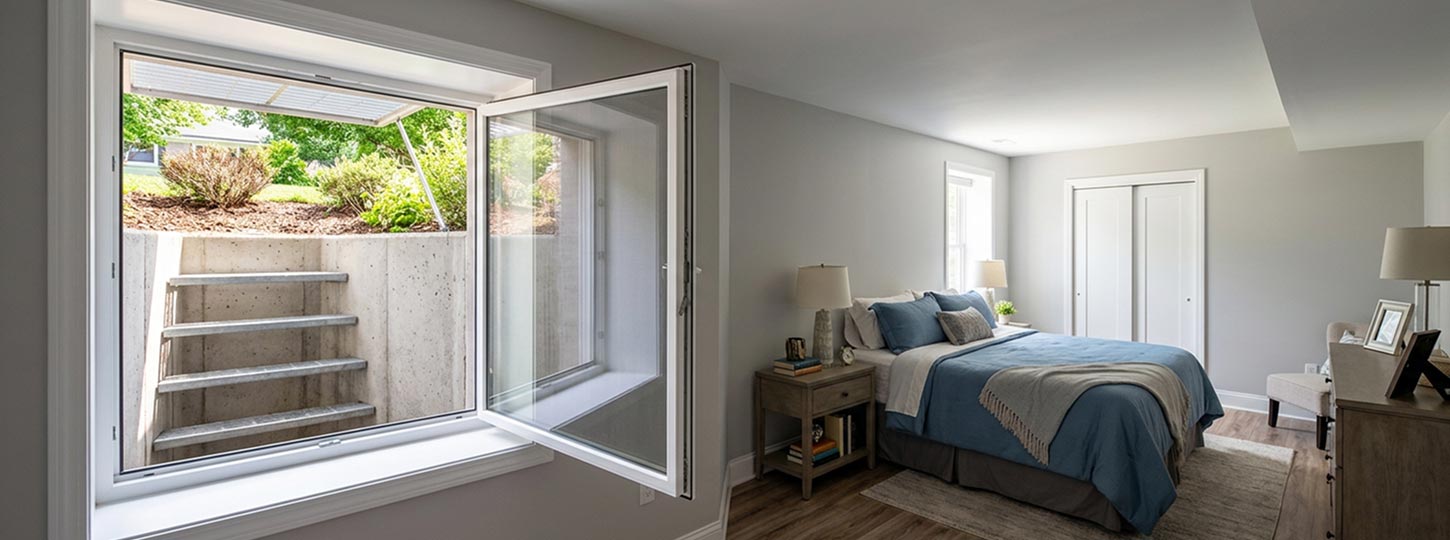
A standard small basement window prioritizes compactness: minimizing the opening in the foundation wall reduces heat loss and structural disruption. An egress window, by contrast, prioritizes the opening size, which means a larger rough opening in the foundation wall, a wider frame, and typically a different window type altogether. Casement windows, which hinge on one side and open fully outward, are the most widely specified window type for basement egress precisely because their entire sash area becomes clear when operated.
Safety and Compliance Benefits
The safety difference is not incremental; it is categorical. A standard hopper or slider window in a basement bedroom provides no viable emergency exit. An egress window provides a route that fire codes recognize as adequate for unaided escape. From a resale and insurance perspective, this distinction matters: homes with non-compliant basement bedrooms may be flagged during a property inspection, and buyers' solicitors routinely flag basement bedroom windows as a code compliance issue.
The durability of the frame material is a long-term factor that resale and inspection assessments don't always capture, but homeowners experience over time. Window Force manufactures egress casements from lead-free uPVC with UV stabilizers, a frame composition that resists the moisture cycling and temperature variation that below-grade installations produce year-round. Because the frame is extruded without metal reinforcement in critical zones, there is no thermal bridge to accelerate condensation at the sill, the first location where frame deterioration typically appears in basement window applications.
Which Rooms Typically Need an Egress Window?
The requirement follows the function, not the label on the floor plan. Any space used, or reasonably intended to be used, as a sleeping area requires an egress window (or a direct exterior door at the same level).
| Room Type | Egress Required? | Basis |
| Basement bedroom | Yes | OBC Section 9.9.10 |
| Basement den used for sleeping | Yes | Use determines requirement |
| Secondary suite bedroom | Yes | Rental code compliance |
| Above-grade bedroom | Yes | Subject to applicable code-compliant means of egress |
| Basement gym/rec room (no sleeping) | No | Non-sleeping use |
| Basement home office | No | Non-sleeping use |
| Guest room (occasional sleeping) | Yes | Sleeping triggers the requirement |
Secondary Suites
For basement secondary suites, every sleeping area should be provided with a code-compliant means of emergency egress in accordance with applicable building code requirements. Many Ontario municipalities, including those served by Window Force across Toronto and the GTA, also require that window wells be clear of obstructions and accessible from the outside. Inspectors will verify both the dimensions of the opening and the clearance in front of it.
Can Existing Basement Windows Be Converted Into Egress Windows?
In most cases, yes, but it is not a simple swap. Converting a small basement window into a compliant egress window typically involves enlarging the rough opening in the foundation wall, installing a window well, and fitting a window sized to the opening. Each step has regulatory and structural implications.
Assessment Process
The starting point is determining what you have and what is required. A contractor or building consultant should measure the existing window's clear opening and compare it against the minimum code-required opening requirements. In the majority of pre-1990s homes, the existing windows will fall short of both the area and the dimension requirements. The next question is whether the foundation wall at that location can be cut without compromising its structural integrity, a determination that may require an engineer's review in certain configurations.
Structural Changes and Permit Requirements
Cutting a larger opening in a concrete or block foundation wall requires:
- Obtaining a building permit from the local municipality is not optional
- Installing a structural lintel (header) above the new opening to redistribute the load around it
- Excavating the exterior soil to create space for the window well
- Installing the window well with a drainage connection to prevent water accumulation
- Installing the egress-compliant window
- Scheduling a building inspection to confirm compliance before closing the wall
Engineer Sergey Essipov, with 20 years of experience in window manufacturing, notes:
At our facility, every egress window we produce is custom-manufactured to the confirmed rough opening dimensions provided after permit review, not to a standard catalogue size. This matters because foundation wall cuts rarely produce a perfectly square or dimensionally consistent opening. Our lead-free uPVC frames with UV stabilizers are produced to exact tolerances, so when a contractor receives the window, it fits the permitted opening as specified. The inspection process exists to protect homeowners, and a precisely manufactured window is what makes that inspection straightforward rather than a source of remediation costs.
Custom-manufactured casement windows can be ordered to match the exact rough-opening dimensions established during an egress conversion.

What Should Homeowners Know About Egress Window Wells?
Most below-grade egress windows require a window well or equivalent exterior clearance to allow safe operation and exit. The window well is the excavated semi-circular or rectangular space outside the foundation wall that gives the window room to open, provides light, and creates the physical space for an occupant to stand while exiting.
Drainage Requirements
The most common maintenance issue with window wells is water accumulation. Without a proper drainage system, a window well can fill with rainwater and snowmelt, creating hydrostatic pressure against the window frame and the risk of basement flooding. Code-compliant window wells must connect to the building's drainage system or to a gravel bed deep enough to disperse water. A window well typically covers a transparent polycarbonate dome that protects the well from debris and reduces the volume of precipitation entering the space.
Safety Features
The Ontario Building Code specifies a minimum clearance of 550 mm between the egress window and the nearest wall of the window well. This is the minimum safe distance for the window sash to open without restriction and for a person to manoeuvre out of the opening. Window wells more than 900 mm deep must have a permanently installed ladder or steps to allow egress from the well.
| Window Well Specification | Requirement |
| Minimum clearance in front of the window | 550 mm (21.7 in.) |
| A ladder is required when the well depth exceeds | 900 mm (35.4 in.) |
| Drainage | Required gravel bed or connected drain |
| Cover | Recommended; must not restrict egress |
Maintenance Tips
Window wells should be inspected at least once a year, ideally in spring, for debris accumulation, drainage function, and any signs of corrosion in the well liner. Covers should be checked to ensure they can be quickly removed from the inside. Gravel drainage beds should be topped up if compaction has reduced their depth.
What Are the Benefits of Installing an Egress Window?
Installing an egress window is one of the most impactful upgrades you can make to a finished basement. While compliance with the Ontario Building Code is often the primary motivation, the advantages extend far beyond meeting legal requirements. A properly designed egress window can improve occupant safety, increase natural light and ventilation, enhance the usability of below-grade living spaces, and contribute to the property's overall marketability. These benefits are particularly important for homeowners who use their basements as bedrooms, family living areas, or rental accommodations.
Safety Benefits
The primary benefit is the one the code was written to address: a second means of escape from a below-grade sleeping area. Smoke and fire can block stairways within minutes; an egress window provides an alternative route that does not depend on the structural condition of the rest of the house. For families with children, elderly relatives, or tenants sleeping in basement rooms, this is not an abstract benefit.
According to guidance from the National Fire Protection Association (NFPA), every bedroom should have access to two potential escape routes, typically a door and an operable egress window. NFPA identifies inadequate escape options as a common weakness in residential fire safety and emphasizes the importance of knowing two ways out of sleeping areas.
Comfort Improvements
Below-grade spaces are typically darker and less ventilated than above-grade rooms. An egress-compliant casement window, by definition, has a much larger glass area than the small hopper windows typical of older basements. The increase in natural light materially changes how a basement space feels, converting what might have been a dim utility area into a usable, comfortable living space. The ventilation improvement is equally significant: a fully opening casement window in a basement bedroom allows for cross-ventilation and helps control humidity, which is a persistent issue in below-grade Canadian spaces.
Natural daylight has measurable effects on occupant comfort and well-being. Research published by the National Research Council Canada indicates that access to daylight can improve visual comfort, support circadian rhythms, and increase perceived indoor environmental quality. Enlarged basement window openings therefore provide benefits that extend beyond code compliance alone.
What Factors Affect the Cost of an Egress Window Installation?
Egress window installation costs vary significantly depending on the scope of work required, specifically whether the existing opening is already large enough or whether foundation cutting and well excavation are needed.
Cost Breakdown
| Cost Component | Approximate Range (Ontario) |
| Egress-compliant window (supply only) | $400 — $900 |
| Window well (supply and install) | $600 — $1,500 |
| Foundation wall cutting (concrete/block) | $1,200 — $2,500 |
| Excavation (exterior soil removal) | $800 — $2,000 |
| Lintel/header installation | $500 — $1,200 |
| Building permit | $150 — $400 (municipality-dependent) |
| Labour (installation and finishing) | $800 — $1,800 |
| Total (full conversion project) | $4,400 — $10,300 |
These figures reflect typical contractor pricing in Ontario. Projects in Toronto or other established urban municipalities tend to fall at the upper end of these ranges due to access constraints, labour costs, and permit complexity.
Upgrade Options
Homeowners undertaking an egress window installation can specify glass upgrades at the same time, since the window will be installed in a new or enlarged frame. Triple-pane glazing, Low-E coatings, and argon gas fill improve the thermal performance of what is typically the largest and most exposed window opening in a basement. For below-grade applications, upgrading to triple-pane is particularly effective at reducing condensation on the interior glass surface, a common issue in Ontario winters.
Window Force egress windows are built with a dual-seal, metal-free warm-edge spacer system that directly addresses the condensation problem in below-grade installations. Unlike standard aluminum spacers, which conduct cold from the glass edge into the frame cavity, our warm-edge system maintains a higher temperature at the glass perimeter, the precise location where condensation forms first in basement environments. For homeowners upgrading to triple-pane glazing during an egress conversion, this spacer configuration is what makes the thermal improvement measurable rather than marginal.
How Can You Ensure Your Egress Window Meets Local Building Codes?
Code compliance is not self-certifying. A homeowner cannot simply install a window they believe to be large enough and assume it is compliant. The formal process involves a permit, a scheduled inspection, and a sign-off from a municipal building official.
Permit Process
The permit application is submitted to the local municipality's building department and should include a description of the work, the location of the proposed window, and details of the structural support being provided. Most municipalities require a site plan or dimensioned drawing. Permit fees vary by municipality but are a fixed cost of compliance, not a discretionary expense.
Inspection Requirements
Once the work is complete, the homeowner or contractor requests a final inspection. The inspector will verify:
- The clear opening dimensions of the installed window as required by the Ontario Building Code
- That the window opens without tools or special knowledge
- That the window holds its open position independently
- That the window well has a minimum 550 mm clearance in front of the sash
- That a ladder or steps are present if the well exceeds 900 mm in depth
- That the structural lintel above the opening is properly installed
Common Mistakes
The most frequent compliance failures are using a window type that cannot produce a full clear opening (particularly double-hung or sliding windows where only one sash operates), measuring the frame opening rather than the clear opening, and failing to confirm the window well clearance matches the sash swing direction. Window Force manufactures all custom vinyl windows to precise dimensional specifications, which allows contractors and homeowners to order the exact clear opening measurements confirmed during the permit review, eliminating sizing ambiguity before installation.
Are Egress Windows Worth the Investment for Homeowners?
Framing this as an optional investment misses the point for any basement with sleeping areas; egress windows are legally required in those spaces. The more useful question is whether homeowners who are renovating basements without current sleeping use should proactively install egress windows.
ROI Analysis
| Factor | Without an Egress Window | With an Egress Window |
| Legal rental status | Not achievable | Achievable with other suite requirements |
| Resale inspection outcome | Likely flagged as a deficiency | No basement window deficiency |
| Emergency safety (occupant) | No secondary exit | Code-compliant secondary exit |
| Natural light in the basement | Limited | Significantly improved |
| Basement humidity/ventilation | Often poor | Improved with full casement opening |
| Code status | Non-compliant (if sleeping) | Compliant |
Property Value Impact
Home inspectors, appraisers, and real estate professionals frequently review basement bedroom egress compliance when assessing a property's legality, safety, and marketability. A basement advertised as containing a bedroom or income-generating secondary suite may be affected by whether the space meets Ontario Building Code egress requirements. A legal basement suite can contribute significantly more value than a non-compliant suite, although the impact varies by location, market conditions, and property characteristics.
Long-Term Benefits
Beyond the immediate financial case, egress windows can provide long-term value to a property. When installed with proper drainage, a code-compliant window well, a durable vinyl frame, and energy-efficient glazing, they improve basement safety, natural light, ventilation, and overall usability. These benefits may enhance the home's appeal to future buyers and occupants. Depending on the manufacturer's warranty terms, a quality egress window can also offer long service life with relatively low maintenance requirements.
Conclusion
Egress windows exist because basement sleeping areas present unique life-safety challenges during emergencies. The Ontario Building Code is specific about what is required: a minimum clear opening of 0.35 m², no dimension below 380 mm, fully operable without tools, and structurally self-supporting when open. For any finished basement bedroom or secondary suite in Ontario, this is a legal minimum, not a recommendation.
Homeowners undertaking basement renovations should treat compliance with egress window requirements as the first fixed cost, not an optional upgrade. The investment protects occupants, enables legal rental status, removes inspection red flags at resale, and improves the livability of below-grade spaces through increased light and ventilation. Window Force manufactures custom egress casement windows from lead-free uPVC at our 80,000 sq ft Ontario production facility. Every unit is CSA certified, ENERGY STAR qualified across all Canadian climate zones, and backed by a 25-year transferable warranty covering both the vinyl frame and the sealed glass unit. Ordering to the confirmed rough opening dimensions established during permit review eliminates guesswork and ensures the window passes inspection the first time.
Frequently Asked Questions
What is the minimum size for an egress window in Ontario?
Under the 2024 Ontario Building Code, the minimum unobstructed clear opening is 0.35 square metres (3.77 sq ft), with no individual dimension smaller than 380 mm (15 inches) in either height or width. This refers to the actual open space available once the window is fully open, not the frame or glass dimensions.
Does every basement window need to be an egress window?
No. The egress requirement applies specifically to basement spaces used as sleeping areas, bedrooms, guest rooms, or any room where a person sleeps. Utility areas, storage rooms, gyms, and recreational rooms without sleeping use do not require egress windows, though they may benefit from them.
What window type is best for basement egress compliance?
Casement windows are widely recommended as the most efficient choice. Because a casement opens fully on one side, the entire sash area becomes clear, meaning a relatively compact frame can meet the 0.35 m² requirement. Sliding windows require approximately double the frame width to achieve the same clear opening, since only one panel moves.
Do I need a building permit to install an egress window?
Yes, in virtually every Ontario municipality. Any work that involves cutting or enlarging an opening in a foundation wall requires a building permit. The permit process includes a structural review and a final inspection to confirm that the window meets code requirements. Skipping the permit is both illegal and structurally risky; foundation walls are load-bearing.
Can I install an egress window myself?
The window itself can be installed by a capable DIYer once the rough opening is correctly prepared and permitted. However, cutting a foundation wall, installing a structural lintel, and excavating a window well involve structural and waterproofing risks that most homeowners should leave to experienced contractors. The permit and inspection process provides a check on the quality of the work, regardless of who does it.
How deep does a window well need to be for egress compliance?
The Ontario Building Code specifies a minimum clear space of 550 mm between the egress window and the wall of the window well, measured in the direction the window sash opens. Window wells deeper than 900 mm must have a permanently installed ladder or steps built into the well to allow a person to climb out after exiting through the window.
People Also Ask