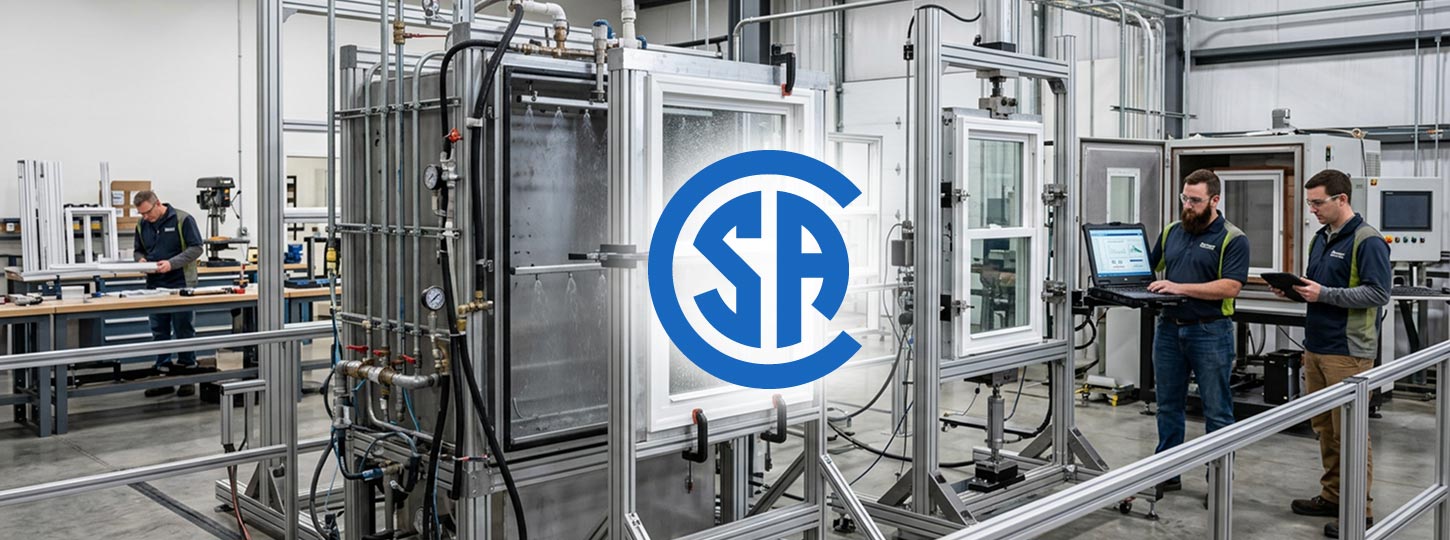


When shopping for replacement or new construction windows in Canada, you will encounter the CSA mark with some regularity. What that mark actually represents, what was tested, how it was tested, and which performance thresholds were met is far less commonly understood. This article explains exactly what CSA certification evaluates, why those tests exist, and why the distinction between a certified and an uncertified product carries real consequences for building performance and code compliance.
Window Force is an Ontario-based manufacturer that has developed and produced its own vinyl window lines since 2007 at an 80,000 sq ft production facility — including casement, awning, hung, slider, picture, bay, bow, and custom architectural configurations — entirely in-house. Because we design our profiles, specify our components, and run our own production under CSA certification, we work within the testing framework described in this article at every stage: from engineering a new frame geometry to fulfilling a trade order with documented performance specifications.
Key Takeaways
- CSA certification for windows and doors is governed by NAFS (AAMA/WDMA/CSA 101/I.S.2/A440) and its Canadian supplement, CSA A440S1, which imposes stricter requirements than those in the United States.
- Certification evaluates core performance categories, including air leakage, water penetration resistance, and structural performance, with additional requirements that vary by product type and application.
- A CSA-certified window is subject to ongoing factory audits that verify continued compliance with the certified design.
- The National Building Code of Canada references NAFS and CSA A440S1 as mandatory compliance benchmarks, meaning that compliance with CSA-referenced performance standards is a code requirement for applicable construction projects, not simply an optional premium feature.
- Even a certified window can underperform if installed incorrectly. Certification defines tested product performance, while installation determines how that performance is achieved in the field.
What Does CSA Certification Mean for Windows and Doors?
CSA Group is a Canadian not-for-profit standards development and testing organization with roots going back to 1919. For the fenestration industry, it operates as both the developer of Canadian window and door standards and as a certification body that tests and audits products against those standards.
The primary standard governing window and door certification in Canada is AAMA/WDMA/CSA 101/I.S.2/A440, known as the North American Fenestration Standard (NAFS). This document was developed jointly by American and Canadian industry organizations and is published as a National Standard of Canada by CSA Group. In Canada, the standard is applied in conjunction with CSA A440S1 — the Canadian Supplement, which introduces additional requirements specific to the Canadian climate and building code environment. According to CSA Group, certification services are provided in accordance with NAFS, CSA A440S1, and CSA A440.2 for energy performance verification.
The purpose of this certification framework is to establish a consistent, independently verified baseline for how a window or door performs under real environmental loads: wind, rain, thermal stress, and structural pressure. A product bearing the CSA mark has been tested in an accredited laboratory and passed those tests.
For Canadian window manufacturers, meeting this standard is not a marketing choice; it is an engineering commitment. Manufacturers who design and produce to these specifications from the ground up build compliance into every component, rather than retrofitting a product to pass a test.
Windows Near Me
Why Is CSA Certification Important in the Canadian Window Industry?
Canada's wide range of climate conditions requires window systems to meet performance criteria designed for significant variations in wind, moisture, and temperature exposure. Heating seasons in most Canadian cities span five to seven months. Driving rain events occur year-round. Wind loads in coastal and prairie regions can be extreme. The CSA certification framework was built with this context in mind.
The National Building Code of Canada references NAFS and CSA A440S1 as the compliance pathway for windows, doors, and skylights in residential and commercial construction. This means that building officials across the country can require CSA-compliant products as a condition of permit approval. Specifying an uncertified window in a permitted project is not merely a quality risk; it can trigger non-compliance findings.
Beyond code compliance, certification also functions as a consumer confidence mechanism. When a homeowner or contractor selects replacement windows, certification provides documented evidence of what the product will do under defined conditions, independent of any claims in sales material. Performance Grades (PG) printed on the certification label correspond to specific tested pressures and allow direct comparison between products. A PG-25 window has been tested under lower design pressure conditions than a PG-40 window, with each rating corresponding to a different structural performance level.
| Performance Class | Typical Application | Performance Grade Range |
| R — Residential | Detached homes, townhouses | PG 15 to PG 25 |
| LC — Light Commercial | Low-rise multi-unit, light commercial | PG 25 to PG 35 |
| CW — Commercial Window | Mid-rise commercial and institutional | PG 30 to PG 60 |
| AW — Architectural Window | High-rise, exposed locations | PG 40 and above |
The Canadian supplement adds a further layer of specificity: unlike the American version of NAFS, which reports a single Performance Grade, Canadian labelling requires separate Primary and Secondary Designators. This means a window's air leakage performance and its water penetration resistance are reported independently from its structural rating. This provides a higher level of granularity, allowing specifiers to confirm that a product meets all three criteria, rather than assuming that a structural pass implies good air or water performance.
How Are Windows Tested for Air Leakage Performance?
Air leakage, the uncontrolled movement of air through window joints, seals, and frame-to-wall interfaces, is one of the most significant contributors to energy loss in Canadian homes. The CSA certification process quantifies this characteristic precisely.
Laboratory testing for air infiltration and exfiltration is conducted by mounting the window in a calibrated test chamber, sealing it against the surrounding structure, and applying a pressure differential across the assembly. Under CSA A440S1, air leakage is measured in litres per second per square metre (L/s·m²) at a reference pressure of 75 pascals. The results are reported using an alphanumeric rating: A1, A2, or A3, where A3 represents the tightest performance standard.
The Canadian Supplement's air leakage criteria are stricter than the corresponding NAFS requirements. An American manufacturer that has tested and certified a product for the U.S. market cannot assume the product meets Canadian code requirements without separately confirming compliance with the CSA A440S1 air infiltration thresholds.
From an energy performance standpoint, reducing air leakage is directly related to heating and cooling costs. A poorly sealed window in a Toronto winter is not merely uncomfortable; it continuously transfers heat, regardless of how good the glass unit or frame insulation is. Well-manufactured custom vinyl windows with fusion-welded corners and tested weatherstrip systems reduce air infiltration at the source, rather than relying solely on installation sealants to compensate for product gaps.
How Does CSA Evaluate Water Penetration Resistance?
Water penetration resistance testing simulates the conditions of a wind-driven rain event, arguably the most destructive and most frequent weather challenge that Canadian windows face across all four seasons.
The test involves mounting the window in a chamber, applying a controlled water spray to the exterior surface at defined rates (typically 2.4 to 5 gallons per square foot per hour), and simultaneously applying air pressure differentials across the assembly to simulate wind. The test pressure values used in Canada are determined using the Driving Rain Wind Pressure calculations in CSA A440S1, which are location-specific; a window installed in a high-exposure coastal location must perform to a higher test pressure than one installed in a sheltered urban setting.
The Canadian Supplement introduces additional water penetration requirements that address conditions specific to Canadian construction and climate exposure. Research published by the National Research Council of Canada found that water penetration testing at varying spray rates and pressure differentials, including up to 700 pascals of air pressure differential, reveals failure modes that simpler static testing protocols do not identify. This matters because moisture that enters at the window-to-wall interface, rather than through the glass unit, is the most common source of long-term building envelope damage. According to the NRC research, water penetration protocols were evaluated at spray rates from 0.8 to 3.4 L/min·m² and pressures from 0 to 700 Pa, in both static and dynamic modes.
| Test Parameter | NAFS Standard | CSA A440S1 Canadian Supplement |
| Water spray rate | Fixed rate | Variable: 0.8 to 3.4 L/min·m² |
| Test pressure | Standardised | Location-specific via Driving Rain Wind Pressure calculation |
| Failure definition | No water on the interior surface | More restrictive criteria; separate Canadian definition |
| US product applicability | Meets NAFS | Must be separately confirmed against the Canadian supplement criteria |
Drainage performance, which determines how well the frame manages water contacting the exterior surface, is also evaluated as part of this assessment. A certified frame design includes drainage channels and weep systems engineered to direct water away from the wall opening, rather than allowing it to accumulate at the sill.
How Is Structural Performance Measured During Certification?
Structural performance testing determines whether a window frame and glazing assembly can withstand the wind loads it will encounter over its service life without failing, deforming permanently, or allowing component separation.
The primary test applies a uniform positive and negative design pressure across the window in a pressure chamber. Under NAFS, the product must not deflect beyond allowable limits (typically L/175 of the span) and must not show permanent deformation or failure after the test cycle. The positive pressure test replicates wind pushing against the window; the negative pressure test replicates suction on the exterior face, which, in practice, can be more demanding for outward-opening products.
Performance Grade numbers correspond directly to these structural test pressures. A PG-25 window has been tested to ±1,200 pascals of static pressure; a PG-40 window to ±1,920 pascals. The required Performance Grade for any given installation is calculated using wind load tables in CSA A440S1, based on the building's geographic location, height above grade, and terrain exposure. A window specified correctly for Calgary's exposed prairie conditions will carry a different PG requirement than one destined for a sheltered residential street in the same city.
Operational performance is also assessed as part of structural testing. Operating forces, meaning the effort required to open, close, and lock the window, are measured to confirm that the hardware performs within acceptable ranges across the rated pressure conditions. For casement and awning configurations, the test confirms that sash alignment is maintained and that the locking mechanism engages correctly after the structure has been subjected to design load.
Engineer Sergey Essipov, with 20 years of experience in window manufacturing, explains:
At our facility, we engineer our multi-chamber uPVC profiles specifically to manage deflection under load — not simply to meet the minimum threshold, but to maintain glass unit seal compression across the product's full service life. When a frame flexes past its design limit, the IGU loses contact pressure at the perimeter seal, and condensation inside the unit follows within a few years. Building that margin into the profile geometry from the start is what separates a frame that passes certification from one that continues to perform after installation.
What Role Does CSA Certification Play in Window Manufacturing Quality Control?
Laboratory testing of a prototype establishes that a product design can achieve the required performance. Factory audits are what confirm that every unit coming off the production line matches what the laboratory tested.
CSA Group's certification programme includes periodic unannounced surveillance audits of manufacturing facilities. During an audit, inspectors verify that the materials, components, and processes in use match the documented specifications on file for the certified product. If a manufacturer changes a profile compound, substitutes a hardware component, or modifies a glazing process, those changes must be reviewed and, if necessary, retested before the certification mark can continue to be applied.
The audit process follows a sequence that covers material verification, production sampling, dimensional inspection, and process compliance:
- Confirm incoming material specifications match certified product documentation (vinyl compound, hardware, glass unit specifications)
- Review production records for traceability. Each window or batch must be linkable to its component sources
- Inspect assembled units for dimensional accuracy, corner weld quality, and hardware alignment
- Verify that certification labels are being applied correctly and only to units that match the certified design
- Review calibration records for production equipment used in quality-critical operations
For consumers and specifiers, factory audits provide additional assurance that certified products continue to be manufactured in accordance with the approved specifications. This is a meaningful distinction from uncertified products, where there is no independent verification that the unit on site resembles anything that was ever formally evaluated.
Does CSA Certification Evaluate the Glass, Frame, and Hardware Components?
CSA certification evaluates the window or door as a complete, assembled system. The performance categories air leakage, water penetration, and structural load reflect the behaviour of the assembly under the specified conditions, which means that glass, frame, and hardware all contribute to the result.
The frame material (vinyl, wood, fibreglass, aluminum) must provide sufficient rigidity to resist deflection under structural loads without allowing the weatherstrip and gasket system to lose contact. Vinyl frames specifically benefit from fusion-welded corners, which create a continuous monolithic joint at the sash and frame corners, a construction detail that meaningfully outperforms mechanically fastened corner assemblies in maintaining air and water seals under thermal cycling and structural load.
The insulated glass unit (IGU) must be manufactured and sealed to retain its gas fill (typically argon) throughout its expected service life and to maintain structural integrity during pressure-testing sequences. Glazing options that include Low-E coatings or triple-pane configurations affect thermal performance ratings (governed separately by CSA A440.2 for energy) but do not change the structural, air, or water performance requirements under the primary NAFS certification.
Hardware is evaluated for operating-force compliance and for maintaining engagement throughout the structural test sequence. A locking mechanism that fails to engage under simulated wind-load pressure constitutes a certification failure, regardless of how well the frame performs.
| Component | What Certification Evaluates | Why It Matters |
| Frame | Rigidity, deflection limits, and weatherstrip retention | Frame flex breaks air and water seals |
| Corner welds/joints | Continuity of seal at corners under load | Most air and water failures originate at corners |
| Insulated glass unit | Structural integrity through pressure cycles | IGU failure voids energy performance over time |
| Weatherstrip/gaskets | Maintained contact under design pressure | Gap at weatherstrip = direct air and water path |
| Hardware (locks, hinges) | Operating force, engagement under pressure | Locking failure under load = structural non-compliance |
The corner joint performance described in that table is where the frame construction method has the most direct consequence. Window Force frames are produced with fusion-welded corners on both the sash and the outer frame, a process that forms a continuous, monolithic joint rather than a mechanically fastened one. Unlike corner keys or bracket assemblies that rely on adhesive or mechanical compression to maintain the seal, a fusion weld becomes part of the profile itself. This matters during structural testing, where pressure cycling repeatedly stresses the corner joint, and it matters equally over a 25-year service life, where seasonal thermal movement accumulates thousands of expansion and contraction cycles.
For homeowners, component-level detail matters because it explains why a frame from a non-certified manufacturer may look similar to a certified product on the showroom floor, yet perform very differently in service. The certification process tests all of these elements simultaneously and under load conditions that a visual inspection cannot replicate.
How Does Certification Influence Window Installation Requirements?
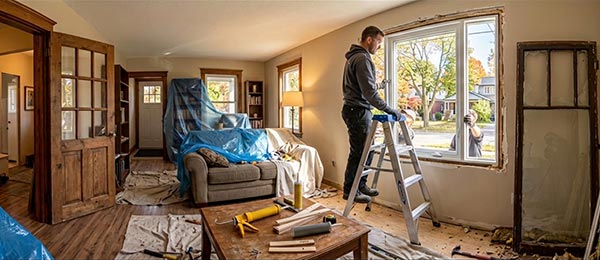
A CSA-certified window achieves its rated performance in the laboratory, mounted in a standardized test fixture. Once the same window leaves the factory and enters a real wall opening, the quality of the installation determines whether that rated performance is actually delivered to the occupant.
CSA A440.4 Window, Door, and Skylight Installation provides the installation standard referenced in Part 9 of the National Building Code for residential buildings. CSA A440.6, published in 2020, addresses high-exposure fenestration installation for Part 5 buildings. Together, these standards define the flashing, shimming, sealing, and anchoring practices that must be followed to maintain the performance a certified window can deliver.
The critical installation elements specified in these standards include:
- Rough opening preparation: The opening must be square, level, and free of obstructions that would prevent the frame from sitting flush and even
- Sill flashing: A sloped, waterproof sill pan is required to direct any incidental water away from the building assembly, preventing moisture accumulation at the most vulnerable point
- Head and jamb flashing: Properly lapped flashing at the head and jambs integrates with the wall's drainage plane; improper lapping can direct water into the wall cavity rather than away from it
- Shimming and fastening: Frame must be shimmed at specified intervals to prevent bow or twist; over-tightening fasteners can distort vinyl frames and affect hardware operation
- Perimeter sealing: Interior vapour seal and exterior weather seal complete the air control layer between the window frame and the rough opening
Engineer Sergey Essipov, with 20 years of experience in window manufacturing, notes:
We see the same installation failures repeatedly: sill pans that drain toward the wall, shimming that twists the frame so the sash drags, exterior sealant applied without backer rod so it bridges the gap instead of filling it. A well-built window deserves a properly prepared opening. You can't recover certified performance from a compromised installation.
Can a Poorly Installed Certified Window Still Fail to Perform Properly?
The short answer is yes, and it happens more often than the industry acknowledges. Certification defines the ceiling of what a product can achieve under ideal conditions. Installation quality determines how close to that ceiling the installed window actually performs.
| Installation Error | Performance Consequence | Homeowner Risk |
| Missing sill pan flashing | Water accumulates at the sill and enters the wall cavity | Structural rot, mould, warranty void |
| Frame not plumb or square | Sash binding, hardware stress, seal gap | Air and water leakage, hardware failure |
| Improper exterior sealant | Wind-driven rain bypasses the frame perimeter | Water intrusion at the jamb or head |
| Over-shimmed frame | Vinyl frame bows inward, glass unit under stress | Seal failure, condensation in IGU |
| Insulation is packed too tightly | The frame is laterally loaded, and the weep system is blocked | Air leakage, moisture damage |
Warranty implications are a second significant consideration. Most window manufacturer warranties, including the structural and material defect coverage that comes with certified products, contain explicit exclusions for damage attributable to installation errors. Water damage resulting from missing sill pan flashing is typically not covered under the window warranty because the cause lies outside the product itself. Homeowners who hire unqualified installers risk losing both the warranty protection and the actual performance the certified window was designed to deliver.
Selecting a certified product through a manufacturer that also maintains an authorized dealer and contractor network reduces this risk, because installation quality is part of the supply relationship, not an afterthought.
How Can Homeowners Identify CSA-Certified Windows and Doors?
Certification status for a window or door can be verified through several channels, and confirming it before purchase is straightforward.
- Certification label on the product: CSA-certified windows carry a permanent label on the frame (typically on the jamb or sill), displaying the Performance Grade, product class, size tested, design pressure, water penetration resistance test pressure, air infiltration level, and the applicable standard reference (e.g., AAMA/WDMA/CSA 101/I.S.2/A440 and CSA A440S1). This label is not a sticker that can be removed after delivery; it is applied as part of the certification programme requirements.
- Manufacturer product documentation: Certified manufacturers maintain test reports and certificates of conformance for their product lines. Ask for the test report specific to the window model and size you are purchasing, not a general certification letter.
- CSA Group's online director: A publicly searchable database of certified products and manufacturers. Verifying that the manufacturer appears in this directory confirms that their certification is current and active, not simply historical.
- Fenestration Canada resources: Fenestration Canada, the national industry association, provides an online calculator that allows specifiers and homeowners to determine the required Performance Grade for any location in Canada, enabling them to verify that a product's rated PG matches the installation location's requirements. According to CSA Group, the certification mark confirms that a product has been tested and audited under both NAFS and the Canadian Supplement requirements.
- Delivery documentation: When windows arrive on site, the packing documentation should reference the product series, the certified design, and the applicable standard. Any discrepancy between what was ordered and what is delivered regarding model, glass configuration, or hardware should be confirmed against the certified product specifications before installation begins.
What Are the Key Takeaways About CSA Certification for Windows and Doors?
CSA certification for windows and doors is a layered process that covers product design, laboratory performance, component quality, manufacturing consistency, and installation compliance. No single element in isolation is sufficient; a well-tested design produced in an unaudited facility offers weaker assurance than one where both the product and the process are under regular independent review.
The Canadian Supplement to NAFS, CSA A440S1, is a meaningful distinction for anyone purchasing windows in Canada. Its stricter water penetration definition, location-specific performance grade requirements, and separate air and structural designators make it a more complete evaluation of real-world Canadian conditions than the baseline NAFS standard alone. Canadian window manufacturers who design the supplement from the ground up rather than adapting products certified for other markets, are in the best position to consistently meet these requirements across their product lines.
For homeowners, the practical conclusion is this: confirming CSA certification status before purchase, verifying that the Performance Grade matches your location's requirement, and ensuring that installation is carried out by a qualified installer in accordance with CSA A440.4 or A440.6 are the three steps that translate a certified product into a certified outcome.
Window Force is CSA-certified and carries an ENERGY STAR qualification across all Canadian climate zones, with both designations verified through independent testing rather than self-reported. Our custom-to-order manufacturing model means that every window is produced from lead-free uPVC compound to the specifications of its installation location, with the Performance Grade matched to the building's geographic and exposure requirements at the time of order. Products are distributed and installed through an authorized dealer network, which maintains installation quality through a defined, accountable process rather than separating product and installation into unrelated transactions. The 25-year transferable warranty covers the result of that entire chain — design, manufacturing, and installation, not the product in isolation.
Frequently Asked Questions
What is the difference between NAFS and CSA A440S1?
NAFS (AAMA/WDMA/CSA 101/I.S.2/A440) is the jointly developed North American Fenestration Standard used in both Canada and the United States. CSA A440S1 is the Canadian Supplement that adds requirements specific to the Canadian building code environment, including stricter water penetration failure criteria, location-specific performance grade calculations, and separate reporting of air and structural ratings on product labels. Both documents are referenced by the National Building Code of Canada; compliance with NAFS alone does not confirm compliance with Canadian code requirements.
Is CSA certification mandatory for windows installed in Canada?
Yes, for buildings governed by the National Building Code of Canada and provincial building codes that adopt it. The NBC references NAFS and CSA A440S1 as the compliance standard for windows, doors, and skylights. Building officials may require documentation of certified performance as a condition of permit approval. Uncertified products installed in permitted construction can result in a non-compliance finding.
What does a CSA Performance Grade number mean?
The Performance Grade (PG) corresponds to the test pressures applied during laboratory structural testing. A PG-25 window has been tested to a design pressure of ±1,200 pascals; a PG-40 window to ±1,920 pascals. The required PG for any installation is determined by the building's geographic location, height, and terrain exposure, using the calculations specified in CSA A440S1. Selecting a window with a PG that matches the location's requirement is a code obligation, not a discretionary upgrade.
Can I verify whether a specific window manufacturer is CSA-certified?
Yes. CSA Group maintains a publicly searchable directory of certified manufacturers and product lines. You can also request a test report and certificate of conformance directly from the manufacturer for the specific model and size you are purchasing. The certification label on the window frame itself should display the applicable standard reference and Performance Grade.
Does CSA certification cover energy performance?
CSA certification under NAFS and CSA A440S1 covers structural, air-leakage, and water-penetration performance. Energy performance, including U-factor, solar heat gain coefficient, and visible light transmittance, is governed separately by CSA A440.2, and compliance with energy requirements is verified through the ENERGY STAR programme administered by Natural Resources Canada. A window can be NAFS-certified without being ENERGY STAR qualified, and vice versa, though reputable Canadian manufacturers carry both designations.
Why does installation affect a certified window's performance?
Certification tests are conducted in controlled laboratory conditions with the window mounted in a standardized, ideal fixture. Once installed in a real wall opening, the air and water seals measured by the laboratory depend on proper flashing, shimming, sealing, and anchoring in accordance with CSA A440.4 and A440.6. An incorrectly installed certified window will not deliver its rated performance, and installation-related damage is typically excluded from manufacturer warranties.
People Also Ask