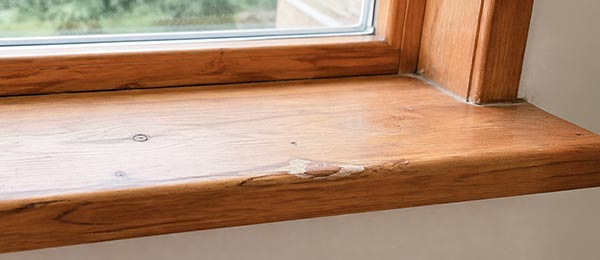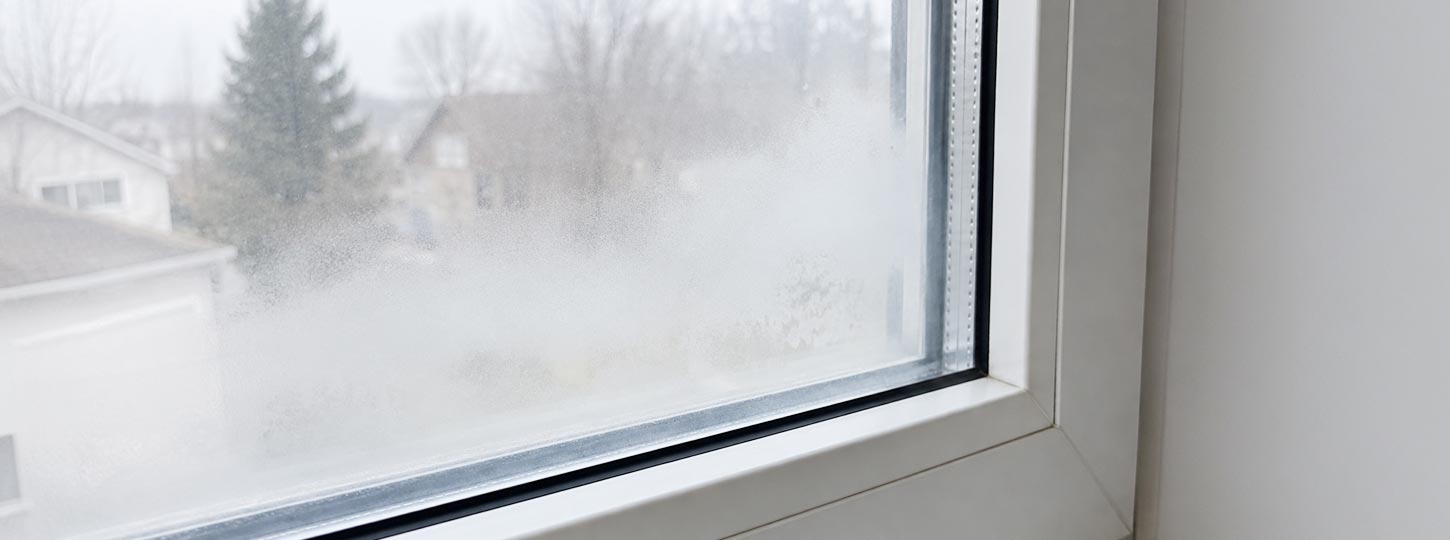


Double-pane windows can develop four distinct problems: a failed insulated glass unit, cracked glass, drafts around the sash, or condensation caused by indoor humidity. Although these symptoms can look similar, each points to a different cause and repair. Identifying the source helps avoid replacing parts that are still working properly.
Since 2007, we have assembled every sealed glass unit that goes into a Window Force window on our own 80,000 sq ft Ontario production line, where we fill the spacer with desiccant, apply both seals, and fill the cavity with gas. That position in the chain gives us a direct view of the questions that reach us through our authorized dealer network when a homeowner calls about "foggy windows": in many cases, the unit is working as designed, and the water is on the room side, while in others the seal has opened and no amount of cleaning will help. This guide follows the same diagnostic order our dealers use on site, so the symptom matches the right component before anyone discusses new glass or a new window.
Key Takeaways
- You can check four signs without tools: fog that stays after you wipe both glass surfaces, a crack in one pane, a draft at the sash, and water on the room-side glass.
- An insulated glass unit is two panes joined by a spacer, a desiccant and a perimeter seal; the gas fill sits in the gap and escapes once that seal opens.
- Seal failure can cause fog, haze or residue between the panes. Age, temperature changes and moisture around the glazing pocket can contribute to deterioration.
- Condensation between window panes is trapped water that no cloth can reach, while condensation on the room side is a humidity problem that can occur on a perfectly sealed unit.
- A cracked pane compromises the glass unit and requires prompt assessment, while a draft around clear glass usually points to the sash, weatherstripping or frame.
- A sound sash can take a new glass unit; only a rotten sash, a frame that cannot hold a unit or widespread failure makes a full window replacement the better job.
What Do Common Double-Pane Window Problems Usually Show First?
Common double-pane window problems announce themselves through four signs, and all four can be checked by a homeowner with nothing more than a cloth and a cold day:
- Fog or haze that remains after you wipe both the inside and outside surfaces of the glass clean.
- A crack running through one pane, often starting at the edge of the glass.
- A draft you can feel at the sash, meeting rail, or corners while the window is closed and locked.
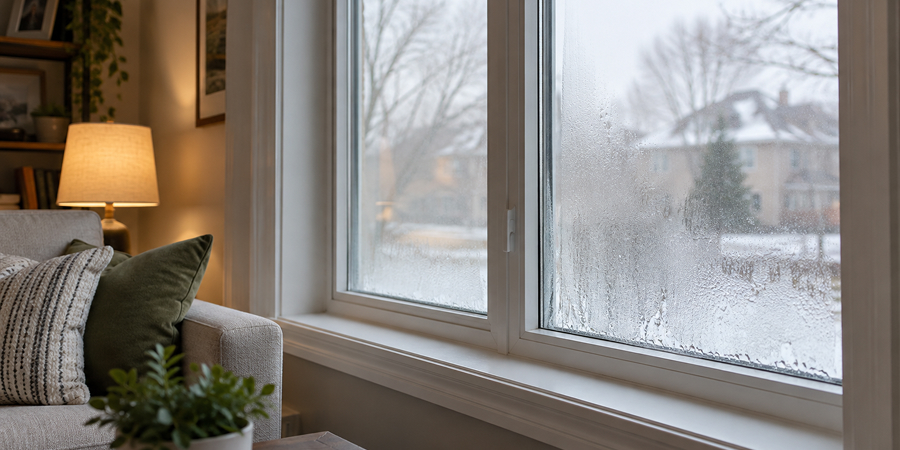
- Water droplets or frost on the room-side surface of the glass, usually worst along the bottom edge on cold mornings.
Wipe both accessible glass surfaces to locate the moisture or residue. If the mark remains between the panes, the problem is inside the sealed glass unit and ordinary cleaning can't remove it.
The second point is that the parts of a window fail independently. A frame can be square, dry and solidly fixed in the wall while the sealed unit inside it has lost its seal, and a perfectly clear unit can sit in a sash that leaks air at every corner. Judging the whole window by one symptom is the most common route to an oversized repair, so read each sign against the component it actually belongs to.
Timing makes the check more reliable. Fog from a failing seal is usually most visible on a sunny morning after a cold night, when the cavity has drawn in moist air, and the sun begins to warm it, while room-side condensation peaks on the coldest winter mornings and fades as the house warms up. Checking the same windows at both times, and noting which elevation and which rooms are affected, gives a much clearer picture than a single look on a mild afternoon.
What Is an Insulated Glass Unit, and Which Part Fails?
An insulated glass unit is the sealed glazing assembly at the centre of every double-pane window. It consists of two panes of glass held apart by a spacer that runs around the full perimeter, a desiccant (a drying agent) packed inside the hollow spacer, and a perimeter seal that bonds the glass to the spacer and closes the gap between the panes. The cavity is filled with either dry air or an inert gas such as argon, which slows heat transfer across the gap.
| Component | What it does | What happens when it fails |
| Glass panes | Form the two surfaces of the unit | A crack lets the cavity communicate with outside air |
| Spacer | Holds the panes at a fixed distance around the edge | Movement or separation can open the seal |
| Desiccant | Absorbs moisture inside the cavity | Once saturated, it can no longer keep the cavity dry |
| Perimeter seal | Keeps moisture out and the gas in | Moisture enters, gas escapes, and fogging begins |
When the perimeter seal fails, gas can escape, and moisture can enter the cavity. Fogging may appear once the desiccant can no longer absorb the incoming moisture.
Do not confuse this seal with the caulk around the frame. The perimeter seal of the insulated glass unit is applied in the factory and sits hidden under the glazing bead or stop of the sash; it controls what happens between the panes. The exterior caulk runs between the window frame and the wall, and it controls air and water at the rough opening. Fresh caulk around the frame does nothing for a unit whose own seal has opened, and a failed caulk joint says nothing about the condition of the glass unit.
The durability of insulated glass units can be evaluated through standardized testing. ASTM E2190 covers performance requirements for insulated glass units, including resistance to fogging under specified test conditions. Certification or test results provide stronger evidence of performance than general claims about seal longevity.
Accelerated-ageing tests expose insulated glass units to controlled environmental conditions to assess durability. The National Research Council Canada's Institute for Research in Construction summarizes relevant methods in this International Energy Agency Solar Heating and Cooling Task 27 report. Results depend on the test method and its acceptance criteria.
Because we assemble the spacer, desiccant, and both seals on our own line, the part of the unit that determines how long it stays clear is built under factory control rather than left to chance. Window Force uses a dual-seal, metal-free warm-edge spacer, where the primary seal blocks moisture vapour, and the secondary seal carries the structural load as the panes flex with temperature. Separating those two jobs slows how quickly moisture can reach the desiccant, so the drying capacity packed into the spacer lasts far longer than it would behind a single seal doing both.
What Does Window Seal Failure Look Like From the Room?
Window seal failure rarely appears overnight. It usually develops in stages that a homeowner can recognize from inside the room:
- A light fog or mist between the panes that comes and goes with the weather, often visible on sunny mornings.
- A permanent white haze or milky film that no longer clears during the day.
- Streaks, spots, or a dirty film between the panes that remain after cleaning both outer surfaces.
Sun exposure and repeated temperature changes can stress the edge seals over time. The rate of deterioration depends on the unit's construction, installation, exposure and local climate. Units exposed to strong sunlight or wide temperature swings may experience more pronounced daily temperature changes.
Conditions around the unit can add to these stresses. A wet frame or a sash that holds water in the glazing pocket leaves the edge of the unit sitting in moisture, and a blocked drain or weep slot keeps water there for days after rain. The seal was designed to resist humidity, not to stand in water, so a glazing pocket that cannot drain shortens the life of an otherwise sound unit. When fog appears on one or two windows at the same elevation, check whether their drainage paths are clear before assuming the units were simply defective.
Why Is Condensation Between Window Panes Stuck There?
Condensation between window panes gets trapped because the only path the water has into the cavity is the same failed seal it would need to leave through, and that path is far too small for liquid water to escape. Once the seal opens, humid outdoor or indoor air slowly enters the cavity, and the desiccant in the spacer absorbs the moisture for as long as it has capacity. When the desiccant is saturated, any further moisture condenses on the coldest inner surface of the glass.
The unit then begins to breathe. During the day, sunlight warms the cavity and the gas inside expands, pushing some of it out through the failed seal. At night, the cavity cools, the gas contracts and fresh humid air is drawn back in. Each cycle adds a little more water vapour, which is why a unit that showed light fog in one season can be permanently clouded a year or two later.
You can't reach the water itself. It sits on the inner surfaces of the two panes, behind glass that is sealed on every edge, so wiping the outdoor face or the room-side face changes nothing. This is the clearest diagnostic difference from the other forms of condensation covered in the next section.
Units on south- and west-facing walls may experience greater daily temperature changes because of sun exposure. If fogging appears first on these elevations and gradually spreads to other windows, ageing seals may be one explanation, although you should also check installation and drainage conditions.
How Is Window Condensation Inside the Room a Different Problem?
Window condensation inside the room forms on the room-side surface of the glass when warm, humid indoor air meets glass that is colder than its dew point. It can occur on a unit with a completely intact seal because the cause is the combination of indoor humidity and outdoor cold, not any defect in the window. The three locations where water can appear on a double-pane window behave very differently:
| Where the water is | Usual cause | Can a cloth reach it? |
| Between the panes | The perimeter seal has opened, and the desiccant is saturated | No |
| On the room-side surface | Indoor humidity too high for the glass temperature on a cold day | Yes |
| On the outdoor surface | Cool, clear nights chill the outer pane below the dew point of outdoor air | Yes |
Room-side condensation is a humidity problem first. Health Canada's guide to addressing moisture and mould indoors recommends keeping indoor relative humidity between 30% and 50%, lists condensation on cold surfaces such as windows among the moisture problems to watch for, and advises using exhaust fans and a dehumidifier when humidity exceeds 50% or moisture is condensing on window panes. Keeping window coverings open also lets warm room air reach the cold glass. Outdoor temperature changes the threshold: on the coldest nights, even humidity within that range can produce droplets along the bottom edge of the glass, where the surface is coolest.
Room-side condensation may appear after installing new windows because tighter windows reduce uncontrolled air leakage. Improve bathroom and kitchen exhaust ventilation, monitor indoor humidity and use a dehumidifier if needed. The cause is often moisture management, not a defective window.
Indoor relative humidity alone does not determine whether condensation will form; glass-surface temperature is equally important. Natural Resources Canada identifies colder outdoor conditions and higher indoor humidity as factors that increase condensation risk. When diagnosing recurring moisture, compare indoor humidity with outdoor temperature and observe whether droplets form mainly along the coldest glass edges or frame surfaces.
Exterior condensation, by contrast, usually signals a well-insulated unit. When little heat escapes through the glass, the outer pane stays close to outdoor temperature and can fall below the dew point on clear, still mornings, much like dew on a car windshield. It clears as the sun warms the glass and needs no repair.
Window Force uses multi-chamber uPVC frame and sash profiles. The enclosed air spaces help reduce heat transfer through the frame, although condensation risk also depends on indoor humidity, outdoor temperature and the window's overall thermal performance.
When Does One Cracked Pane Leave the Opening Closed?
A cracked pane means the insulated glass unit is damaged, even if the second pane remains intact. The unit may no longer provide its original weather resistance or security. Arrange an assessment promptly and keep people away from damaged glass until it has been made safe.
The crack's shape indicates its origin. A thermal stress crack usually starts at the edge of the glass, runs inward roughly at right angles to the edge and then curves or branches; it forms when the centre of a pane is heated by sun while the edge stays cold in the frame, or when part of the glass is shaded or covered by a heater, a dark blind or a film. An impact crack, by contrast, radiates from a single point where something struck the glass. Neither type means the other pane is compromised.
Engineer Sergey Essipov, with 20 years of experience in window manufacturing, notes:
When a homeowner reports a cracked pane, the first question is what was next to the glass. A crack that starts at the edge and runs inward usually means the centre of the pane was much warmer than the edge, which happens behind a dark blind, a heater or an applied film. A new unit with the same blind in front of it will crack the same way. The replacement can be built to the original specification, but the fix that matters is moving whatever was heating the glass.
A crack and a fogged seal are separate faults, although one can lead to the other. A crack through either pane breaches the cavity, so the gas fill escapes and humid air can enter through the crack, and fog may follow weeks or months later. A unit can also fog with both panes perfectly intact. In both cases, the fix is a new insulated glass unit rather than a new window, as long as the sash and frame are sound.
Glass requirements depend on the location, application and applicable building code. Safety glazing may be required in certain doors, near walking surfaces and around tubs or showers. Tempered glass typically breaks into small pieces when it fails, while laminated glass can remain bonded to its interlayer. Check local code requirements before specifying replacement glass.
When Is a Draft Around the Sash, Not a Failed Seal?
A draft at a closed window with clear glass is a frame and sash problem, not a glass problem. Air moves around the edges of the sash, not through the sealed unit, so the insulated glass unit can be in perfect condition while the window still feels cold and leaky. The usual places to check are these:
- The perimeter of the sash, where compressed or torn weatherstripping no longer meets the frame.
- The meeting rail of a hung or sliding window, where the two sashes overlap, and the lock pulls them together.
- The corners of the sash and frame, where joints can open slightly over time.
- The joint between the window frame and the wall, behind the interior trim, where insulation or caulk has failed.
The seal between the panes and the caulk around the frame are two different barriers with two different jobs. The first keeps moisture out of the cavity and gas in; the second, together with the weatherstripping, keeps outdoor air out of the room. A clear unit can still draft, and fixing the draft will not change the glass, just as replacing the glass will not stop air leaking at a worn weatherstrip or an unsealed rough opening.
Some drafts are adjustments rather than repairs. On hung and sliding windows, a lock that no longer pulls the sashes tight at the meeting rail, or a sash that has dropped slightly in its track, leaves a gap that reappears every time the window closes. On casement and awning windows, a sash that no longer draws in evenly against the frame when cranked shut can usually be corrected at the hinges or the locking points. In all of these cases, the glass is not involved, and the work belongs to the hardware and the weatherstrip.
Mechanically joined frames and sashes are held together at the corners by screws or keys, and those corners can loosen slightly over years of thermal movement, leaving a gap that weatherstripping alone cannot close. Window Force fusion-welds the corners of its uPVC frames and sashes, melting the profiles into one continuous piece, so the sash stays square, and the weatherstrip compresses evenly along all four sides rather than lifting away at a corner. The practical result is that a draft at a Window Force sash is a matter of adjustment or weatherstrip wear, not of a frame that has started to come apart.
What Drives Double Pane Window Repair Cost?
Double pane window repair cost depends on which part of the window has failed and how much you have to take apart to reach it. The factors that move the bill are the following:
- One unit or the whole window: replacing a single insulated glass unit costs far less than replacing the window, and some windows contain several units.
- The size of the glass: larger units use more glass and gas, weigh more, need more handling, and very large or tempered units take longer to produce.
- A grid between the panes: muntins or grilles sealed inside the cavity have to be built into the new unit to match the existing ones.
- Specialty glass: tempered or laminated safety glass, Low-E coatings, and gas fill must match the original specification or be upgraded.
- Access: a ground-floor window is quicker to service than an upper-storey unit that needs ladders, scaffolding or work from inside a finished room.
- Whether the sash has to come out: some units can be replaced with the sash in place, while others require removing the sash or the whole operable panel and reglazing.
Access often weighs more than homeowners expect. A homeowner working with a window supplier in Quebec City on an older multi-storey masonry building may face higher labour costs because of deep openings and limited access. By comparison, a ground-floor window in a suburban home may be easier and less expensive to service.
Timing also matters. A replacement insulated glass unit is manufactured to the exact size, thickness and specification of the opening, so it is ordered after measurement rather than taken from stock, and the window remains in service with its damaged unit until the new one arrives. A fogged or cracked unit with an intact pane rarely needs emergency work, which lets you group the order with other failed units in the house and install them in one visit.
When Does Double Pane Window Repair Clear the Fog, and When Does It Not?
Double pane window repair, in the sense of a "defogging" or dry-out service, aims to remove moisture from a fogged unit and keep it from returning. It can make a unit look clear again, but its reach is limited by what the moisture has already done to the glass.
When Is the Glass Still Clear Enough to Dry?
A dry-out is only worth considering for a unit in the early stages of failure, when the fog comes and goes, and the glass beneath it is still clean and smooth. The evaluation follows a simple order:
Even when the result is clear glass, a dried unit is not restored to its original condition. The original gas fill has already escaped and is not replaced; the factory seal remains open, and the cavity now depends on the treatment rather than a sealed edge, so its insulating value is at best that of an air-filled unit.
When Have Minerals Already Etched the Pane?
Repeated cycles of condensation and evaporation inside the cavity leave minerals and residue on the glass's inner surfaces. Over time, these deposits bond to the surface or etch it, producing a permanent white haze, streaks or a frosted look that no cleaning or drying can remove. At that stage, the problem is no longer moisture, but the glass itself, and only a new insulated glass unit will restore a clear view.
When Is Double Pane Window Glass Replacement Enough?
Double pane window glass replacement is enough when the failure is confined to the sealed unit and the rest of the window is sound. The conditions that point to a glass-only job are straightforward:
- The sash is square, dry and solid, with no soft or rotten wood and no cracked or warped vinyl.
- The frame is firmly fixed in the opening and holds the sash correctly when it closes and locks.
- The hardware, balances and weatherstripping still work, or can be serviced separately.
- The fault is fog, haze or a crack in the unit itself, not water entering around the frame.
In that case, a new insulated glass unit is built to the size and specification of the existing one and fitted into the existing sash, with new glazing tape or sealant and the glazing stops refitted. The sash, frame, and interior and exterior trim stay where they are. This is a much smaller job than a new window: no work at the rough opening, no change to the wall, and no disturbance to the finishes around the window.
Matching the new unit to the original is the main technical requirement. The overall thickness must fit the glazing pocket, and the grid, Low-E coating, tempered glass, or gas fill in the original unit should be carried over or deliberately upgraded rather than lost in the replacement.
It is also worth checking the warranty before ordering. Many sealed units carry a code or date printed on the spacer, visible between the panes near one corner, which identifies the manufacturer and the production period. With the original purchase documents, that information shows whether the failed unit is still covered, and a unit replaced under warranty is usually handled through the manufacturer rather than ordered privately.
On Window Force windows, the separate 10-year non-prorated glass warranty covers film formation or dust collection between the interior glass surfaces within 10 years of installation. It does not cover cracked or broken units or damage from high indoor humidity such as condensation, frost or mould, and installation labour is the responsibility of the installing dealer. That is why the diagnosis matters before anyone calls: fog or film forming between the panes is the failure that warranty is written for, while room-side condensation and a cracked pane are not.
When Does the Job Become Double Pane Window Replacement?
Double pane window replacement becomes the better job when the problem is no longer confined to the glass. The clearest cases are a sash that is rotten, split or warped; a frame that is out of square or can no longer hold a new unit securely; and a house in which many openings have failed together, typically because the windows were installed at the same time and have reached the end of their service life as a group.
Fog alone does not require a new window. A single failed unit in a sound sash is a glass replacement, and treating it as a reason to replace the window adds cost without improving the result. The decision changes only when the frame or sash is failing too, or when the number of failed units across the house makes a coordinated replacement more practical than repeated glass orders. Many window replacement companies will quote both options when asked, and comparing them side by side shows whether the window replacement cost is justified by the condition of the frames rather than by the fog alone.
The age of the local housing stock often decides which situation is common. A window company in Ottawa sees many suburban homes built in the 1980s and 1990s whose original sealed units are now failing in groups, while homeowners in newer subdivisions around a town such as Milton more often face an isolated failed unit in an otherwise sound window.
When frames reach the end of their service life, Window Force builds each replacement window to order, sized to the opening an authorized dealer measures, with the sealed units assembled on the same line as the frames that hold them. All common types of vinyl windows in the range, in both the Ultraslim Series and the Classic Series, are built to order from lead-free uPVC with UV stabilizers. They are CSA certified, and Window Force is an ENERGY STAR Partner whose windows are engineered to meet ENERGY STAR requirements. They carry a 25-year transferable warranty on the frame, sash and hardware, with a separate 10-year non-prorated warranty on the sealed glass unit. For the homeowner, that means one manufacturer stands behind both the glass unit and the frame, and a new buyer inherits the same coverage if the property changes hands.
Which Mistakes Send You Back to the Same Fog?
The same fog tends to return when the original fault was misread, or a repair hid it rather than solved it. The most common mistakes are these:
- Treating room-side water as a dead seal, and replacing a sound unit when the real issue is indoor humidity.
- Caulking over a weep slot or drain hole, which traps water in the glazing pocket against the unit edge.
- Drying glass that is already etched, which removes the moisture but leaves the permanent haze in place.
- Replacing the unit without correcting a wet frame or a blocked drain, so the new unit sits in the same water as the old one.
- Pressure washing the window at close range, which drives water against the edge of the unit and into the glazing pocket faster than it can drain.
Engineer Sergey Essipov, with 20 years of experience in window manufacturing, explains:
A sealed unit is designed to resist humidity, but not to sit in water. When someone runs a bead of caulk over the weep slots to stop a leak, the water that should drain out of the glazing pocket stays there and soaks the edge seal day after day. At our facility, we build drainage chambers and weep systems into the frame so that any water reaching the glazing pocket is carried back outside. For the homeowner, the lesson is simple: never seal a drainage opening, and treat a fogged unit next to a wet sill as a drainage problem until proven otherwise.
The limit of a home kit is equally clear. A kit may clean the inside of the glass or vent the cavity, but it doesn't rebuild the spacer or the perimeter seal, and it doesn't restore the gas fill. Once the seal fails, only a new sealed unit restores the original performance.
Which Problem Can You Leave, and Which One Needs a New Unit?
Fog between the panes means a failed insulated glass unit, water on the room side means humidity that needs managing, and a draft at a clear sash points to weatherstripping or the frame seal. A sound sash can take a new glass unit, while a rotten sash, a frame that cannot hold a unit or widespread failure across the house makes a new window the better choice.
Reading the symptom before choosing the fix keeps the work proportionate. In most cases, the decision comes down to whether the problem can be reached with a cloth, whether it is confined to the glass and whether the frame around it is still sound.
Not sure whether the fog in your windows calls for new glass or a new window? Send a request through the Window Force website, and an authorized dealer near you will inspect the affected units, check the sash, frame, and drainage around them, and tell you whether a glass replacement or a full window is the right job. If new windows are the answer, you will also receive a recommended configuration and the production timeline for custom vinyl windows built to your openings.
Frequently Asked Questions
Can a fogged double-pane window be fixed without replacing the glass?
A dry-out service can sometimes clear light fog in a unit that hasn't yet etched, but it doesn't restore the original gas fill or reseal the factory edge. Where the glass is already hazed or etched, only a new insulated glass unit will restore a clear view.
Does a fogged window lose insulating value?
Yes. Once the seal fails, the gas fill escapes and humid air replaces it, so the unit loses some of its insulating value. The loss is gradual and often happens before fog becomes visible.
Is condensation on the inside of the glass a sign of a bad window?
Not usually. Water on the room-side surface forms when indoor humidity is high for the glass temperature, and it can appear on a perfectly sealed unit. Lower indoor humidity and improve air circulation near the glass as first steps.
Why do new windows sometimes have condensation on the outside?
Exterior condensation forms when the outer pane cools below the outdoor air's dew point, usually on clear, still mornings. It shows that little heat is escaping through the glass and clears as the sun warms the window.
Can I replace just one pane of a double-pane window?
Not as a single sheet of glass. The two panes form one sealed unit, so you fix a cracked or fogged pane by replacing the whole insulated glass unit in the existing sash.
How do I know if the problem is the glass or the frame?
Clean both surfaces of the glass and check where the fault sits. Fog or haze between the panes points to the glass unit, while drafts, water around the frame, or a sash that doesn't close properly point to the frame, sash, or weatherstripping.
Do triple-pane windows have the same problems?
Yes. A triple-pane unit is built from the same components, with two sealed cavities instead of one, and it can fog, crack or draft in the same ways. The diagnosis is the same: fog that stays after cleaning both outer surfaces points to a failed seal, and water on the room side points to humidity.
People Also Ask