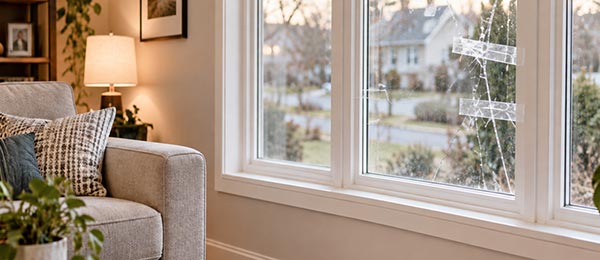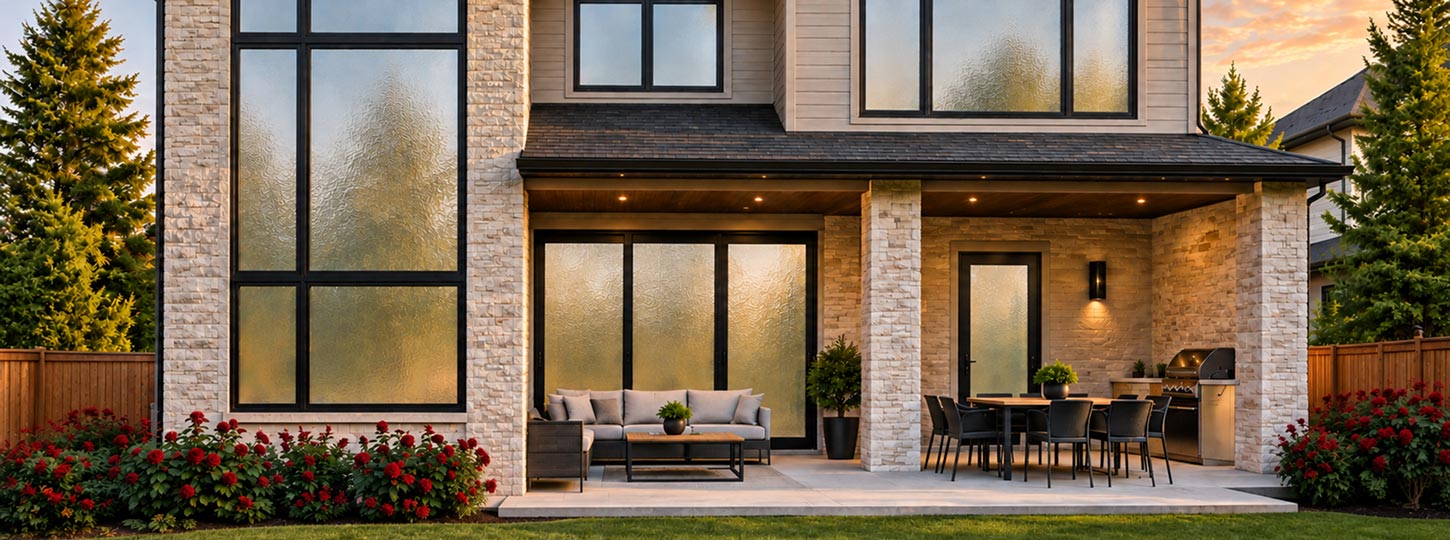


Choose satin glass when you want a smooth, even matte finish that keeps the room bright and is easy to wipe clean. Choose heavier frosted or patterned glass when a person's outline has to disappear completely, especially at night. Both let daylight through and block a clear view. The real differences are how much of a silhouette still shows, how the surface behaves when it gets wet or greasy, and whether the finish is permanent or can be peeled off later.
Privacy glass is one of the few window choices you can't change after the unit is sealed, so you have to decide at the order stage. Window Force has built custom vinyl windows since 2007 at its 80,000 sq ft Ontario plant, and on every order it records which privacy pattern goes into the window, which pane of the sealed unit carries it, and whether that opening needs safety glass, before the window goes into production. Our authorized dealers then see how those choices look in the real room, at noon and after dark, which is where most of the advice in this guide comes from.
Key Takeaways
- Satin glass is acid-etched glass: a smooth, uniform matte surface. "Frosted" is a broader term that can mean acid etching, sandblasting, patterned glass or an applied film.
- Acid-etched glass feels smoother and holds fewer fingerprints. Sandblasted glass can hide more, but its rougher surface traps oil, dust and water spots.
- Any light-coloured matte finish can still show a silhouette at night when the room is lit. Test the sample after dark before you decide.
- Patterned glass such as Chinchilla, Niagara or Glue Chip breaks up the view rather than blurring it evenly, and usually lets in more light.
- In a sealed unit, the textured surface can face into the cavity, where it never needs cleaning. Ask which surface your order puts it on.
- You can remove film; you can't remove etched and sandblasted glass. Film is a temporary fix, not the same product as factory privacy glass.
- Privacy glass does not improve heat loss or noise. Those come from the Low-E coating, the number of panes, the gas fill, laminated glass and the frame.
What Is the Difference Between Satin Glass and Frosted Glass?
Satin glass is a specific finish. Frosted glass is a family of looks. That is the source of most confusion when homeowners compare quotes.
Satin glass is produced by acid etching: a controlled acid treatment removes a very thin, even layer from the glass surface and leaves a fine, silky matte texture. The result is uniform from edge to edge, with no visible pattern. On a product list, it usually appears as acid-etched glass.
Frosted glass describes any translucent matte appearance, regardless of how it was made. A showroom may call all of the following "frosted":
- Acid-etched glass, the same smooth satin finish described above.
- Sandblasted glass, where fine grit is blasted at the surface, leaving a rougher, pitted matte.
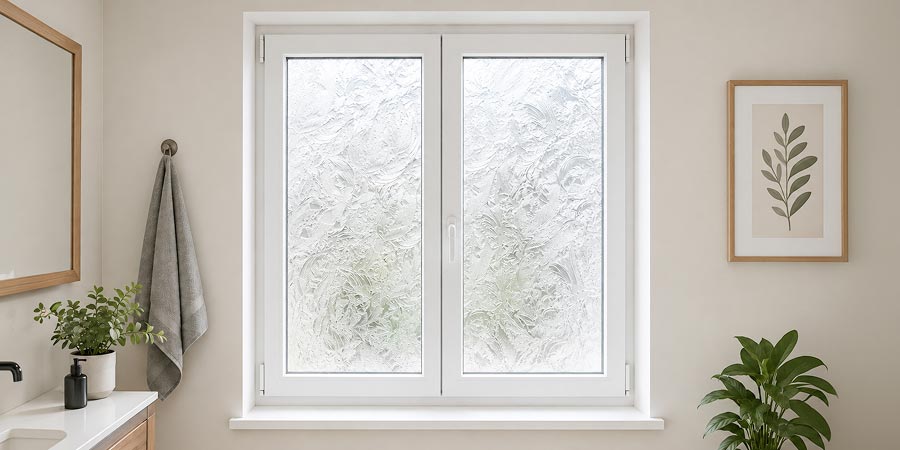
- Patterned glass, where a texture is rolled into the glass as it is made, such as Delta Frosted or Chinchilla.
- Frosted window film, a vinyl layer applied to existing glass.
Each one lets light through and blocks a clear view, but they differ in how much they hide, how easy they are to clean, and how long they last. When a quote says "frosted," ask which of the four it means. Window Force's current glass options include Acid Etched, Delta Frosted, Chinchilla, Pinhead, Niagara and Glue Chip, with additional patterns available on request.
What Is Satin Glass?
Satin glass is clear float glass acid-etched on one surface. The microscopic texture scatters light instead of letting it pass straight through, so the room stays bright while faces, text and details disappear. The farther a person stands from the glass, the more opaque it looks. Up close, a shoulder or a moving arm can still register as a soft shape.
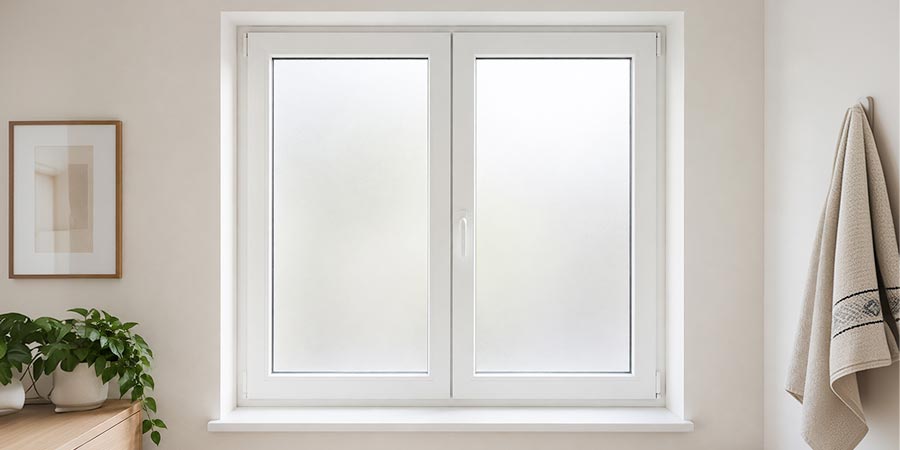
That soft quality is the point. Satin glass gives privacy with daylight rather than a solid wall, which suits bathrooms that still need morning light, front entries and sidelights, and interior doors where you want to share light without sharing a view.
The finish is permanent. It will not peel, yellow or wear back to clear glass with ordinary cleaning. Because the surface is smooth, fingerprints and water spots have little to grip, so satin glass is one of the easiest obscure finishes to keep looking clean.
Its limit is night privacy. In a lit room facing a sidewalk or a neighbour's window, satin glass may still show a readable outline from outside. If a person's shape must disappear entirely, a denser pattern or heavier frost is the better choice.
What Is Frosted Glass?
Frosted glass is translucent glass with a matte or textured surface. As described above, the look can come from four different processes, and the process matters more than the name.
Every frosted finish has scattered light and a blocked view in common. None of them provides better insulation, less noise, or a safety rating on its own. Those belong to the rest of the glass unit: the number of panes, the Low-E coating, the gas fill and, where required, tempered or laminated glass. Calling a pane "frosted" says nothing about any of them.
Before you approve a frosted option, ask three questions:
- Which process? Acid-etched, sandblasted, patterned, or film behave differently once water and cleaners reach them.
- Which pane? In a double- or triple-pane unit, usually only one pane carries the texture.
- Which surface? The textured side can face the room, the outdoors or the sealed cavity inside the unit.
How Does Acid-Etched Glass Differ From Sandblasted Glass?
Acid etching and sandblasting are the two permanent ways to give glass a matte surface. Both scatter light, but they leave very different surfaces.
Acid etching removes a thin, uniform layer of glass. The texture is shallow and consistent, and it feels smooth, closer to honed stone than to sandpaper. Skin oil and water have little to cling to, so marks wipe off easily.
Sandblasting drives grit into the surface. The pits are deeper and less even. Light scatters more aggressively, so a sandblasted pane can hide more of a shape than a light etch. The trade-off is upkeep: hand oils, minerals from hard water, and dust settle into the pits, and scrubbing can leave shinier patches that look uneven. Sandblasting is also the usual method for logos, borders, and gradients, because you can mask areas and leave them clear.
| Feature | Acid-etched (satin) | Sandblasted |
| Surface feel | Smooth, silky | Rough, slightly gritty |
| Uniformity | Very even across the pane | Can vary with depth and technique |
| Privacy | Soft blur; outline may show at night | Can hide more, depending on depth |
| Fingerprints and water spots | Few; wipes clean easily | Shows oil and mineral marks more readily |
| Designs and logos | Possible with masking | Common; easy to mask clear areas |
| Permanence | Permanent | Permanent |
For a full privacy pane in a home, acid-etched glass is usually the more predictable choice. Sandblasting makes sense when you need a heavier hide, a custom design, or a decorative border, and you accept the extra cleaning.
Which Finish Gives More Privacy at Night?
Privacy glass is usually judged at noon and tested at night. In daylight, the brighter side is outdoors, so almost any matte finish looks private from the street. After dark, the lit room becomes the bright side, and a silhouette behind a light etch can become readable from outside: a head, shoulders, the movement of an arm.
Run a simple lamp test with a sample before you order. Hold it in the actual opening, turn the room lights on after dark, and look from where a neighbour or a passer-by would stand. If a shape reads clearly, choose a denser finish for that opening.
Several factors work together:
- Distance. The farther the viewer is from the glass, the more any finish hides.
- Height. A pane above eye level hides more than the same pane beside a vanity or at a sidewalk.
- Texture. A dense pattern breaks a shape into fragments; a light, even mist only softens it.
- Lighting. A dimmer, indirect light inside reduces how much shows through.
Long winter evenings make this more than a theoretical concern. In Regina, where winter temperatures regularly drop below −30°C and darkness comes early, rooms are lit for most of the evening for months at a time, so anyone ordering from a vinyl window manufacturer in Regina should consider a denser texture on street-facing elevations.
How Do Patterned Glasses Like Chinchilla, Niagara and Glue Chip Compare?
Patterned obscure glass has a texture rolled into the glass during manufacturing. Instead of blurring the view evenly, it breaks the image into fragments, so shapes behind it split and distort rather than fade. Patterned glass usually lets more light through than a dense matte, and it looks more like a material than a fog.
These are the patterns on Window Force's standard list, described by how they typically look:
| Pattern | Appearance | Typical privacy | Light |
| Acid Etched | Smooth, even satin matte | Soft, uniform blur | Bright, evenly diffused |
| Delta Frosted | Fine frosted texture that reads close to a matte from a distance | Good | Bright |
| Chinchilla | Dense, irregular texture | High | Moderate to bright |
| Pinhead | Fine pattern of small raised dots | Moderate to good | Bright |
| Niagara | Flowing, vertical waterfall-like lines | Moderate; distorts rather than hides | Bright and lively |
| Glue Chip | Open, fern-like frost pattern | Lower; the eye finds gaps | Very bright |
Treat the privacy column as a starting point, not a rating. Distance, lighting, and pane size change the result, so judge the sample in the actual room.
Many homeowners search for "rain glass," the patterned look of water running down a pane. Niagara's flowing vertical lines are the closest look on our standard list, and other patterns are available on request. Like any open pattern, it suits openings that are already above eye level or turned away from the street: a stair, a landing, a kitchen facing a fence. It is a poor choice for a low, street-facing window, where the clearer lanes in the pattern become sightlines.
Our guide to the best bathroom window types covers how these patterns perform specifically in bathrooms.
Where Does the Textured Surface Sit in a Sealed Unit?
A double-pane unit has four glass surfaces, numbered from the outside in: surface 1 faces the weather, surfaces 2 and 3 face the sealed cavity, and surface 4 faces the room. A triple-pane unit has six. You can use acid-etched glass on any of the four surfaces of an insulating glass unit, and each position gives a slightly different look.
The position also decides how much cleaning the texture needs. A textured surface facing the sealed cavity never sees fingerprints, steam, or rain, so the difference between acid-etched and sandblasted cleaning largely disappears. A textured surface facing the room or outdoors behaves exactly as described above. The Low-E coating also needs its own surface, so the privacy texture and the coating are planned together. When you order, ask which surface carries the texture and which carries the coating.
Engineer Sergey Essipov, with 20 years of experience in window manufacturing, explains:
When the privacy texture faces into the sealed cavity, it is protected only for as long as that cavity stays dry. If moisture gets in, it settles on the textured surface, where it shows far more than it would on clear glass and where no cloth can reach it. At our facility, every sealed unit is built with a dual-seal, metal-free warm-edge spacer: one seal keeps moisture out, and the other holds the unit together, so the texture stays the only thing softening the view. If you ever see a grey haze that does not wipe off either side of a textured window, treat it as a seal question, not a cleaning one.
Can Frosted Window Film Replace Factory Privacy Glass?
Frosted window film is a vinyl layer applied to glass you already have. Its main advantage is that you can remove it. In a rental, a temporary office, or a window that is otherwise in good condition, film gives privacy without replacing anything.
Its limits show up over time and in moisture. Film has an edge, and the edge is where peeling starts, from fingernails, cleaners, steam on the room side or sun on the outside. In a bathroom with daily showers, adhesive can loosen at the corners within a few years. Film also cannot reach the inner surfaces of a sealed unit, and some glass manufacturers warn that certain films applied to sealed units can affect the glass warranty, so check before applying it to a newer window.
Wet coastal climates are hard on film. For homeowners choosing replacement windows in Victoria, persistent winter rain and high year-round humidity mean film on any exposed face ages quickly, while a texture that is part of the glass keeps the same privacy for years.
The simple test: if you can lift a corner with a fingernail and peel the privacy away, it is film. If the surface stays matte, the texture is in the glass.
After fifteen years, a homeowner notices that factory privacy glass still looks the same as the day it was installed. The texture cannot peel, and the frame around it doesn't age either: Window Force compounds its lead-free uPVC with UV stabilizers, so a white frame next to a bright satin pane doesn't drift toward yellow and make the glass look dingy by comparison. Film rarely ages that gracefully, which is why it works best as a bridge until a window is due for replacement.
Which Rooms Suit Each Finish?
The right finish depends on the room, the window height, and who might be looking in.
Bathrooms and Shower Enclosures
A bathroom needs daylight, a broken sightline and a surface that can handle steam. Satin glass or a dense pattern such as Chinchilla is the usual answer when the sill is low or a neighbour's window is close. A more open pattern works when the window is high. If the window opens, it helps clear humidity on mild days, but it does not replace the exhaust fan. Health Canada recommends keeping indoor humidity between 30% and 50%; a bathroom that stays wetter than that will leave water spots on any textured surface that faces the room.
Glass in a shower or tub enclosure has a stricter requirement. Under the Ontario Building Code, safety glazing is required in shower and bath enclosures, doors, sidelights and other hazardous locations, and it must conform to CAN/CGSB-12.1, which requires a permanent identifying mark. Other provinces adopt their own versions of the model code, and a window beside a tub may or may not count as part of the enclosure, so confirm the local rule. A decorative frosted film on ordinary glass does not turn it into safety glass.
That is why safety glass is decided for each opening, not for the house as a whole. Because Window Force builds every window to order, a bathroom window that needs tempered, permanently marked glass is specified that way for that one opening, together with its privacy pattern, while the bedroom next door can keep standard glass. The inspector finds the mark where the code expects it, and you don't pay for safety glass in openings that don't need it.
Engineer Sergey Essipov, with 20 years of experience in window manufacturing, notes:
A privacy pattern and a safety-glass requirement have to be decided together, because both are built into the glass before the unit is sealed. If a bathroom window turns out to need safety glass after the unit has been built, the only fix is a new unit. That is why our dealers confirm where each opening sits relative to the tub or shower before the order is released to production. A window that looks like a simple obscure-glass choice on the quote can turn out to be a code question on the wall.
Bathrooms are also where cold frames cause trouble. Warm, humid air meeting a cold surface condenses first at the window edges, and textured glass makes those droplets more visible. Window Force builds its frames from multi-chamber profiles, where several sealed air chambers inside the vinyl slow heat flow through the frame, so the room-side frame surface stays closer to room temperature. Less condensation forms along the edge of the pane, and less water runs down onto the sill after every shower. Every corner is also fusion-welded into one continuous joint, so the sill corners where shower water collects have no seam to open.
Street-Facing Windows and Narrow City Lots
A street-facing window is more of a night problem than a daytime one. A uniform satin finish is often enough for a side yard, but it can be too thin for a low window facing a public sidewalk in a room used after dark. A denser pattern or a heavier frost belongs there. Avoid designs with clear borders or open areas at eye level, since every clear lane is a sightline.
On narrow city lots, the window is often small to begin with. Homeowners working with a window supplier in Montreal often deal with the tall, narrow windows of Plateau-Mont-Royal and Rosemont triplexes, where an overly dense pattern can turn the little daylight a side wall receives into a dark panel. In those openings, satin glass or a brighter pattern such as Pinhead or Delta Frosted often balances privacy and light better than the densest option.
Interior Doors, Offices and Transoms
Interior doors, transoms and office partitions are the easiest applications. Viewing distances are short, and the goal is usually to share light without sharing a screen, so satin glass is typically enough. This is also where film is most defensible, especially when the layout may change.
How to Clean Frosted and Satin Glass Without Damaging It
Start with the gentlest method that works, and never use powders, blades or abrasive pads on a textured surface.
On patterned glass, wipe along the pattern rather than across it, and avoid flooding the surface with soap. On sandblasted glass, blot rather than scrub; scrubbing can polish shiny patches into the texture.
A casement window that opens to about 90 degrees lets you reach the outside surface from inside, which helps on upper floors. If washing both sides doesn't clear a cloudy look, the problem isn't on the surface. Stop cleaning and check the seal.
What Frosted Glass Will Not Do
Privacy glass changes the view. It doesn't change how the window performs in other ways, and expecting it to will lead to disappointment.
It will not reduce heat loss. Insulation comes from the number of panes, the gas fill, the frame and the Low-E coating; our guide to Low-E glass explains how coatings are chosen. Add the privacy finish to a well-specified unit, not instead of one.
It will not quiet a busy road. Laminated glass, with its plastic interlayer, improves acoustic performance compared with ordinary glass and holds fragments together if broken. A matte surface does neither.
It will not explain every white pane in the morning. On efficient windows, if the night has been cool and calm and the air is humid, condensation may form on the outside surface of the glass around sunrise. That dew burns off as the day warms. It is a sign the glass is insulating well, not a defect in the finish.
A haze between the panes is different. If a cloudy patch survives cleaning on both outside surfaces, moisture has entered the sealed unit. Our guide on how to fix a foggy window explains the options. Window Force's 10-year glass warranty covers material obstruction of vision from film formation or dust collection between the interior glass surfaces, separate from the 25-year coverage on the frame, sash and hardware.
Which Finish Should You Choose?
Use this order:
- Choose satin (acid-etched) glass when you want an even, bright matte that is easy to clean, and the opening does not face a close, direct sightline after dark.
- Choose a dense pattern such as Chinchilla, or a heavier frost, when the lamp test shows a silhouette, and the window is low or faces a sidewalk or a neighbour.
- Choose an open pattern such as Niagara or Glue Chip when the window is high or turned away, and you want maximum light with a decorative look.
- Choose film when the change must be reversible, and the existing window is sound.
- Confirm safety glass for any opening in or near a shower or tub, and ask which surface of the unit will carry the texture.
Privacy glass is chosen once and stays with the window for decades, so accountability matters. Window Force manufactures each window and supplies it through an authorized dealer network, so the dealer who measures each opening also confirms the pattern, surface position, and any safety-glass requirements with you before the order goes into production. The windows are CSA certified. Window Force is also an ENERGY STAR Partner, and its windows are engineered to meet ENERGY STAR® requirements, so choosing privacy glass does not mean giving up efficiency. The 25-year transferable warranty on the frame, sash, and hardware moves with the house if you sell, and the separate 10-year non-prorated glass warranty covers film or dust forming between the panes of the sealed unit that protects the texture inside.
Not sure which pattern will hold up to your lamp test? Send us a request through our website, and an authorized Window Force dealer will help you compare privacy patterns for each opening, confirm where safety glass is required, measure the windows, and give you a production timeline for units built with the glass you choose.
Frequently Asked Questions
Can you see through frosted glass at night?
You cannot see a clear image, but a lit room can show a silhouette through a light frosted or satin finish, even when faces are not recognizable. A denser pattern or a heavier frost reduces that effect. Test a sample in the actual window after dark with the lights on.
Can you see through satin glass?
Not clearly. Satin glass blurs the view into soft light, but movement and a vague outline can show, especially close to the glass and at night. If any outline is unacceptable, choose a denser pattern.
Is frosted glass translucent?
Yes. Frosted glass lets light through while blocking a clear view. It is not opaque, which is why rooms behind it stay bright.
Does frosted glass reduce heat?
No. The matte surface does not insulate. The Low-E coating, the number of panes, the gas fill, and the frame control heat loss. Frosted glass in an energy-efficient sealed unit performs like the unit, not like the finish.
Does frosted glass block sunlight?
It diffuses sunlight rather than blocking it. The room stays bright, glare softens, and direct beams are scattered. The Low-E coating, not the frosted surface, controls solar heat and UV.
Is frosted glass outdated?
No. Acid-etched and patterned privacy glass is widely used in modern homes, especially in bathrooms, entries and interior doors. What looks dated is usually yellowed film or a heavily patterned glass that no longer suits the house.
What is satin etched glass?
Satin etched glass is glass with a smooth, uniform matte finish created by acid etching. It is the finish most people mean when they say "satin glass," and it usually appears on product lists as acid-etched glass.
Can a frosted finish be removed?
Film can be peeled off. Acid-etched, sandblasted and patterned glass cannot be returned to clear glass; changing them means replacing the pane or the sealed unit. Decide on permanence before the window is ordered.
People Also Ask