

The best bathroom window is one that ventilates on demand, blocks sightlines without blocking daylight, and keeps the interior glass surface warm enough to resist condensation in the room that carries one of the highest moisture loads per square metre in the house. In most bathrooms, this points to a high-mounted top-hinged unit or a compact side-hinged one fitted with obscured glazing, with a fixed unit reserved for rooms where mechanical exhaust already carries the moisture load.
Window Force sits at the point where these decisions can no longer be reversed. Every bathroom unit is specified before it is cut: the obscurity level, the glazing package, the hardware position and the sill height are confirmed against the rough opening recorded on the order rather than selected from a range of stock sizes. Building to order since 2007 has made the wet-room pattern easy to recognize on our production floor, because bathrooms arrive with smaller openings, higher sills and obscured glazing far more often than any other room in a house.
Key Takeaways
- Bathroom window selection is driven by four competing priorities: privacy, ventilation, daylight and resistance to condensation. The style that wins is the one that satisfies the priority your specific room cannot compromise on.
- Awning and casement units both use compression seals, which close more tightly than the sliding weatherstrip used in horizontal sliders and therefore help maintain a warmer interior glass surface in cold weather.
- An awning sash placed above eye level keeps obscured glazing in front of the sightline even when the window is open, which a side-hinged sash cannot do once it swings clear.
- Bathroom windows are typically smaller and set higher than windows in living spaces. Roughly 18 to 24 inches wide by 18 to 24 inches high suits a compact bathroom, while 24 to 30 inches wide by 24 to 36 inches high covers many standard bathrooms.
- Health Canada recommends an exhaust fan in every bathroom and indoor relative humidity between 30 and 50 percent, so an operable window supplements mechanical ventilation rather than replacing it.
- Factory-obscured glazing outperforms retrofit film in durability and appearance, but a moisture-rated film remains a reasonable interim measure for an otherwise sound existing window.
What Should You Look for When Choosing a Bathroom Window?
A bathroom imposes a set of requirements that rarely apply together anywhere else in a home: constant sightline exposure, repeated humidity spikes, limited wall area, and fixtures that dictate where a person can physically reach. There is no universally correct style because these requirements conflict. The unit that maximizes airflow may compromise privacy when opened, and the unit that seals most tightly may not open at all.
Moisture management is not an abstract concern. In the 2021 Canadian Housing Survey, 8 percent of renting households reported problems with mould or mildew, against 4 percent or fewer of owner households. Dampness concentrates in the rooms that generate it, and the bathroom generates more of it per square metre than any other room in daily use. A window that cannot be opened when the room needs purging, or that runs cold enough to stream water onto the sill every morning, adds to that load instead of relieving it.
Privacy
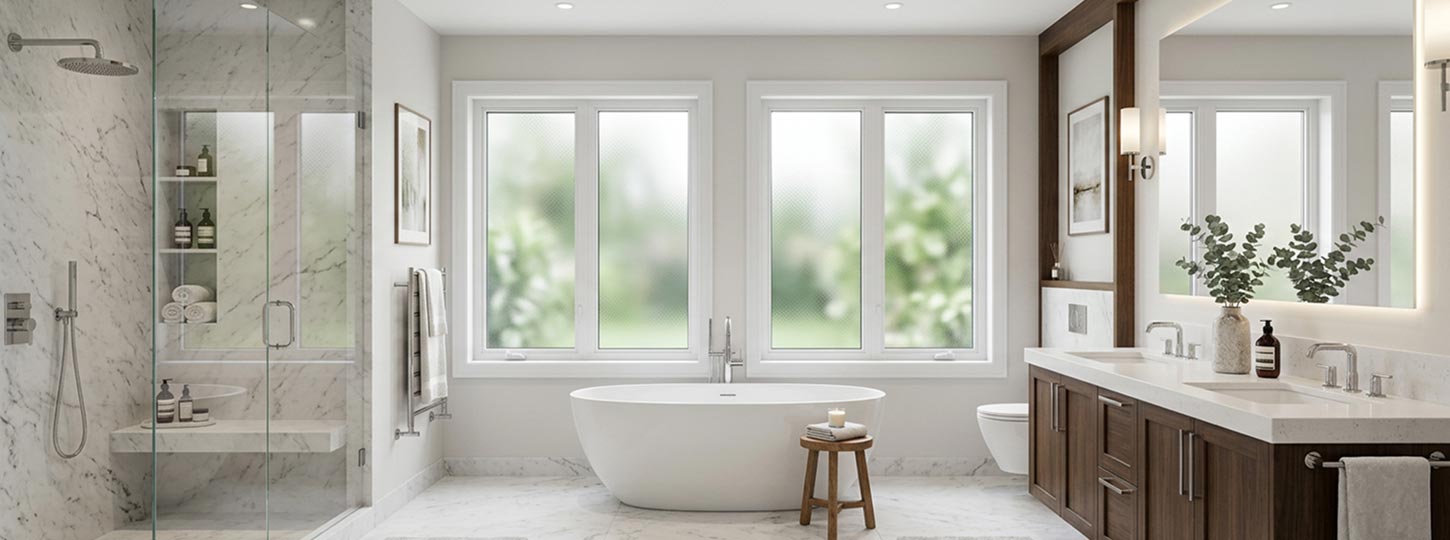
Privacy is the requirement most homeowners lead with and the one most often solved incorrectly. Clear glass in a bathroom is only acceptable when the exterior view is genuinely unobstructed by neighbouring properties, and even then, interior lighting reverses the situation after dark: the glass that looked opaque at noon becomes a lit panel at night. The reliable solution combines placement above the sightline with obscured glazing rather than relying on either one alone.
Ventilation
The purpose of an operable bathroom window is to shed a humidity spike quickly after a shower, not to serve as the room's primary air exchange. Short periods of cross ventilation on a mild, dry day can help reduce indoor humidity. In February, in most Canadian climate zones, that same open sash is a heat loss penalty you will not want to repeat daily, which is why the mechanical system carries the year-round load.
Natural Resources Canada treats bathroom ventilation as part of the home's overall moisture-control strategy rather than as a function that should depend solely on window opening. Operating bathroom exhaust fans during use helps remove moisture at the source, while natural ventilation through a window depends on outdoor conditions.
Natural Light
Bathrooms are frequently the darkest rooms in a house because they sit at the interior of the floor plan or face a side yard. Obscured glass diffuses light rather than eliminating it, and lighter patterns transmit nearly as much as clear glass. Where the opening is small, choosing a lower obscurity level and relying on height for privacy preserves more usable daylight than choosing a dense pattern in a larger opening.
Energy Efficiency
Thermal performance in a bathroom matters for reasons unrelated to the heating bill. The glass's interior surface temperature determines whether the room's elevated humidity condenses on the window or remains in the air until the fan removes it. A colder interior glass surface falls below the room's dew point sooner, increasing the risk of condensation during periods of high indoor humidity. Windows with less thermally efficient edge spacers may therefore be more prone to condensation along the glass perimeter.
Most insulating glass units on the market still use a metal spacer bar around the perimeter, which conducts heat directly from the glass edge, making the perimeter more susceptible to condensation and frost in a humid room. Window Force builds a metal-free, dual-seal spacer into every unit, with the primary seal controlling gas retention and the secondary seal carrying the structural load, so neither function depends on a single material to perform both. In a bathroom, that difference lands exactly where condensation is worst, along the bottom edge above the sill, where water would otherwise collect and sit until someone wipes it away.
Windows Near Me
Which Bathroom Window Types Work Best for Privacy, Light, and Ventilation?
Six configurations account for nearly all bathroom applications, and each resolves the privacy, airflow and sealing trade-off differently. A full comparison of all residential window styles is available for homeowners still deciding on the broader product type. The table below compares them on the criteria that actually differentiate performance in a wet room, rather than on general characteristics that apply equally everywhere.
| Type | Ventilation | Privacy when open | Airtightness | Best position | Main limitation |
| Awning | Good, controlled | Maintained, sash stays in the sightline | High, compression seal | High on the wall | Requires exterior clearance below the sash |
| Casement | Highest, large clear opening | Reduced once the sash swings clear | High, compression seal | Beside a vanity or tub | Sash swing and crank reach |
| Hopper | Moderate | Maintained, bottom-hinged inward swing | Moderate to high | Low or below grade | Intrudes into the room |
| Single or double slider | Moderate, half the opening | Partly maintained | Lower, sliding weatherstrip | Wide, short openings | Weatherstrip performance in cold |
| Fixed or picture | None | Constant | Highest, no operable sash | Where a fan handles moisture | No airflow contribution |
| Combination units | Depends on operable portion | Depends on configuration | Mixed | Larger openings | Higher cost and weight |
Awning Windows
A top-hinged sash is often a strong choice for bathrooms because it can maintain privacy while the window is open. Placed above a tub surround or a vanity mirror, an awning window ventilates without ever presenting a clear line of sight into the room.
Casement Windows
Side-hinged units deliver the largest unobstructed opening for their frame size and can be angled to scoop air into the room. They suit bathrooms with a wall segment beside the vanity or bathtub where the crank is within comfortable reach, and the exterior sash swing is unobstructed.
Slider Windows
Horizontal slider windows fit wide, short openings that would be awkward for a hinged sash, and they never project outward, which matters where a walkway or fence sits close to the wall. The trade-off is sealing: a sliding sash rides on weatherstripping rather than compressing into the frame, so both air infiltration and the risk of frost are higher than with a crank unit.
Hopper Windows
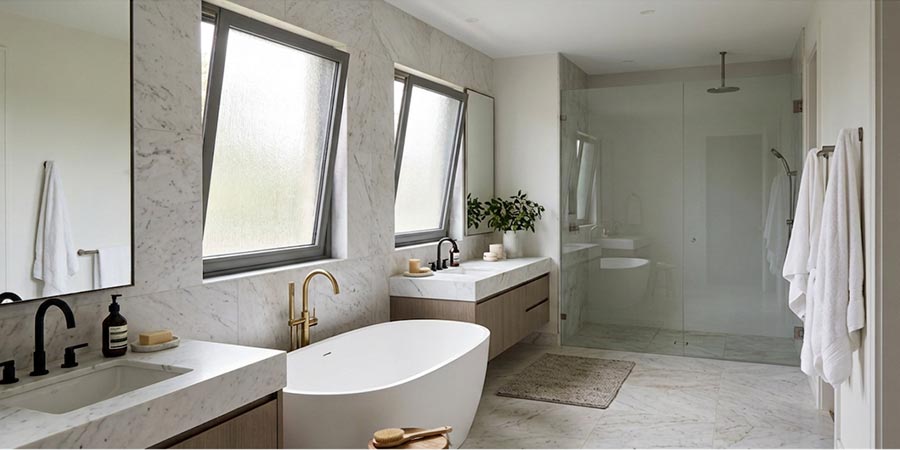
A bottom-hinged sash that tilts inward is the answer where an outward-swinging unit has nowhere to go. It maintains its glazing across the sightline while open, as a top-hinged sash does, and it requires no exterior clearance at all, making it the practical option on a narrow lot or below grade. The trade-off is interior projection: the open sash occupies room space and has to clear a blind, a shelf or a shower curtain rail.
Fixed Windows
A fixed sash has no operable joint that can leak, making it the most airtight option available and a legitimate choice in a bathroom with properly sized mechanical exhaust. Larger decorative configurations, such as bay and bow windows, occasionally appear in generous ensuites, but their projecting geometry and seat depth are rarely practical within a standard bathroom footprint.
Why Are Awning Windows Often a Strong Choice for Bathrooms?
The top hinge is the defining feature. Because the sash pivots at its head and swings outward from the bottom, the glass remains angled across the opening throughout its travel, and the closing action pulls the sash inward against a continuous compression gasket rather than sliding past it.
High Placement for Privacy
An awning unit is designed to work above eye level, which is exactly where a bathroom window should sit. Mounting the sill at roughly 1.6 to 1.8 metres above the finished floor places the lower edge of the glazing above the eye level of most standing adults, which is typically between 1.5 and 1.65 metres. The wall below remains available for a vanity, a towel bar, a mirror or built-in storage, which is the practical constraint in most renovations.
Ventilation During Light Rain
The projecting sash forms a canopy over the opening. Air passes through the gaps at the sides and bottom, while falling rain runs down the exterior face of the glass and off the leading edge, so the window can often remain partially open during light rain, reducing the amount of water that enters the room. In a bathroom used every morning, regardless of the weather, this is a functional advantage rather than a marginal one.
As Sergey Essipov, a production engineer with more than 20 years of experience in window manufacturing, points out:
When a bathroom unit fails early, the seal is rarely where it started. Water has been standing in the bottom corners of the frame after every shower because the weep channel is packed with lint and cleaning residue and never drains. At our facility, the drainage path is formed in the sill chamber during extrusion rather than drilled into the profile afterwards, and the weep openings are positioned to stay accessible for cleaning. On a top-hinged sash, that path is also short, so the sill dries between uses, which is part of why these units age better in wet rooms than a specification sheet alone would suggest.
When an Awning Window May Not Fit
Outward projection requires clearance. Before specifying a top-hinged unit, confirm that nothing sits within the sash swing: a side-yard walkway, a deck railing, a downspout, a gas meter, or a neighbouring wall on a narrow lot. Ground-floor bathrooms on tight urban lots are the common failure case. Where clearance is unavailable, a hopper unit that opens inward, a slider, or a fixed unit paired with mechanical exhaust are the practical alternatives.
Are Casement Windows a Good Option for Bathrooms?
Side-hinged units perform well in bathrooms where the opening sits beside a fixture rather than above one. They open to nearly the full frame area, which no other operable style matches, and the same compression sealing that makes them efficient in a bedroom applies in a wet room.
Ventilation Advantages
Casement windows can provide high ventilation potential because they typically offer a large unobstructed opening. Because the sash swings clear of the opening, a casement window can exchange air more effectively than a comparable slider of the same dimensions. The projecting sash can help direct airflow into the room: angled toward the prevailing wind, it directs outdoor air into the room instead of letting it pass across the face of the opening. In a small bathroom that needs to shed humidity quickly, this considerably shortens the ventilation window.
Hardware Reach and Sash Position
Where the crank falls behind a deep vanity or across a bathtub, specify hardware accordingly or reposition the unit. A folding crank handle sits flush against the frame and clears a window covering, while a lever-operated unit entirely avoids the reach problem on smaller sashes. Obscured glazing is available across the full casement range, so privacy while the window is closed is never the limiting factor.
What Are the Best Small Bathroom Windows for Limited Wall Space?
Compact bathrooms and powder rooms rarely have a full wall available. The usable area is whatever remains after the shower surround, the mirror, the vanity and the storage have taken their positions, which usually leaves a narrow band high on one exterior wall. The goal in these rooms is to place the glazing where it does not compete with the fixtures.
Compact Awning Windows
A short, wide top-hinged unit, 18 to 24 inches wide by 18 to 24 inches high, is a common solution for small bathroom windows because it occupies the strip of wall above a vanity mirror or tiled surround that has no other function. The proportions suit the style as well: awning sashes perform best when they are wider than they are tall, since the bottom projection remains modest.
Narrow Casements
A tall, narrow side-hinged unit works where the available space is vertical rather than horizontal, such as the wall segment between a shower enclosure and an exterior corner. Narrow casements maintain a full-height opening for ventilation while consuming very little wall width, and they accept the same obscured glazing as any other configuration.
High Fixed Windows
Where mechanical exhaust already handles moisture, a high fixed unit delivers daylight with no operable joint, no hardware to corrode and no sash to reach. High-fix and casement-fix configurations are commonly specified as transom-height glazing above a shower, and they can also be combined with an operable unit below in a single frame when the opening allows.
How Large Should a Bathroom Window Be?
Window size in a bathroom should follow the opening dimensions, the scale of the room, the daylight target and the ventilation strategy rather than a single recommended number. Local requirements also apply, most often for safety glazing where the window is within or adjacent to a bathtub or shower enclosure. If the same basement level contains a bedroom, the egress requirement applies to that room rather than to the bathroom.
When a Larger Window Makes Sense
A larger glazed area is justified when the bathroom has genuine visual privacy from its surroundings, such as a rear elevation facing a treed yard or a second-storey wall with no facing windows, and when the glazing package is specified to hold a warm interior surface. Larger units also make sense when they replace artificial lighting during daylight hours in a room that is used heavily in the morning. What does not justify a larger window is the assumption that more glass means more ventilation, since airflow is governed by the operable area and the pressure difference across the opening rather than by total window size.
Where Should Bathroom Windows Be Placed for Better Privacy?
Placement resolves more privacy problems than glass selection does, and it is decided before the window is ordered. Assess the exterior condition first, then choose the height, and finally decide how much obscurity the glazing needs to provide.
- Map the sightlines from outside. Stand where a neighbour, a passerby or a second-storey window would be and note what is visible through the existing opening at standing height and at seated height. Angles matter more than distance.
- Set the sill height against those sightlines. Raising the sill to roughly 1.5 metres above the finished floor can reduce many direct sightlines from nearby properties and pedestrians.
- Check the night condition. Interior lighting reverses the transmission of any glazing. Test the room after dark before deciding that placement alone is sufficient.
- Select the obscurity level last. With placement resolved, a lighter obscurity pattern is usually adequate, which preserves daylight. Where placement cannot be changed, a denser pattern compensates.
Above-Eye-Level Placement
Mounting the unit above eye level is one of the most effective ways to improve privacy without reducing glazing. It also frees the wall below for fixtures and storage, which is why smaller, higher units are the conventional approach in bathrooms across housing types, from a postwar bungalow to a new build.
Windows Near a Tub or Shower
A window within a bath or shower enclosure introduces two additional requirements. Glazing in that location generally needs to be tempered for safety, and the surrounding assembly needs a finish and sill detail that tolerates direct water contact rather than incidental humidity. Hardware selection also changes, since reaching a crank across a filled tub is neither comfortable nor safe.
The joint that decides how a bathroom frame ages is the one nobody inspects. A mechanically joined corner maintains its geometry with metal fasteners and a bead of sealant, and both sit in the wettest part of the assembly while ageing on their own schedules. Window Force fusion-welds each corner into one continuous section of lead-free uPVC compounded with UV stabilizers, so at the sill corners where shower water actually collects, there is no fastener to corrode and no bead to renew. The surface taking that water is the profile material itself rather than a finish applied over it, so a frame set beside a tub keeps its appearance through years of wiping rather than gradually dulling as a coating is worn back.
Street- and Neighbour-Facing Bathrooms
Front elevations and narrow side yards are the hardest cases because the sightline is close and fixed. Here the combination of a high sill, a denser obscurity pattern and a smaller operable sash is more effective than any single measure. On a tight urban infill lot the neighbouring wall may sit within two or three metres, which also constrains outward sash projection and may push the selection toward a hopper or a fixed unit.
Which Privacy Glass Works Best for Bathroom Windows?
Obscured glazing works by scattering transmitted light so that shapes cannot be resolved, and the patterns differ in how aggressively they do it. The practical selection criterion is the obscurity level you need at night, since that is the demanding condition, balanced against the daylight you are prepared to give up.
Frosted Glass
Uniform frosted and acid-etched surfaces provide the most consistent obscurity because the diffusion is even across the entire pane, with no clear zones between pattern elements. This is the safest specification for an opening with direct sightline exposure. The trade-off is that a uniform matte surface transmits less light than a textured one and shows water spotting more visibly on the exterior face.
Textured and Patterned Glass
Patterned glass distorts rather than uniformly diffuses light, allowing more light through while still preventing recognition of shapes. Patterns with finer, denser elements obscure more than open crystalline textures. Obscurity levels differ enough to change the specification:
- Uniform patterns such as Delta Frosted and Acid Etched offer the highest and most consistent obscurity with moderate light transmission, making them the safe choice for an opening with direct sightline exposure.
- Dense textures such as Chinchilla: medium to high obscurity with better light transmission, suited to street-facing bathrooms that still need daylight.
- Open textures such as Glue Chip, Niagara and Pinhead: medium obscurity and the highest light transmission, appropriate where placement already carries most of the privacy load.
The full range of privacy glass options can be combined with Low-E coatings and argon fill, so choosing obscured glazing does not require sacrificing thermal performance.
Privacy Glass vs. Clear Glass
Clear glass belongs in a bathroom only where the exterior conditions genuinely preclude observation, and the homeowner accepts the night-time reversal. In every other case, obscured glazing is the more durable option because it does not depend on a blind being closed, a plant remaining in place, or a fence remaining unbuilt. It also removes the maintenance burden of a window covering in a room where fabric and humidity are a poor combination.
Obscured glass is not a finish applied to a completed window; it is a component that has to be chosen before the unit is assembled. On our line, the pattern is selected at the order stage alongside the Low-E coating, the gas fill and the tempering requirement, then cut for that one opening. The sequence matters more in a bathroom than elsewhere because tempering must be specified before the glass is processed rather than added to a finished unit, and because a directional pattern needs to be oriented against the sightline the window will actually face. Obscured glazing is standard throughout the 80,000 sq ft Ontario plant rather than an exception, keeping a textured or frosted bathroom unit on the same production schedule as a clear one.
Is Privacy Window Film a Good Alternative to Frosted Glass in a Bathroom?
Applied film and factory-obscured glazing achieve a similar visual result by different means, and they are not equivalent over their service lives. Film is an adhesive layer on the room-side surface of the glass; factory privacy glass is the glass itself, sealed inside the insulating unit.
Film vs. Factory Privacy Glass
The decisive factor in a bathroom is humidity. Repeated condensation cycles attack the adhesive bond at the film edges, and a product not rated for wet rooms will begin to lift at the corners within a season or two. A moisture-rated frosted or translucent film applied to a scrupulously clean, dry surface performs considerably better, but it remains a surface treatment on a room-side pane rather than a permanent property of the glass.
When Film Makes Sense for an Existing Window
Film is a sound choice when the existing window is structurally sound, the seals are intact, and the only deficiency is privacy. It is also useful as a temporary measure while a replacement is being planned, and in rental situations where modifying the glazing is not an option. When the window is already being replaced, specifying factory-obscured glazing costs less over the life of the unit than repeatedly reapplying film.
Do Windows for Bathrooms Provide Enough Ventilation on Their Own?
This is the most persistent misconception in bathroom design. An open window helps when outdoor conditions permit, but it is not a substitute for mechanical exhaust, and treating it as one produces exactly the moisture problems the window was meant to prevent.
Health Canada's guidance on indoor moisture is explicit on this point. The department recommends using an exhaust fan when showering or bathing, states that an exhaust fan should be installed in each bathroom, and advises keeping it running for at least 30 minutes after a shower or bath. It also recommends maintaining a relative humidity between 30 and 50 percent and emphasizes the importance of promptly addressing excessive moisture to prevent mould growth.
Natural vs. Mechanical Ventilation
Natural ventilation through an open sash depends on variables no one can control: outdoor temperature, wind direction, pressure difference, and whether anyone remembers to open the window. Mechanical exhaust removes moisture-laden air from the bathroom and provides more consistent ventilation when properly sized, installed, and used, venting it outdoors rather than into an attic or soffit. The correct relationship between the two is that bathroom windows supplement the fan on mild days and provide a rapid purge when needed, while the fan handles the year-round load.
Why an Exhaust Fan Still Matters
In cold weather, the argument becomes decisive. Opening a bathroom window at minus 20 °C to clear steam pushes a large volume of heated air outdoors, cooling the surrounding wall assembly and lowering surface temperatures, thereby increasing the risk of condensation elsewhere in the room. A properly sized exhaust fan can remove moisture without the large uncontrolled air exchange associated with opening a window in very cold weather. Confirm that the duct terminates outside the building envelope, because a fan discharging into an attic relocates the moisture problem rather than solving it.
How Can a Bathroom Window Help Manage Humidity and Condensation?
A window contributes to humidity control in two distinct ways, and they are often confused. The operable sash provides a temporary airflow path, while the glazing package determines how warm the interior glass surface stays when the room's humidity spikes.
Why Condensation Forms
Condensation forms when humid indoor air comes into contact with a surface at a temperature below its dew point. Windows are often among the coldest interior surfaces in a room, which is why condensation is often the first to appear on the glass. Raising the interior surface temperature of the glass raises the humidity level the room can carry before condensation begins, which is the function of Low-E coatings, inert gas fill and a warm-edge spacer. A warm-edge spacer helps reduce heat transfer at the glass perimeter, which is typically colder than the centre of the insulating glass unit.
Ventilation and Indoor Humidity
The room's dew point tracks its relative humidity, so the two levers work together. Keeping indoor humidity within the recommended range means the same glass surface temperature no longer produces condensation. Running the fan through and after every shower, keeping window coverings open so warm room air reaches the glass, and drying the sill are ordinary measures that can resolve condensation caused primarily by excessive indoor humidity.
As Sergey Essipov, a production engineer with more than 20 years of experience in window manufacturing, explains:
Homeowners often report condensation on a new bathroom window and conclude the unit is defective. In most cases, the new window is simply tighter than the one it replaced, and the uncontrolled leakage that used to accidentally dry the room is gone. At our facility, every sash closes onto a compression gasket carried by a multi-chamber profile, so the unit holds that air seal and keeps the interior frame surface warmer than a single-cavity profile would. The window did not create the humidity. It made it visible, and the fan is what removes it.
When the Window Is Not the Root Cause
Persistent condensation on every window in a home, mould in more than one room, or moisture on cold-water pipes and toilet tanks all point to a whole-house humidity problem rather than a glazing deficiency. Blocked or undersized exhaust ducting, a humidifier running above the recommended setpoint, and unvented clothes drying indoors are the usual causes. Replacing the window in that scenario reduces the symptom without addressing the source.
What Window Frame and Glass Features Work Best in a High-Moisture Bathroom?
Material selection in a wet room is governed by how the assembly behaves under repeated wetting and drying rather than by appearance. Thermal performance remains relevant even in a warm, humid space, because the interior glass surface temperature determines the condensation threshold.
- Frame material. Vinyl does not absorb moisture, corrode or require refinishing, and fusion-welded corners eliminate the mechanical joints where water would otherwise track into the frame. These properties make vinyl a practical choice for many bathroom replacement applications.
- Insulated glass unit. Double-pane glazing with a low-emissivity coating and argon fill covers most bathroom applications. Triple-pane raises the interior surface temperature further, which is worth specifying in colder climate zones or where the bathroom runs consistently humid.
- Spacer. The perimeter of the sealed unit is its coldest zone. A metal-free dual-seal spacer reduces conductive transfer at the glass edge and delays the onset of frost or condensation along the bottom of the pane.
- Low-E coating selection. Coating choice should follow orientation. A north-facing bathroom prioritizes insulation, while a south- or west-facing bathroom benefits from a coating that manages solar heat gain.
- Weep and drainage detail. Frames must drain outward. Weep channels should be inspected and cleared periodically, since lint, dust and cleaning residue accumulate faster in a bathroom than anywhere else in the house.
- Hardware finish. Corrosion-resistant hardware is not optional in a room that sees repeated humidity cycles. The operating force on a crank or lever should remain consistent over the years, not stiffen as surface oxidation develops.
- Surface cleanability. Smooth vinyl profiles and a glazing pattern that does not trap residue reduce the maintenance load in a room cleaned more often than most.
Climate zone changes the weighting of these choices more than most homeowners expect. A bathroom in Vancouver faces relatively mild winters and higher ambient humidity, so drainage detailing and material durability may receive greater emphasis. In Calgary, larger temperature differences and colder winters place greater emphasis on the temperature of interior glass surfaces and edge performance.
Should You Choose an Operable or Fixed Bathroom Window?
The choice comes down to whether the room's mechanical ventilation is adequate and properly used. An operable sash adds flexibility at a small cost in airtightness; a fixed sash maximizes the seal and removes the hardware entirely.
When an Operable Window Is Better
Specify an operable unit when the bathroom already has adequate mechanical ventilation but would also benefit from additional natural ventilation on suitable days. Bathrooms with a bathtub for long soaks, or rooms that benefit from additional natural ventilation, may suit an operable configuration. Where an existing exhaust system is inadequate, the ventilation system should be corrected rather than relying on the window as a replacement.
When a Fixed Window Makes Sense
Fixed windows are the better specification when the bathroom already has correctly sized exhaust that vents outdoors and is used consistently, when exterior clearance rules out any outward-swinging sash, or when the opening is above a shower where reaching hardware would be impractical. With no operable sash, there is no operating hardware or sash-to-frame weatherstrip, reducing potential air leakage through the operable portion of the unit and making a fixed unit the most airtight and lowest-maintenance option available. Combination frames resolve the trade-off directly by pairing a fixed pane with a small operable sash, and this configuration appears frequently in replacement windows for bathrooms where a single style cannot satisfy both requirements. Whether the project involves window installation in Ontario, a bathroom retrofit in Quebec, a coastal replacement in Nova Scotia, or work in any other province, the decision logic is identical: confirm the mechanical ventilation first, then choose the sash.
A bathroom window is usually the smallest line on a replacement order and the one that works hardest, absorbing a humidity spike every day of its service life. Every unit built to that specification — whether from the Ultraslim Series or the Classic Series— is CSA certified and meets ENERGY STAR® requirements across all Canadian climate zones. Qualifying units may also be eligible for rebates through federal or provincial programs covered in the Canada window and door rebates guide. The 25-year transferable warranty applies to a compact obscured awning on exactly the same terms as to a full-height picture window. Because installation and service run through an authorized dealer network working from the order file we produced, a later question about a glazing pattern, a hardware adjustment or a seal is answered against the original specification rather than reconstructed from memory.
How to Choose the Right Bathroom Window for Privacy, Ventilation, and Natural Light
The best bathroom window is defined by the room rather than by the style name. Placement above the sightline solves privacy at no cost; compression-sealed operable units maintain a warmer interior glass surface than sliding sashes; and factory-obscured glazing outlasts any surface-applied alternative in a humid room. Where mechanical exhaust is properly sized and consistently used, a fixed unit is a fully valid specification.
Approach the selection in this order: confirm what the exhaust system actually does, map the exterior sightlines and clearance, then choose the sash type, and only afterwards the glass obscurity level. Working in that sequence prevents the two most common outcomes: a window that cannot be opened where it needs to be and a glazing pattern that gives up daylight it did not need to.
Ready to lock down the glazing for your bathroom? Send the opening dimensions and a short note on what is visible from outside through the request form on our website, and our team will confirm which sash type clears the space you actually have, recommend an obscurity pattern that still holds privacy once the interior light is on after dark, and give you current production lead times for that configuration.
Frequently Asked Questions
What is the best window style for a bathroom?
A top-hinged awning unit mounted above eye level suits the majority of bathrooms because it ventilates while keeping its glazing across the sightline, and its compression seal holds a warm interior glass surface. A casement is the stronger choice when the opening is beside a vanity or tub, and maximum airflow is the priority.
Do bathroom windows need to be frosted?
Not universally, but obscured glazing is the reliable solution in any bathroom with facing properties, street exposure or a neighbouring second storey. Placement above eye level reduces the amount of obscuration the glass provides, allowing a lighter pattern and more daylight.
Can I rely on a window instead of a bathroom fan?
No. Health Canada recommends installing an exhaust fan in each bathroom and running it for at least 30 minutes after a shower or bath. An operable window supplements the fan on mild days and provides a quick purge when needed, but it cannot reliably remove moisture in cold weather.
What size should a bathroom window be?
Compact bathrooms commonly use openings of roughly 18 to 24 inches per side, while standard bathrooms typically fall in the range of 24 to 30 inches wide by 24 to 36 inches high. Final dimensions should follow the actual opening, the room proportions and any applicable requirements for egress or tempered glazing.
Why does my bathroom window get condensation even though it is new?
A new window seals far better than the unit it replaced, so the air leakage that previously dried the room by accident is gone. The moisture is the same; it is simply no longer escaping unnoticed. Running the exhaust fan through and after every shower and keeping indoor relative humidity between 30 and 50 percent resolves most cases.
Is privacy film as good as privacy glass?
For appearance and durability in a humid room, no. Factory-obscured glazing lasts as long as the glazing unit itself, whereas bathroom film requires a moisture rating and can still lift at the edges over time. Film remains a reasonable option on an existing window that is sound in every respect except privacy.
Should a bathroom window be tempered?
Glazing installed within a bathtub or shower enclosure generally requires tempered glass for safety, and specific requirements vary by project and jurisdiction. Confirm the applicable requirement before ordering, since tempering must be specified at the time of manufacture and cannot be added afterwards.
Can a bathroom window be fixed rather than operable?
Yes, provided the bathroom has correctly sized mechanical exhaust that vents outdoors and is used consistently. A fixed unit has no operable joint, making it the most airtight and lowest-maintenance configuration available, and it works particularly well for high glazing above a shower.
People Also Ask