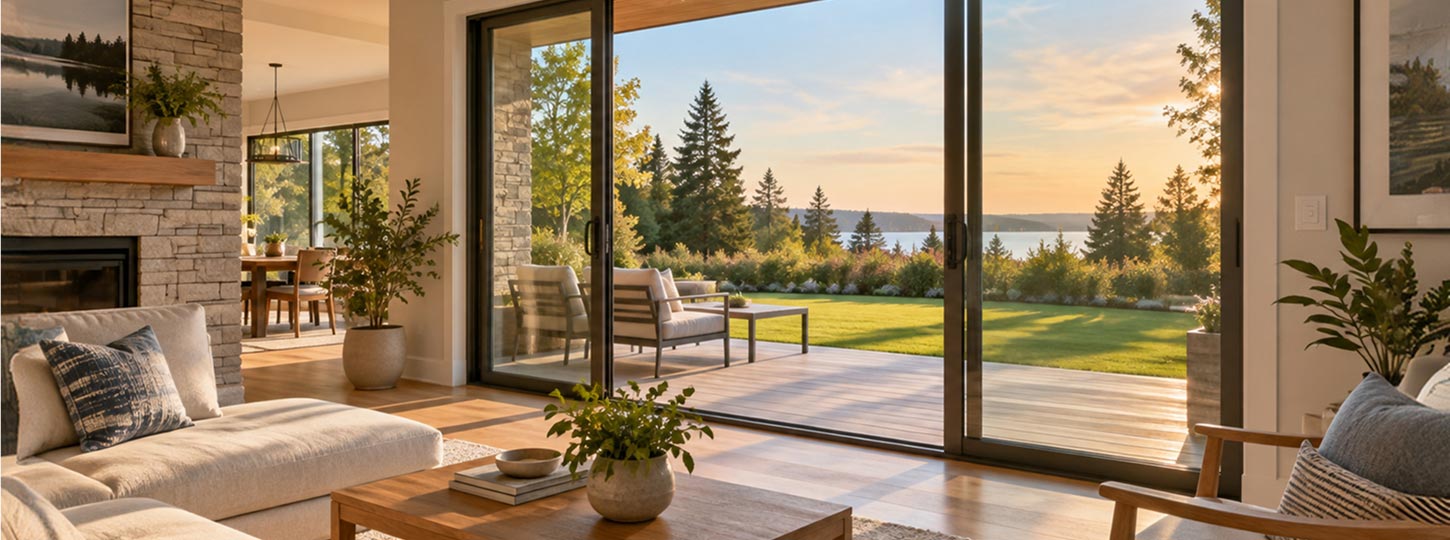


A sliding patio door is the largest opening at the back of most Canadian homes, and it is usually protected by one small hook latch. Securing it properly means covering four separate weak points: the latch, the bottom track, the top track, and the glass. A security bar in the track solves only one of them. A panel that can be lifted out of its frame, or glass that falls out after one hit, stays open no matter how good the bar is.
Window Force has built custom vinyl windows to order since 2007 in an 80,000 sq ft Ontario plant and places them through an authorized dealer network. That includes single and double sliders, which share their working parts with a sliding door: the frame corners, the interlock where the sashes meet, the rollers, and the keeper the latch engages. We see the same sash twice: when it is first hung in a square frame, and years later, when a dealer is called because the hook no longer catches. The four checks below come from the difference between those two moments, and they work on any sliding door, whoever made it.
Key Takeaways
- A sliding door is secure only when four things work together: the latch, a block in the bottom track, an anti-lift stop in the top track, and the glass.
- A security bar or dowel stops the panel from sliding. It does nothing against lifting the panel out or breaking the glass.
- A single factory hook latch is the usual weak point. A second locking point, such as a foot lock, a keyed auxiliary lock, or a multi-point lock, is the hardware upgrade.
- Anti-lift screws or blocks in the top track stop the panel from being lifted off its rollers. They cost almost nothing and are the most often skipped step.
- Security film holds broken glass together on the door you already have. Laminated glass is a different product that has to be built into the glass unit at the factory.
- A new lock is enough only when the frame is square, the rollers hold the panel at the right height, and the glass is sound. Otherwise, the lock is the wrong first purchase.
What Parts of a Sliding Door Matter for Security?
Most advice on patio door security uses trade terms without explaining them. These are the parts this guide refers to:
- Panel (sash): the glass panel that slides. A standard two-panel door has one sliding panel and one fixed panel.
- Stile: the vertical edge of a panel. The meeting stile (interlock) is where the two panels overlap when the door is closed.
- Head: the top track of the frame. The panel's top rail runs inside it.
- Sill: the bottom track. The panel rides on rollers in this track.
- Keeper (strike): the metal catch on the jamb that the latch hook engages.
- Rollers: the wheels under the panel. Adjustment screws at each end of the bottom rail raise or lower the panel.
- Glass unit: the sealed double- or triple-pane unit in the panel. Older doors may have a single pane.
How to Secure Sliding Doors in Layers
A sliding panel can be defeated in three ways: slid open, lifted out, or bypassed through the glass. Each path needs its own layer of protection.
- Slide. The panel moves along the sill track because the latch missed the keeper, the latch was pried, or the door was never locked. The latch and a block in the track address this.
- Lift. Raise the panel until the bottom rail clears the sill track, then pull it out. This works when there is a gap above the panel in the head and the rollers are set low. An anti-lift stop in the head answers this.
- Glass. A pane near the latch is broken, and a hand reaches in to turn the thumb latch. Laminated glass or security film answers this.
Each layer covers one path and leaves the others alone. Two bars in one track still do nothing against a lift. For that reason, the order matters: find out whether the closed panel lifts before you buy anything for the track.
The other test is habit. A bar you take out in the afternoon and leave on the deck is not in the track when the house is empty. An anti-lift screw set once, and a latch that catches every time the panel closes, work without anyone remembering to use them.
Check the closed door with your hands in this order:
- Slide. With the latch locked, push the stile toward the opening. Any movement means the hook missed the keeper or the keeper has shifted.
- Pry. Look at the meeting stile from outside. A gap wide enough for a flat bar can lever a single hook out of its keeper.
- Lift. With the door locked, lift the panel at the stile. If the top rail rises enough for the bottom rail to leave the sill track, a bar in the sill will not help.
- Glass. Find the latch and check whether a broken pane next to it would let a hand reach the thumb turn.
If the lift test fails, fix the head before you shop for a bar. Everything else assumes the panel is still in the frame.
Who Needs Extra Sliding Door Security?
Extra security matters most on a door that still has only its factory latch and fails one of the four checks above: an older door with a single hook, a door hidden from the street by a fence, or a door that often gets left unlocked.
Police in Canada reported 109,753 breaking-and-entering incidents in 2025. The rate fell 11% to 264 incidents per 100,000 people, the third consecutive annual decline. The total still works out to roughly 300 police-reported break-ins a day nationwide. Statistics Canada does not break the count down by point of entry, but local police services consistently list sliding doors as one of the first openings to secure. A patio door is rarely the only weak point, so it is worth checking the rest of the house the same way; our guide on how to make your windows more secure against break-ins applies the same layered approach to every operable window.
Older Doors With a Single Factory Latch
A sliding door from the 1970s or 1980s often has one hook at the meeting stile and a keeper held by two short screws in thin jamb metal. A screwdriver in the stile gap can push that hook out of the keeper. If the screws have stripped, the keeper creeps, the hook stops seating fully, and the panel still moves when locked.
The most common standard patio door size in Canada is 72 inches wide by 80 inches tall, with one fixed panel and one sliding panel about 36 inches wide each. On a door that large, the factory latch is a small metal piece holding a heavy glass panel. Age shows up in the rollers first: the wheels flatten, one corner drops, and the hook meets the keeper too high or too low. Forcing the thumb turn then bends the hook. Get the panel level and the hook seated before you add anything to the track.
The fixed panel needs the same attention. If it is held only by clips that have loosened, lifting it opens the same hole as lifting the sliding panel. The screen panel in the outer track lifts off even more easily and should not be counted as a layer at all.
- The hook seats fully in the keeper, and the keeper screws are tight.
- The sliding panel does not move when you push the stile with the latch locked.
- Neither the sliding panel nor the fixed panel can be lifted clear of the head.
- The glass beside the latch is not a pane; you can push a hand through after one hit.
If the first two checks pass and the lift check fails, the latch is not the part to replace. The head stop is.
Openings Where Drilling Is Not Allowed
Some frames cannot be drilled. A lease, a condominium rule, or a building-owned aluminum frame may forbid screws into the frame or the surrounding wall. In that case, the layers that need a hole drop out and the layers that need none stay.
A wooden dowel in the track needs no hole. A screw that goes only into the door's own head track, set from inside, is a different question from a screw into the building. If the door unit is yours, that screw is in your door. If the frame belongs to the building or the landlord, ask before drilling there. Do not move the screw to the outside face of the frame; the anti-lift stop belongs in the head, set from the room side.
What you give up without drilling is the mounted bar and, often, a keyed auxiliary lock. What you keep is the dowel, the lift test, the habit of locking the factory latch, and security film on the existing glass. A rule against drilling is not a rule against securing the door.
Where Does a Sliding Door Latch Give Way?
The latch on a typical patio door is one hook, sometimes two, that rotates into a keeper on the jamb when you turn the thumb piece. It is designed to hold the panel closed against a slide. It offers limited resistance to a pry, none against a hand that has come through the glass, and, on many doors, very little against a lifted panel.
The hook fails in four ordinary ways, and none of them need special tools:
- The keeper has moved, so the hook swings past it or stops on its face instead of in the pocket.
- The hook is worn or bent, so it no longer reaches the keeper.
- The panel has dropped on its rollers, so the hook and the keeper are no longer at the same height.
- The glass beside the latch is broken, and a hand turns the thumb piece from outside.
Glass within 40 inches of a door lock can be broken so someone can reach inside and unlock the door, Brantford Police warn. On a patio door, the latch sits on the stile right next to the glass, so the pane beside it is always within that reach. A stronger hook does not change this. It only changes how much push the latch can take.
A pry is the attack that leaves the glass intact. A flat bar in the gap at the meeting stile levers the hook down or tears the keeper off its screws. Mortise latches that sit deeper in the stile, and keepers screwed through the jamb into solid backing, resist that lever better than a surface keeper on thin metal. You can see which one you have with the panel open: a small angle bracket held by two short screws is the setup a pry defeats.
Misalignment is the failure that looks intermittent. One roller drops, the hook hits above the pocket, and forcing the thumb turn bends it. The fix is roller height so the hook meets the pocket, not a stronger latch at the wrong height. A second lock point belongs in the track or the head, not as a second hook on the same two short screws, or one pry defeats both.
Sliding Door Security Bar vs. Dowel: What Is the Difference?
A security bar and a wooden dowel in the track do the same mechanical job. Each fills the open sill track when the panel is closed so the panel cannot slide. Neither one stops a lift or holds broken glass. York Regional Police recommend placing a snug security bar or wood dowel in sliding door tracks, together with blocking devices or screws that prevent the door from being lifted out.
A Dowel Cut for the Track
Close and latch the panel. Measure the clear sill track from the edge of the sliding panel to the jamb on the side the panel opens toward. Cut the dowel a few millimetres shorter so it drops in flat, but not so short that a kick knocks it aside. A gap you can fit a finger into is too large.
Hardwood holds its length. Green or softwood stock shrinks, and the gap appears within a month. Round stock can roll in the track; a square or rectangular piece lies still.
Snug means the panel does not move when you push the stile, but you can still lift the dowel out by hand. A dowel so tight you need a hammer will end up left out. A dowel that rattles is already too short. Cut it after you adjust the rollers, or the length will be wrong.
The dowel works whether the latch is locked or not, which makes it useful on a door people forget. It does nothing if the panel is lifted first, because the bottom rail rises and the dowel stays in an empty track.
The sill track that holds the dowel is also the door's drainage channel, a detail most security advice skips. On a well-built sliding unit, water that gets past the exterior weatherstrip drains out through weep openings in the sill instead of standing in the track. Keep those openings clear when you clean the track in the fall: a wooden dowel sitting in standing water swells, and in January it can freeze in place, which turns a removable security layer into one nobody wants to touch.
A Mounted Bar or a Foot Lock
A mounted security bar hinges on the jamb and drops into a cradle on the panel, or it sits in two brackets and lifts out. It stops the slide the same way a dowel does. Its weak point is the cradle: if the panel rises, the bar slips out, and the slide opens again. Where screws into the jamb are allowed, use screws long enough to reach past the face metal into solid material, and do not treat the bar as an anti-lift device.
A foot lock stays on the door. A pedal drops a pin into the sill or a socket in the track. Most foot locks block horizontal movement only, so the panel can still be lifted. Release the pin before you slide the door, or you will bend it.
| Device | Stops the slide | Stops the lift | Holds broken glass | Daily use | Needs screws |
| Wood dowel | Yes, if cut snug | No | No | Lift it out to open | No |
| Loose security bar | Yes, if adjusted snug | No | No | Lift it out to open | No |
| Mounted security bar | Yes, while seated in the cradle | No, the panel can rise out of the cradle | No | Swing it clear to open | Yes, into the jamb or panel |
| Foot lock | Yes, while the pin is down | Only if the pin also traps vertical movement | No | Release the pedal | Usually, for the socket |
If the lift column says No, the head of the door is still your next job. A second bar does not change that column.
Which Patio Door Lock Adds a Second Locking Point?
A patio door lock is only as useful as the place where its metal lands. A hook lands in one keeper on the jamb, a foot lock lands in the track, a keyed auxiliary lock lands in a keeper you add, and a multi-point lock engages several keepers from one handle.
None of these change the glass. Choose the lock by the hole it needs and the attack it answers. A lock that requires routing the stile is the wrong choice for a rental you cannot alter, and a second copy of the same hook is the wrong choice if the hook was not what failed.
| Lock type | Where it engages | Installation | Attack it answers | What it leaves open |
| Factory hook latch | One keeper on the jamb | Existing pocket | A casual push | A pry, a lift, and a hand through the glass |
| Foot lock | A pin into the track or sill | Often a socket in the track | The slide, as a second point | The lift, and the glass |
| Keyed auxiliary lock | A second keeper on the jamb or head | New holes in the frame | The slide, and locking from outside | The lift, if the bolt only moves sideways, and the glass |
| Multi-point lock | Several keepers along the stile from one handle | Stile routed for the lock body | The slide and the pry; the lift, if the hooks or cams are designed to resist it | The glass, and any point that misses on an out-of-square frame |
Multi-point hardware varies by system. Some designs use hooks or mushroom-shaped cams that hold the panel against both sliding and lifting; others add more points only against sliding. Ask the supplier whether the hardware is designed to resist lifting, and set the anti-lift stop in the head regardless. Look at the keepers with the panel open: if every point moves sideways into the jamb and nothing locks vertically, you have bought a stronger slide latch.
A keyed cylinder on the outside lets you lock the door when you leave. From inside, the door should still open without a key, because a patio door is often a second way out of the house in a fire. Keep the inside thumb turn.
A multi-point lock is a stile job, not a screw-on accessory. All points must meet their keepers at the same time. If the frame is twisted, they will not, and forcing the handle bends the connecting rod. Square the opening before you cut the stile.
How to Lock a Sliding Door So It Actually Holds
Locking a sliding door properly is a sequence, not a harder turn of the thumb latch. Test the lift, set the track block, lock every point, then push and lift again. Do it with the screen out of the way, so you are testing the door and not the mesh.
How to Secure a Sliding Glass Door From the Inside
Everything you need to secure a sliding glass door from the inside is on the room side: the thumb latch, the sill track, the head, and the roller adjustment screws on the bottom rail.
If the anti-lift screws are set so low that the panel will not slide, back them off until it runs freely but still cannot rise enough to leave the track. A stop that jams the door will not stay in place for long.
What to Check Before You Leave the House
A door left open a few inches for the dog or for air, with a dowel limiting the gap, is not locked. The gap itself is a reach. When the house is empty, close the door fully.
- The dowel or bar is in the track, not leaning beside the mat.
- The latch and any foot lock are fully engaged.
- Lifting the stile does not raise the panel out of the track.
- The screen is closed only as a screen, not as a substitute for the door.
A door sensor tells you the panel moved; it does not hold the panel. Arm it if you have one, and still do the four checks.
What Keeps the Panel From Lifting Off the Track?
A sliding panel comes out of its frame in one motion. Lift the stile, raise the top rail into the head, and clear the bottom rail from the sill track. Rollers set low make this easier, because they leave more room above the panel. Anti-lift screws or blocks in the head take that room away. They sit in the head track and are set from inside.
On a single sliding panel, two screws are the usual pattern, one near each end of the head, turned down until they almost touch the top rail when the door is closed. The panel must still slide freely. It must not rise far enough for the bottom rail to leave the sill. On a door with two sliding panels that meet, a pin or bolt at the meeting point keeps one panel from being lifted while the other is held. Check the fixed panel too: loose clips at the jamb are a lift path people overlook because that panel has no handle.
Roller height and the anti-lift stop work as one setting. The roller adjustment screws sit at each end of the bottom rail, usually behind small plugs on the face or edge of the stile. Raise a dropped corner until the latch meets the keeper, then set the head stop for that height. If you raise the rollers after the stop is set, the top rail binds on the screws. If you lower them, the stop no longer reaches. Never leave the hook missing its keeper just to keep the panel low.
Set the roller height so the closed panel sits fully up into the head, then set an anti-lift stop so that the panel cannot be lifted clear of the track. A bar in the sill does not do either job,
— engineer Sergey Essipov, with 20 years of experience in window manufacturing, explains.
A bar, a dowel, and a foot lock pin all stay in the bottom track while the top rail rises. Once the bottom rail is out, those devices are behind the burglar. That is why the Côte Saint-Luc crime prevention guide recommends adding an anti-lift device together with a bar or dowel in the track, not instead of it.
Anti-lift screws will not hold a panel whose rollers have collapsed, or a frame so far out of square that the top rail presses against the head at one end and leaves a gap at the other. Square the panel first.
When Does the Glass, Not the Lock, Decide the Outcome?
The lock decides the outcome when the attack is a push or a pry and the glass stays whole. The glass decides it when the shortest path is a break beside the latch. Canadian building codes require safety glazing in glass doors, so a modern patio door has tempered or laminated glass, but the two behave very differently once broken. Older doors may also have a single pane rather than a sealed unit.
Tempered Glass, Security Film, and Laminated Glass
Fully tempered glass is roughly three to five times stronger than ordinary glass of the same thickness, and when it breaks, it crumbles into small, blunt granules instead of large, sharp shards. That's why it is used as safety glass. For security, the same behaviour works against you: the pane empties out of the opening, and the latch behind it is in reach.
Security film is a polyester layer bonded to the room side of the glass, sometimes both sides. When the glass breaks, the fragments stick to the film, so an intruder meets a sagging sheet instead of an open hole, at least for a few hits. Its limit is the edge. Film that is not anchored at the edges, or that has peeled at the stile, lets the whole sheet push through. You can add film to your door, but it does not turn the glass into a laminated product.
Laminated glass is two panes bonded to a plastic interlayer. Under Canada's safety glazing standard, it is one of the recognized types of safety glass, and when it breaks, the fragments tend to stay attached to the interlayer. The pane stays in the opening far longer than tempered glass or film that has come loose at the edges. The interlayer has to be built in when the glass unit is made. Choosing laminated glass is a glass unit replacement, not a lock upgrade.
| Glass type | When it breaks | Security value at the latch | How you get it |
| Tempered | Crumbles into small granules and leaves the opening | Low: opens a path to the thumb latch | Standard safety glass in most patio doors |
| Tempered with security film | Fragments stick to the film while the edges hold | Moderate, depends on edge attachment | Retrofit on the existing glass |
| Laminated | Fragments stay bonded to the interlayer; the pane stays in place | High: delays a reach-in | Specified when the glass unit or door is replaced |
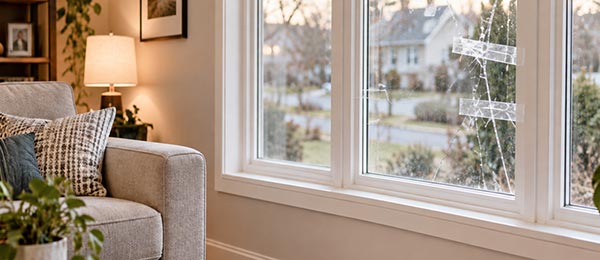
In a sealed double- or triple-pane unit, breaking the outer pane ruins the unit's seal but leaves the inner pane in place. A new latch does not repair that outer pane. If it is already cracked, the glass decision comes before the lock.
A laminated upgrade only pays off for as long as the sealed unit around it stays sealed. When an edge seal fails, the unit fogs, and the only fix is replacing the glass, interlayer included. Window Force builds its glass units around a dual-seal, metal-free warm-edge spacer: an inner seal that keeps the gas fill in and moisture out, and an outer seal that holds the unit together, with no aluminum at the edge to conduct cold into the seal. For a security upgrade, that means the laminated glass you paid for stays clear and in service, rather than coming out early because the unit fogged.
How Is Patio Door Security Different at the Back of the House?
The back door gets the same four layers as any other sliding door, but it is the opening where they are least likely to be in place. A fence hides the stile from the street, the panel sits open for the dog, and the house is empty during the day.
An empty house is most exposed while the household is at work or school. Lock the patio door for a short errand the same way you lock it at night, and lock an upper-floor balcony door as well. A ladder or a neighbouring balcony puts that door within reach.
A solid fence with no view from the lane hides anyone working at the door. A motion-activated light shows the door but does not hold the panel. Closed blinds hide the room, and they also hide the door from you. Set the hardware first; lighting and blinds come after.
The sliding screen is the piece most often mistaken for a locked door. It sits in the outer track, looks closed from the yard, and lifts off with a small raise. The mesh cuts easily. If the only click you heard was the screen latch, the door is open.
A rear patio door often faces south or west, and its frame takes more direct sun than almost any other opening in the house. Where a vinyl compound is poorly stabilized, years of that exposure reduce its impact strength, and the profile becomes more prone to cracking around the small screws that hold a keeper or an anti-lift stop. Window Force compounds its lead-free uPVC with UV stabilizers, so a frame on a sun-facing wall keeps enough toughness for those small fasteners to hold long after the door was installed.
When Is Patio Door Lock Replacement the Wrong Fix?
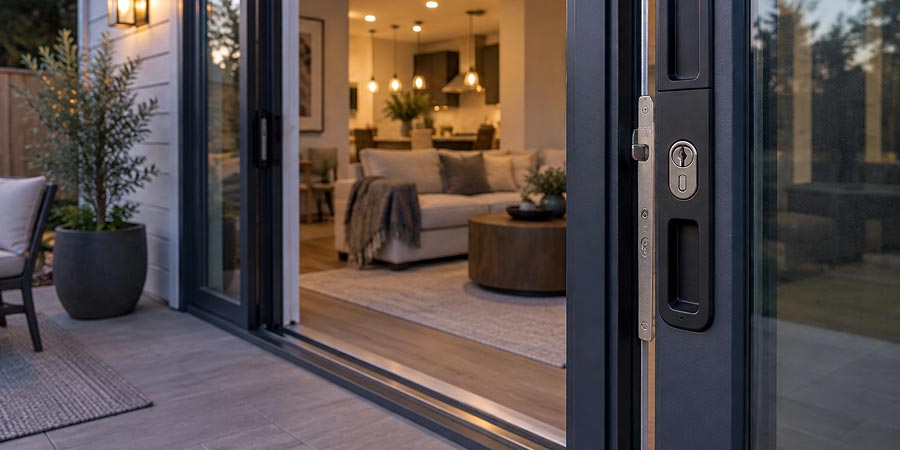
Replacing the lock is the right fix when the frame is square, the rollers hold the panel at the correct height, the head stop can be set, and the glass is already what you want. It is the wrong fix when the new hardware cannot meet the keeper, cannot stop the lift, or sits beside glass that opens with one hit.
When the Frame Is Out of Square
An out-of-square (racked) frame shows up as a meeting stile that touches the jamb at the top and leaves a gap at the bottom, or the reverse. The rollers can correct a small drop at one corner. They cannot correct a bowed jamb or a crushed sill. In that opening, every lock point aims at keepers that are no longer in line. One point catches, the others miss, and forcing the handle bends the lock instead of pulling the frame square.
Look at the sill before blaming the lock. A soft or rotten sill lets the threshold settle, and the panel follows. Roller screws at the end of their travel with the latch still missing signal that the frame has moved farther than adjustment can correct. New hardware on that door repeats the same miss.
A smaller version of the problem is still a lock problem: a keeper screwed on crooked or shifted by stripped screws. That can be reset with longer screws into solid backing, if the jamb allows it. If the jamb itself curves against a straightedge, the keeper is not the bent part.
What a homeowner notices on a frame that stays square is simple: the latch keeps meeting its keeper season after season, with fewer trips back to the roller screws. Window Force fusion-welds every corner of its vinyl frames, melting the profile ends into one continuous joint instead of joining them with screws and corner keys. A welded corner has no fastener to loosen as the house settles, so the frame holds the alignment that the hook, the keepers, and any added lock point all depend on.
When the Panel Still Lifts, or the Glass Is Weak
If the rollers are set for the latch and the panel still clears the head, you need the anti-lift stop, a lock designed to resist lifting, or both. A like-for-like hook, swapped because the old one looked worn, leaves the lift exactly where it was.
Weak glass makes the lock a second decision. A single pane beside the latch is one break from an open hole. Film is the retrofit for glass that stays; a laminated unit is the upgrade when you replace the glass. Changing only the lock leaves the reach-in path open.
A lock replacement is the right job when all four of these are true:
- The frame is square, and a straightedge confirms it.
- The rollers still have adjustment left, and the latch meets the keeper.
- The head stop is set, and lifting does not clear the panel.
- The glass beside the latch is already the glass you intend to rely on.
If any one of them fails, the lock is the wrong first purchase.
Should You Reinforce the Sliding Door You Have or Replace It?
Reinforce the door you have when the frame is square, the rollers can hold the panel up in the head, and the glass is sound. Add the track block, the head stop, and a second locking point, and use them every time you close the door. That door does not need a new frame to pass the slide and lift tests.
Replace the door when the frame is racked beyond what the rollers can correct, when the panel lifts freely and no head stop can be set, or when the glass is a weak single pane and the panel cannot take a better unit. More hardware on that door only delays the same failure.
Engineer Sergey Essipov, with 20 years of experience in window manufacturing, explains:
Most keeper failures we see on older doors are not broken hooks; they are screws that pulled out of a jamb with nothing solid behind the surface. At our facility, we build our sliding window frames from multi-chamber uPVC profiles reinforced through the chambers, so the keeper and the hardware fasteners anchor into more than a thin vinyl wall. For a homeowner, the practical rule is that an added lock is only as strong as what its screws reach: drive them into solid backing, and if the jamb flexes under a screwdriver, the frame is the upgrade, not the lock.
When the work extends beyond the door, for example to the sliding windows beside it, Window Force builds its single and double sliders in the Ultraslim Series, with a 2-7/8-inch visible sightline for contemporary openings, or the Classic Series, with a 3-1/4-inch frame depth suited to retrofit work. An authorized dealer measures the openings and installs the units, so the installer works to the same specification the plant built them to. Window Force windows are CSA certified, and Window Force is an ENERGY STAR Partner whose windows are engineered to meet ENERGY STAR requirements. The 25-year transferable warranty stays with the window if you sell, which gives the next owner a documented unit rather than an unknown one.
If you are choosing a new patio door, ask about three things beyond the price: a lock that resists lifting as well as sliding, laminated glass on the operating panel, and a frame that will stay square.
Not sure whether the problem is your door's hardware or frame, or planning to replace the sliding windows beside it? Send a request through our website, and an authorized Window Force dealer will measure the openings, recommend a series, glass, and hardware configuration for the windows, and provide the production timeline for units built to that size.
Frequently Asked Questions
How to lock a sliding door with no lock?
Close the panel and place a hardwood dowel in the open sill track, cut so the panel cannot move when you push the stile. Then set a screw or block in the head track, from inside, so the panel cannot be lifted out. A dowel alone leaves the lift open. Until you fit a proper latch and keeper, the dowel and head stop do all the work.
How can I make a DIY lock for my sliding door?
The most effective DIY lock is a hardwood dowel cut to fit the track with the door closed, combined with anti-lift screws in the head. Measure after you adjust the rollers, or the length will be wrong. A broomstick that rattles is too short, and a dowel you have to hammer in will end up left out. Skip chains and string; they pull out of a screw eye.
How to keep sliding doors from swinging?
A sliding door should not swing. If the panel tips or swings, the top rail has come out of the head or a roller has dropped so far that the panel pivots instead of rolling. Seat the top rail back in the head, adjust the rollers until the panel hangs level, then set the anti-lift stop. If the panel keeps coming out, the frame or the rollers need repair.
How to lock a sliding door from the outside?
Only a keyed lock works from outside. If the door has a key cylinder, lock it and check that the latch actually engaged by pushing the panel. You can only place a dowel or bar from inside, so if you leave through the patio door, those layers will not be in place; leave through another door when you can, and set the dowel and the anti-lift stop before you go. Don't install a lock that requires a key from inside, because the door may be a fire exit.
How to fix a patio door lock?
Open the panel and check whether the hook is bent, the keeper has shifted, or the two no longer line up. Tighten or reset the keeper first. Raise a dropped corner with the roller adjustment screw until the hook meets the pocket, and do not force a thumb turn that stops on the face of the keeper. If the hook is bent or its spring is broken, replace the latch. If the panel still lifts, the latch was not the broken part.
How to change a patio door lock?
Match the new lock to the pocket already cut in the stile, or plan to rout the stile for a different lock body. A cover plate that hides a mismatch will not move the hook into the keeper. Set the keepers after you adjust the panel. If the frame is out of square, changing the lock repeats the miss, so square the door first, then fit the lock, then test a push and a lift.
How to adjust a sliding door so the latch meets the frame?
Find the roller adjustment screws at each end of the bottom rail, usually behind small plugs on the face or edge of the stile. Raise the low corner a little at a time until the hook enters the keeper without riding up. When the latch meets, set the anti-lift stop for that height. If you run out of adjustment and the hook still misses, the frame or the sill is the problem.
People Also Ask