

No conventional residential window provides absolute protection against forced entry. Effective security instead combines physical resistance, reliable locking and detection. Window security is cumulative rather than singular: a locked sash with multiple locking points, glazing that holds together when struck, a rigid frame anchored to the structural opening, and a detection layer that reduces the time an intruder can work without being detected.
This guide works through each of those layers in the order a technician would assess them, starting with the realistic goal of forced entry delay, moving through hardware, glazing, film, frames and window styles, and finishing with the point at which upgrading an old assembly stops making sense and replacement becomes the better engineering decision.
Key Takeaways
- No residential window product provides absolute protection; the practical objective is to increase resistance to forced entry through multiple security measures.
- Layering improves security because each safeguard addresses a different failure point, reducing reliance on any single component.
- Reliable locking hardware is a foundation of window security, particularly on accessible operable windows.
- Laminated glazing and properly installed security film can improve resistance after glass breakage.
- The frame, fasteners and anchoring set the ceiling on what the glazing can contribute, since glazing that can be levered out of a weak frame never has to be broken at all.
- Emergency escape requirements override security preferences in bedrooms, and any bar, grille or supplemental lock on an egress window must be released from inside without tools or special knowledge.
Can You Actually Make Burglar-Proof Windows?
The phrase burglar-proof windows describes a marketing category rather than a performance class. Security professionals avoid absolute language about glazing for the same reason they avoid it about locks, and guidance from the Royal Canadian Mounted Police makes it clear that even bullet-resistant materials are described in terms of rated performance against a defined threat, not immunity.
Burglar-Proof vs. Burglar-Resistant
The working concept in physical security is delay: the time required to defeat a barrier after the attempt has been detected. An opportunistic intruder works against exposure, not against a stopwatch set by the homeowner, so every additional second spent striking, prying, or clearing fragments increases the probability of abandonment. The practical target for a residential opening is not a barrier that cannot be defeated but one that cannot be defeated quietly or quickly.
This distinction changes how you should spend money. A homeowner who buys one premium upgrade and leaves the adjacent basement window with a worn latch has not improved the house's security, because an intruder selects the weakest opening rather than the strongest. The same budget may provide broader protection when spread across several accessible openings rather than concentrated on a single high-specification pane.
Why Layered Security Works Better Than One Upgrade
Each safeguard addresses a different point of failure. Layering reduces reliance on any single measure by requiring an intruder to overcome several different forms of resistance before entry is possible.
Start with basic security habits, then address the physical resistance of vulnerable openings and add detection where concealment increases the risk. The goal is to make an opening progressively harder to exploit, rather than relying on a single upgrade.
Windows Near Me
How Do You Secure Windows From Break-Ins With a Layered Approach?
A practical security plan combines measures that prevent easy entry, increase physical resistance and improve detection. Police-reported crime statistics provide useful context for the overall risk of residential break-ins, although they do not show how individual window-entry attempts occurred. Statistics Canada recorded 109,753 police-reported breaking and entering incidents in 2025, a rate of 264 per 100,000 population, which was the largest single contributor to the decline in the national Crime Severity Index that year. The long-term trend is favourable, with the rate 41 percent below 2015; because these figures cover police-reported incidents, they do not capture every break-and-enter incident.
Window Security Checklist at a Glance
Work through the layers in this order, since each step is cheaper and more effective when the previous one is already in place:
The order matters. Adding a sensor to a window whose latch doesn't engage is an expensive way to be notified of a problem the hardware should have prevented.
Which Windows Around a Home Should Be Secured First?
Security spending should follow accessibility and concealment rather than being distributed evenly across the house. A second-storey bedroom window on a sheer elevation and a basement window behind a cedar hedge present entirely different risk profiles, and treating them identically wastes budget at one end while leaving exposure at the other.
The practical exercise is to walk the perimeter and rank each opening by two questions: can a person reach it without equipment, and can a person work at it without being seen. Openings that score high on both are where the first dollar belongs.
Ground-Floor Windows
Windows within reach of grade are often a priority because you can approach them without a ladder or climbing equipment. Their priority depends on the combination of accessibility and concealment. Kitchen and bathroom openings may deserve particular attention if they are frequently left open for ventilation or are concealed from view.
Within this group, the highest-risk configuration is a reachable operable sash screened from view by fencing, a garage wall or dense planting. That combination gives an intruder both access and cover, which is exactly what turns an opportunistic look into an attempt.
Basement Windows
Basement openings combine several unfavourable characteristics. They sit low, they are often small enough that homeowners discount them, they are frequently the oldest units in the house, and window wells provide concealment once a person has stepped down into them. The Edmonton Police Service crime prevention guidance recommends securing basement openings with grillwork, guards or bar mechanisms fastened with one-way screws, pins or padlocks, while ensuring at least one basement window remains operable for escape and that all basement bedroom windows stay functional.
Utility, storage and mechanical-room windows can accommodate stronger physical security measures, while bedroom openings must remain suitable for emergency escape.
Windows Near Decks and Roofs
Decks, porch roofs, garage roofs, carport structures, retaining walls and permanent yard fixtures all convert upper-level windows into ground-floor windows. A second-storey window above a single-storey rear addition is functionally accessible, and it usually carries the original hardware because nobody considered it exposed. The same applies to windows beside external stairs and to any opening reachable from a stored ladder, a bin or a woodpile, which is why removing those climbing aids is part of the exercise rather than separate from it.
Large glazed doors and the fixed sidelights beside entry doors belong in this priority group as well. A sidelight can provide a large pane within arm's reach of a door lock, and where that geometry exists, the glazing specification of the sidelight matters as part of the overall entry assembly, and where that geometry exists, the glazing specification of the sidelight matters more than the specification of the door itself.
How Much Difference Do Better Window Locks and Multi-Point Hardware Make?
Locking hardware can provide one of the most cost-effective security improvements for an existing window, because it addresses both unsecured operation and resistance to prying. The difference between the two hardware generations is structural, not incremental.
A basic latch resists force at one location. When force is applied at a corner, the sash deflects, and the single engagement point can disengage or pull out of its fixing. Hardware that engages the sash at multiple points along its perimeter distributes the same applied force across several fixings and several areas of the frame, and the sash must deflect much further before any single point fails.
Single-Point vs. Multi-Point Locking
The Edmonton Police Service makes a point that surprises many homeowners: the latches supplied on many older double hung windows are not locked at all, and exist to hold the sash closed against weather rather than against force. A latch like that can often be disengaged from outside by shimming, and even when it holds, it holds in one place.
| Characteristic | Single-point latch | Multi-point locking system |
| Engagement points | One, usually at the centre of the meeting rail or stile | Multiple points distributed along the sash perimeter |
| Response to prying | Load concentrates at one fixing; sash corner deflects first | Load distributes across several fixings and frame areas |
| Typical failure mode | Fixing pulls out, or latch cams over | Requires multiple locking points or related components to be defeated |
| Operation | Independent latch, often keyless | Single-handle actuation driving all points at once |
| Weather seal effect | Compression at one point only | Uniform perimeter gasket compression |
| Common on | Older units, low-specification replacements | Current casement and hung systems, including Window Force units |
Current Window Force casement windows use a single-actuation handle operating all locking points, a multi-point locking system distributed along the sash perimeter, a corner drive that keeps locking force consistent at the corners, and an anti-pry hardware configuration integrated into the locking system. The same mechanism that resists prying also produces uniform gasket compression, which is why hardware quality shows up in air leakage test results as well as in security behaviour.
Signs a Lock Needs Adjustment or Replacement
Hardware degrades gradually, and the early symptoms are usually dismissed as annoyances rather than recognized as security defects. The following are worth acting on:
- The sash must be lifted, pushed or pulled before the lock will engage, which indicates the sash has dropped or the frame has moved and that some locking points are no longer aligned with their keepers.
- The handle turns through its full travel with noticeably less resistance than before, suggesting a worn drive or a disengaged locking point.
- Visible movement at the sash edge when moderate hand pressure is applied to a closed and locked window.
- Corrosion, chalking or play at the keepers and strike plates, particularly on units over roughly twenty years old.
- A latch that can be moved from outside by inserting a thin blade at the meeting rail.
Engineer Sergey Essipov, with 20 years of experience in window manufacturing, explains:
When we pull failed hardware from older units, the locking point itself is rarely the part that broke. What we find is that the sash has settled by two or three millimetres over the years and only two of the four locking points were still meeting their keepers. The window felt locked to the homeowner because the handle turned, but mechanically it was operating as a single-point latch. Alignment is not a comfort issue. It is what decides whether the hardware you paid for is actually engaged.
How Can You Secure Windows From Inside Without Replacing Them?
Not every opening justifies replacement, and homeowners have legitimate interior options for securing windows without replacing the assembly. The governing constraints are compatibility with the frame and any active warranty, and preserving emergency escape on bedroom openings.
Interior upgrades are best understood as supplements to functioning primary hardware, not substitutes. Adding a secondary lock to a sash whose main lock no longer aligns simply relocates the weakness.
Secondary Locks and Stops
Supplemental hardware for residential sashes includes pin-type restraints for vertically sliding units, track blocks and charley bars for horizontal sliders, keyed latches or keyed slide bolts to replace keyless latches on hinged units, and ventilation stops that allow a limited opening while restraining the sash beyond it. Edmonton Police Service guidance describes the pin method for double-hung sashes: drill a downward-sloping hole through the top of the lower sash frame and into, but not through, the upper frame, and replace keyless latches on crank-operated units with keyed alternatives.
Two cautions apply to both. Fasteners must land in structural frame material rather than a hollow chamber or a glazing bead, and drilling into a vinyl frame can affect both drainage paths and warranty coverage, so the manufacturer or window supplier should confirm the detail before drilling.
Sensors
Contact sensors report that a sash has moved. Glass-break sensors report acoustic signatures consistent with fracture. Together, they cover both unforced and forced entry paths, and they convert delay into consequence, since delay only matters if someone is alerted during it. For openings concealed from the street, sensors carry more weight than on an overlooked front elevation, because concealment removes the informal detection neighbours otherwise provide.
Egress-Safe Upgrades
Any bedroom that lacks an exterior door depends on its window for escape. Edmonton Police Service guidance states plainly that security bars on such a window must be openable from the inside without tools or special knowledge, and the same principle governs supplemental locks: a lock that requires a key kept elsewhere in the house is not an egress-safe device. Ventilation stops on bedroom windows should be releasable by hand from inside, and you should demonstrate the release to every occupant rather than assume it.
Does Laminated Glass Make Windows More Resistant to Forced Entry?
Laminated glass is one of the most effective glazing-level upgrades commonly available for residential window systems, and its mechanism is well documented. It does not prevent breakage. It changes what breakage produces.
How Laminated Glass Works
A laminated unit consists of at least two glass plies bonded to a plastic interlayer, commonly polyvinyl butyral. When struck, the glass fractures, but the fragments remain adhered to the interlayer and the assembly stays in the frame. RCMP glazing guidance states that this retention maintains a barrier after breakage and greatly increases the forced entry delay factor over non-laminated glass. The same document notes a secondary deterrent effect, since fragments remaining in the opening present an injury risk even after a breach has been started.
The practical consequence is a change in the attack profile. Breaking annealed or tempered glass can create a clear opening relatively quickly, depending on the glass and the attack method. Breaking laminated glass produces a cracked but intact panel that must then be cut, torn, or repeatedly struck along the perimeter to clear, which multiplies both time and noise.
Where Laminated Glass Is Most Useful
Laminated glazing isn't required everywhere, and specifying it house-wide is rarely the best use of budget. It earns its cost at openings where accessibility and concealment matter most: ground-floor rear and side elevations, basement openings that are not egress windows, sidelights and transom panels adjacent to entry door hardware, and any opening on a property with limited natural surveillance. Window Force lists laminated glass among its laminated glass configurations, describing enhanced resistance to penetration and forced entry alongside improved acoustic performance, and it can be specified selectively, opening by opening rather than across a whole order.
The acoustic benefit is also worth noting for homeowners weighing the cost, since laminated glazing can improve sound reduction depending on the glass and interlayer configuration.
Because Window Force builds every unit to order rather than pulling from pre-built stock, glazing is assigned opening by opening when the order is placed, so a laminated pane can go to the two concealed rear windows that justify it while the rest of the house carries a standard package. Each unit is assembled on the same metal-free, dual-seal warm-edge spacer system, which keeps edge performance and condensation resistance consistent whether the build-up is a conventional double pane or a heavier laminated make-up. The practical effect is that you can specify and price a security upgrade for each opening instead of applying it across the whole order.
Is Tempered Glass the Same as Security Glass for Break-In Protection?
Tempered and laminated glass can both be used as safety glazing, but they solve different problems and are often confused. Tempered glass is engineered to fail safely. Laminated glass is engineered to fail slowly. Only the second is a security feature.
Tempered vs. Laminated Glass for Home Security
Tempered glass has roughly three to five times the strength of annealed glass, according to RCMP glazing guidance, which represents a real increase in the force required to break it. The complication comes at the moment of failure. Heat treatment puts the surface in compression and the core in tension, so when the panel fails it disintegrates completely into small cube-like fragments, and the opening clears in a single event. The engineered tension also carries a known risk of spontaneous breakage, amplified by any edge damage sustained during manufacture or installation.
| Property | Annealed | Tempered | Laminated | Annealed with security film |
| Relative impact strength | Baseline | Approximately 3 to 5 times annealed | Varies by glass type, thickness, interlayer, and construction | Baseline glass, retention added |
| Behaviour at failure | Large sharp shards, opening clears | Disintegrates into small fragments, opening clears | Fragments retained on interlayer, barrier persists | Fragments retained on film, barrier persists if anchored |
| Forced entry delay | Minimal | Modest increase from higher break force only | Substantial, retention plus multiple strikes required | Moderate, dependent on specification and attachment |
| Injury risk after breach | High | Low | Low, fragments stay bonded | Low to moderate |
| Typical residential role | Legacy and non-code openings | Code-required safety glazing locations | Security-sensitive and acoustically sensitive openings | Retrofit where replacement is not viable |
For homeowners, the takeaway is that tempered glazing should be treated as a code-compliance and injury-prevention specification, not a security specification. When the objective is delay, laminated construction or a properly attached film is the relevant choice, and a window that already has tempered glass gains no meaningful security from that alone.
Can Security Window Film Help Protect Existing Windows?
Security film is a common retrofit option when budget or building constraints rule out replacing the glazing, and it is a legitimate measure when specified and installed correctly. It is also the measure most commonly oversold, so it is worth being precise about what it does.
RCMP guidance lists film among complementary safeguards and describes its benefits as increased delay on forced-entry attempts, reduced glass shrapnel, increased visual privacy, low cost, and rapid installation. Its main benefit is improved fragment retention after breakage, which can increase the time and effort required to create a passable opening.
What Security Film Can and Cannot Do
Security film primarily improves what happens after the glass breaks rather than turning conventional glass into impact-resistant glazing. Its main security benefit is holding broken fragments in place and increasing the effort required to create a passable opening. What changes is everything after that moment, since a broken filmed pane is still a spanning membrane rather than an opening. Film also cannot compensate for a weak sash, a failed lock or a frame that can be levelled, because in each of those cases the glass is not the element being attacked.
Film should therefore be understood as a glazing-retention measure only, appropriate for openings where the glass is the likely attack surface and where the rest of the assembly is sound. On a window with a worn single-point latch, correct the hardware first.
Why Installation Matters
Attachment determines performance, and this is where installations most often disappoint. The same RCMP guidance notes that large glazed areas may require multiple film sheets, and that the resulting seams reduce efficiency. It also states that film should be installed according to the manufacturer's instructions to achieve the stated level of protection.
Two details carry most of the outcome. First, a film that terminates at the edge of the glass without a mechanical or adhesive attachment to the frame can be pushed out as an intact sheet once the glass has fractured, which defeats the purpose entirely; anchored systems that bond the film perimeter to the frame perform very differently from daylight-applied film. Second, film applied to the interior surface of a sealed unit is protected from weathering, but you should review the film-and-glazing combination for compatibility because some films can affect the glass's thermal behaviour.
Why Do the Window Frame and Installation Matter as Much as the Glass?
The weakest link principle governs every window assembly. An opening is only as resistant as its weakest component, and upgrading the glass while leaving the frame and anchoring unchanged simply shifts the point of failure rather than removing it.
RCMP glazing guidance is direct on this point, stating that consideration must be given to the window frame and how it is anchored to the building structure, that even the strongest glazing solution provides no security value if it can be forcefully removed, and that a frame must be able to withstand the same level of force as the glazing in order to mitigate the threat properly. Although the RCMP guidance addresses physical-security applications, its basic principle applies to residential assemblies as well: the frame and anchoring must resist the forces transferred through the glazing.
Frame Rigidity
A frame resists prying through its overall section stiffness, reinforcement, geometry and connection to the structure. Multi-chamber vinyl profiles and reinforced sash construction resist the torsional deflection that prying generates; a hollow, thin-walled, or degraded profile deflects, and once it deflects, the locking points move away from their keepers while the load is still being applied. Since 2007, Window Force has built its systems at an 80,000 sq ft Ontario facility with multi-chamber frames, fusion-welded corners and reinforced sash construction sized to the operable loads of each style, which is the same structural work that supports large triple-glazed units.
Age and material condition matter here. Older, degraded or inadequately reinforced frames may deflect more readily under prying loads, allowing locking points to move out of alignment.
Hardware Attachment
A locking point is only as strong as what it is fastened into. Hardware fixed into a single thin wall of vinyl, a glazing bead, or degraded wood will pull free at loads far below the hardware's rating. Correct attachment lands fasteners in reinforced or multi-wall sections, and this is one of the clearest differences between factory-integrated hardware and aftermarket hardware retrofitted into an opening that was never designed for it.
Screw retention in a vinyl frame is a material question before it is a hardware question, because a fastener holds only as long as the wall it bites into stays stiff. Window Force extrudes lead-free uPVC with UV stabilizers blended through the compound rather than applied at the surface, and runs multi-chamber profiles that give locking hardware more than one wall to pass through. This can provide a more robust substrate for hardware attachment than a thin-walled or degraded profile, where fastener retention may become a concern as the material ages.
Professional Installation
Installation determines whether the frame transfers load into the structure or into the shims. A unit that is square, plumb, shimmed at the anchor points and fastened into the framing behaves as a rigid assembly. A unit that is inadequately anchored, insufficiently supported, or installed out of square can move under load, allowing the locking points to shift out of alignment. Proper installation requires the frame to be correctly aligned, supported and anchored to the structure so that the window behaves as a stable assembly under load. Whether the job is a window installation in an Alberta bungalow or a retrofit in a Quebec row house, the same basic principles apply: the opening and unit should be properly aligned, the frame should be adequately supported and anchored, and the locking points should engage correctly with the sash at rest.
Engineer Sergey Essipov, with 20 years of experience in window manufacturing, notes:
There is a pattern we see on service calls that has nothing to do with the product. The window is sound, the hardware is current, and the whole assembly moves in the opening because it was fastened through the jambs into insulation with no shim behind the anchor. Under a prying load, the frame rotates, and the locking points simply travel with it. Anchoring is invisible once the trim is on, and it is the part of the job that determines how the window behaves when force is applied to it.
Are Casement, Sliding, or Hung Windows More Secure Against Break-Ins?
No window style is inherently secure or insecure. What differs is how each style resists force, and therefore which specification details matter most. Comparing vinyl window types for security is useful mainly as a guide to what to check on a given unit.
When comparable hardware and installation quality are assumed, hinged compression-closing units generally offer advantages against common prying methods, while sliding styles require additional attention to their tracks, lift resistance, and locking hardware. The actual security of any unit still depends on its specific hardware, glazing, frame, and installation.
| Style | Security mechanism | Principal vulnerability | What to specify or check |
| Casement | Sash pulls into the frame against a compression seal, locked at several perimeter points | Older units with a single keyless latch are easy to lever | Multi-point locking, corner drive, anti-pry configuration, heavy-duty hinges |
| Awning | Compression closing on a horizontal axis, similar locking geometry | Individual panes and operator arms on older units can be worked from outside | Locking points rather than an operator holding the sash closed |
| Double hung | Sash locks engage at the meeting rail, upper sash restrained | Legacy latches hold against weather rather than force; upper sash often unsecured | Positive locks at the meeting rail, restraint of the upper sash, pin or bolt supplement |
| Single hung | Fixed upper sash reduces the attack surface to one operable unit | Same latch weakness at the meeting rail | Meeting rail hardware quality and alignment |
| Single and double slider | Sash locks against the frame in the track | Sash can be lifted out of the track; track locks vary widely in quality | Anti-lift provision, track block or charley bar, keeper depth |
| Picture and fixed | No operable sash and no hardware to defeat | The glazing itself is the only path | Glazing specification, laminated where accessible |
| Bay and bow | Combination assembly; security follows the operable units within it | Large fixed panes and structural head support | Glazing specification plus hardware on the operable flankers |
Casement Windows
Casement units close by drawing the sash inward against a perimeter gasket, so an attacker works against compression rather than a simple catch, and the locking points sit at intervals around the sash rather than at one location. This geometry can offer advantages against common prying methods when the hardware, glazing and installation are properly specified. The qualifier is the hardware generation: Edmonton Police Service guidance notes that lower-quality crank-operated units can be difficult to secure because panes and operators can be worked from outside, which accurately describes older stock rather than the configuration itself.
Hung Windows
Vertically sliding units depend entirely on meeting-rail hardware and whether the upper sash is genuinely restrained. Current double-hung windows address this with positive locking and upper-sash restraint, whereas legacy units often have a keyless latch at the meeting rail and nothing holding the upper sash. Homeowners often overlook the upper sash because they test the lower sash and assume the assembly is secure.
Sliding Windows
Horizontal sliders concentrate the security question in the track. Two questions decide the outcome: can the sash be lifted vertically out of its track while closed, and does the lock engage deeply enough to resist the sash being sprung sideways? Current single slider windows address both through keeper depth and anti-lift provision; older sliders often fail both tests, which is why a track block is the standard supplement for this style.
Fixed glazing deserves a mention alongside the operable styles. Picture windows and other fixed units present no hardware to defeat, and Edmonton Police Service guidance notes that most intruders have little interest in attacking fixed panes because it takes time and makes noise. This is why a large fixed unit in an accessible location is often lower risk than a small operable one beside it.
Should You Use Window Bars or Grilles for Extra Security?
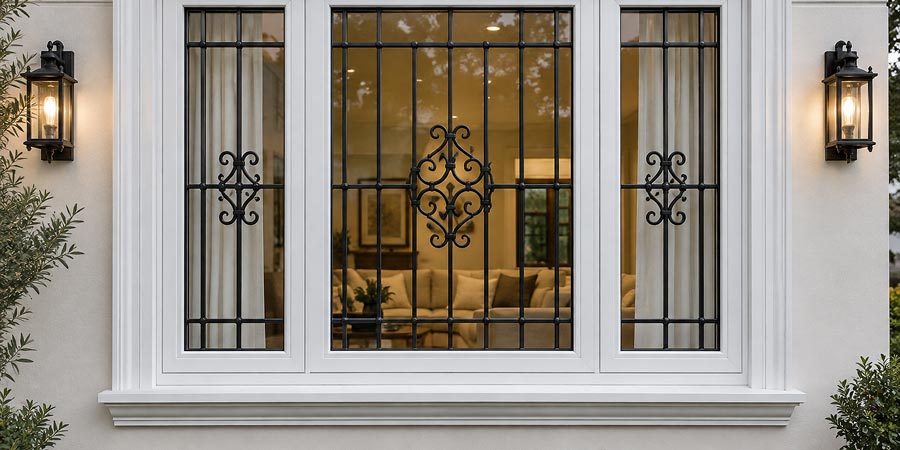
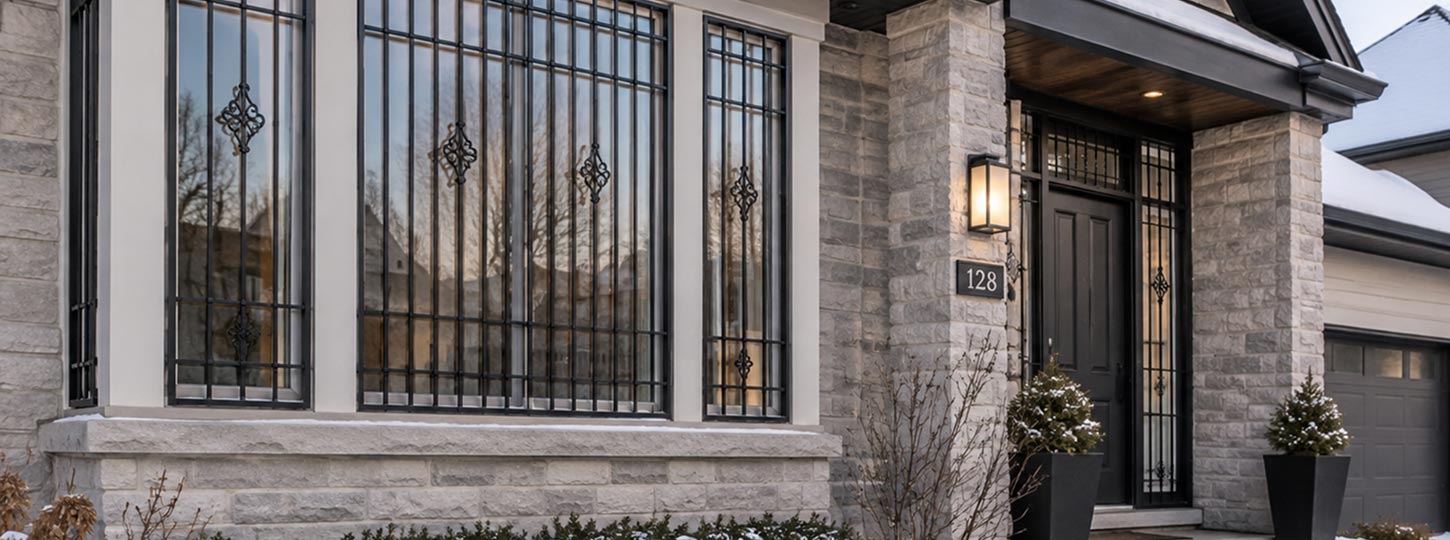
Bars and grilles can provide substantial physical delay, but they also carry the largest set of safety, egress and appearance considerations. They are the right answer for a narrow set of openings and the wrong answer for most of a house.
RCMP guidance states that metal bars or screens fastened to a glazing frame can greatly increase forced-entry delay. The guidance also notes that bars may be cheaper to retrofit than forced-entry-resistant glazing and can be difficult to damage. However, building and fire-safety requirements may restrict their use, so check local requirements before installation.
Where Bars Make Sense
Bars suit openings where the security case is strong, the escape case is absent, and the appearance cost is low. That combination points to basement utility, mechanical, and storage windows; detached garage and workshop openings; window wells serving non-bedroom spaces; and seasonal or unoccupied properties where extended absence is the governing risk. Fastening determines performance: one-way screws, carriage bolts through the frame, or anchors that land in structural material rather than trim.
Appearance is a real constraint, not a vanity concern, since visible bars affect both how a house presents and, in some markets, how it appraises. For a street-facing elevation, laminated glazing usually delivers a better balance of delay and appearance at a comparable cost.
Why Bedroom Egress Changes the Decision
Bedroom windows are governed by escape requirements, and those requirements always override security preferences. When you use security bars on bedroom egress windows, the release mechanism must meet applicable building and fire-safety requirements and allow the window to open from inside without tools or special knowledge.
Two further points are frequently missed. The release must be operable by the room's actual occupant, including children and elderly or mobility-limited residents, in darkness and under stress. The mechanism must also be tested periodically rather than installed and forgotten, because release hardware can become difficult to operate if it is not tested and maintained regularly.
How Do Lighting, Cameras, Alarms, and Landscaping Support Window Security?
Physical resistance buys time, and time is only valuable if something happens during it. The detection and visibility layer converts delay into an outcome, and it is generally the least expensive part of the exercise.
Exterior Visibility
Concealment is the single most underrated factor in opening-level risk. A window screened by mature planting gives an intruder a workspace that cannot be observed from the street, the sidewalk, or adjacent properties. Edmonton Police Service guidance is direct: clip bushes, shrubs, and trees around windows, because covered or hidden windows offer intruders an ideal work location.
A practical CPTED approach is to keep vegetation low enough to preserve clear visibility around vulnerable windows and avoid creating concealed work areas. Fencing, stored materials, bins and trailers parked against a rear elevation produce the same concealment effect and are easier to correct than planting.
Lighting and Cameras
Lighting works by removing the cover of darkness and by making an observer's job possible. Motion-activated lighting can improve visibility around reachable openings and can be part of a broader exterior-security strategy; mounting it high enough to be out of easy reach prevents obvious defeat. Cameras provide both deterrence and evidence, and the deterrent effect depends on visibility; positioning them to cover the approach path to an opening rather than the opening itself generally yields more usable footage, since faces are recorded on approach rather than after concealment.
Window Sensors and Alarms
Alarms close the loop. RCMP guidance notes that even the most robust prevention measures can be overcome if a threat actor has unlimited time, and that alarms can trigger a localized response through an audible or visual cue or a monitored response through a private security provider and, where applicable, notification of emergency services. In residential terms, that means contact sensors on accessible operable windows, glass-break sensors covering rooms with large or accessible glazing, and a response plan that does not depend on someone happening to be home.
When Does Replacing an Older Window Make More Sense Than Adding Security Hardware?
Retrofit measures and replacement are not competing philosophies. They sit at different points on a condition curve, and the decision depends on whether the existing assembly can support the upgrade.
The useful question is not what the security upgrade costs but what it is being fastened to. Retrofit works best when the existing assembly is structurally sound and can accept the planned upgrade.
When Retrofit Upgrades Are Enough
Retrofit is the correct answer when the frame is sound and square, the sash is not distorted, the anchoring is intact, the existing hardware aligns with its keepers or can be adjusted to do so, and the desired upgrade can be fastened into structural material without compromising drainage or warranty. Under those conditions, supplemental locks, a replacement keyed latch, a track block, film on selected panes and sensors will produce a real improvement at modest cost.
Windows at the older end of that range but still structurally sound are good candidates for a staged approach: hardware and sensors now, glazing upgrades at the openings that matter most, and replacement deferred until thermal performance or seal failure forces the decision on its own schedule.
When Full Replacement Makes More Sense
Replacement becomes the better decision when the frame or sash has deflected, rotted, or lost section; when the unit cannot be locked without lifting or forcing the sash; when hardware is obsolete and no longer available in compatible geometry; when a failed sealed unit is accompanied by frame, sash, hardware or anchoring problems that make a larger intervention more practical; when the anchoring is inadequate and cannot be corrected without removing the unit; or when the assembly cannot accept suitable upgrades without obstructing operation or egress.
In those cases, a replacement unit integrates every layer at once rather than adding them sequentially: a reinforced multi-chamber frame, multi-point locking with anti-pry configuration, correct anchoring into the rough opening, and optional laminated glazing specified per opening. Window Force's custom vinyl windows are built to those specifications on a per-opening basis rather than assembled from a fixed catalogue. The economics also change when thermal performance enters the calculation, since the same unit addresses both security and heat loss. Window Force replacement windows are available in both retrofit and full-frame installation methods, which matters here because a full-frame replacement may be the appropriate approach when the existing frame or rough opening requires correction.
Regional context affects timing rather than specification. Both the Ultraslim Series and the Classic Series carry the same multi-point locking and reinforced construction described above. A vinyl window manufacturer in Ontario works with a shoulder season in spring and autumn that suits staged replacement, while in Prairie and northern markets the heating season compresses the practical installation window and pushes homeowners to bundle security and thermal upgrades into a single project. A window company in Vaughan and a crew working in Saskatoon or Halifax are installing the same systems to the same anchoring standard; what varies is the sequencing, the glazing package appropriate to the climate zone, and the lead time.
The argument for replacing rather than layering upgrades onto an old assembly holds only if one party stays accountable for the frame, hardware, and glazing as a complete system. Selected Window Force configurations are CSA certified and engineered to meet applicable ENERGY STAR requirements for Canadian climate zones, and each configuration is documented against the opening it was built for before it leaves the production line. The transferable warranty provides 100% factory coverage for the first 25 years and continues with reduced coverage thereafter, subject to the manufacturer's warranty terms. Installation is coordinated through an authorized dealer network, so the anchoring and shimming work that decides how the frame behaves under a prying load is carried out by installers who set these systems regularly rather than occasionally.
Conclusion
No window can be made truly burglar-proof, but that was never really the goal. The practical objective is to delay forced entry by increasing the time and effort required to create an opening large enough for a person to pass through.
The strongest results come not from a single high-end upgrade but from a sequence of layers that each compensate for the others' weaknesses:
- Behaviour — locking every accessible window whenever the house is unattended costs nothing and removes the largest single category of preventable entry.
- Hardware — multi-point locking distributes prying force across several fixings instead of concentrating it at one point, which determines whether a sash holds under attack.
- Glazing — laminated glass or a correctly anchored security film turns a broken pane into a barrier that still has to be worked through, rather than an instant opening.
- Frame and anchoring — set the ceiling on what the hardware and glazing can contribute; a weak frame lets even the best glazing be levered out intact.
- Detection — lighting, sightlines, and sensors convert delay into an actual outcome by alerting someone while the intruder is still working.
The practical rule is to spend according to accessibility and concealment rather than evenly across the house. An intruder is more likely to target the weakest accessible opening than the strongest one. The practical rule is to prioritize openings that are both accessible and concealed, rather than spending evenly across the house, while upper-storey windows on sheer elevations can wait.
One rule has no exceptions: in bedrooms, egress requirements always override security preferences. Any bars or supplemental locks on a bedroom window must be released from inside without tools or special knowledge.
The final decision should depend on the condition of the existing assembly and whether it can reliably support the required security upgrades.
Frequently Asked Questions
Can any residential window be made completely burglar-proof?
No. Every glazing and hardware option can be defeated with enough time, tools, and motivation. The realistic and measurable objective is forced entry delay, meaning the time and noise required to create an opening large enough for a person to pass through. Layered measures raise that figure substantially, which is what causes opportunistic attempts to be abandoned.
Is laminated glass or tempered glass better for security?
Laminated glass is generally the better choice for forced-entry resistance because it retains fragments after breakage. Tempered glass is stronger than annealed but disintegrates completely when it fails, so the opening clears in one event. Laminated glass retains its fragments on the interlayer, so the panel continues to act as a barrier after breakage and must be worked through rather than simply cleared.
Does security window film actually work?
Correctly specified and anchored film increases forced-entry delay by holding broken glass together, and it is a legitimate option when replacement is not viable. Its effectiveness depends on the glass, film specification, and perimeter attachment, so treat it as a glazing-retention upgrade rather than a replacement for sound hardware and framing. Large panes requiring multiple sheets can have reduced film performance because seams can affect the system's effectiveness.
Are window bars legal on bedroom windows?
Requirements for window bars vary by jurisdiction, but bedroom egress openings must remain usable for emergency escape. If you install security bars on a bedroom egress window, the release mechanism should let the occupant open the barrier from inside without tools or special knowledge. Check the applicable building and fire-safety requirements before installation.
Which windows in a house should be secured first?
Openings that are reachable without equipment and concealed from view. In practice, that means rear and side ground-floor windows, basement openings and window wells, windows accessible from decks, porch roofs or garage roofs, and sidelights adjacent to entry door hardware. Upper-storey windows on sheer elevations are a much lower priority.
Do multi-point locks make a real difference against prying?
Yes, and the difference is structural rather than marginal. A single latch concentrates all applied force at one fixing, so the sash corner deflects and that fixing fails. Multi-point hardware distributes the same force across several fixings and several areas of frame, so defeating the window requires multiple simultaneous failures rather than one.
Will upgrading window security void my warranty?
It can, depending on what is done. Drilling into frames, installing hardware in non-approved locations, or applying film to glazing can affect warranty coverage, depending on the manufacturer's terms; film, in particular, can alter the glazing's thermal behaviour. Confirm any modification with the manufacturer before work begins, since approvals are simple to obtain in advance and impossible to obtain afterward.
Is it worth replacing an old window for security alone?
Rarely for security alone, but frequently once security is combined with the other reasons the window is already a candidate. It can be, particularly when the existing window has unreliable hardware, a deteriorated frame or sash, or other conditions that make retrofit upgrades impractical. If the assembly is still structurally sound, targeted hardware, glazing, or sensor upgrades may be sufficient.
People Also Ask