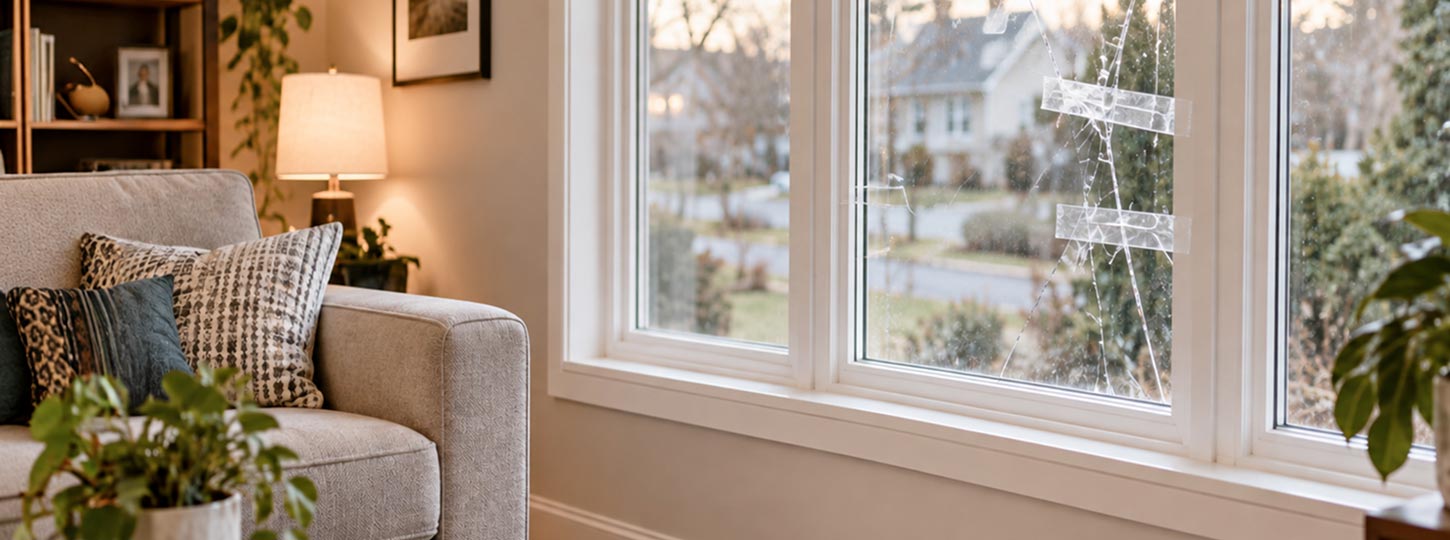


How you tape a broken window depends on one thing: whether the glass is still held firmly in the frame. If the pane is cracked but seated, strips of clear tape laid across the crack can hold it for a short time. If the glass is loose, falling out or already gone, tape cannot hold it together; remove the loose pieces and tape a plastic sheet to the frame instead. Neither fix secures the opening or restores insulation, so book the replacement while the temporary cover still holds.
When a pane breaks, the first questions a dealer asks are practical: Is the frame still square, is the sash undamaged, and can the opening be measured today? Since 2007, Window Force has built custom vinyl windows and sealed glass units to order at its 80,000 sq ft Ontario plant and supplies them through its authorized dealer network, and in our experience, the temporary fix decides how easy the permanent one will be. A clean, dry, well-covered opening can be measured and quoted quickly. A soaked sill, stripped trim or tape baked onto the frame adds work before the new glass can go in.
Key Takeaways
- Tape only works on a crack that is still firmly seated. If the pane flexes, rattles or sheds pieces, remove the loose glass and cover the opening instead.
- Lay strips of clear packing tape across the crack, not along it, and on both sides of the glass when you can reach them safely.
- Cover an empty opening with plastic sheeting taped to the frame: top edge first, then the sides, then the bottom, pulled tight and with overlapping tape.
- Board the opening with plywood after a break-in, on a ground floor, or when the hole is large. Tape and plastic do not keep anyone out.
- In a double- or triple-pane window, a crack in one pane usually means replacing the whole sealed unit, not one sheet of glass.
- Accidental breakage is usually a home insurance matter, not a window warranty claim.
First, Check What Kind of Break You Have
Before you reach for tape, work out which of three situations you are in. Each one needs a different fix.
- A seated crack. The pane is cracked, but the frame still holds its edges, and nothing moves when you press gently beside the crack. Tape can hold it temporarily.
- Loose or hanging glass. The pane flexes, rattles or has pieces hanging from the edge. Tape will not hold it safely. The loose glass has to come out.
- An empty opening. The glass is gone or mostly gone. Nothing to tape; the opening needs a cover.
Look at the edges, not only the crack in the middle. Shine a flashlight across the glass from the side. If you can see the glazing bead or gasket with no glass behind it, part of the pane has already fallen out.
Most Canadian homes have double- or triple-pane windows, and only one pane may be broken. To tell which, run a fingernail lightly across the crack on the room side of the glass. If the nail catches, the inside pane is broken. If the room-side surface is smooth, the crack is in the outer pane, or in the middle pane of a triple unit, and the inside pane is still closing the room. That matters for what you tape and how urgent the fix is.
It also explains why the replacement usually covers more than the broken pane. A sealed unit works because its edge is sealed all the way around, and in a Window Force unit that edge is a dual-seal, metal-free warm-edge spacer: one seal keeps moisture out of the cavity, the other holds the panes together as one assembly. A crack in any one pane breaks that sealed cavity, so the gas fill escapes and moisture can begin to enter even while the other pane is intact. That is why a dealer will quote a new sealed unit rather than one replacement sheet of glass.
Stay Safe Before You Touch the Glass
The break is over in a second, but the risk of cuts lasts until you collect every piece. Before you start:
On an upper floor, never lean out of the window to reach the outside surface. Work only on the side you can reach while standing safely on the floor, and keep people away from the area below the window.
Leave the frame, glazing beads and gasket in place. They hold the shape of the opening, and the next step, measuring for the new glass, depends on them.
Engineer Sergey Essipov, with 20 years of experience in window manufacturing, notes:
The glazing beads and gasket are the only record of the pocket depth and the unit thickness once the glass is gone, and they are the first things lost when someone pries at the frame to tidy up. We build the replacement sealed unit from those measurements, so a cover that is taped to the trim or to the interior face of the frame, with the beads left alone, makes the replacement quicker to measure and more likely to fit the first time.
How to Tape a Cracked Window
Once you have confirmed the crack is seated, the goal is simple: stop the crack from spreading and keep small fragments from dropping out until you replace the glass.
Which Tape to Use
The tape you have on hand matters less than where you put it, but each type has trade-offs on a house window.
| Tape | On cracked glass | Holding plastic to a frame | Removal |
| Clear packing tape | Best choice; you can still see whether the crack is growing | Good on smooth vinyl or painted frames | Peels cleanly if removed within days |
| Painter's tape | Weak hold | Often peels in wind | Releases easily from paint |
| Duct tape | Strong but blocks your view of the crack | Holds best on rough or weathered frames | Leaves heavy residue, especially after sun exposure |
For a crack you need to watch, use clear packing tape. Keep duct tape for holding plastic to the frame when nothing else will stick, and plan to remove it within a day or two.
How to Lay the Strips
Do not force the sash closed or lock it hard to "clamp" a cracked pane. Hardware pressure loads the glass and can push a stable crack out to the edge. Leave the window as it was when it broke, and check the tape the next morning.
A pencil mark at each end of the crack is a simple way to see whether it is still moving. If it grows past the marks, or a piece begins to sag, take the glass out and cover the opening.
What Tape Can and Cannot Do
Tape holds fragments together. That is its only real job. It does not make cracked glass strong again, and a second impact, a hard gust or a slammed door can still finish the break.
Tape is also not a protective film. PreparedBC recommends window safety films to help prevent glass from shattering in a hailstorm, and impact-resistant storm shutters for windows, skylights and doors. Those are products designed for that job. Packing tape on a crack is a short-term hold, not a substitute for either.
Tape does not insulate. A cracked sealed unit has already lost its gas fill, and a plastic sheet over an empty opening is a single thin layer. Expect the room to be colder than usual until the glass is replaced.
And tape does not keep anyone out. If security is a concern, the opening needs a board.
How to Cover a Broken House Window When the Glass Is Gone
When the pane is gone or too loose to trust, stop working on the glass and cover the opening instead. Heavy plastic sheeting, at least 6 mil thick, is the most practical overnight cover.
Taping the bottom first locks in a sag, and a loose sheet flaps. Every flap tugs at the tape, so the cover loosens faster.
Older houses add a complication. Openings in homes built decades ago rarely match modern standard sizes, and a stock sheet of plywood or plastic may not line up with the trim. In Winnipeg's century-old Craftsman bungalows and Four-Square homes, for example, openings often conform to no current standard, which is why anyone working with a window manufacturer in Winnipeg should expect the replacement to be built to the measured opening rather than a stock size. Cut the cover to the frame you actually have, and measure for the replacement the same way.
How to Seal the Cover Against Wind and Rain
A plastic cover keeps wind and rain out only as well as its edges are sealed.
- Start at the top. Each band of tape should cover the plastic edge and a clean strip of frame beneath it.
- Watch the bottom edge. Water runs down the sheet and finds the first unpressed corner. Press the bottom band firmly and check it after the first rain.
- Wipe the sill. Warm room air meets the cold plastic and condenses. Droplets on the sheet or the sill are normal; wipe them so they do not soak into wood trim or the drywall below.
- Re-tape; do not pile on. If an edge lifts, dry the frame and apply a fresh band. Extra tape in the middle of a loose sheet does nothing.
Wind is the biggest threat to a taped cover. In Moncton, where periodic high winds from Atlantic weather systems are normal, a window supplier has to plan for the kind of gust that lifts a loose bottom corner and drives rain onto the sill. On an exposed wall, a taped sheet is an overnight cover; if wind is forecast, board the opening.
Temperature swings loosen tape too. Adhesive softens in warm air and stiffens in cold, so a cover that held in the afternoon can release overnight. Chinook winds can swing temperatures by 20°C or more in a single day, which is why homeowners waiting on vinyl windows in Calgary should check every taped edge again the same evening, not after the next storm.
When to Board Up a Broken Window
Plastic keeps weather out; it does not keep people out. Board the opening the same day in any of these situations:
The police-reported breaking-and-entering rate in Canada fell to 264 incidents per 100,000 people in 2025, but a broken window is still an obvious invitation while it waits for repair.
| Cover | Wind | Rain | Light | Security |
| Plastic sheet | Stops a breeze if tight | Holds if edges overlap | Lets light in if clear | None |
| Cardboard | Tears in a gust | Soaks and sags | Blocks light | None |
| Plywood | Holds a large opening | Holds with plastic behind it | Blocks light | Stops entry when screwed to the frame |
Use plywood at least 1/2 in. thick, cut to overlap the frame. If rain is coming, tape plastic over the opening first, then fasten the board over it. Drive screws into the frame, not through any remaining glass and not into siding alone, and use enough of them that a push in the middle cannot lever the board off. Screws are easier to remove than nails and do less damage to the frame when you remove the board to measure.
Once the window is replaced, our guide on how to make your windows more secure against break-ins covers the layers that make an opening harder to force.
When to Call a Professional Right Away
Some breaks should not wait for a morning appointment, and some should not be handled yourself at all:
- A large pane, a patio door or a window over a stairwell, where the glass is heavy and can fall.
- Glass hanging from the top of the frame.
- An upper-floor window you cannot reach safely from inside.
- A break that followed a break-in, especially if the frame or lock is damaged.
- Water already running into the wall or onto the floor.
- Any sign the frame itself is cracked, twisted or pulled out of the opening.
Who Pays for a Broken Window?
Accidental breakage is not a manufacturing defect, so a window warranty generally doesn't cover it. Window Force's warranty, for example, excludes accidental damage and negligence and does not apply if a unit is cracked or broken. Its separate 10-year glass warranty covers sealed-unit failure, meaning film formation or dust collection between the panes, not impact damage.
For a ball, a storm, a fallen branch or a break-in, contact your home insurer. Take photos of the damage, the cover you installed, and any debris before you clean up, and keep receipts for tape, plastic and plywood. Many policies expect you to take reasonable steps to prevent further damage, and a documented temporary cover shows you did.
Repair, Replace the Glass, or Replace the Whole Window?
Tape buys time. What happens next depends on the glass and the frame.
Repair is rarely an option for a real crack. Our guide to cracked glass repair explains that small, shallow surface chips may sometimes be repaired, but once a crack has a defined starting point and radiating lines, the glass has lost its strength at that spot and needs to be replaced.
Replacing only the glass makes sense when the frame, sash and hardware are sound. The broken sealed unit comes out, a new one goes into the same sash, and the frame stays in the wall. Our guide on replacing just the glass in a window covers when that works.
Replacing the whole window is the right scope when the frame is twisted, rotted, split, or the hardware no longer works.
Engineer Sergey Essipov, with 20 years of experience in window manufacturing, explains:
A hit hard enough to break the glass also jolts the frame, and on frames with screwed or keyed corners, that jolt can open a joint you will not notice until the next rain. At our facility, we fusion-weld every frame and sash corner, melting the profile ends into a single joint, so in most impact breaks, the frame stays square, and only the sealed unit needs replacing. Before you order anything, open and close the sash and look at each corner. If it still operates smoothly and the corners are tight, ask about glass-only replacement first.
Window Force frames are extruded from lead-free uPVC with UV stabilizers in multi-chamber profiles, so a frame that has taken an impact and a few days of weather does not rot or corrode the way an unprotected wood or steel sash can, which keeps glass-only replacement open as an option.
Replacement glass isn't an off-the-shelf part. A sealed unit must match the glazing pocket of your sash to within a fraction of an inch, along with the pane count, coating, and any tempered or laminated glass the opening requires. Because Window Force builds every sealed unit and window to order, the dealer measures your actual sash or opening and builds the unit to those dimensions, rather than a stock size shimmed to fit. That is also why measuring early pays off: production starts from the measurement, not from the day the cover finally fails.
If a Car Window Breaks
Car side and rear windows are usually tempered glass, which crumbles into small pebbles when it breaks, so there is nothing left to tape. Some newer vehicles use laminated side glass, which cracks but stays in place; a small lattice of clear tape can hold it until you replace it.
For a shattered side window, vacuum the glass out of the seats and door channel, then tape clear plastic sheeting over the opening, onto the rubber seals and interior trim rather than the painted surface, where tape residue bakes on in the sun. Do not use the window switch; the motor can drag broken glass into the door and jam the regulator.
Keep the driver's view clear. Ontario's Highway Traffic Act requires the windshield and the windows on either side of the driver to provide a clear view to the front and sides, so a dark garbage bag over a driver-side window is only a cover for a parked car. Other provinces have similar rules. Book an auto glass shop as soon as possible.
Book the Replacement While the Cover Still Holds
Use tape on a seated crack, plastic on an empty opening, and plywood when security or wind is the concern. In every case, the temporary fix has a countdown: sun, rain, wind and freeze-thaw cycles all shorten how long tape holds. The best time to arrange the replacement is while the opening is still dry and covered, because a dry, intact opening is quicker to measure and quote.
Window Force builds replacement windows and sealed units to order and installs them through an authorized dealer network, so the person who measures the opening is accountable for fitting the unit made to that measurement. The windows are CSA certified. Window Force is also an ENERGY STAR Partner, and its windows are engineered to meet ENERGY STAR® requirements, so the new glass restores the insulation the broken pane lost rather than just closing the hole. The 25-year transferable warranty on the frame, sash and hardware stays with the house if you sell, and the separate 10-year non-prorated glass warranty covers sealed-unit failure on Window Force windows.
Covered the opening and ready for a permanent fix? Send us a request through our website, and an authorized Window Force dealer will check whether the frame can stay, measure the sash or opening for glass-only or full replacement windows, and give you the production timeline so you know how long the cover needs to last.
Frequently Asked Questions
What is the best tape for a cracked window?
Clear packing tape is the best choice for a cracked pane. It holds well on clean, dry glass and lets you see whether the crack is growing. Lay strips across the crack in a crosshatch pattern, on both sides if you can reach them safely, and remove it soon after you replace the glass.
Should you tape both sides of a cracked window?
Yes, if you can reach both sides safely from the floor or the ground. Taping both sides holds fragments better. Never lean out of an upper-floor window to reach the outside; tape the inside and leave the outside for a professional.
How long will tape hold a broken window?
There is no reliable number of days. Sun, rain, wind and temperature swings all weaken the adhesive. Treat tape as a fix for a night or a few days, check it daily, and book the replacement right away.
Can you use a garbage bag to cover a broken window?
A heavy, clear plastic sheet is better because it lets light in and lets you see outside. A garbage bag can work overnight on a house window if you tape it tightly to the frame, but it tears easily and shouldn't be used over a car window the driver needs to see through.
Does homeowner insurance cover a broken window?
Many home insurance policies cover glass broken by storms, falling objects or break-ins, depending on the policy and deductible. Window warranties generally do not cover accidental breakage. Photograph the damage and your temporary cover before cleanup, and contact your insurer.
Can a cracked window be repaired instead of replaced?
Only very small, shallow surface chips can sometimes be repaired. A crack with a clear starting point and lines spreading from it means the glass has lost strength, and in a double- or triple-pane window, the sealed unit should be replaced.
How do you remove tape residue from a window after replacement?
Peel the tape slowly, folding it back along itself. On vinyl frames, use mild soap and warm water with a soft cloth. Avoid razor blades on glass you want to keep and harsh solvents on vinyl, which can damage the finish.
People Also Ask