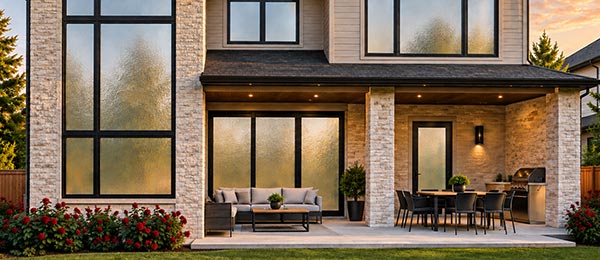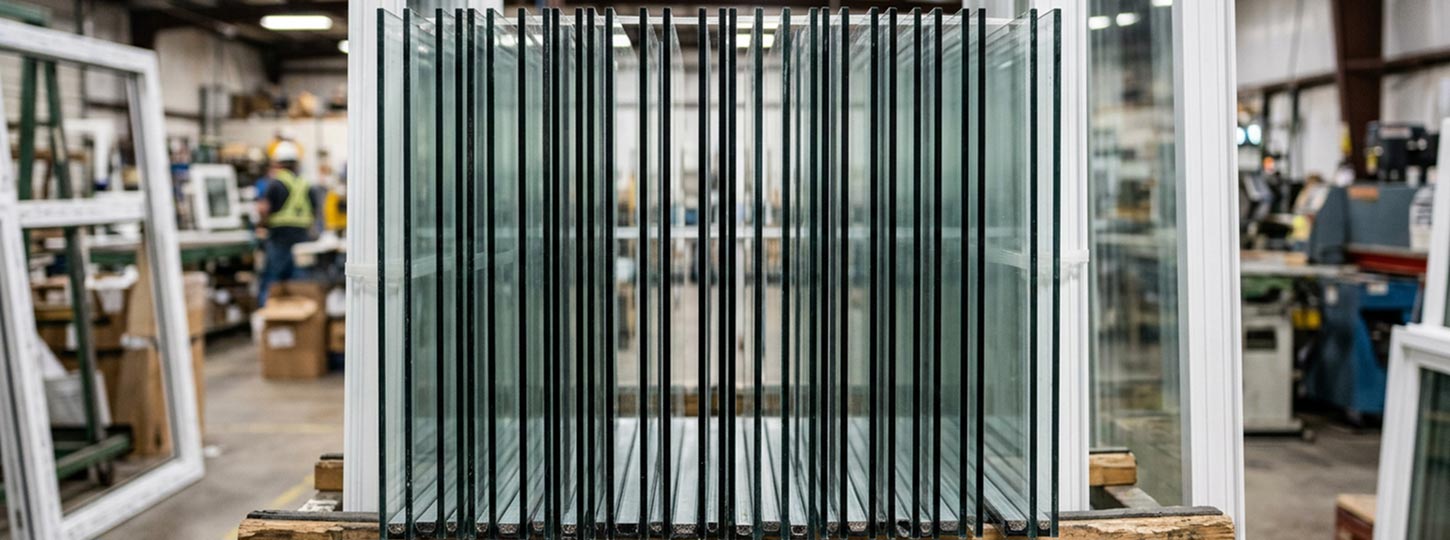


Most window glass begins with silica sand, soda ash, limestone, and other raw materials that are melted at high temperatures before being formed, cooled, and processed into a finished pane. Understanding how window glass is made helps explain how manufacturing, glass composition, and subsequent processing affect its strength, durability, and thermal performance.
Window Force's work begins where the float line ends. Flat glass arrives at the plant as stock and cut sheets, and what happens next- matching the coating to the orientation recorded on the order, setting the spacer and cavity depth, sealing and testing the unit, then glazing it into the frame- is what turns a sheet into a window. The company has manufactured fenestration for the Canadian market since 2007, and its own production line now occupies 80,000 sq ft in Ontario. The stages described below are covered from the point at which a manufacturer takes delivery of glass and becomes accountable for its performance.
Key Takeaways
- Most architectural and residential float glass starts with a carefully controlled batch of silica sand, soda ash, limestone, dolomite, and, where used, recycled cullet, melted at temperatures above 1,500°C before it ever takes the shape of a pane.
- The float process, where molten glass spreads across a bath of liquid tin, is what gives modern window glass its flat, distortion-free surface.
- Cooling, annealing, and cutting are engineered stages, not afterthoughts; uneven cooling can leave internal stress that causes a pane to fail later.
- A finished window depends on more than the glass itself. Frame material, spacers, Low-E coatings, and gas fills determine how well it actually performs in a Canadian winter.
- According to Natural Resources Canada, windows, doors, and skylights can account for up to 25% of a home's total heat loss. That is why the properties of the finished glazing and complete window assembly can have a meaningful effect on energy use.
What Is Glass Made of Before It Enters the Furnace?
Before any melting begins, manufacturers assemble what the industry calls a batch: a carefully weighed combination of raw materials that determines the glass's final properties. The proportions of silica, soda ash, limestone, dolomite, cullet, and other additives are controlled according to the required glass composition. This formulation establishes the chemical and physical properties of the base glass before it enters the furnace.
Silica sand
Silica sand, or silicon dioxide, forms the backbone of nearly every type of commercial glass. Corning identifies silica as the foundational ingredient in glassmaking, since it is what actually vitrifies, or turns into glass, when heated to extreme temperatures. On its own, pure silica melts at over 1,700°C, which is why manufacturers rarely use it alone.
Soda ash and limestone
Soda ash (sodium carbonate) is added to lower the batch's melting temperature, reducing the energy required for industrial-scale glass production. Limestone and dolomite are added as sources of calcium and magnesium oxides, which improve the glass's chemical durability and resistance to weathering. Manufacturers may also add smaller amounts of other compounds to adjust properties such as optical performance, thermal resistance, or chemical durability, depending on the type of glass being produced.
Why manufacturers add cullet
Alongside virgin raw materials, most batches include cullet, which is crushed recycled glass from either internal production scrap or post-consumer sources. Cullet melts at a lower temperature than raw sand and limestone, so a higher proportion in the batch reduces the total energy needed to reach a working melt. The batch formulation is also determined according to the intended end use, since window glass, container glass, and specialty glass require different compositions.
| Raw Material | Function in the Batch |
| Silica sand | Forms the glass network; the core vitrifying agent |
| Soda ash | Lowers the melting temperature of the mixture |
| Limestone/dolomite | Improves chemical durability and weather resistance |
| Cullet | Reduces the energy required for melting |
| Minor additives | Adjusts clarity, colour, or thermal performance |
Windows Near Me
How Is Glass Made From Raw Materials, Step by Step?
Once the batch is measured, the raw materials undergo a defined sequence before becoming a usable sheet of glass. Cardinal Glass Industries manufactures flat glass using the float-glass process, the standard method described below.
This process produces the base flat glass that can then receive additional treatments, such as Low-E coatings, before being fabricated into insulated glass units and complete window assemblies.
Why Is Molten Glass Floated on a Bath of Tin?
The float process is the step that gives window glass its signature flatness, and the physics behind it is straightforward once broken down. Molten glass flows onto a bath of liquid tin, where gravity and surface tension allow it to spread into a smooth, continuous ribbon. The process also gives manufacturers precise control over the ribbon's thickness, width, and surface quality.
How the glass ribbon forms
Molten glass is poured into a bath of liquid tin, which remains molten at glass-forming temperatures but does not mix with the glass. Gravity pulls the glass into a level layer across the tin's surface, while surface tension between the two materials smooths out irregularities that would otherwise appear on a rigid surface. The result is a smooth, uniform sheet with highly flat and parallel surfaces and minimal optical distortion.
How manufacturers control thickness
Thickness is controlled through the ribbon draw rate and other process parameters, including temperature and width control, which are continuously monitored during production. Temperature is carefully controlled along the bath to maintain the required glass viscosity and ribbon dimensions during forming. This combination of gravity, surface tension, and drawing speed allows manufacturers to maintain tight tolerances throughout a continuous production run rather than treating each sheet as a separate casting. One consequence of the float process that most buying guides skip entirely is that the two surfaces of the glass are not chemically identical. The face that rested on the tin bath retains trace amounts of tin atoms diffused into the glass surface, which fluoresce under ultraviolet light and behave slightly differently from the air-side surface when coatings are applied. Manufacturers and fabricators check which face is which before applying Low-E coatings, because certain coating chemistries are formulated specifically for the air side and will adhere inconsistently if applied to the tin-enriched face. It is a handling detail invisible to the homeowner but measurable in coating performance over the life of the unit.
Engineer Sergey Essipov, with 20 years of experience in window manufacturing, explains:
The speed at which the glass ribbon is drawn from the tin bath directly affects the thickness of the finished sheet. Manufacturers continuously monitor the drawing rate and make precise adjustments throughout production to maintain consistent thickness and meet the required specifications.
How Is Window Glass Cooled, Annealed, Inspected, and Cut?
Forming the ribbon is only half the job. What happens next determines whether that glass will hold up once it is installed in a window. Controlled cooling relieves internal stresses, while inspection and cutting ensure that the finished sheets meet dimensional and quality requirements before secondary processing.
Why annealing matters
The ribbon leaves the tin bath still extremely hot and passes into an annealing lehr, a long chamber that lowers its temperature in carefully controlled stages. Cooling glass too quickly creates uneven internal stress, because the outer surface hardens while the interior is still contracting. That stress can later cause a pane to crack under thermal load or impact that ordinary annealed glass would otherwise survive. A properly annealed sheet cools slowly and evenly enough that the internal structure settles without locking in that tension.
Automated glass inspection
After annealing, the ribbon passes through optical scanning systems that check for thickness consistency, embedded bubbles, stones (undissolved raw material particles), and surface scratches. Any section that fails inspection is flagged and diverted before it reaches the cutting stage, which keeps defective material out of the finished product stream.
Cutting glass to size
Once inspected, the ribbon is scored and cut into standard stock sheets, which manufacturers hold in set dimensions, or custom sizes ordered for a specific project. From here, the cut sheets move on to secondary processing rather than going straight into a window frame.
Production-stage checklist: dimensional accuracy confirmed, surface free of visible defects, thickness within tolerance, edges clean and ready for further processing.
How Does Ordinary Float Glass Become Glass for Windows?
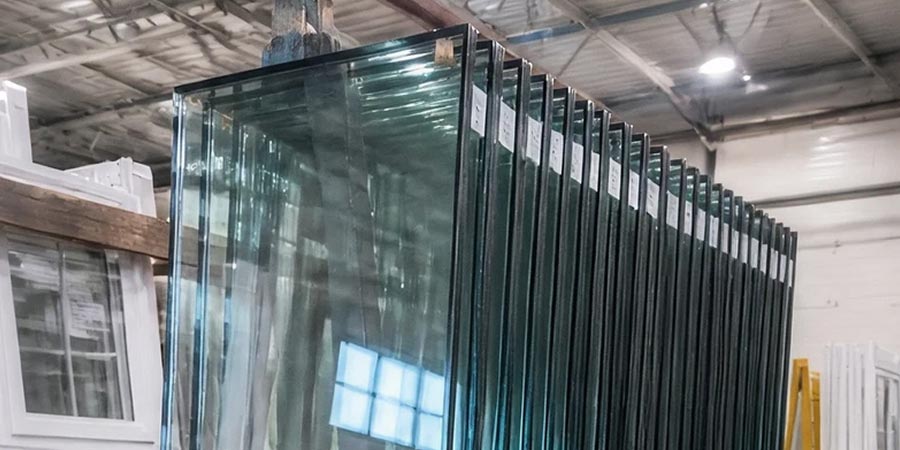
A freshly cut sheet of float glass is not yet a window pane. It must first be fabricated according to the intended application, which may involve edge finishing, heat treatment, lamination, tinting, or coating. The processed panes can then be assembled into insulated glass units and integrated into complete window systems.
From glass sheet to window pane
The cut sheet first goes through edge finishing, called seaming, which removes sharp edges and reduces the risk of chipping during handling. From there, depending on the specification, the glass may be tinted, coated, or heat-treated. Heat treatment converts standard annealed glass into tempered or heat-strengthened glass, while lamination bonds two or more layers together with a plastic interlayer for added security and sound control.
From pane to finished window unit
Individual panes are then combined into an insulated glass unit, where two or more sheets are separated by a spacer, sealed, and filled with air or an insulating gas. That completed glass unit is set into a frame, along with weatherstripping, hardware, and locking mechanisms, to become a functioning window.
What Types of Glass Are Used for Residential Windows?
Not all window glass performs the same way, and the type used directly affects safety, clarity, and long-term costs.
Annealed glass is standard float glass that has not undergone additional heat treatment. It is the least expensive option and works for applications where impact resistance is not a primary concern, though it breaks into large, sharp shards if it fails.
Heat-strengthened glass is partially tempered, giving it roughly twice the strength of annealed glass. It is commonly specified where wind load resistance matters but full temper is not required by code.
Tempered glass is used where safety glazing is required or where greater resistance to thermal and mechanical stress is needed. It is roughly four times stronger than annealed glass and breaks into small, relatively blunt fragments when it fails.
Laminated glass bonds a plastic interlayer between two panes, so the assembly remains intact even when cracked, making it a common choice for ground-floor windows and high-traffic areas.
Tinted and patterned glass are used mainly for solar control or privacy rather than structural performance, and are typically layered with other treatments rather than used alone.
Low-E glass is widely used in modern residential windows because it reduces radiant heat transfer while maintaining useful levels of visible light.
| Glass Type | Typical Purpose | Break Pattern | Relative Cost |
| Annealed | Basic glazing, non-safety applications | Large, sharp shards | Lowest |
| Heat-strengthened | Wind load resistance | Larger fragments than tempered | Moderate |
| Tempered | Standard residential safety glazing | Small, blunt pieces | Moderate |
| Laminated | Security, sound control, ground-floor units | Stays bonded to interlayer | Higher |
| Low-E coated | Energy efficiency, UV control | Depends on base glass type | Moderate to higher |
Window Force's own glazing configurations bring several of these categories together into a single unit, allowing a designer, architect, or specifier to match glazing performance requirements to a specific project rather than defaulting to a single standard pane for every order.
How Are Tempered and Laminated Window Glass Made Safer?
Tempered and laminated glass improve safety in different ways. Tempering increases glass strength and causes the pane to break into small fragments, while lamination holds broken glass together with an interlayer.
How glass tempering works
Tempering starts with a cut and finished annealed sheet, which is heated to roughly 620 — 650°C and then rapidly cooled with jets of air. This rapid cooling puts the outer surfaces into compression while the interior remains in tension, increasing the strength of tempered glass. When tempered glass breaks, the internal stress causes it to fracture into small, rounded fragments rather than long shards, which significantly reduces the risk of injury.
How laminated glass is assembled
Laminated glass takes a different route. Two or more glass plies are bonded together with an interlayer, typically polyvinyl butyral, using heat and pressure. The National Glass Association describes laminated glazing in exactly these terms: multiple glass plies combined with an interlayer or resin to form a single assembly. If the glass cracks under impact, the interlayer holds the fragments in place instead of letting them scatter, which is why laminated units remain a common specification for storm-prone regions and ground-level openings.
Tempered versus laminated glass
The two are not interchangeable in every application. Tempered glass provides greater strength and resistance to mechanical and thermal stress, while laminated glass provides superior post-breakage retention and can improve sound control. Many manufacturers combine both properties in a single unit for applications where security and safety code compliance both matter, though local building code requirements should always be confirmed with a qualified professional before final specification.
How Are Double- and Triple-Pane Insulated Glass Units Assembled?
Insulated glass units, or IGUs, are what allow a window to insulate rather than simply glaze an opening. Two or more panes are separated by sealed cavities containing air or an insulating gas, creating a thermal barrier between the interior and exterior. The spacer, seals, gas fill, and Low-E coatings all contribute to the unit's overall performance.
Spacers and seals
Two or three panes are held apart by a spacer bar, typically installed around the perimeter of the unit, which maintains a consistent air gap between the layers. A desiccant inside the spacer absorbs residual moisture to prevent internal fogging, and a dual seal, primary and secondary, keeps the cavity airtight over the life of the window.
On our own assembly line, the spacer is set before either pane is closed: desiccant is loaded into the bar, a primary seal is laid along both faces, and a secondary structural seal is run around the perimeter to carry the load. Window Force uses a metal-free warm-edge spacer at that step, which keeps a conductive path away from the cavity edge rather than treating the spacer as a purely mechanical component. A homeowner never sees the spacer, but they see its effect: an edge that stays closer to room temperature, which is exactly where fogging and edge condensation would otherwise begin.
Gas-filled cavities
Many insulated glass units use argon or krypton gas fills because these gases conduct heat less readily than air. Argon is the standard choice for most residential applications, while krypton, denser and more expensive, is typically reserved for narrower gaps where its higher insulating value matters most.
Double-pane versus triple-pane construction
A double-pane unit uses two panes with a single gas-filled cavity, while a triple-pane unit adds a third pane and a second cavity for additional insulation and sound reduction. Low-E coatings can be applied to selected glass surfaces within either configuration, depending on the desired thermal and solar-control performance.
| Configuration | Panes | Insulating Cavities | Best Suited For |
| Double-pane | 2 | 1, typically argon-filled | Most residential applications |
| Triple-pane | 3 | 2, argon- or krypton-filled | Colder climates, improved thermal performance, and applications where additional sound control is desired |
| Vacuum-insulated (VIG) | 2 | Sealed vacuum, no gas fill | Retrofit projects needing slim profiles |
What Are Windows Made of Besides the Glass?
The glass unit is only one component of a complete window. Frame, hardware, and sealing systems all affect how that glass ultimately performs once installed.
Window frame materials vary in cost, maintenance, and thermal behaviour. Vinyl frames, which Window Force Inc. manufactures as custom vinyl window systems, resist moisture and do not require repainting, which makes them a common choice across Canadian climates. Wood frames offer a traditional appearance but require more upkeep; aluminum frames conduct heat readily unless thermally broken; and fibreglass frames offer strong dimensional stability across temperature swings.
Beyond the frame itself, a finished window depends on:
- Sash components, which hold the glass unit and allow operable windows to open and close
- Weatherstripping and compression seals, which block air infiltration around moving parts
- Locking hardware and operators, which secure the window and control how it opens
- Installation components such as fins, flashing, and shims, which manage water and air sealing at the rough opening
A high-quality insulated glass unit cannot compensate for air leakage through a poorly sealed frame. For this reason, glass and frame specifications should be evaluated together when assessing overall window performance.
Frames built for the volume market are commonly fastened mechanically at the corners, which leaves four joints on every sash and frame depending on fasteners and sealant to stay airtight. Window Force fusion-welds those corners into a continuous section, so there is no mechanical joint at the corner to work open as the profile expands and contracts through Canadian seasons. The profiles are extruded from lead-free uPVC with UV stabilizers compounded through the material rather than applied to the surface, which prevents the welded geometry from distorting on sun-exposed elevations and is why a properly built frame does not become the leak the glass has no way of offsetting.
How Do Low-E Coatings and Gas Fills Improve Window Performance?
Coatings and gas fills can significantly improve the thermal and solar-control performance of window glazing, and the terminology here matters for anyone comparing options.
Low-E, or low emissivity, coatings are microscopically thin metallic layers applied to the glass surface that reflect infrared heat while still allowing visible light through. Emissivity itself describes how much radiant heat a surface releases; a lower emissivity means less heat escapes through the pane in winter and less enters during summer. The U-factor measures the rate of heat transfer through the entire window assembly, so a lower U-factor indicates better insulation. The solar heat gain coefficient, or SHGC, measures how much solar heat passes through the glass, which matters most for south- and west-facing installations. Visible transmittance describes how much natural light the glass allows through, independent of heat.
Between the panes, argon and krypton gas fills reduce convective heat transfer compared with ordinary air, since both gases are denser and conduct heat less readily. According to Natural Resources Canada, ENERGY STAR-certified windows are about 20% more energy-efficient than average windows sold in Canada, a difference driven largely by the combined effect of Low-E coatings, gas fills, and insulated spacer design, rather than by any single component alone. Homeowners installing qualifying units may also be eligible for federal and provincial incentives; the Canada window and door rebates guide summarizes current programs by region.
U-factor is rated for the whole assembly, so the frame is inside the number a homeowner compares, even though the discussion usually stops at coatings and gas fills. Window Force sets the chamber layout of its profiles so the frame's contribution keeps pace with the glazing package it holds, rather than pulling the assembly figure below what the glass alone would deliver. When two windows have identical Low-E and argon specifications yet rate differently, the frame section is usually where the difference lies.
How Do Manufacturers Test Window Glass for Quality and Durability?
Consistent glass-quality testing distinguishes a reliable window from one that fails prematurely, and reputable manufacturers apply several layers of verification before a unit ships. Inspections can cover dimensions, thickness, optical quality, safety performance, seal integrity, and other characteristics depending on the product. Testing the complete window assembly is also important because glass performance alone does not determine how the finished window will perform in service.
Visual and dimensional inspection
Every sheet is checked for dimensional accuracy, correct thickness, and optical clarity. Inspectors look specifically for distortion, scratches, and inclusions- small particles of undissolved raw material trapped in the glass during melting- since any of these can compromise both appearance and structural integrity.
Safety testing
Safety-glazing performance is verified through impact and fragmentation testing appropriate to the glass type, confirming that tempered units break into small, blunt fragments and that laminated units hold together as designed. Seal integrity of insulated glass units is also tested to confirm that the units will resist moisture intrusion and gas loss over their expected service life.
Whole-window performance
Beyond the glass itself, complete window assemblies are evaluated for U-factor, air leakage, and structural performance in accordance with a recognized standard. Window Force Inc. documents that its applicable window products are CSA-certified and ENERGY STAR-certified, reflecting third-party verification of the finished window rather than a claim about generic industry practice, and this distinction matters when comparing manufacturers on paper.
Engineer Sergey Essipov, with 20 years of experience in window manufacturing, notes:
We reject more units for seal and gas-fill problems than for any visible glass defect, because a compromised seal produces no symptoms for a year or two. At our facility, each unit is checked for seal integrity and gas retention before it is glazed into the frame, and since every unit is built to a specific order rather than to stock, that check runs on the exact configuration the customer receives instead of on a sample pulled from a batch.
Quality-control checklist: dimensional tolerance confirmed, optical clarity verified, safety-glazing performance tested, seal integrity checked, whole-window U-factor and air leakage certified.
Verification is only worth something when it applies to the unit that actually ships. Window Force builds each window to a specific order rather than drawing from stock, and it is that configuration- the exact glass package, spacer, and frame section- that is documented as CSA certified and carries ENERGY STAR® qualification across all Canadian climate zones. Distribution runs through an authorized dealer network, so the specification agreed at the quotation stage remains attached to the unit throughout production and installation rather than being approximated on-site. The 25-year transferable warranty covers the same unit and transfers with the property, which makes the tested figures meaningful to a second owner as well.
Can Window Glass Be Recycled and Reused in Manufacturing?
Recycled glass, known in the industry as cullet, plays a meaningful role in reducing the energy required for new glass production, though flat glass recycling faces more obstacles than most people assume.
What cullet is
Cullet is simply crushed glass returned to the melting process, sourced either from a manufacturer's own production scrap or from post-consumer collection. Because cullet has already undergone a full melt cycle, it liquefies at a lower temperature than raw sand and limestone, reducing the total energy the furnace needs to reach a working melt. A peer-reviewed overview published in the MDPI journal Recycling found that adding cullet to a glass batch can reduce the energy required for melting by roughly 3%, a modest but consistent efficiency gain across large-scale production.
Why window glass is difficult to recycle
Flat glass recycling is harder than container glass recycling for a specific reason: contamination. Coatings, laminated interlayers, ceramic frit, wired glass, and mixed colours can all compromise a batch if they end up in flat-glass cullet, because contaminants that may be acceptable in some glass-recycling streams can interfere with the composition and quality requirements of flat-glass production. Manufacturing scrap, generated in-house and free of these contaminants, is far easier to reintroduce into production than post-consumer window glass collected from renovation or demolition sites.
Where old glazing may go
Post-consumer window glass that cannot be reintroduced into flat-glass production often finds a second use in fibreglass insulation, container glass, or aggregate applications. Local recycling options vary significantly by municipality, so homeowners replacing old windows should confirm with their contractor or municipal program what happens to the removed glass in their specific area.
Which Glass for Windows Works Best in Canadian Homes?
The right glass for windows depends on climate, orientation, and what a homeowner is trying to solve, whether that is heating cost, condensation, noise, or security.
For most of the country, a double-pane unit with a Low-E coating and an argon fill delivers strong baseline performance at a reasonable cost. Adding a third pane and a second gas-filled cavity further improves thermal performance, and that upgrade pays for itself fastest in the coldest climate zones, where the heating season is long enough for the reduced heat loss to accumulate. In milder coastal conditions, the same unit is more often specified for sound reduction than for heating savings. Orientation matters too: south- and west-facing windows may benefit from a lower SHGC when solar heat gain raises overheating concerns, though the appropriate value depends on climate, shading, and building design.
Homeowners seeking sound reduction should consider laminated glass or triple-pane construction, both of which dampen exterior noise more effectively than a standard double-pane unit. Those prioritizing security should consider laminated or tempered glass depending on the specific opening and local code requirements. Window Force Inc. builds its glazing packages around CSA- and ENERGY STAR-certified configurations suited to regional Canadian climate zones, allowing a specifier to match glass selection to a specific building's exposure rather than defaulting to a single configuration nationwide.
How Regional Climate Changes the Glazing Specification
The same house plan calls for a different glass package depending on which side of the country it is built on, because the two climates load the glazing in opposite directions. Much of Ontario sits at winter design temperatures near -20 °C with a long heating season and repeated freeze-thaw cycling, so the specification is driven by heat loss: a low U-factor, a triple-pane cavity where the budget allows, and a warm-edge spacer that keeps the glass edge above the dew point on the coldest nights. The south coast of British Columbia rarely drops below about -7 °C, so a third pane returns far less on the heating bill and is more often specified for sound control on busy urban streets, while sustained humidity, condensation management, and summer heat gain on west-facing glass become the governing concerns.
Price follows the same divergence rather than the label on the box. A vinyl window manufacturer Ontario homeowners buy from will price the upgrade around the cavity and coating package, because the added cost is recovered across a heating season long enough to justify it. A window manufacturer in British Columbia will more often steer the same budget toward laminated glass for noise or a lower SHGC for west-facing rooms, since a third pane spends most of the coastal year doing very little. Both units can carry an ENERGY STAR label for their respective climate zone while containing quite different glass.
Orientation interacts with all of this, which is why the decision is made per elevation rather than per house. A north-facing wall in either province prioritizes insulation, because it receives no useful solar gain to trade against heat loss, while a south-facing wall in Ontario can be specified to admit winter sun that the same wall on the coast does not need to the same degree.
Conclusion: What Should Homeowners Remember About How Glass Is Made?
The quality and performance of window glass depend on the controlled selection of materials, melting, float forming, annealing, and subsequent fabrication. The final glazing specification, including the glass type, Low-E coating, gas fill, and IGU configuration, determines how the glass performs once installed.
The process begins with batching and melting, during which raw materials are fused at temperatures above 1,500°C to establish the base glass composition. The molten glass then undergoes float forming, in which it spreads across a bath of molten tin to create a flat, smooth, distortion-free surface.
Next, the glass is annealed and cut. Controlled cooling relieves internal stresses, after which the glass is inspected and cut to the required dimensions. Depending on the application, it may then undergo additional treatment, such as tempering, lamination, or Low-E coating, to improve safety, security, or energy performance.
For insulated glazing, the processed panes are assembled into an insulating glass unit (IGU). The panes are separated by a spacer and sealed together, with the space between them typically filled with insulating gas. This configuration improves thermal insulation and can help reduce condensation.
Homeowners comparing windows should evaluate the complete assembly, including the glass type, coating, gas fill, IGU configuration, and frame material rather than relying on any single specification. For Toronto-area homeowners ready to compare glazing packages based on their home and budget, Window Force Inc.'s replacement window resources offer a practical starting point, and a quote request can help identify configuration options for a specific project.
Frequently Asked Questions
What is window glass made of?
Window glass is made primarily from silica sand, soda ash, and limestone, with recycled cullet typically added to reduce the energy required for melting. Minor additives adjust clarity and thermal properties depending on the intended glass type.
Why does window glass go through a bath of molten tin?
Floating molten glass on liquid tin allows gravity and surface tension to produce a perfectly flat, optically clear ribbon without the distortion older rolled-glass methods produced. This float process remains the standard for nearly all flat glass manufactured today.
What is the difference between tempered and laminated glass?
Tempered glass is heat-treated to shatter into small, blunt fragments, while laminated glass bonds multiple layers with a plastic interlayer, so the assembly remains intact after cracking. Many security and safety applications combine both properties in a single glazing unit.
How much more efficient are Low-E, gas-filled windows?
According to Natural Resources Canada, ENERGY STAR-certified windows are about 20% more energy efficient than average windows, a result of Low-E coatings, argon or krypton fills, and insulated spacers working together rather than any one feature alone.
Can old window glass be recycled?
Manufacturing scrap is readily recycled into new production, but post-consumer window glass is harder to process because of coatings, laminates, and mixed materials that can contaminate a flat-glass batch. Where recycling isn't feasible, old glazing is often redirected into insulation or aggregate applications instead.
What type of glass works best for a Canadian home?
The best window glass depends on the home's climate, window orientation, and performance priorities. Low-E coatings, gas fills, and the choice between double- and triple-pane glazing should be based on the home's specific conditions.
People Also Ask