

Choosing a privacy film comes down to a three-way trade-off that no product resolves: privacy, daylight, and a clear view outward, of which any film delivers two at the cost of the third. Visible light transmission is the number that decides which two, since a translucent frosted film in the 40 to 60 percent range obscures shapes around the clock while keeping a room bright, whereas a reflective film preserves the outward view but loses its privacy effect the moment interior light exceeds exterior light.
The compatibility question in this article lands on manufacturers before it lands on homeowners. Window Force is regularly asked to confirm whether a specific film can be applied to a specific sealed unit without compromising it, which means checking the pane count, the coating surface, and the gas fill recorded for that order before giving an answer. Building sealed units in Canada since 2007 has produced a clear pattern in those requests: the failures almost never come from poor-quality film, and almost always come from a film rated for single-pane glass being used on an insulated one.
Key Takeaways
- The decision fork is not which film to buy but whether the window is staying: film is a reversible retrofit on existing glass, privacy glass is built into a new unit at the factory, and comparing them on price alone hides that difference.
- Frosted and translucent films obscure detail but not silhouette. A backlit room at night still projects recognizable shapes onto the glass, which is why bathrooms and bedrooms need a covering behind the film or a denser pattern rather than a light decorative one.
- Films that absorb solar heat rather than reflect it can raise the temperature of a sealed unit enough to stress the edge seal, and most sealed-unit warranties exclude damage caused by aftermarket film applied to the interior surface.
- Partial-height coverage, applied only to the lower third or half of the pane, blocks the sightline a passerby actually has while leaving the upper glass clear, and it costs less than a full-pane application on a large window.
- Film has a service life of roughly ten to fifteen years and fails visibly through edge lift, bubbling, and colour shift, while a factory privacy pattern is part of the glass and carries the same warranty term as the rest of the window. For homeowners weighing the cost of film against a full window upgrade, understanding why window quotes vary so widely helps frame what a replacement actually costs before committing to a film-only approach.
What Is Window Film for Privacy and How Does It Work?
Window film is a thin, adhesive polyester layer applied to the interior surface of existing glass. It's a retrofit product: the film goes on top of an existing window rather than being part of the glass itself, and a professional installer or a careful DIY applicator can add it to a pane in under an hour. Once bonded, the film changes how the glass interacts with light through some combination of diffusion, opacity, tint, and reflectivity.
Diffusion scatters light passing through the glass, which is what makes a frosted or decorative film block a clear view while still letting daylight into the room. Opacity and tint reduce how much light gets through overall, which increases privacy but also dims the space. Reflectivity, the mechanism behind one-way mirror film, reflects light back toward the brighter side of the glass, which is why its effectiveness depends entirely on the light difference between the outside and the inside at any given moment.
It's also worth separating adhesive film from static-cling alternatives. Adhesive film uses a permanent bonding layer and is meant to stay in place for years, while static-cling products rely on surface tension alone, install without adhesive, and are easier to remove but generally shorter-lived and less resistant to edge lifting.
Which Factors Determine Privacy Performance
Three variables determine how private a given film actually feels in daily use: the film's visible light transmission rating, the light difference between the interior and exterior at the time of day in question, and the distance and angle from which someone outside views the window. A film that performs well on a bright afternoon can behave very differently at dusk, which is a distinction worth understanding before choosing a category.
Which Types of Privacy Film for Windows Are Available?
Most privacy films fall into one of several categories, and each is built around a different primary purpose rather than privacy alone.
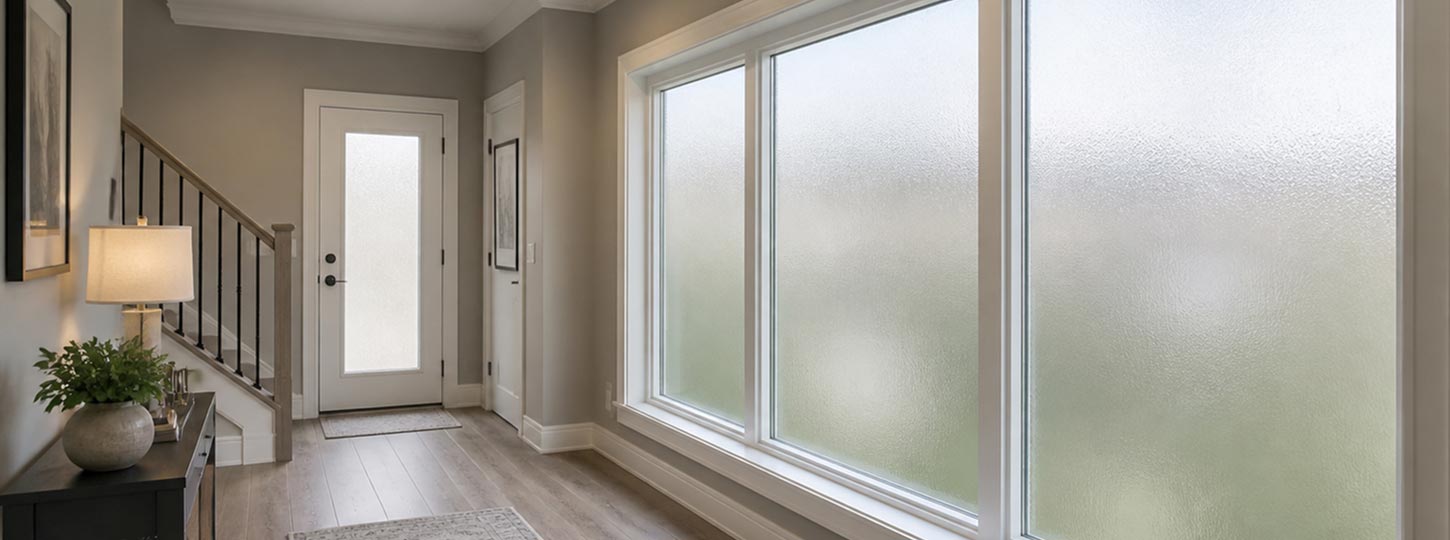
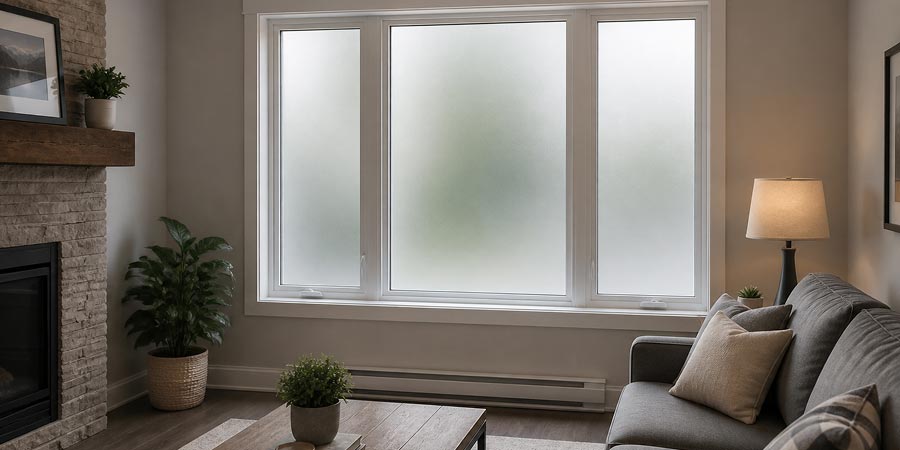
Frosted and decorative films mimic sandblasted or etched glass. They diffuse light rather than blocking it, so the room stays bright while the exterior view is scrambled into shapes rather than detail, and the pattern becomes permanent once the film is bonded. Reflective, or one-way, films use a metallic layer that reflects the brighter side of the glass, making them a daytime solution that requires a second layer of coverage after dark.
The remaining three categories provide varying degrees of privacy, but each comes with a significant trade-off in natural light or outward view that homeowners should carefully consider:
- Blackout and whiteout films prioritize opacity over daylight, virtually eliminating outward visibility and light transmission, while translucent options offer a balance by diffusing view while preserving natural daylight.
- Solar control films exist to cut heat and ultraviolet transmission, and their light tint reduces daytime visibility only as a side effect.
- Security films are several times thicker than decorative products, are specified for forced-entry resistance, and add cost without contributing meaningful privacy on their own.
Two published figures separate products more reliably than any category label: visible light transmission, which states the percentage of light the film passes, and solar heat gain coefficient, which states how much solar energy it admits. Both vary widely within a single category, so two films sold as frosted can differ by more than twenty percentage points of light transmission. Ask for the technical data sheet rather than the product description.
How Do Window Film Privacy Levels Differ Across Frosted, Decorative, Reflective, and Blackout Options?
No single film category maximizes privacy, daylight, and an unobstructed outward view simultaneously. Choosing a film means deciding which two of those three priorities matter most for a specific window, then accepting a trade-off on the third.
| Film Type | Daytime Privacy | Night Privacy | View From Inside | Natural Light |
| Frosted/decorative | High | Moderate to High (shows silhouettes if backlit) | Obscured | High |
| Reflective/one-way | High | Low (reverses) | Clear | Moderate to high |
| Blackout | Very high | Very high | None | Very low |
| Whiteout | High | High | None | Moderate |
| Translucent | Moderate to high | Moderate to high | Obscured | High |
A room that needs full daytime privacy and a workable outward view during the day, but doesn't need privacy after dark, is well suited to reflective film. A bathroom that needs consistent privacy at every hour is better served by a frosted or translucent option, since its performance doesn't depend on the light difference between the two sides of the glass.
Does One-Way Window Film Provide Privacy After Dark?
The privacy effect of reflective window film depends on which side of the glass is brighter, and during the day, that's almost always the exterior. Sunlight striking the window from outside overwhelms the light inside a typical room, so the film's reflective layer bounces that exterior brightness back outward, making the glass look like a mirror from the street while the interior view outward stays clear.
Engineer Sergey Essipov, with 20 years of experience in window manufacturing, explains:
One-way film is popular because it sounds like a complete solution, but the physics only work one direction. Once the room lights come on and it's darker outside than in, the glass stops reflecting and starts transmitting, and now it works exactly like a clear window at night. Homeowners who buy the film expecting round-the-clock privacy are usually the ones calling us six months later asking why the effect stopped working.
Why the Effect Reverses at Night
The reversal is not a defect. It is the same physical principle that makes the film work during the day, operating in the opposite light condition: the reflective layer always mirrors whichever side of the glass carries more light, so when interior brightness exceeds exterior brightness, the mirror moves to the inside face, and the direction of visibility flips with it.
The crossover is not a fixed hour. It happens whenever the two sides equalize, which in practice means shortly after sunset in a lit room, but also on a heavily overcast winter afternoon, and in any room where the lights are on while the sky is still dim. A north-facing room with ceiling lights running through a grey day can lose the effect at two in the afternoon.
This matters for how the film is specified rather than whether it works. A reflective film chosen for a living room that is used mainly in daylight performs exactly as advertised. The same film on a bedroom or bathroom window fails at precisely the hours those rooms are in use, which is the single most common reason homeowners replace a film within the first year.
How to Improve Nighttime Privacy
There are three workable approaches, and they differ in cost and in what they give up.
- Pair the reflective film with a covering that closes at night. Cellular shades add insulation and privacy; roller shades are the cheapest option, and full-length drapery reads better on a front elevation. The film handles the day, the covering handles the evening, and the outward view is preserved for the hours it is actually used.
- Switch to a frosted or translucent film. Diffusion does not depend on the light differential, so performance is identical at noon and at midnight. The cost is the outward view, which becomes permanently obscured.
- Reduce the light differential rather than the transmission. Lower-wattage lamps positioned away from the glass, or lighting placed behind the sightline rather than facing it, meaningfully cut how much of a room is legible from outside without changing the glazing at all.
Frosted film deserves a specific caution here, because it is often sold as the round-the-clock answer. It obscures detail but not the silhouette: a person standing between a light source and the window still casts a recognizable outline on the glass. In a bathroom or a ground-floor bedroom, that outline is usually the exact thing the film was bought to prevent, which is why those rooms benefit from a denser pattern, a blind behind the glass, or a lamp positioned to avoid backlighting the window.
Which Privacy Film Works Best for Bathrooms, Bedrooms, Living Rooms, and Offices?
Room function changes which trade-off is worth making. A bathroom needs privacy at every hour regardless of the time of day, while a street-facing living room might only need daytime coverage paired with curtains for the evening.
| Room / Space | Recommended Film Type | Target VLT Range | Coverage | Second Layer Needed |
| Bathrooms, shower glass | Frosted or translucent, moisture-rated | 40 — 60% | Full pane | No |
| Bedrooms | Translucent or blackout | 0 — 40% | Full pane | Blind for silhouette control |
| Street-facing living rooms | Reflective | 20 — 35% | Full pane | Curtains after dark |
| Home offices, glass partitions | Light decorative or etched | 50 — 70% | Full pane or upper band | No |
| Sidelights and entrance doors | Etched or patterned decorative | 40 — 60% | Full pane | No |
Moisture is the deciding factor in bathrooms specifically. A film rated for high-humidity environments resists edge lifting near a shower far longer than a general-purpose decorative product, so checking the manufacturer's moisture rating matters more in that room than the pattern itself.
How Can You Preserve Natural Light While Improving Privacy?
Privacy and daylight pull against each other, but the relationship isn't linear across every film option. Visible light transmission, the percentage of light that passes through a given film, is the number that predicts how a room will actually feel once the film goes on, and it varies far more than most homeowners expect within a single category.
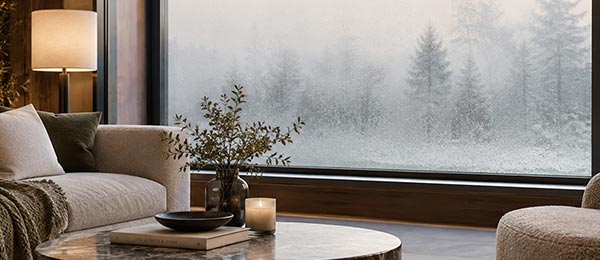
A translucent frosted film with 40 to 60 percent visible light transmission keeps a room bright while obscuring most details and significantly reducing visibility from outside. Lighter decorative patterns, rather than dense, heavily textured designs, let more ambient light scatter through even at similar opacity levels. Partial-height installation, covering only the lower portion of a window, is another practical middle ground: it blocks a direct line of sight into the room from street level while leaving the upper glass clear for daylight.
Sample testing before committing to a full installation is worth the extra step. Holding or temporarily applying a swatch to the actual window at the actual time of day when privacy matters most shows how the film performs under real light conditions rather than in a showroom sample.
Privacy Without Making the Room Feel Dark
Density and light transmission move in opposite directions by design, so the films that preserve the most daylight are lighter frosted and translucent patterns rather than anything described as blackout or heavily tinted. Within that range, three choices change the outcome more than the category label does.
Pattern density matters more than opacity. A finely textured pattern scatters light across the whole pane, while a dense, heavily printed design blocks it in the printed areas and passes it through the gaps, producing a patchier, dimmer room at the same nominal transmission rating. Placement matters as well: light entering through the top of a window travels furthest into a room, so leaving the upper glass clear preserves far more usable daylight than leaving an equivalent area clear at the bottom.
Room finishes carry part of the load too. A film that removes 40 percent of incoming light noticeably reduces perceived brightness in a room with a white ceiling and pale walls compared with one finished in dark tones, because the remaining light is reflected rather than absorbed. Repainting a ceiling is frequently cheaper than upgrading to a higher-transmission film across every window in the room.
Full-Pane Versus Partial-Pane Coverage
Full-pane coverage provides uniform privacy across the entire window and a clean, finished appearance on both sides. Partial coverage treats only the height where a passerby's eyeline actually falls, which is typically the lower third to half of the glass, and leaves the rest of the pane clear for daylight.
Working out the right band height is straightforward. Stand outside at the distance and elevation from which the window is actually overlooked, whether that is a sidewalk, a neighbouring deck, or a driveway, and mark the height on the glass at which the room becomes legible. On a ground-floor window viewed from a level sidewalk, that line usually falls somewhere between waist and chest height. On a window overlooked from a raised deck or a second storey next door, partial coverage rarely works at all, since the sightline enters through the upper glass.
A partial band also costs less per unit area, since both material and labour scale with the treated area. The trade-off is visual: the transition line is visible from both inside and outside, so it should be set deliberately at a consistent height across all windows on the same elevation, rather than window by window.
Can Privacy Film Also Reduce Heat, Glare, and UV Exposure?
Privacy and solar control are related but separate properties, and assuming a film provides both because it reduces visibility is a common and costly mistake. A film's visible light transmission rating describes how it affects what a person can see; its solar heat gain coefficient and UV-blocking rating describe how it affects temperature and fading, and the two numbers don't move together automatically.
According to Natural Resources Canada, low-emissivity window film is recognized as an after-market product that can improve a home's energy efficiency when applied to existing glazed units.
Glare reduction correlates with visible light transmission in a predictable way: a lower VLT film generally reduces glare, which matters for rooms with televisions or monitors facing a bright window. UV blocking is largely independent of the privacy pattern chosen; high-quality films block the vast majority of UV transmission regardless of whether they're decorative, translucent, or reflective, which protects flooring and furnishings from fading even when a film is selected primarily for its privacy pattern rather than its solar rating. The practical takeaway is to check the specific technical data sheet for solar heat gain coefficient, UV blocking percentage, and visible light transmission for the exact product under consideration, rather than assuming a privacy-focused film automatically delivers meaningful heat or UV performance.
One limit of that protection is easy to miss. A film applied to the interior surface shields everything behind the glass, which is why flooring and upholstery benefit, but the window frame sits outside the glazing line and receives no protection at all from it. Its resistance to ultraviolet degradation is a property of the material it was extruded from, not of anything added later. Window Force compounds UV stabilizers throughout the full thickness of its lead-free uPVC profiles rather than applying them as a surface coating, so the exterior face retains its colour and surface integrity regardless of what is done to the glass on the inside.
Is Window Film Safe for Double-Pane, Triple-Pane, and Low-E Windows?
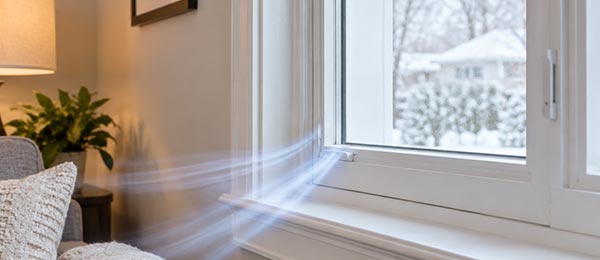
Compatibility between film and glass is the question most likely to be skipped, and it's the one with the most expensive consequences if it's wrong. Insulated glass units trap a sealed gas layer between panes, and a film that absorbs rather than reflects solar heat can raise the temperature of that sealed cavity enough to stress the perimeter seal over repeated heating and cooling cycles.
As Sergey Essipov, an engineer with more than 20 years of experience in window manufacturing, notes:
A sealed unit is certified against a durability protocol that assumes the glass leaves the plant with the surfaces it was built with. At our facility, a unit is qualified with its coating on a specified surface and a known gas fill, and the cycling it survives in testing is calculated for that build. Bond an absorptive film to the inboard lite afterwards. The unit is running warmer than anything it was tested at, so the certification still describes the product, but it no longer describes the assembly on the wall. That is the reason we ask for the film's absorption rating before we comment on whether a window will tolerate it.
It is worth knowing what is actually at stake, because the exclusions are more specific than most homeowners expect. A window warranty on a sealed unit typically covers seal failure, visible condensation between the panes, and defects in the glass itself for a defined term. Most of those documents also carry a clause excluding damage arising from any coating, tint, or film applied to the glass after manufacture, which means a fogged unit under an aftermarket film is usually assessed as an owner modification rather than a manufacturing defect. The film's own warranty rarely fills that gap, since it covers the film's appearance and adhesion and stops at the glass surface.
The practical step is to read both documents before ordering the film, and to obtain written confirmation from the window manufacturer that a specific film product on a specific unit does not void coverage. A manufacturer that declines to give that confirmation is telling you something useful about the risk.
Academic research on insulated glass unit degradation identifies sunlight and thermal cycling as leading contributors to seal deterioration over the service life of a sealed unit, alongside oxygen exposure and pressure fluctuation at the edge seal.
A practical compatibility checklist covers pane count, glass thickness, the position of any existing Low-E coating, whether the unit already has a factory tint, the type of gas fill, how much heat the specific film absorbs versus reflects, window orientation, local climate, and whether the wall receives uneven shading through the day. Ontario's freeze-thaw cycling and a hot, humid summer place different demands on a sealed unit than a drier, colder climate does, which is one reason a window supplier serving both Toronto and Ottawa builds compatibility guidance around regional exposure rather than a single national default. Window Force's glass options include fusion-welded frames, multiple Low-E coatings, and warm-edge spacer configurations engineered for exactly this kind of temperature cycling, which is a relevant reference point when comparing a factory-sealed unit's tolerances against an aftermarket film's absorption rating.
Answering that checklist requires information most homeowners do not have on hand, which is where the manufacturing record matters. Because Window Force builds every unit to order, each window is tied to a stored specification listing the pane count, coating type, the surface it sits on, gas fill, and spacer configuration for that exact opening. A homeowner who supplies the order reference can retrieve those values in a few minutes and hand a film supplier the actual glass build instead of a guess, which turns the compatibility question from an assumption into a checkable comparison before anything is bonded to the glass.
How Should You Measure and Install Window Film for Privacy?
Installation quality affects both appearance and lifespan more than the film choice itself, and the process is largely the same whether the job is DIY or professional.
The sequence is short, and most failed applications trace back to a skipped step rather than to poor technique:
- Measure the visible glass area precisely, then add a small margin, typically an extra inch on each side, to allow for trimming.
- Gather everything before starting: a spray bottle with a mild soap-and-water solution, a squeegee, a sharp utility knife, and a lint-free cloth.
- Clean the glass thoroughly, since any trapped dust or debris will show as a permanent bump under the finished film.
- Wet the glass surface generously, then position the film while it can still slide slightly for alignment.
- Work the squeegee from the centre outward to drive trapped air and liquid to the edges.
- Trim the excess with a fresh blade, then allow the recommended curing time, often several days, before cleaning the surface.
Only step four is genuinely time-sensitive, since the film begins to grab as the solution drains, which is why the alignment is worth checking before the squeegee touches it.
Operable units need a different measurement approach than fixed glass. On a casement window, the sash swings inward at the hinge stile as it opens, and film carried past the daylight opening onto the sash frame will bind against the jamb or catch the weatherstripping on the first full swing. The same applies to an awning window, where the sash pivots at the head and the lower edge is the one that fouls. Measure the visible glass with the sash closed, then trim to the glass line rather than to the frame edge, leaving a consistent margin of a millimetre or two so the film never contacts a sealing surface.
Two further points apply to any operable unit. Interior screens sit close enough to the glass on some hardware configurations that a freshly applied film can be disturbed during the curing period, so screens are best left out for the several days it takes for the film to bond. And a bathroom or kitchen unit that is opened daily for ventilation puts repeated moisture and mechanical stress on the film edge, which is where a product rated for high humidity earns its cost difference.
Static-cling products skip the adhesive and wetting steps entirely; the film is pressed onto clean, dry glass and held in place by surface tension, which makes it faster to apply and remove but generally less durable than a properly bonded adhesive film.
Tools and Materials
A basic kit covers a spray bottle, mild dish soap, a squeegee with a felt edge, a sharp blade with spare snap-off sections, painter's tape for alignment on larger panes, and a lint-free cloth for final cleanup.
Three details in that list account for most failed applications. The soap solution needs to be weak, roughly a few drops per litre, because excess surfactant prevents the adhesive from bonding and leaves a haze that only appears once the film has cured. The blade must be replaced frequently rather than sharpened, since a dulled edge tears the film instead of cutting it, leaving a ragged border that lifts within months. And the squeegee edge has to be soft: a hard plastic blade drags across the film surface, leaving permanent, clearly visible scratch lines in raking light.
Temperature is the variable most often ignored. Most adhesive films specify an application range of roughly 5 to 35 degrees Celsius at the glass surface, not the room air. Glass on a sunlit elevation in July can sit well above the room temperature, so working on the shaded side of the house, or early in the day, produces a noticeably cleaner result.
DIY Versus Professional Installation
Smaller, simpler windows with decorative patterns are the most forgiving DIY projects, since pattern alignment has some margin for error. Larger panes, solar-control films, and anything applied to an insulated or Low-E unit benefit from professional installation, both for a cleaner finish and because a professional is more likely to catch compatibility issues before they become warranty problems.
When Is Factory-Made Privacy Glass a Better Choice Than Film?
Film makes sense when the existing window is in good condition, and a lower-cost, reversible privacy upgrade is the goal. That calculation changes the moment a window replacement is already on the table, whether for age, energy performance, or drafts, because at that point the marginal cost of choosing privacy glass instead of clear glass is far smaller than adding film to a brand-new window.
Factory-built privacy glass integrates the privacy effect into the glass itself rather than applying it as a separate layer, which removes film compatibility concerns, eliminates the need for future film replacement, and avoids the risk of voiding the glass warranty. Window Force manufactures every unit at its 80,000-square-foot Ontario facility with several privacy glass patterns available as factory configurations, including frosted, chinchilla, Niagara, delta frosted, glue chip, and acid-etched textures, each shaping light and privacy differently depending on the room and the desired look. Every privacy pattern can be combined with the same Low-E coatings, argon fill, and warm-edge spacer used across the full window collection, so choosing privacy glass doesn't mean giving up thermal performance.
The mechanical difference behind that durability is worth stating plainly. A decorative film carries its pattern in a printed or embossed layer on the glass surface, where it is exposed to cleaning products, abrasion, and ultraviolet light throughout its service life. A factory privacy pattern is formed in the glass itself, whether by acid etching, rolling, or texturing during production, so the diffusion occurs within the material rather than on its surface. Window Force produces its frosted, chinchilla, Niagara, delta frosted, glue chip, and acid-etched patterns this way, which is why they cannot be scratched off, discoloured, or lifted at the edge, and why they are cleaned with the same products used on any other pane in the house.
Long-term maintenance is the other deciding factor. Privacy glass is cleaned exactly like clear glass, with no separate film to inspect for bubbling or peeling, and it lasts as long as the window itself rather than needing replacement on a 10- to 15-year cycle. For a homeowner who is already replacing windows, that combination- no separate maintenance schedule, no film-to-glass compatibility question, and coverage under the same warranty as the rest of the unit- typically makes privacy glass the more durable choice.
Film does not fail suddenly. It degrades in a recognizable order, and knowing that order makes the replacement cycle easier to plan:
- Edge lift appears first, usually at a corner or along the bottom edge where cleaning solution and condensation collect.
- Bubbling follows as the adhesive bond breaks down across the pane, sometimes as a fine haze rather than distinct blisters.
- Colour shift comes last, most visibly on older dyed films that turn purple as the pigment breaks down under ultraviolet light.
The sequence runs fastest on the elevation with the most direct sun, which is why a single window on a south or west wall often looks wrong against the rest of the house while the shaded elevations still appear fine.
None of these are repairable. The film is stripped, the adhesive residue is removed, and the pane is refilmed, which is a labour cost equivalent to the original installation. Over a twenty-five-year window life, that is typically two replacement cycles.
The comparison ends on coverage rather than appearance. A privacy pattern ordered as part of the unit falls under the same 25-year transferable warranty as the rest of the window and passes to the next owner rather than expiring with the original purchaser, which is documentation a buyer's inspector can verify years later. Units are supplied and installed through an authorized dealer network, so the party that specified the pattern is the party accountable for the installation behind it. Certification carries over as well: a patterned unit is CSA-certified and engineered to meet or exceed ENERGY STAR® requirements across all Canadian climate zones, meaning privacy is achieved without stepping outside the performance specified for the rest of the home.
Conclusion: Which Window Film for Privacy Best Fits Your Space?
The right answer depends on three questions: whether the existing window is staying or being replaced, whether privacy is needed around the clock or only during the day, and how much natural light the room can afford to lose. Film is the practical choice for good-condition windows that need a lower-cost or reversible upgrade, while factory-built privacy glass is the stronger long-term fit for anyone already planning a replacement.
Before purchasing, confirm the visible light transmission and solar performance figures for the specific product against the specific glass it will be applied to, not just the general category. If the honest answer is that the window will be replaced within the next few years regardless, it's worth comparing the cost of film now against the marginal cost of upgrading to privacy glass as part of that future project.
People Also Ask