

New windows can increase a home's resale appeal and contribute to its market value, but the gain is rarely a dollar-for-dollar return on what the project cost. The effect is strongest when replacement removes something a buyer can see or an inspector will flag, such as fogged sealed units, deteriorated frames, or sashes that no longer operate, and weakest when the existing windows are already sound, matched, and presentable.
For a homeowner preparing to list, this is a budget question with a number attached. Replacing 10 to 12 windows and a patio or entry door on a typical Canadian detached home runs roughly $15,000 to $25,000 installed. The real question isn't whether windows add value, but how much of that spend returns at closing, what it changes about the offers you receive, and when the same budget would do more elsewhere in the house.
Window Force sits at the point in this decision where claims turn into records. We build every unit to order rather than pulling from stock. We specify the glass package, spacer, coating, and resulting whole-window ratings for each opening and document them before the unit leaves the production line. That paperwork is exactly what a homeowner needs years later, when a buyer or an inspector asks what was actually installed. Window Force has manufactured vinyl windows in Canada since 2007, and the patterns described in this guide come from what our production and dealer teams see when homeowners replace windows ahead of a sale.
Key Takeaways
- The Appraisal Institute of Canada places cost recovery for windows and doors at roughly 50 to 75 percent of project cost, so a $25,000 project returns $12,500 to $18,750 as a renovation line item.
- Sale price and cost recovery are different calculations. On a $1,000,000 home, the gap between a move-in-ready listing and one carrying visible deferred work is commonly five to ten percent, or $50,000 to $100,000, which is why replacement before listing can be worth several times its cost when windows and doors are the deficiency holding the property in the lower band.
- Certified performance carries more weight with buyers than appearance alone, because an Energy Rating or U-factor can be verified against a federal product list while a marketing claim cannot.
- Failed insulated glass units, drafts, and stiff hardware are among the defects buyers price into their offers, so replacing visibly compromised windows usually produces a stronger return than upgrading functional ones.
- Whole-house replacement delivers consistency in appearance, age, and warranty coverage, while phased replacement is often the better financial decision when only a few openings have failed.
- Energy savings accrue to the current owner rather than the buyer, so measure the total return on a window project over the ownership period, not just at the point of sale.
Do New Windows Increase Home Value?
Window replacement influences value in two distinct ways that people often confuse. First, it changes what a buyer is willing to pay for the property. Second, it reduces what the current owner spends on heating, cooling, and repairs while still living in the home. Both are real, but only one shows up in the sale price.
Simply put, new windows rarely add value by acting as a high-end upgrade that commands a luxury premium. Instead, they protect and boost your home's selling price through three clear mechanisms: removing the heavy "renovation discount" buyers deduct when they see deferred maintenance, creating a strong first impression (curb appeal) that places the home in a higher tier of comparable listings, and providing documented energy efficiency that promises lower monthly operating costs. In short, they increase market value by eliminating a buyer's reasons to negotiate down while making the property stand out as move-in ready.
Resale Value vs Project Payback
Four terms get used interchangeably in conversations about window projects, and separating them is what makes every number later in this guide readable.
- Resale value: the market value of the property at the point of sale.
- Cost recovery: the share of what the window project cost that is reflected in the selling price.
- Total project return: cost recovery plus the operating savings and avoided repairs collected during the years of ownership.
- Project payback: the number of years of measurable savings required to equal the original spend.
Cost recovery is the figure homeowners quote most often, and it is the narrowest of the four. A project that returns part of its cost at closing while also lowering operating costs every winter until the house sells produces a different total outcome from the resale figure alone, which is why evaluating window replacement purely as a resale transaction undercounts it.
Why the Result Varies by Home
Two houses with identical window projects can produce very different results. Key variables include the condition of the units being replaced, the home's price bracket, the property's age and style, and how visible the windows are from the street. A 1970s bungalow with original aluminum sliders and condensation between the panes has more value to gain than a 2005 build with functional double glazing. Regional differences also apply, since a buyer comparing homes in a cold Prairie market weighs thermal performance differently from a buyer in a mild coastal one.
Windows Near Me
What Is the Real ROI on New Windows and Doors Before a Sale?
Cost recovery figures circulate widely and are often quoted without their source or their geography. The most commonly cited benchmark comes from renovation cost surveys conducted in the United States, making it a useful directional indicator rather than a guaranteed Canadian outcome. Those surveys also report a national average drawn from thousands of projects, which flattens the two variables that matter most to any individual homeowner: what the replaced windows looked like and what the local market rewards. The figures that follow should be read as the shape of the return rather than as a quotation for a particular house.
Why Recovery Is Usually Below 100 Percent
The Appraisal Institute of Canada, the country's largest property valuation body, places cost recovery for window and door replacement at roughly 50 to 75 percent, and lists windows and doors among the renovations that most consistently affect appraised value. Canadian projects tend to sit lower in that range because triple glazing and higher-specification hardware raise project cost even when they improve performance, and because local market conditions matter more than either factor. The same project in Ontario produces a different result in a market with tight inventory than in one where buyers have leverage. Recovery falls short of the full amount because buyers price a house as a complete asset rather than as a sum of recent receipts. New windows remove a reason to discount the property; they do not create a premium above what comparable homes in the area achieve. The projects that come closest to full recovery are those where the replaced units were actively depressing the home's value.
A $25,000 Project on a $1,000,000 Home
Take a detached home listed at $1,000,000 with eleven original windows, a sliding patio door that no longer seals, and fogged glass on the front elevation. Replacing all of it with triple-glazed vinyl costs about $25,000 installed. That $25,000 shows up in four different places, and sellers usually count only the first one.
| What the $25,000 does | Typical range | When it is collected |
| Cost recovery as a renovation line item (AIC: 50 to 75 percent) | $12,500 to $18,750 | At closing |
| Removal of the buyer's deferred-maintenance deduction | Set by the buyer's estimate, not the invoice | At the offer stage |
| Repositioning out of the "needs work" band of comparables | 5 to 10 percent of list price in a $1M market | At listing and closing |
| Energy savings kept before the sale | Per heating season, for as long as the owner stays | Every year of ownership |
The first row is why cost recovery never reaches 100 percent. The next two are why the sale price can move by more than the project cost. Buyers do not price deferred work at contractor rates: presented with eleven aging windows and a door that sticks, a buyer does not collect quotes and deduct the average; they deduct the amount that protects them from a project they do not want to inherit. Appraisers then value the property against recent comparable sales, and those sales spread into bands. In a $1,000,000 market, that spread is commonly $50,000 to $100,000 wide, and windows and doors are among the few street-visible items that can place a house at the bottom of it. Replacement does not add $75,000 to a house that was already going to sell at the top of its band. It can move a house from the bottom of the band to the middle, and on a million-dollar property, that movement is worth several times the invoice.
Where Doors Change the Arithmetic
Doors return more than windows, and by a wide margin. In Zonda's 2025 Cost vs. Value report, a steel entry door replacement recovered 216.4 percent of its cost, on an average job of $2,435 against $5,270 in added resale value, placing it second among all tracked renovation projects. The reason is the ratio, not the product: an entry door is inexpensive relative to how much of the first impression it occupies. For a seller working to a fixed budget, that makes the front door and a failed patio door the first two openings to address, before deciding how many windows the remaining money covers.
How Do Windows Increase the Value of a Home Beyond the Sale Price?
Financial return is the most quoted benefit and the least complete. Windows sit at the intersection of building envelope performance, daily comfort, exterior appearance, and deferred maintenance risk, so their contribution shows up in areas not captured directly by the property's sale price. Some of that contribution is collected every heating season, some only once at closing, and some never converts into money at all because it is experienced rather than sold. Separating those categories is what makes the value of a window project measurable instead of anecdotal.
Financial Value
The financial component includes the portion of project cost reflected at resale, the reduction in heating and cooling costs during ownership, and the avoided expense of repairing units that would have failed anyway. It also includes negotiating positions. A home with documented recent window work gives the seller a defensible answer when a buyer's agent raises the envelope as a concession point.
Comfort Value
Comfort is where homeowners notice the change first. Higher interior glass surface temperatures reduce the cold radiant effect near windows in winter, tighter compression seals cut air leakage, and multi-pane assemblies with laminated or asymmetric glass configurations reduce transmitted noise. None of this appears in a price comparison, yet it is consistently what owners describe when asked whether the project was worth it.
Maintenance and Buyer Confidence
Buyers read a home's exterior as a record of how it has been maintained. Matched, recently installed windows suggest a property that has been kept up to date. Mismatched units, peeling paint on wood frames, and visible seal failure suggest deferred work, and buyers may factor that into their assessment.
| Category of value | What it looks like in practice | When it is realized |
| Resale appeal | Stronger first impression, fewer objections, better negotiating position | At the point of sale |
| Cost recovery | A share of project cost reflected in the selling price | At the point of sale |
| Energy savings | Lower heating and cooling load through a tighter, better insulated envelope | Every year of ownership |
| Comfort | Fewer drafts, warmer glass surfaces, reduced noise transmission | Immediately after installation |
| Maintenance relief | No repainting, no re-glazing, no chasing failed seals | Across the service life of the units |
| Buyer confidence | Documented certification and coverage that can be verified | At inspection and offer stage |
Do Energy-Efficient Windows Increase Home Value for Canadian Buyers?
Efficiency has moved from a technical footnote to a purchasing consideration, largely because it addresses two things buyers care about simultaneously: what the house costs to operate and how it feels to live in. Federal guidance treats efficiency as a resale factor, not just an environmental one. Buyers rarely ask for a U-factor by name, yet they routinely ask what a house costs to heat through a Canadian winter, and the windows are a substantial part of that answer. Homeowners installing qualifying ENERGY STAR windows before listing may also be eligible for federal or provincial rebates covered in the Canada window and door rebates guide, which documents the programs that can reduce the net cost of the project before the sale. Efficiency therefore enters the negotiation indirectly, through operating cost, comfort, and whether the claim can be substantiated.
Buyer Appeal
Natural Resources Canada advises homebuyers to ask directly about window and door efficiency, noting that windows and doors can account for up to 25 percent of a home's energy loss and that ENERGY STAR certified windows are about 20 percent more energy efficient than the average window. The same federal guidance says an energy-efficient home can appeal to future buyers and stand out from comparable properties on the market. That framing, published in the department's buyer's guide to energy-efficient homes, matters because it shapes the questions informed buyers bring to the table.
Lower Operating Costs
Operating cost is the most tangible efficiency argument for a buyer, since it is a recurring expense rather than a one-time one. A buyer comparing two similar homes, one with original windows and one with a recent certified upgrade, is comparing two different annual utility commitments. That comparison sharpens in provinces with high heating loads and long winters.
Documented Energy Performance
Under the current national specification, a residential window qualifies as ENERGY STAR certified in Canada by achieving a U-factor of 1.22 W/m²·K or lower, or an Energy Rating of 34 or higher, and every certified model is listed in a federal searchable database. A seller who can name the model and its rating gives a buyer an independently verifiable performance claim. A seller who can only say the windows are new gives them nothing.
The frame is the part of that rating nobody thinks about, yet it borders every glazed area in the house and carries a meaningful share of the whole-window number. Window Force's custom windows are extruded with multiple internal chambers that trap still air and interrupt the conduction path through the frame wall, which is what allows a unit to hold its rating as a complete assembly rather than only at the centre of glass. You can then verify that performance rating by checking the model against the federal certified product list.
Which Window Improvements Are Most Likely to Matter to Potential Buyers?
Buyers evaluate windows in the order they encounter them: what they see from the driveway, what they touch during a walkthrough, and what an inspector writes in a report. Improvements that align with that sequence carry more weight than those that do not.
Certified Performance
Certification is the only window or door attribute a buyer can check without taking anyone's word for it, which is why it carries weight that appearance cannot. The number that matters is the whole-window rating, because U-factor and Energy Rating measured on the assembled unit account for the frame, the spacer, and the air leakage of the finished product, while a centre-of-glass figure describes one part of the window and flatters it. Two units quoted with identical glass packages can therefore perform differently once the frame and spacer are included, and only the whole-window number reflects that gap. ENERGY STAR certification applies to doors on the same basis, so a patio or entry door replaced at the same time belongs in the same record. For a seller, the practical result is a model number a buyer can look up rather than a description they have to trust.
Condition and Appearance
Physical condition is assessed within seconds. Buyers look for clear glass without internal condensation, consistent frame colour across elevations, intact weatherstripping, and clean sightlines. Among the types of vinyl windows available in Canada, the practical differences at resale come down to how each style suits the opening and the architecture, not to any single style being universally preferred. Buyers test patio doors by hand during a walkthrough, so a door that drags or fails to latch registers as strongly as fogged glass.
Installation Quality
Installation determines whether the specified performance is ever achieved. A certified unit installed without proper shimming, perimeter cavity insulation, and continuous air and water barriers will underperform its rating and can cause condensation or water entry.
| Feature buyers can verify | What to look for | Why it affects value |
| ENERGY STAR certification | Model listed in the federal certified product database | Independent confirmation of performance |
| Whole-window U-factor | 1.22 W/m²·K or lower for certified residential windows | Describes the assembled unit, not just the glass |
| Energy Rating | 34 or higher for certification, 40 or higher for Most Efficient | Combines heat loss, solar gain, and air leakage |
| Low-E coating and gas fill | Stated on the specification sheet for the ordered configuration | Determines winter heat retention and summer control |
| Sealed unit condition | No internal fogging, staining, or visible desiccant migration | Failed units can become a negotiating point and may affect the buyer's assessment of the property. |
| Hardware operation | Smooth cranking, positive locking, even compression | Signals age and maintenance history |
| Installation documentation | Invoice, model numbers, and coverage terms | Converts claims into verifiable records |
Engineer Sergey Essipov, with 20 years of experience in window manufacturing, explains:
The failures we see most often in the field are not glass failures; they are perimeter failures. A certified unit can be installed in an opening that was never properly insulated or air-sealed, and two winters later the homeowner sees condensation on the frame and assumes the window is defective. When we inspect those openings, the sealed unit is usually intact, and the air barrier was never made continuous.
Why Can Old or Damaged Windows Reduce Buyer Confidence?
Deteriorated windows do more than look dated. They introduce uncertainty, and uncertainty is expensive in a negotiation because buyers resolve it in their own favour, usually by assuming the worst plausible repair bill rather than the actual one. Window defects are also unusually easy to detect, since nobody needs tools or expertise to see condensation trapped between panes or to feel cold air at a sash. A small physical problem can therefore produce a disproportionately large deduction.
Visible Defects
Fogged glass, water staining on sills, cracked glazing beads, and sashes that will not close fully are all visible without tools. Each one prompts the same question in a buyer's mind: what else has been left? A single failed sealed unit in a front elevation can shape the impression of the entire house.
Traditional metal spacers have higher thermal conductivity than warm-edge spacers, which can increase heat transfer at the glass edge and lower edge-of-glass temperatures. IGU seal failure, however, can result from several factors, including sealant degradation, manufacturing quality, installation conditions, and thermal or mechanical stresses. Window Force assembles its insulated glass units on a metal-free, dual-seal warm-edge spacer, so the glass edge runs warmer, and the seal is protected by two independent barriers rather than one. For a homeowner preparing to list, that difference shows up as glass that stays clear at the perimeter, making early signs of seal failure easier to spot during an inspection.
Home Inspection Concerns
Home inspectors commonly assess visible window condition, including operation, moisture indications, and evidence of water entry, depending on the inspection scope. Once a defect appears in writing, it becomes a negotiating item with a number attached, and the number the buyer proposes is rarely the number the repair would actually cost.
Future Replacement Costs
Buyers may factor the expected future replacement cost into their assessment of the property. A house with twenty original windows that are visibly at the end of life carries an implied future project, and buyers discount it whether or not they intend to do the work. Replacing those units before listing removes the deduction and replaces it with a documented recent improvement.
The asymmetry is worth stating plainly. Two failed sealed units can often be resolved by replacing the glass rather than the whole window, and a patio door that drags is frequently a roller and adjustment issue. A buyer who sees either one does not price the repair; they price every opening in the house on the assumption that all of them are the same age.
How Much Does Curb Appeal Contribute to the Value of Replacement Windows?
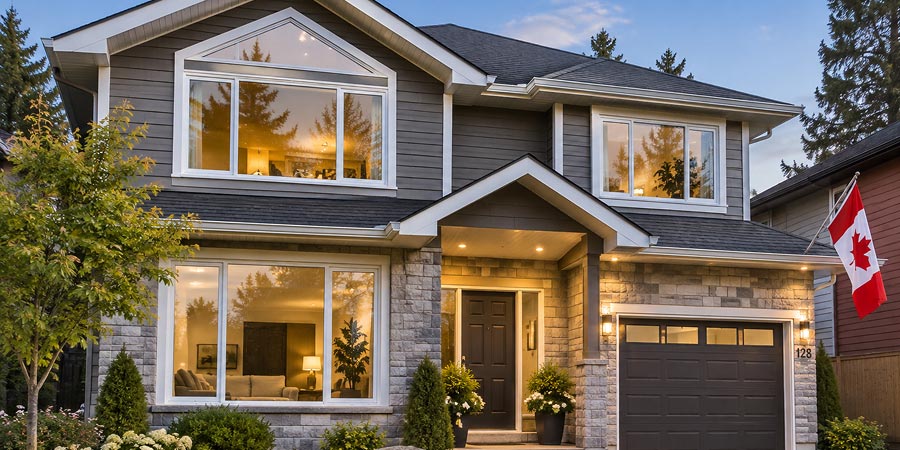
Curb appeal has no fixed dollar value, which is why people often dismiss it or overstate it. Its practical effect is on the first impression that frames every subsequent observation during a showing. Unlike a roof or a furnace, buyers judge windows before anyone enters the house, and that first impression sets the tone for how they assess the rest of the property. The useful question, then, is not whether curb appeal matters, but which window conditions actually change it.
First Impressions
Windows occupy a large share of a front elevation and establish its rhythm. The entry door anchors that composition, which is why a dated door undercuts a full window replacement more than its cost would suggest. Consistent frame colour, aligned sightlines, and proportionate glass area read as intentional. Mismatched replacements accumulated over decades read as improvised, even to buyers who could not articulate why.
Matching Window Styles
Style consistency matters more than style selection. A home with casement units on one elevation and sliders on another, especially in noticeably different colours, may appear less visually cohesive than a home with a consistent window style and finish. Regional architecture also sets expectations, and a window supplier in Kelowna works with different prevailing elevations and glazing preferences than one serving a Maritime market of older wood-frame housing.
When Cosmetic Replacement Has Limited Return
Replacing windows that are functional, matched, and reasonably current for purely cosmetic reasons may provide less resale-related value than replacing windows that are visibly damaged or no longer performing properly. The existing units are not depressing value, so there is no deduction to remove. In that situation, the case for replacement rests on comfort, efficiency, and personal preference, which are legitimate reasons, but they should be evaluated as such rather than as a resale strategy.
The same limit applies to over-improvement. A $40,000 premium window and door package on a house in a $600,000 neighbourhood cannot be recovered, because the ceiling on the sale price is set by the street rather than by the specification.
Can Lower Energy Bills Improve the Overall Return on New Windows?
The ownership horizon determines how much weight to give each part of the return. Someone selling within a year has little time to accumulate operating savings, while a homeowner staying for ten years can capture those savings throughout the ownership period. The same window project can therefore make financial sense for different reasons depending on when the property is likely to be sold.
Resale Return
The resale effect is realized at closing through improved condition, presentation, and the absence of deficiencies. Judge it against comparable properties rather than treat it as a separate premium automatically added to the sale price.
Energy Savings Before the Sale
Operating savings accumulate over the ownership period, making them relevant in proportion to how long the owner stays. Their size is also bounded in a way any homeowner can check against their own bill. In the Canada Energy Regulator's national comparison, Canadian households have averaged just over $4,000 a year on energy, roughly half of it gasoline for vehicles rather than energy used inside the home, with Atlantic households at the top of the national range and Quebec households at the bottom. The heating and cooling portion of a household budget is therefore measured in the low thousands, and windows and doors account for a share of it, not all of it.
That arithmetic sets the expectation for a whole-house project. Replacing original or failed units on a detached home typically moves annual heating and cooling costs by a few hundred dollars rather than by several thousand, so a $25,000 project does not reach payback on utility bills alone within any ordinary ownership period. Over eight years in the home, those savings amount to a few thousand dollars collected before the sale, which is a meaningful addition to cost recovery but not a substitute for it. CMHC's 2026 Mortgage Consumer Survey found that 75 percent of consumers who completed energy-efficiency renovations reported savings on their energy bills, although the survey covers energy-efficiency renovations broadly rather than window replacement alone.
The numbers suggest a practical rule. Energy savings can justify specification choices in a project already underway, such as a better glazing package or a warmer spacer, but they rarely justify the project on their own. Condition and resale positioning do.
Does Replacing Every Window Add More Value Than Replacing Only the Worst Ones?
This decision is usually framed as a budget question, but it is really about what the house needs and how long the owner intends to stay. Both approaches are defensible, and the right one depends on how many units have actually failed. A house where most windows are original and deteriorating points to one answer, while a house with a handful of compromised openings in an otherwise sound envelope points to the other. The comparison below covers cost, appearance, documentation, and how each approach presents at the point of sale.
Whole-House Replacement
A complete project produces uniform appearance, a single installation date, one set of documentation, and consistent coverage across every opening. For a seller, that package is easy to present and easy for a buyer to verify. It also eliminates the possibility that a buyer finds one overlooked failed unit and uses it to reopen the conversation about all of them.
Phased Replacement
Phasing concentrates spending where the deterioration is. If four of eighteen windows have failed sealed units and the rest are sound, replacing four addresses the actual problem at a fraction of the cost. The trade-off is visual and administrative inconsistency, since the new units will differ slightly in colour and profile from the originals, and coverage terms will run from different dates.
Because every Window Force unit is manufactured to order at our 80,000 sq ft Ontario plant rather than drawn from pre-built inventory, a second or third phase can match the first: same profile — whether the Ultraslim Series or the Classic Series— same colour formulation, same hardware, ordered years apart. Dealers keep the original order specification on file precisely so that later phases can be reproduced rather than approximated. Homeowners replacing in stages usually appreciate this only at the end, when the last four windows have to sit beside the first six on the same elevation.
| Consideration | Whole-house replacement | Phased replacement |
| Upfront cost | Highest, single commitment | Lower, spread across years |
| Appearance | Fully consistent across all elevations | Possible mismatch in colour and profile |
| Documentation | One invoice, one date, one coverage period | Multiple records with different start dates |
| Efficiency gain | Applies to the entire envelope at once | Limited to the openings replaced |
| Best suited to | Homes where most units are at end of life | Homes with a few clearly failed openings |
| Pre-sale positioning | Strongest, presents as a completed improvement | Adequate if the failed units were the visible ones |
Engineer Sergey Essipov, with 20 years of experience in window manufacturing, notes:
Orientation matters more than age. South and west elevations absorb the greatest thermal cycling, and on a house where every unit went in the same year, those are almost always the first to degrade. At our facility, we extrude frames from lead-free uPVC with UV stabilizers blended into the compound rather than applied as a surface coating, and we fusion-weld every corner so the profile behaves as one continuous section through expansion and contraction. Anyone replacing in stages should walk the sun-exposed elevations before deciding which openings to do first.
Is Window Replacement Worth It if You Plan to Sell Soon?
A short ownership horizon shifts the focus toward the resale effect because there is less time to recover the investment through energy savings. The key question is whether the existing windows create a visible or documented deficiency that could affect the sale.
When Replacement Before Sale Makes Sense
Replacement before listing can make sense when the existing windows have a material deficiency likely to affect buyer perception or show up in an inspection report. Choosing standard-specification replacement windows rather than premium configurations is usually the more efficient decision here, since the goal is to eliminate an objection rather than create a selling feature.
| Condition at the time of listing | The more efficient decision | What it protects |
| Most units original, several visibly failed | Full replacement before photographs | Removes the "needs work" classification entirely |
| Two or three failed units, rest sound and matched | Replace the failed openings or the sealed units | Removes the visible defect at a fraction of the cost |
| Windows sound, entry or patio door dated | Replace the door only | The highest-return opening in the house |
| Failed units found after offers are in | Negotiate with real quotes in hand | Caps a deduction the buyer has already set |
Custom windows and doors carry a manufacturing lead time measured in weeks, so a project meant to be finished before listing photographs has to start well before the listing date rather than after the agent's first walkthrough.
Which Window Features Can Strengthen a Home's Resale Story?
A resale story is only as strong as what you can substantiate. Features with paperwork outperform features with adjectives, because a buyer who can verify a claim stops discounting for the possibility that it is untrue. In practice, this favours three things: performance recorded on a specification sheet, coverage that survives a change of ownership, and glazing choices that answer a problem specific to the property. Each of them can be handed over at closing as a document rather than a description.
Performance Documentation
The specification sheet for the ordered configuration is the most useful document a seller can produce. It records the glass package, coating, gas fill, spacer type, and resulting whole-window ratings for the exact units installed, which lets a buyer check the model against the federal certified product list.
Warranty
Coverage terms and their transferability are a legitimate resale asset, since a buyer inheriting active coverage inherits protection against a cost they would otherwise carry alone. Present a window warranty that transfers to a subsequent owner with the original invoice and model information, because coverage you can't substantiate is functionally the same as no coverage. Buyers and their agents increasingly ask for this documentation directly.
Glazing and Comfort Features
Glazing choices carry resale weight where they solve a specific local problem. Laminated glass on a street-facing elevation addresses traffic noise, low solar gain coatings address overheating on west exposures, and tempered glass satisfies code requirements near doors and low sills. These details also vary most between quotes, which is why comparing glass options across bids matters more than comparing headline prices.
The practical advantage is continuity: the exact product specification remains tied to the units installed in the home, making future verification easier. Coverage runs 25 years and transfers with the property, giving the next owner a documented installation record rather than a verbal description.
What Factors Determine the Actual Return on New Windows?
No single figure applies across every project, because return is the product of at least a dozen interacting variables. Some are set by the house itself, such as the condition of the existing units and the number of openings involved. Others are set by the specification, including frame profile, glazing package, and installation method, and the remainder by the market the property sits in. Reading them together is more useful than measuring a project against a national average.
| Factor | Effect on return |
| Condition of existing windows | The largest single variable, since replacing failed units removes an active deduction |
| Number of openings replaced | Determines both total cost and whether the improvement reads as complete |
| Frame material and profile | Drives cost, appearance, and long-term maintenance expectations |
| Glazing package | Sets thermal and acoustic performance and a significant share of unit cost |
| Installation method | Retrofit versus full-frame changes labour, cost, and achieved performance |
| Structural repair discovered | Rot or damaged framing found at removal adds unbudgeted cost |
| Local housing market | Determines whether improvements are rewarded or merely expected |
| Home price bracket | Home price bracket can influence how much premium window specifications affect the overall project cost and how buyers perceive those upgrades. |
| Energy costs in the region | Higher energy costs can increase the potential savings from efficiency improvements and therefore shorten the financial payback period. |
| Length of ownership after the project | Longer tenure collects more operating savings before the sale |
| Documentation retained | Determines whether performance and coverage can be verified by a buyer |
A homeowner comparing quotes from a window company in Halifax with quotes from a supplier in a Prairie market will see different pricing for the same nominal product, driven by shipping, local labour rates, and the glazing packages typical for each climate. That variation is normal and is one reason national average ROI figures should be treated as orientation rather than prediction.
Conclusion: How Much Can New Windows Really Contribute to Home Resale Value?
New windows and doors contribute to resale value through two separate calculations, and confusing them is what leads sellers to the wrong decision. As a renovation line item, a $25,000 project returns roughly $12,500 to $18,750 at closing, in line with the Appraisal Institute of Canada's 50 to 75 percent range. As a repositioning decision on a home carrying visible deferred work, the same project can be worth considerably more, because it removes the discount buyers apply to uncertainty and moves the property out of the lower band of comparable listings. The condition of the existing openings, not preference, determines which calculation applies.
The practical conclusion is to sequence the work correctly. Replace failed or visibly deteriorated units first, since those are the ones actively costing value, then compare certified whole-window performance rather than glass-only claims; then keep the specification sheets, invoices, and coverage terms in one place so the improvement can be verified rather than described. Homeowners who intend to stay in the property for several more years should weigh operating savings alongside resale, and homeowners listing within the year should limit spending to what removes a buyer objection rather than what adds a feature the next owner will enjoy.
Planning a replacement around a listing date? Send your openings through the request form on the Window Force website and our team will review the measurements, recommend a configuration for each elevation, and confirm production lead times so the work is finished before listing photographs are taken. We match homeowners with an authorized dealer for measurement and installation, and we issue a specification sheet for every unit with the order, so the documentation a buyer may ask for is in place from day one. Every unit is CSA certified and manufactured to meet ENERGY STAR® requirements across all Canadian climate zones.
Frequently Asked Questions
How much can new windows and doors add to the sale price of a $1,000,000 home?
There is no fixed premium. As a renovation line item, recovery is roughly 50 to 75 percent of project cost, so a $25,000 replacement of 10 to 12 windows and a door credits back $12,500 to $18,750. The larger effect is positional. On a home where aging windows and a failed door are the visible deficiency placing it below comparable move-in-ready listings, replacement can close a gap of five to ten percent of list price, which on a $1,000,000 property is $50,000 to $100,000. That figure is the discount being removed, not a premium windows create on their own.
Should I replace before listing, or price the house lower and let the buyer do it?
Pricing it in is usually more expensive because the buyer sets the deduction to protect themselves rather than match a quote. A seller who replaces beforehand pays the contractor's price once. A seller who discounts pays whatever number the buyer is comfortable defending, usually after an inspection report puts the defect in writing.
Do new windows increase home value in Canada?
They can, primarily by improving condition, appearance, and verified efficiency rather than by adding a fixed premium to the asking price. The increase is largest where the replaced windows were visibly deteriorated and smallest where they were already functional and matched.
How much of the cost do homeowners typically get back at resale?
The Appraisal Institute of Canada places recovery at roughly 50 to 75 percent of project cost for windows and doors. Where an individual project lands inside that range depends on how far the replaced units had deteriorated, the scope of the work, and local market conditions. Results below 50 percent are common where the existing windows were already sound and matched, because there was no deduction for the replacement to remove.
Do buyers actually pay attention to ENERGY STAR certification?
Increasingly, yes, because certification is one of the few window attributes a buyer can verify independently. Federal guidance directs homebuyers to ask about window and door efficiency during their search, and buyers can check certified models against a national database by model name.
Is it better to replace all the windows or only the failed ones before selling?
If most units are at or near the end of their service life, a full replacement presents the home more consistently and reduces the chance a buyer will find an overlooked defect. If only a few openings have failed, replacing those addresses the immediate problem while requiring substantially less upfront spending.
Will new windows lower energy bills enough to pay for themselves?
Not on their own in most cases. CMHC survey data shows that 75 percent of surveyed recent mortgage consumers who completed energy-efficiency renovations reported lower energy bills, but those savings depend on the property, the existing windows, energy prices, and how long the owner remains in the home.
Does installation quality affect resale value?
Substantially. A certified window installed in a poorly insulated or improperly sealed opening will underperform its rating and can cause condensation or water entry, both of which show up in inspection reports. Installation records and coverage documentation help make the improvement credible to a buyer.
What documentation should a seller keep?
Keep the invoice, model numbers and the specification sheet for the exact configuration installed, the installation date, and the coverage terms, including whether they transfer to a new owner. Documentation lets a buyer confirm the improvement instead of relying on trust.
People Also Ask