

Two windows can share the same frame, the same U-factor and the same price, yet one will warm a living room on a sunny January afternoon while the other keeps a west-facing bedroom noticeably cooler in July. The difference is the solar heat gain coefficient, a single number on the rating label that determines how much of the sun's energy becomes heat inside the home. Reading it correctly, and matching it to each wall rather than to the house as a whole, is one of the most consequential glazing decisions a Canadian homeowner makes.
Most of the SHGC choices we see on incoming orders are made by default, with one glass package copied across every opening regardless of the direction the wall faces. Window Force has built windows to order since 2007 at our 80,000 sq ft Ontario production facility, and reviewing that choice is part of how each order moves through production: our team checks the coating against the elevation recorded for each opening, flags unshaded west glass and large fixed units for solar control, and confirms the whole-window rating that will appear on the label before the unit is glazed. These recommendations come from that review and apply to homes in every Canadian climate we supply.
Key Takeaways
- SHGC is the fraction of solar energy striking a window that ends up as heat indoors, expressed as a number between 0 and 1; a rating of 0.30 means roughly 30% of incident solar energy enters under standard rating conditions.
- Neither a low nor a high SHGC is universally better: higher values supply free winter heat, lower values limit summer overheating, and the right choice depends on climate, orientation, shading and how well the house stores and regulates heat.
- Natural Resources Canada (NRCan) treats products below about 0.30 as low solar gain and describes 0.30 to 0.40 as a rule-of-thumb range for new or substantially renovated Canadian homes, while stressing that the optimal value is project-specific.
- Side-by-side field monitoring in twin research houses found that switching from high-gain to low-gain glazing raised winter gas use by 8.7% but cut summer cooling electricity by 17.7%, which helps explain why orientation-specific glazing often outperforms a one-size-fits-all glass package.
- Canada's Energy Rating (ER) weights solar gain heavily and contains no cooling term, so a high ER does not automatically identify the most comfortable window for an exposed west or south wall.
- Low-E coating selection is the main tool for tuning SHGC, and you should check every step toward stronger solar control against visible transmittance so rooms don't get dimmer than expected.
What Is Solar Heat Gain Coefficient in Plain Language?
Solar heat gain coefficient is the share of the sun's energy striking a window that ends up as heat inside the building. It captures two separate paths: solar radiation that passes straight through the glass, and solar energy that the glass and frame first absorb and then release toward the interior as they warm up. Both paths add to the heat a room receives, so the rating combines them into one figure.
In its homeowner guide to window and door upgrades, NRCan lists SHGC alongside U-factor, Energy Rating and visible transmittance as the core rating information Canadians should use when discussing specifications with a supplier. Of these, SHGC is the rating whose ideal value most clearly changes direction with the project: a lower number is preferable in some situations and a higher one in others.
What Does SHGC Measure?
SHGC measures solar heat only. It does not describe how much heat escapes from a warm room on a cold night (that is the role of U-factor), and it does not describe how much visible daylight enters (that is visible transmittance). A window can therefore insulate extremely well and still admit a great deal of solar heat, or insulate moderately and admit very little.
Buyers should also know which version of the number they are looking at. A centre-of-glass SHGC describes only the middle of the glazing, whereas a whole-window SHGC accounts for the frame, sash and spacer, which block sunlight almost completely. In the Canadian twin-house study discussed later in this guide, the same high-gain glazing unit carried a centre-of-glass SHGC of 0.72 but a whole-window SHGC of 0.52. When comparing quotes from a vinyl windows manufacturer, confirm that every product is quoted on a whole-window basis, because a glass-only figure will always look higher and cannot be fairly compared with a rated window.
Why Is It a Number Between 0 and 1?
SHGC is a dimensionless ratio: the solar heat entering the room divided by the solar energy arriving at the window's outside surface. A value of 0 means no solar heat gets through, and a value of 1 means every unit of incident solar energy becomes indoor heat. Real products sit well inside those limits. A single sheet of clear glass typically falls around 0.8 to 0.9, while a triple-glazed unit with two soft-coat Low-E layers usually drops to roughly 0.2 to 0.3, which shows how much control modern coatings provide.
Windows Near Me
What Is SHGC in Windows, and What Does the Number Actually Mean?
SHGC is easiest to read as a measure of how much solar heat a window admits under standardized rating conditions. Lower values mean less solar heat enters through the window, while higher values mean more solar heat enters. For example, an SHGC of 0.30 indicates that about 30% of incident solar energy contributes to indoor heat gain under the test conditions used to determine the rating.
SHGC 0.30 Explained
SHGC is determined under standardized test conditions, including normal solar incidence. In a real home, the amount of solar heat entering the room varies with sun angle, orientation, shading, weather and the amount of glazing. The rated SHGC is therefore a consistent basis for comparing products, not a prediction of hourly heat gain.
Low vs. High SHGC
In practice, the range divides into recognizable glazing families. Triple-pane units with solar-control Low-E typically sit around 0.20 to 0.25, and double-pane units with a triple-silver coating around 0.27 to 0.30, both of which reject most solar heat while keeping good daylight. Double-silver coatings land near 0.35 to 0.45 and balance summer and winter behaviour; triple-pane units with passive coatings reach roughly 0.50 to 0.60; and double-pane passive Low-E or clear double glass sits at 0.65 and above, where winter gain is greatest and overheating risk is highest. These pairings reflect typical centre-of-glass values; whole-window ratings for the same glass are lower because the frame blocks sunlight.
Is a Lower or Higher Solar Heat Gain Coefficient Better?
The appropriate SHGC depends on climate, solar exposure, shading and window orientation. A lower value reduces summer overheating and cooling demand, while a higher value lets the low winter sun contribute free heat during a long Canadian heating season. NRCan's guidance states that the appropriate choice depends on the length of the heating season relative to the cooling season, the home's ability to regulate temperature through its HVAC system, airtightness and passive heat-storing elements, available shading, and each window's orientation.
A single glass package can simplify ordering, but it may not be appropriate when different elevations have substantially different solar exposure. That approach is acceptable when a house has modest glass areas and balanced exposure, but it becomes costly in comfort terms when one elevation carries most of the glazing or faces the open western sky.
In practical terms, a long or hot cooling season, west or unshaded south exposure, a very airtight envelope, large glass areas and rooms such as home offices or bedrooms push the choice lower. A long heating season, shaded south glass, an older, leakier envelope, and living areas used during winter daylight hours push it higher.
When Lower SHGC Helps
A lower SHGC pays off when solar gain arrives at the wrong time. Western glazing, large sliding doors and oversized fixed units in tightly built homes can push room temperatures well above the thermostat setting on clear afternoons, even in spring and autumn. In those locations, cutting the solar load at the glass is more effective than asking the cooling system to remove it afterwards.
When Higher SHGC Helps
NRCan identifies three situations in which an SHGC above 0.4 is normally suitable:
- homes built before 1980, or homes that are not well insulated and air-sealed;
- mainly sunny areas with a short cooling season of less than two months and summer temperatures below 25°C most of the time;
- homes designed around passive solar heating.
In each case, the house can use the extra solar energy productively instead of overheating, so the gain offsets purchased heating fuel.
What Is Considered a Low, Moderate, or High SHGC for Windows?
These reference points fall into three practical SHGC bands. The two NRCan documents that set these reference points frame them slightly differently. Its research summary on low-solar and high-solar gain glazings draws a single line at 0.30, labelling anything below it low solar gain and anything above it high solar gain. Its homeowner guidance describes 0.30 to 0.40 as the rule-of-thumb optimum for new or substantially energy-renovated homes and reserves the term high SHGC for values above 0.4. Together, they produce the three practical bands shown below, with the caveat NRCan repeats: the optimal value is always specific to the project.
SHGC Range Comparison Chart
These ranges are practical reference points, not fixed targets.
| Band | SHGC | Typical application | Watch-outs |
| Low | Below 0.30 | West-facing glass, large unshaded openings, air-conditioned homes with high glass ratios | Sacrifices winter solar heating; verify visible transmittance |
| Moderate | 0.30 to 0.40 | General rule of thumb for new or deep-retrofit homes; mixed exposures | May still overheat very large west glazing |
| High | Above 0.40 | Shaded south glass, passive solar designs, older and leakier homes | Requires effective summer shading |
Regional climate can shift the practical choice within these ranges. A research review prepared for BC Housing summarizes an earlier BC Hydro study showing that, in the southern mainland of British Columbia, air-conditioned homes with lower-U, lower-solar-gain Low-E glazing used less energy overall than homes with high-gain glazing. In colder and sunnier interior climates, higher-gain glass can be useful on well-shaded south-facing windows.
Heating and cooling conditions also vary considerably across Canada. The BC Housing review lists Winnipeg at roughly 5,900 heating degree days and 168 cooling degree days, compared with about 3,600 and 124 for Kelowna. This difference shows why the same SHGC cannot be a universal target: a Winnipeg home may benefit from higher-gain glass on a properly shaded south wall while still needing stronger solar control on exposed west-facing windows. In the Okanagan, the shorter heating season can reduce the benefit of passive solar gain and make moderate or lower values more appropriate for some exposures.
How Should Window Orientation Affect the SHGC You Choose?
Orientation should drive the SHGC choice because each wall receives sunlight at different times, angles and intensities. The strongest Canadian evidence comes from a glazing project run by the National Research Council (NRC), NRCan and CMHC, with 37 industry contributors, at the Canadian Centre for Housing Technology. Researchers tested 31 glazing units across casement, fixed casement, fixed and patio door products on north, south, east and west walls. Compiled for 10 Canadian locations, high-solar-gain windows delivered 13% to 17% energy cost savings compared with conventional windows ($117 to 71 to $203 per year). The researchers also observed that combinations of glazing, such as low gain on the north and high gain on the south, can generate the best results.
Orientation also interacts with the types of vinyl windows specified. A fixed picture unit has more glass and less frame than an operable casement of the same rough opening, so its whole-window SHGC runs higher even with identical glass; factor that difference into exposed walls.
| Orientation | Winter solar availability | Summer overheating risk | Typical SHGC direction |
| South | Highest; low sun strikes glass almost head-on | Moderate; high summer sun is easy to shade | Higher, if overhangs or deciduous trees control summer sun |
| West | Limited in winter | Highest; low afternoon sun at peak temperature | Lower; strongest solar control |
| East | Modest morning gain | Moderate; morning sun, cooler air | Moderate, adjusted to room use |
| North | Very little direct sun | Low | Largely neutral; prioritize U-factor |
South-Facing Windows
South glazing works best for passive solar heating in a heating-dominated climate. In winter, this elevation receives the strongest radiation of the day, while in summer the sun rides high and a correctly sized overhang can block most of it. A higher-gain coating makes sense here only when that summer shading exists; without it, the same glass can overheat rooms from late spring to early autumn.
West-Facing Windows
West glazing can be particularly difficult to control because afternoon sun arrives at a low angle that conventional fixed overhangs block less effectively. It also arrives when outdoor temperatures and the house's accumulated heat are already near their daily peak. In the published discussion of the Canadian twin-house study, a reviewer pointed out that summer solar gains on east- and west-facing glazing at that latitude are much higher than on south-facing glazing, and the authors agreed with the principle. West elevations therefore usually receive the strongest solar-control specification.
East- and North-Facing Windows
East windows receive morning sun while the outdoor air is still cool, so their solar gain is less likely to cause discomfort and a moderate SHGC is usually adequate. North-facing windows receive much less direct solar radiation during the heating season, so SHGC generally has less influence on heating performance than it does on south- or west-facing windows. U-factor, spacer performance and airtightness therefore become more important considerations on this elevation.
Engineer Sergey Essipov, with 20 years of experience in window manufacturing, explains:
Part of every window's SHGC is solar energy that the frame absorbs and passes inward, and on a west wall in late afternoon that share is not trivial. At our facility, we extrude multi-chamber profiles so that the sun-heated outer face of the frame is separated from the room side by several sealed air cavities, which slows the absorbed heat on its way indoors. For the homeowner, that means the glass package chosen for an exposed elevation is not undermined by a frame that behaves like a small radiator.
Why Can the Same SHGC Perform Differently on Different Sides of a Home?
Identical windows can therefore behave differently on two elevations because solar exposure changes throughout the year. Season, latitude, neighbouring buildings, trees, overhangs, glass area and room use all affect the amount of solar heat a window receives. A west-facing window, for example, can experience a very different solar load from an identical window on the north wall, even when both use the same glass package.
Sun Angle
Solar geometry changes dramatically across the year. Figures compiled for the BC Housing research review show that at noon on a south wall, the sun meets the glass at 64.3° from perpendicular in Vancouver on June 21 but only 17.7° on December 21; in Edmonton, the corresponding angles are 60.9° and 15.2°. The same review found that at an 80° angle of incidence, double glazing admits 66% to 68% less solar heat than when the sun strikes it straight on. The practical consequence is that south glass can collect more solar energy in winter than in summer. In the Canadian twin-house monitoring, peak daily solar radiation on the south wall reached about 22,600 kJ/m² in winter compared with about 12,100 kJ/m² in summer.
Shading
Exterior shading changes a window's effective SHGC without altering the glass. Overhangs, awnings, deciduous trees and adjacent houses all reduce the solar energy reaching the glazing, and some do so seasonally. Canada's Energy Rating formula already assumes a 20% solar reduction to account for typical trees, nearby houses, overhangs and even dirty glass, so a heavily shaded window will capture considerably less than its rating implies.
Window Area
Solar gain scales directly with the glass area. With the same SHGC, incident solar conditions and exposure, doubling the glazed area approximately doubles the solar heat gain. Whether you order with a window manufacturer in Ontario or a regional supplier elsewhere in Canada, the glazing schedule should list glass area by elevation so SHGC matches the actual solar load rather than the window count.
A large west-facing fixed unit can therefore receive a different glass package from a smaller north-facing casement.
How Is SHGC Different From U-Factor?
U-factor measures how quickly non-solar heat flows through the whole window because of the temperature difference between indoors and outdoors, and a lower value always means better insulation. SHGC measures how much solar heat the window admits, and its ideal value can be high or low depending on the project. NRCan lists the two as separate standardized ratings because they describe different physical processes.
What U-Factor Measures
U-factor reflects the entire assembly, including centre-of-glass, edge-of-glass and frame performance. NRCan notes that better double-glazed windows can reach 1.2 W/m²·K or lower and triple-glazed windows as low as 0.8 W/m²·K. Because heat loss continues around the clock throughout the heating season, U-factor governs comfort near the glass on cold nights and overcast days.
What SHGC Measures
SHGC matters mainly when sunlight reaches the window, so its influence is concentrated in daylight hours and varies strongly by orientation. On a north wall it has little effect, while on an exposed south or west wall it can dominate the room's energy balance for much of the day.
Why Buyers Need Both
The Canadian twin-house study illustrates the interaction clearly. The low-solar-gain windows actually had the better U-factor (1.62 versus 1.76 W/m²·K), and on cold nights their interior pane stayed about 1°C warmer. Yet the house fitted with them used more heating energy overall because, on sunny winter days, the extra solar gain admitted by the high-gain glass outweighed the small insulation advantage. Choosing energy-efficient replacement windows on U-factor alone would have missed that result, which is why both figures belong on every quote.
How Does SHGC Affect a Window's Canadian Energy Rating?
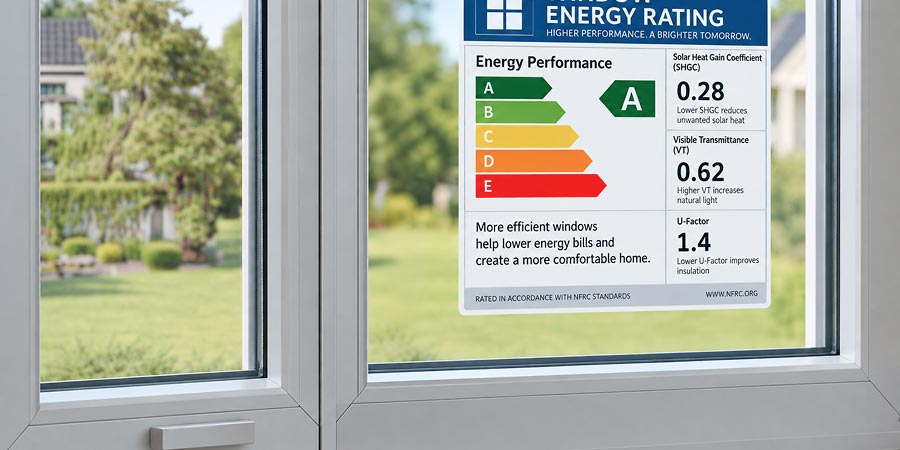
SHGC strongly affects Canada's Energy Rating because the formula heavily weights solar gain. A higher SHGC raises the ER, but that does not make the highest SHGC the best comfort choice for every exposure. The Window Force guide to ENERGY STAR certified windows summarizes the difference between the two metrics, and the underlying arithmetic explains why.
What Goes Into ER?
The ENERGY STAR Canada technical specification for windows, doors and skylights publishes the simplified equation: ER = (57.76 × SHGC) − (21.90 × U-factor) − (1.97 × L75) + 40, where L75 is the air leakage rate at 75 Pa. The SHGC multiplier is more than 2.5 times the U-factor multiplier.
A worked example shows the effect. Take a window with a U-factor of 1.40 W/m²·K and an air leakage rate of 0.20 L/s·m². With an SHGC of 0.50, its ER rounds to 38; change only the coating so that SHGC falls to 0.28 and the ER drops to 25. To recover those 13 points through insulation alone, the U-factor would need to fall by roughly 0.6 W/m²·K, which is about the gap between a good double-pane unit and a high-performance triple-pane one.
Why ER and SHGC Answer Different Questions
ER answers how a window performs on average during a heating season; SHGC answers how much solar heat it admits at any moment. A 2013 research review of the Energy Rating procedure, prepared by RDH Building Engineering for BC Housing, with NRCan as a funding partner, confirms this distinction. It found that ER evaluates performance under winter heating conditions only, contains no cooling component, and was designed mainly for heating-dominated climates. The review also noted that, in certain regions, products with high ERs and high solar heat gain caused overheating discomfort and customer complaints.
This is partly because the ER uses a single national average for usable winter sun, while original ER calculations found values ranging from about 48 W/m² in Vancouver to about 85 W/m² in Saskatoon. A homeowner comparing quotes from a vinyl windows manufacturer in Saskatoon is therefore working with considerably more winter sun than the formula assumes, whereas on the cloudier coast the same high ER overstates how much heat a passive coating will actually deliver.
The same review concluded that ER remains an appropriate ranking tool for typical Canadian houses, but that it should not be used on its own in three situations:
- far northern locations, including the Canadian territories, where winter sun is scarce;
- windows with significant winter exterior shading;
- houses whose windows face primarily in one direction.
In those cases, and for any design with site-specific priorities, the review recommends selecting windows based on U-factor and SHGC rather than ER alone.
How Do Low-E Coatings Change Solar Heat Gain Coefficient?
Low-E coatings are the primary tool for setting SHGC, because the number, type and arrangement of their microscopically thin metallic layers determine how much solar infrared energy the glass reflects. NRCan distinguishes passive Low-E coatings, which have a high SHGC and harness the sun to supplement heating, from solar-control Low-E coatings, which have a lower SHGC and reduce the air-conditioning load. Window Force's Low-E glass options cover the full range: LoĒ-180 for cold-climate heat retention, LoĒ²-272 for balanced year-round performance, and LoĒ³-366 for stronger solar control, with LoĒ-i89 available as an interior-surface coating focused on insulation.
| Coating | Silver layers | Approx. SHGC | Approx. VT | Design intent and typical placement |
| LoĒ-180 | 1 | 0.69 | 0.78 | Passive gain; shaded south glass, cold and sunny climates |
| LoĒ²-272 | 2 | 0.40 | 0.71 | Balanced; mixed exposures, whole-house default in many homes |
| LoĒ³-366 | 3 | 0.27 | 0.64 | Solar control; west glass, large unshaded openings |
Values are approximate centre-of-glass figures for a double-pane, argon-filled unit, based on the coating manufacturer's published LoĒ performance data. Whole-window values are lower because the frame blocks sunlight, and exact figures vary with glass thickness, airspace and gas fill.
Passive Low-E
A single-silver passive coating keeps SHGC high while still reflecting long-wave heat from the room back indoors. It suits south-facing glass with good summer shading, older homes with higher heating demand, and cold, sunny regions with plentiful winter solar radiation.
Balanced Low-E
A double-silver coating cuts solar gain substantially while preserving most visible light, typically landing within NRCan's 0.30 to 0.40 rule-of-thumb range once framed as a complete window. It is the most common choice when one specification must serve several orientations reasonably well.
Solar-Control Low-E
A triple-silver coating rejects the largest share of solar infrared energy and is the logical specification for west-facing glass, large fixed units and window walls without exterior shading. On a south wall in a heating-dominated climate, choose it deliberately, because it also removes much of the free winter heat that orientation could otherwise provide.
One detail rarely discussed alongside SHGC is that the soft-coat silver layers responsible for it sit inside the sealed cavity, and they stay protected only as long as the edge seal keeps moisture out, a service-life question covered in more depth in our guide to the average lifespan of vinyl windows. Window Force assembles its insulated glass units with a dual-seal, metal-free warm-edge spacer, pairing a primary moisture-vapour seal with a secondary structural seal, so the coating and argon fill that define the rated SHGC and U-factor stay intact for the window's service life.
Does a Lower SHGC Also Mean Less Natural Light?
A lower SHGC does not have to mean a much darker room, although stronger solar control usually costs some daylight. SHGC measures solar heat across the whole solar spectrum, while visible transmittance (VT) measures only the visible light that reaches the eye. Modern spectrally selective coatings reject far more invisible infrared energy than visible light, so check the daylight trade-off in the specification rather than assuming it's proportional.
SHGC vs. Visible Transmittance
The coating data in the previous section quantifies the difference. Moving from LoĒ-180 to LoĒ³-366 lowers SHGC by roughly 61%, while VT decreases by only about 18%. This shows that stronger solar control does not reduce visible transmittance in direct proportion to the reduction in solar heat gain.
Heat Control Without Making Rooms Too Dark
The simplest way to protect daylight is to apply strong solar control only where it is needed, keeping higher-VT glass on north and shaded elevations. For large picture windows facing west, a triple-silver coating typically offers a better balance than tinted glass or aftermarket films. NRCan cautions that solar-control films offer little added insulation, can greatly reduce solar gain in winter and raise heating bills, carry a small risk of thermal-stress breakage, and may void the original window manufacturer's warranty.
Engineer Sergey Essipov, with 20 years of experience in window manufacturing, notes:
Solar-control coatings do their work at the outer pane, so the glass and the frame edge beside it run warmer on a sunny wall; Canadian field measurements recorded the exterior surface of low-gain glass up to 4.7°C warmer than high-gain glass on summer days. At our facility, the frames that carry those packages are extruded from lead-free uPVC compounded with UV stabilizers, because heat and ultraviolet exposure together make lower-grade vinyl chalk and lose stiffness. The practical result is that choosing stronger solar control for a bright west room does not shorten the life of the frame holding the glass.
Can the Wrong SHGC Make a Room Too Hot or Too Cold?
Yes, and researchers have measured the effect in real houses. A study published in ASHRAE Transactions (Vol. 114, 2008) by researchers from NRC and NRCan monitored two identical R-2000 houses at the Canadian Centre for Housing Technology, one fitted with high-gain glazing (whole-window SHGC 0.52) and the other with low-gain glazing (whole-window SHGC 0.33). The results show both failure modes. Switching the test house to low-gain glass cut summer cooling electricity by 17.7%, but it also raised furnace gas use by 8.7% over the winter test period, and on sunny winter days south-facing rooms behind the high-gain glass ran up to 3.8°C warmer at mid-height.
Too Much Solar Gain
Excess solar gain is not only a summer problem. In the high-gain house, a south-facing bedroom exceeded the winter comfort zone on some sunny afternoons, and the BC Housing review found that windows with a high SHGC produced more overheating hours in simulations than low-SHGC windows, with south- or west-facing rooms recording the most. Very airtight, well-insulated homes are especially prone, because they retain the heat that enters. A homeowner arranging window replacement in Alberta for a sunroom with a large west-facing wall, for example, may find that afternoon overheating becomes a genuine comfort issue despite the long heating season.
Too Little Useful Winter Gain
The opposite mistake is quieter but persistent. On an annual basis, the twin-house analysis projected that operating the test house with low-gain windows would cost about C$26 more per year at 2006 utility prices, and the authors noted that the advantage of high-gain glazing would be larger in a house with electric heating or without air conditioning. Climate shifts the balance as well: the test houses stood in Ottawa, which the BC Housing review lists at about 236 cooling degree days, while a home served by a window supplier in Windsor faces roughly 418, so summer overheating carries noticeably more weight in the southernmost part of the province. Specifying strong solar control on a well-shaded south wall in a heating-dominated climate forfeits free heat every sunny winter day for the life of the window.
Should Every Window in a House Have the Same Solar Heat Gain Coefficient?
Not necessarily. A single glass package is convenient to order and guarantees a uniform appearance, but it forces one SHGC onto walls with very different solar exposure. A single glass package applies the same SHGC to walls with very different solar exposure.
Whole-House vs. Orientation-Specific Glazing
The trade-off is largely practical. A single package offers the simplest ordering and a uniform exterior appearance, and it suits homes with modest glass areas, balanced exposure or heavy shading. Orientation-specific glazing requires a clear glazing schedule and labelled units, but it matches each elevation's solar load, reduces hot and cold spots, and suits large glazing, passive solar designs and strong west exposure.
In practice, the coating change should happen at the corner of the house rather than within a single wall, because different coatings can show subtle differences in exterior reflectance when installed side by side. For new construction windows, the glazing schedule can be finalized with the architectural drawings; in a replacement project, the installer should record the orientation of each opening during measurement so that the correct glass reaches the correct wall.
Window Force puts this approach into practice through the way it builds and sells windows. Our authorized dealers record the orientation and shading of each opening during measurement, and our production line glazes every unit to that schedule, so a mixed-coating order is handled as routinely as a uniform one. Window Force applies orientation-specific glazing within its CSA-certified and ENERGY STAR®-qualified product range, with the same 25-year transferable warranty across all available coating options.
Conclusion: How to Choose the Right SHGC for Your Windows
SHGC is most useful when it is evaluated as part of the complete window specification. The right value depends on orientation, shading, glazing area, climate, and how the space is used, so no single SHGC suits every opening in a Canadian home.
For a new-build or replacement project, compare whole-window SHGC with U-factor and visible transmittance, then match the glazing to each opening's exposure. Strong afternoon exposure and large unshaded glass areas may call for greater solar control, while well-shaded south-facing openings in heating-dominated conditions may benefit from higher solar gain.
The objective is not to maximize or minimize SHGC across the entire house. It is to select a glazing package that meets each room's thermal and comfort requirements.
Frequently Asked Questions
What is a good SHGC for windows in Canada?
For new or substantially renovated homes, NRCan describes 0.30 to 0.40 as a rule-of-thumb range. The appropriate value depends on orientation, shading, climate and the amount of glazing.
Is SHGC the same as the shading coefficient?
No. The shading coefficient is an older metric that compares a glass product to a single pane of 3 mm clear glass and considers only the glass. SHGC has replaced it as the standard indicator and can describe the whole window; as a rough conversion, the shading coefficient is about 1.15 times the SHGC.
Does triple-pane glass always have a lower SHGC than double-pane?
Usually, but not always. Each additional pane and coating absorbs and reflects some solar energy, so triple-pane units generally have lower SHGC values. However, the coating choice matters more than the pane count: a triple-pane unit with passive coatings can admit more solar heat than a double-pane unit with a triple-silver solar-control coating.
Can I lower the SHGC of my existing windows without replacing them?
Exterior shading such as awnings, overhangs or deciduous trees reduces solar gain before it reaches the glass and is the most effective retrofit. Applied solar-control films also lower solar gain, but they bring the winter-heat and warranty trade-offs described earlier in this guide, so they are best limited to rooms that genuinely overheat.
Where can I find the SHGC of a window?
Rated products list SHGC on the product label and in the manufacturer's performance documentation, and you can check ENERGY STAR certified models in NRCan's searchable product listings. Ask the supplier to confirm that the value quoted is the whole-window SHGC rather than a centre-of-glass figure.
Does SHGC affect condensation or how cold the glass feels in winter?
Only slightly. The interior glass surface temperature on a winter night is governed mainly by U-factor, spacer quality and airtightness. The BC Housing review found that SHGC has much less impact on window surface temperature than on room operative temperature, which is driven by solar gain during the day.
People Also Ask