

U-factor is the rate at which heat passes through a complete window assembly, expressed in Canada as watts per square metre per kelvin, and a lower figure means the unit loses less heat. It describes the whole product rather than the glass alone, so the frame, sash, spacer, and the band of glazing nearest the frame are all inside the number a buyer reads on the label. That distinction is what makes two ratings comparable or meaningless: a figure only holds against another produced for the same unit size under the same test standard.
Window Force works on the side of this rating that buyers rarely see. As a Canadian manufacturer of vinyl windows building custom units to order since 2007 from our 80,000 sq ft Ontario production facility, we specify the frame profile, spacer, coating, and gas fill on every order. The resulting whole-window U-factor is verified for that exact build and size under CSA certification before the unit is released to our authorized dealer network.
Key Takeaways
- U-factor measures the rate at which heat passes through a complete window assembly, expressed in Canada as watts per square metre per kelvin, and a lower number always indicates better insulation.
- The rating covers the whole product, not just the glass. Frame, sash, spacer, and the band of glazing nearest the frame all pull the figure upward, which is why a centre-of-glass number always looks better than the certified one.
- U-value and U-factor describe the same physical property, but a European U-value and a North American U-factor are calculated under different test conditions and are not interchangeable.
- U-factor and R-value are inverses of one another. Lower is better for U-factor, higher is better for R-value, and neither can be converted casually between metric and imperial without stating which system produced it.
- Certification thresholds are a floor, not a recommendation. A window that meets the national minimum may still be the wrong choice for a large opening, a cold climate zone, or a room where comfort near the glass matters.
- U-factor alone never settles a purchase. Solar heat gain, air leakage, orientation, window size, and installation quality all shape what the window actually delivers once it is in the wall.
What Is U-Factor in Windows in Plain Language?
U-factor tells you how readily heat passes through a window. If you put two windows of identical size in the same wall on the same winter night, the one with the higher U-factor loses heat faster. That is the entire concept, and everything else is detail about how the number is produced and what it does and does not include.
Formally, the rating expresses heat transfer per unit time, per unit area, per degree of temperature difference between the inside and the outside. In Canada, it is reported in watts per square metre-kelvin, written as W/m²·K. The convention is counterintuitive for buyers who are used to bigger numbers meaning better products, because here the direction is reversed: a window rated 0.90 insulates better than one rated 1.40.
Why Is a Lower Number Better?
The rating measures a rate of loss rather than a quantity of protection. A larger figure means more heat crossing the assembly for every degree of temperature difference, so a lower figure means the window resists that flow more effectively. Nothing about the number describes sunlight, drafts, or condensation; it describes conduction, convection, and radiation through the assembly under still-air laboratory conditions.
Because it is a rate, U-factor also scales with area. A large window with an excellent rating can still lose more total heat than a small window with a poor one, simply because there is more of it. This is the reason a rating should be read alongside the size of the opening rather than in isolation.
Windows Near Me
What Is U-Value in Windows, and Is It Different From U-Factor?
U-value, U-factor, and thermal transmittance all refer to the same physical property: the rate of heat transfer through an assembly. In North American window documentation, the term U-factor is standard, while European and British documentation generally says U-value. Canadian technical writing uses both, and Window Force uses U-factor for the whole-window figure throughout its technical material.
The terminology is not the real problem. The real problem is that the same window produces genuinely different numbers depending on which calculation standard generated them, and buyers comparing an imported product against a domestic one are frequently comparing results from two incompatible systems.
Why Two Standards Produce Two Different Numbers
North American ratings follow the NFRC 100 procedure referenced by the Canadian fenestration energy performance standard, which simulates the window at an exterior surface temperature of −18°C against an interior temperature of 21°C. European ISO calculations run the same window at 0°C exterior and 20°C interior, use different surface film coefficients, and account for heat loss at the perimeter of the glazing with a linear thermal transmittance value rather than an area-weighted edge zone.
A simulation study commissioned by BC Housing’s Homeowner Protection Office and funded jointly by Natural Resources Canada, Fenestration Canada, BC Hydro, Manitoba Hydro, and Hydro-Québec quantified the gap. Modelling North American vinyl, North American fibreglass, and European vinyl windows with identical insulating glass units, the researchers found whole-window U-values differing by up to 17 percent between the two systems for the same physical product, with centre-of-glass values diverging by up to 23 percent. The report concluded that no reliable conversion factor exists between them and recommended that the industry label results explicitly as NFRC or ISO to prevent exactly this confusion. The full study is published as International Window Standards.
Engineer Sergey Essipov, with 20 years of experience in window manufacturing, explains:
We are asked several times a year why a European window quotes a better U-value than a Canadian unit with a comparable build. Usually it is not a better window; it is a warmer test. North American ratings are simulated at minus eighteen, which is a peak design condition, while the ISO figure comes from a simulation at zero. Run the Canadian product through the ISO method and the number improves without a single component changing. Everything we certify at our facility is simulated under the North American procedure, so the figures on our documentation are the cold-condition numbers.
How Should You Read a Window U-Factor Number?
Reading W/m²·K in plain English is simpler than the notation suggests. The figure describes how many watts of heat cross each square metre of window for every degree of temperature difference between the two sides. A window rated 1.0 W/m²·K passes one watt per square metre for each degree of difference; a window rated 1.6 passes 1.6 watts under the same conditions.
That makes the arithmetic straightforward. Take the standard test size for a fixed window: 1.2 metres wide by 1.5 metres high, which works out to 1.8 square metres. On a day when it is 21°C indoors and −9°C outdoors, a 30-degree difference, the 1.0-rated unit transfers roughly 54 watts while the 1.6-rated unit transfers about 86 watts. The gap of just over 30 watts per window is the physical meaning of the difference between those two ratings.
That calculation illustrates the physics and should not be mistaken for a utility bill projection. Actual consumption depends on the number and orientation of windows, insulation and airtightness elsewhere in the envelope, the heating system’s efficiency, thermostat behaviour, local weather, and how well the units were installed. The rating tells you which window loses heat faster; it does not tell you what your bill will be.
How Do You Compare Two Ratings Correctly?
Three conditions have to hold before a comparison means anything. Both numbers must describe the entire window rather than the glass alone, be expressed in the same unit system, and come from the same calculation standard. If any of the three is unclear on a quote, the correct response is to request the certified documentation rather than to assume.
Comparing within those constraints, the difference between two ratings is meaningful even when it looks small. A drop from 1.60 to 1.22 W/m²·K represents almost a quarter less heat transfer per square metre, and across a full house of glazing that is a substantial change in the load the heating system carries on the coldest nights of the year.
Why Does a Lower U-Factor Usually Mean Better Window Insulation?
A lower U-factor changes four things inside the house, and only one of them appears on a utility bill. The most immediate is the rate of non-solar heat transfer, which is the property the rating measures directly.
The second is interior glass surface temperature. A better-insulating assembly keeps the inner pane closer to room temperature during cold weather, which reduces the radiant chill people feel when seated near a window and lowers the likelihood of condensation forming on the glass. The third is a reduction in heating demand, which follows from the first but varies widely between houses. The fourth is comfort in the room as a whole, since cold glazing creates convective downdrafts that make a space feel colder than the thermostat reading suggests.
Why Energy Savings Vary So Much Between Homes
Two houses fitted with identical windows can post very different results, because the window is one component in a system. Glazing area relative to floor area, wall and attic insulation levels, airtightness, the type and efficiency of the heating equipment, the local climate, and the quality of the installation all move the outcome. A precisely rated window installed into an out-of-square opening with compressed or missing perimeter insulation will not deliver its rated performance, and no label accounts for that.
This is why responsible specification treats U-factor as a comparative tool for choosing between products rather than as a predictive tool for forecasting savings. The rating is reliable for the first purpose and unreliable for the second.
The frame side of that arithmetic is easy to overlook, because a rating is published once and the assembly then has to hold that geometry for decades. Window Force extrudes its profiles from lead-free uPVC with UV stabilizers compounded into the material and fusion-welds every corner, so the sash and frame maintain the dimensional relationship they had during the simulation. A frame that softens at the surface or drifts at the corners changes the seal geometry the rating assumed, and no certificate is reissued when that happens.
Does U-Factor Measure the Glass or the Entire Window?
The certified U-factor describes the entire window assembly. It is an area-weighted average of three separately calculated values: the centre-of-glass U-factor, the edge-of-glass U-factor, and the frame-and-sash U-factor. Under the NFRC 100 procedure used in Canada, the edge-of-glass zone is defined as the glazing area within 63.5 millimetres, or 2.5 inches, of the frame sight line, because that is the band in which the spacer bar measurably affects heat flow.
Frames and edge zones conduct heat more readily than the centre of a well-built insulating glass unit, so the whole-window figure is always worse than the centre-of-glass figure for the same product. That gap is not small. The same BC Housing study noted that whole-window solar heat gain values can fall as much as 50 percent below centre-of-glass values on the same unit, which gives a sense of how heavily the opaque perimeter weighs on any whole-product rating.
Why Centre-of-Glass Numbers Mislead Buyers
A supplier quoting a centre-of-glass value presents a number that will always look more favourable than the certified result, and this is not always deliberate. Glass manufacturers legitimately publish centre-of-glass data because it isolates the performance of the insulating unit itself, which is useful information at the design stage. It becomes misleading only when it appears on a homeowner’s quote next to a competitor’s certified whole-window figure.
The tell is usually the number itself. Whole-window ratings for good residential products in Canada generally range from 0.80 to 1.40 W/m²·K, while centre-of-glass values for the same units are substantially lower. A quote showing a figure well below the range of certified whole-window products should be questioned rather than admired.
Engineer Sergey Essipov, with 20 years of experience in window manufacturing, notes:
The frame and the spacer are where a rating is won or lost, not the coating. We build with a metal-free dual-seal spacer specifically because an aluminum spacer creates a conductive path right at the edge of the glass, and that band is weighted into the certified number. Two units with the same coating and the same gas fill can land a tenth of a point apart on U-factor purely on what is holding the panes apart.
What Is Considered a Good U-Factor for Windows in Canada?
There is no universal answer, because “good” depends on the certification target being used and on what the buyer needs from the opening. The national benchmark is a reasonable starting point, not a recommendation for every project.
Under the ENERGY STAR technical specification administered in Canada by Natural Resources Canada, a residential window can qualify in one of two ways: a U-factor of 1.22 W/m²·K or lower, or an Energy Rating of 34 or higher. The higher ENERGY STAR Most Efficient tier requires a U-factor of 1.05 W/m²·K or lower, or an Energy Rating of 40 or higher. Both tiers are verifiable model by model through the federal searchable product list for certified windows. For context, the Passive House Institute’s certification criteria for transparent components set a whole-window maximum of 0.80 W/m²·K, which sits well below either Canadian tier.
| Benchmark | U-factor (W/m²·K) | Imperial equivalent (Btu/h·ft²·°F) | Approximate RSI | Approximate imperial R-value |
| ENERGY STAR certified in Canada | 1.22 or lower | about 0.21 | about 0.82 | about R-4.7 |
| ENERGY STAR Most Efficient | 1.05 or lower | about 0.18 | about 0.95 | about R-5.4 |
| Passive House certified component | 0.80 or lower | about 0.14 | about 1.25 | about R-7.1 |
The R-value column is included because buyers frequently ask for it, and the conversion is where confusion often starts. It is arithmetic on the same certified figure, not a separate test result, and it should never be compared against the R-value of a wall assembly, which is measured differently and covers a very different construction. Homeowners whose windows meet the certified threshold may be eligible for federal or provincial rebates; the Canada window and door rebates guide covers which programs require a specific certified tier as a condition of eligibility.
How the Target Shifts With Climate and Budget Across Provinces
The certified threshold is national, but the sensible target is not, and this is where regional comparison genuinely matters. A window company Red Deer homeowners work with is specifying for a prairie climate with long, deeply cold winters and a large annual heating load, so pushing toward the Most Efficient tier and triple glazing repays the investment more quickly there than almost anywhere else in the country. A vinyl window manufacturer that Victoria residents deal with operates in Canada's mildest climate, where a well-built double-glazed unit comfortably meets or exceeds the certified standard threshold, making the additional weight and price of a third pane harder to justify on heating economics alone. In a mixed-climate market, a window installation in Mississauga falls between those two cases, with cold enough winters to warrant a low U-factor and warm enough summers that solar heat gain must be balanced against it rather than ignored.
Price follows a related but separate pattern. Moving from the certified tier to the Most Efficient tier typically adds a modest percentage to the unit price, whereas the window replacement cost on the same project varies far more with local labour rates, access, opening size, and installation method than with the glazing package. Comparing quotes across provinces on the basis of the rating alone, therefore, misreads the arithmetic. The disciplined approach is to set the U-factor target based on the climate zone and the size of the opening, then compare installed pricing in the local market.
How Does U-Factor Compare With R-Value?
U-factor and R-value describe the same physical situation from opposite directions. U-factor measures the rate at which heat flows through an assembly, so the lower the U-factor, the better. R-value measures resistance to that flow, so higher is better. Mathematically, each is the reciprocal of the other, with the metric form of resistance written as RSI.
The relationship is exact within a single unit system: RSI equals one divided by the U-factor in W/m²·K. Converting to the imperial R-value used in most consumer conversations requires multiplying RSI by 5.678, which is why a window meeting the Canadian-certified threshold of 1.22 W/m²·K corresponds to roughly R-4.7 rather than the double-digit figures homeowners associate with insulation.
Why Windows Never Post Wall-Like R-Values
A window is a glazed assembly holding two or three thin panes separated by a gas cavity, mounted in a frame that must also open, seal, and carry structural load. A wall is a much deeper assembly filled with insulation and interrupted only by framing members. Comparing the two numbers directly leads buyers to conclude that windows are failing, when they are simply different components with different jobs.
The useful comparison is between windows, and for that purpose, the industry standard in Canada is the U-factor rather than the R-value. Buyers who prefer thinking in resistance terms can convert, provided they convert from a certified whole-window figure and state which unit system the result is in.
How Is U-Factor Different From SHGC and Energy Rating?
Three numbers appear together on Canadian window documentation, each answering a different question. U-factor addresses heat that moves through the assembly by conduction, convection, and radiation, independent of sunlight. The solar heat gain coefficient addresses how much of the sun’s energy the window admits, expressed as a fraction between 0 and 1. The Energy Rating combines heat loss, solar gain, and air leakage into a single comparative score in which higher is better.
None of the three substitutes for the others. A window can post an excellent U-factor and a solar heat gain coefficient that is poorly matched to the elevation it will sit on, and the Energy Rating can mask that mismatch because it rewards solar gain heavily and reports a single figure for a window that will be installed on a specific wall facing a specific direction.
| Rating | What it measures | Unit | Better direction | Where it matters most |
| U-factor | Non-solar heat transfer through the whole assembly | W/m²·K | Lower | Cold climates, large glazing areas, comfort near glass |
| U-value | The same property, calculated under a different standard | W/m²·K or Btu/h·ft²·°F | Lower | Comparing imported and domestic products |
| RSI and R-value | Resistance to heat flow, the reciprocal of U-factor | m²·K/W or h·ft²·°F/Btu | Higher | Buyers who think in insulation terms |
| SHGC | Fraction of solar energy admitted through the window | Unitless, 0 to 1 | Depends on orientation | South and west exposures, sunrooms |
| Energy Rating | Combined score from heat loss, solar gain, and air leakage | Unitless | Higher | Quick like-for-like comparison of certified models |
| Air leakage | Air passing through the assembly under test pressure | L/s·m² | Lower | Drafts, comfort, and real-world performance |
Which Rating Should Buyers Check First?
In a heating-dominated climate, U-factor is the sensible first read, because winter heat loss is the dominant cost across most of the country and because the number is unambiguous once it has been confirmed as a whole-window certified value. Energy Rating is the more efficient second read, since it combines air leakage and solar gain into a single comparable figure across models.
Solar heat gain then deserves attention on an elevation-by-elevation basis rather than for the house as a whole, and the reasoning behind that is set out in the guidance on ENERGY STAR certified windows, which explains how certification attaches to a specific configuration rather than to a brand.
Which Window Components Have the Biggest Effect on U-Factor?
The certified figure results from the interaction among all components in the tested assembly, which is why a rating applies to a specific build rather than a generic category. Buyers pricing replacement windows see these components listed as separate line items on a quote, which can lead to the assumption that each one contributes independently. Five component groups do most of the work jointly.
The number of panes sets the ceiling on what the assembly can achieve, since each additional sealed cavity adds a barrier to heat flow. Low-emissivity coatings then determine how much long-wave radiant heat the glass reflects back into the room, and they are the single most cost-effective improvement available on a double-glazed unit. The insulating gas fill, most commonly argon, slows convection within each cavity, with krypton offering better performance in narrow gaps at a considerably higher cost. Frame construction governs conduction through the opaque portion of the assembly and varies widely across materials and profiles within the same material. Finally, the window spacer system holding the panes apart determines how much heat short-circuits around the edge of the glass, which is the mechanism the edge-of-glass zone was defined to capture.
What matters more than any single item is that these components are rated together. A coating that improves performance in one frame may contribute differently in another, and the certified number reflects the tested combination rather than the sum of its parts. The available glass options are therefore specified as packages rather than as interchangeable upgrades.
Frame conduction is where standard profiles give up the most ground, since a single hollow extrusion provides a continuous path for heat to flow across the opaque portion of the assembly. Window Force builds its frames as multi-chamber cross-sections, dividing that path into separate air chambers so the frame contributes less to the area-weighted figure printed on the certificate. Because the frame value is calculated separately and then weighted by area, profile design shows up directly in the whole-window number rather than in a footnote about the glass.
Do Triple-Pane Windows Always Have a Better U-Factor Than Double-Pane Windows?
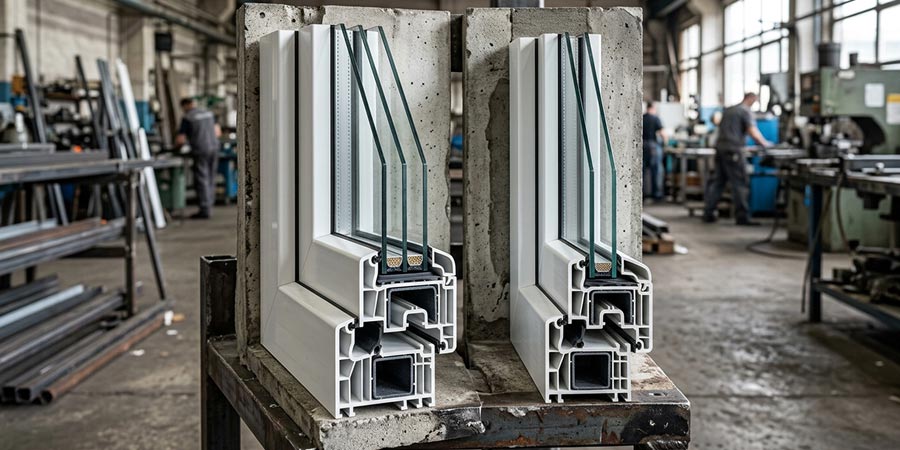
Not automatically. Triple glazing gives a manufacturer more opportunity to achieve a low U-factor because a third pane adds a second sealed cavity and a second surface for a low-emissivity coating. Whether a given triple-glazed product actually outperforms a given double-glazed product depends on the coatings, gas fill, cavity widths, spacer design, and frame construction in each specific build.
Well-executed double-glazed units with a high-quality coating and argon fill reach values near 1.2 W/m²·K, comfortably within the certified threshold, while high-performance triple-glazed units reach substantially lower values. Those ranges overlap in practice, which means a premium double-glazed unit can outperform an economy triple-glazed one. The cavity width matters more than most buyers realize: the BC Housing simulations showed that North American products optimized for narrower gaps, near 12.7 millimetres, performed very differently from European products built around wider ones, with the ranking between calculation standards reversing depending on the gap.
Why Pane Count Is Not a Performance Rating
Marketing routinely treats “triple pane” as a specification, and it is not one. It describes a configuration, not a measured outcome, and it says nothing about which coating is on which surface, what gas is in the cavities, or what the frame does at the perimeter. A buyer who asks for the certified U-factor of the exact model receives a fact; a buyer who asks for triple glazing receives a category.
Pane count also carries trade-offs beyond thermal performance, including weight that constrains sash size and hardware selection, and a higher initial price with a longer payback in milder regions. Those trade-offs are examined in more detail in the analysis of double- and triple-pane performance.
On the production side, the sequence runs in the opposite direction to the way pane count is marketed. Window Force sets the coating, gas fill, cavity width, and pane count per order once the opening, orientation, and target rating are known, and then records the resulting configuration in the file for that job. A homeowner therefore receives a build assembled around a performance target rather than a glazing tier chosen from a price list.
How Can Buyers Find and Verify the U-Factor Before Purchasing Windows?
Verification is a short process, and skipping it is the most common reason a homeowner ends up comparing numbers that were never comparable. Five steps cover it.
Identify the exact product and configuration. Certification attaches to a specific combination of frame series, operating type, glass package, spacer, and gas fill, so the model name alone is not enough.
- Ask for the certified performance documentation rather than a brochure. The document should state the U-factor, the solar heat gain coefficient, the visible transmittance, the air leakage rate, and the Energy Rating for that configuration.
- Confirm the number is a whole-window value in W/m²·K, generated under the North American procedure. If the quote shows an imperial figure or an ISO-derived one, convert or request the equivalent before comparing.
- Check certification status independently where it matters, using the federal product list rather than relying on a supplier’s claim that a product line is certified.
- Retain the specification alongside the signed quote. If the delivered units differ from the documented configuration, that record is the only practical basis for a conversation about it.
One caveat is worth carrying through the whole process. Certified ratings are produced at standard test sizes, 1.2 by 1.5 metres for fixed and sliding windows and 0.6 by 1.5 metres for a single casement, among others, and a much larger or much smaller opening will shift the ratio of frame to glass and therefore the real performance of the installed unit. The certified number remains the right basis for comparing products; it is simply not a measurement of the specific window going into a specific wall.
Verification is only as useful as the paperwork standing behind it. Window Force units in both the Ultraslim Series and the Classic Series are CSA certified and built to meet ENERGY STAR® requirements across all Canadian climate zones, and the certified performance data is issued for the specific configuration on the order rather than for a product family. That same configuration record supports the 25-year transferable warranty, which stays with the window when the house changes hands and is administered by the manufacturer alongside the authorized dealer who handled the installation. For a buyer, the number used to choose the window and the number on file if a question arises years later are the same number.
Should You Choose a Window Based on U-Factor Alone?
No. U-factor answers one question well and is silent on several others that determine whether a homeowner is satisfied five winters later.
Air leakage is the most consequential omission because a poorly sealed unit undermines every other rating on the label, and the seal depends as much on operating style and installation as on the product. Solar heat gain matters because orientation changes what a window should be doing, and a coating optimized for a shaded north wall is the wrong specification for a south elevation. Window style affects both, since a compression-sealing casement behaves differently from a sliding unit at the same rated U-factor. Beyond the product, climate zone, glazing area, comfort targets, budget, and installation quality, all shape the outcome.
When U-Factor Deserves Extra Weight
There are cases where the rating should dominate the decision. Large glazed areas amplify every fraction of a point, since the rate is multiplied by area. Rooms where people sit close to the glass, such as dining areas and window seats, benefit disproportionately from a warmer interior pane. Homes in the coldest climate zones carry a heating load long enough for the difference to compound. Buildings with high indoor humidity gain condensation resistance along with insulation, since a warmer inner surface is less likely to reach the dew point.
Where the exposure is heavily shaded, the glazing area is modest, or the climate is mild, the marginal value of chasing the lowest available U-factor drops quickly, and the same money is often better spent on installation quality or on matching solar heat gain to each elevation. Whatever the balance, the terms behind each number are defined in the window terminology glossary for buyers who want to check a definition mid-quote.
Engineer Sergey Essipov, with 20 years of experience in window manufacturing, adds:
A homeowner will spend three weeks comparing U-factors to two decimal places and then accept an installation with no perimeter insulation detail and a foam gap stuffed by hand. The label describes the product in a laboratory. What ends up in the wall is the product plus the opening plus the installer, and the last two are not on any certificate.
Conclusion: What Should Window Buyers Remember About U-Factor?
U-factor measures how quickly heat crosses a complete window assembly; lower is always better, and the figure only carries meaning when both numbers being compared are whole-window values in the same units from the same calculation standard. Certification thresholds mark a national floor rather than a recommendation, and the sensible target rises with climate severity and glazing area.
Read alongside solar heat gain, air leakage, the Energy Rating, and the build details, the number becomes a genuinely useful decision tool rather than a marketing figure. Ask for the certified documentation of the exact configuration being quoted, verify it independently, and keep it with the contract, because a rating that cannot be traced to a specific tested build is not a rating at all.
Frequently Asked Questions
Is a lower or higher U-factor better?
Lower is better. The rating describes the rate at which heat passes through the window, so a smaller figure indicates less heat transfer for the same area and temperature difference. This is the opposite of R-value, where a higher number indicates better performance.
What is a good U-factor for a window in Canada?
In Canada, a window qualifies for ENERGY STAR certification with a U-factor of 1.22 W/m²·K or lower, and for the Most Efficient tier at 1.05 W/m²·K or lower. Those are minimum qualifying levels rather than targets, and larger openings or colder climate zones justify aiming below them.
Is U-value the same as U-factor?
They describe the same physical property, but the numbers are not interchangeable across markets. North American ratings and European ISO ratings are calculated under different temperatures and different treatments of the glazing perimeter, and research has found differences of up to roughly 17 percent for the same window, with no reliable conversion between the two systems.
Does the U-factor on the label include the frame?
Yes. The certified figure is an area-weighted average of the centre-of-glass, edge-of-glass, and frame values for the complete assembly. A centre-of-glass number covers only the glass and will always look better than the certified whole-window rating for the same product.
How do I convert U-factor to R-value?
Divide one by the U-factor in W/m²·K to obtain RSI, then multiply RSI by 5.678 for the imperial R-value. A window rated 1.22 W/m²·K therefore corresponds to about RSI 0.82, or roughly R-4.7. The result should never be compared against a wall R-value, which is measured on a different basis.
Do triple-pane windows always have a lower U-factor?
No. Triple glazing offers greater potential for a low rating, but the result depends on coatings, gas fill, cavity width, spacer, and frame. A well-built double-glazed unit can outperform a basic triple-glazed one, which is why certified numbers for the specific model should be compared instead of pane count.
Where can I check whether a window is really certified?
Certification is recorded model by model in the federal searchable product list maintained by Natural Resources Canada. Because certification is tied to a specific configuration rather than a brand, the exact glass package and frame series being quoted should be the ones looked up.
Will a better U-factor lower my heating bill?
It reduces the rate of heat loss through the glazing, which contributes to lower heating demand, but the size of the effect depends on glazing area, envelope insulation, air tightness, heating equipment, climate, and installation quality. Treat the rating as a reliable way to compare windows, not as a forecast of savings.
People Also Ask