

A basement window that appears generously sized can still fail an egress inspection when an inspector measures the actual clear opening created by the window. Getting the size right from the start means understanding what code measures, what counts as "clear," and which window styles make that target easy or nearly impossible to hit.
This guide draws on Window Force's direct experience manufacturing basement egress windows for Canadian builders and homeowners since 2007. From our 80,000 sq ft Ontario production facility, we build every window to order against verified rough-opening measurements rather than from pre-built stock, which means the net clear opening is confirmed before a unit ships, not discovered to be marginal after it's set in the wall. The egress compliance issues described in this article are the ones we encounter regularly on the production side: frame depth that eats into the clear opening, sash travel restricted by hardware, and window wells that were never coordinated with the window specification.
Key Takeaways
- A legal basement bedroom window must provide a minimum clear opening of 0.35 m² (3.77 sq. ft.), with no single dimension smaller than 380 mm, under the Ontario Building Code and the National Building Code framework most provinces follow.
- "Clear opening" means the unobstructed space available once the sash is fully open, not the frame size on a spec sheet, which is why many basement windows that look large enough still fail inspection.
- Casement windows consistently meet egress code in smaller overall frame sizes than sliders or single-hung styles because the entire sash swings clear of the opening.
- Window wells need their own clearance and drainage planning; a window can be code-compliant on paper and still fail if the well in front of it is too shallow or holds water.
- Every basement bedroom needs its own compliant egress window; a single large window elsewhere in the basement does not cover multiple sleeping rooms.
- In our retrofit work on older Canadian homes, the most common reason a basement window fails egress isn't the glass size; it's the frame thickness and hardware that eat into the opening the original installer never accounted for.
What Is Considered a Legal Basement Window Size?
A legal basement window size is not a single number you can write on a tape measure and walk away from. It is a combination of three separate, code-defined measurements that must all be satisfied at once: a minimum clear opening area, a minimum dimension on every side of that opening, and a maximum sill height above the finished floor. Miss any one of the three and the window fails, regardless of how large the frame appears from the outside.
Under Ontario Regulation 332/12, the provincial Building Code, every floor level containing a bedroom must have an outside window that provides an unobstructed open portion of at least 0.35 m², with no dimension less than 380 mm, openable from the inside without tools. According to the Government of Ontario's e-Laws database, this requirement is set out specifically in Article 9.9.10.1 of the Building Code, and applies to basements unless a door on the same level already gives direct access to the exterior.
In practice, manufacturers such as Window Force design their basement egress systems specifically around these constraints, ensuring that the net clear opening is verified not only on paper but also in actual installed performance of the sash. This reduces the common mismatch between catalogue dimensions and real inspection measurements.
Legal Size vs. Practical Size
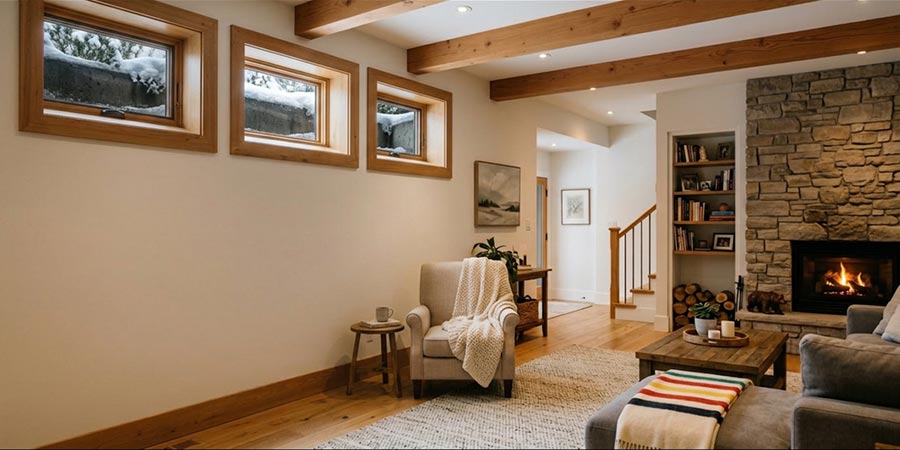
The legal minimum and a practically comfortable size are two different targets. A window that just clears 0.35 m² will pass inspection, but it will also be a tight fit for an adult moving quickly in an emergency, and it will let in proportionally little daylight. Most basement renovation projects we see specify something noticeably larger than the bare minimum once daylight, ventilation, and resale value enter the conversation, while still treating the code minimum as the non-negotiable floor.
Why Intended Room Use Matters
The legal requirement is triggered by how a room is used, not by how it is labelled on architectural drawings. A space called a "den" or "media room" that contains a bed, or that a tenant sleeps in, is functioning as a bedroom and is held to the bedroom egress standard regardless of the name on the permit drawing. A basement used only for mechanical equipment, laundry, or storage is not held to this standard at all. The distinction matters most in secondary suite conversions, where a basement apartment intended for rental income is routinely treated as containing sleeping rooms even if the listing calls it a "flex space."
Windows Near Me
Why Does a Basement Window Need to Meet Egress Requirements?
The purpose behind the code is straightforward: if a fire or other hazard blocks the stairs, a person sleeping in a basement room needs an independent way out, and emergency responders need a way in. An egress window is the backup exit when the primary path through the house is no longer usable.
This is why the requirement is strictest for sleeping areas specifically. A person who is awake and in a living room has more options and more warning than someone asleep in a basement bedroom at 3 a.m. The code treats that vulnerability as the deciding factor, which is why egress requirements apply to any room used for sleeping, including guest rooms and basement apartments, but not to a furnace room or storage area with no sleeping function.
Emergency Escape Explained
In practice, the egress window has to do two jobs simultaneously. It needs to allow an occupant to climb out without tools, exceptional strength, or prior practice, which is why the code specifies operability without keys or special knowledge. It also needs to let a firefighter in full gear climb in, which is part of why the minimum clear opening is sized the way it is, rather than being scaled down to "average adult" dimensions alone.
When Egress Rules Usually Apply
Egress requirements are triggered any time a basement space is finished for habitable use with a sleeping function, such as converting an unfinished basement into a bedroom, adding a secondary suite, or renting out a basement room to a tenant. They are not triggered by finishing a basement purely as a rec room, office, or gym, provided no one sleeps there. The classification changes the moment a bed, sofa bed, or Murphy bed is introduced for regular overnight use.
What Is an Egress Window in a Basement, and How Is It Different from a Standard Basement Window?
A standard basement window and a basement egress window installation can look almost identical from the curb. The difference is entirely in what happens when the sash is opened, not in the frame dimensions printed on a brochure.
| Feature | Standard Basement Window | Egress-Compliant Basement Window |
| Primary function | Daylight and ventilation | Daylight, ventilation, and emergency exit |
| Minimum clear opening | Not regulated | 0.35 m² (3.77 sq. ft.), per Article 9.9.10.1 |
| Minimum single dimension | Not regulated | 380 mm on every side of the opening |
| Sill height | No code-mandated maximum | Must comply with maximum sill height from finished floor as required by code, independent of window well design |
| Window well (if below grade) | Optional, often decorative | Must provide a minimum 550 mm clearance in front of the sash |
| Operation | May use a key-locked security feature | Must open from the inside without tools or special knowledge |
The practical effect of this table is that a window can be glazed, framed, and installed correctly as a "window," and still be the wrong product for a bedroom. A standard basement window prioritizes a smaller rough opening and lower cost; an egress-compliant window is sized and selected specifically so that the openable portion, not just the glass, clears the code minimum.
Functional Differences
Because the clear opening is what's regulated, the window type can dramatically change the math. A casement window opens its entire sash outward, so close to 100% of the frame area becomes a usable clear opening. A horizontal slider only opens about half its width, so a slider needs roughly double the total glass area of a casement to reach the same 0.35 m² target. This is the single most common reason a basement window that "looks the same size" as a neighbour's egress-compliant window still fails: it's a slider doing half the work of a casement in the same frame footprint.
When a Standard Window Is Not Enough
A standard window is no longer enough the moment the room it serves is used for sleeping. At that point, the window's glass area, sash type, sill height, and well clearance all become code-relevant in a way they weren't when the room was a rec room. Homeowners converting a basement frequently discover this only at permit review, after a window has already been ordered and installed.
What Are the Standard Basement Window Sizes Homeowners Usually See?
Standard basement window sizes in older Canadian homes tend to cluster around a handful of common nominal dimensions, most of which were specified for daylighting and ventilation rather than egress.
| Common Nominal Size | Typical Window Style | Egress-Suitable Without Modification? |
| 24″ x 12″ (610 mm x 305 mm) | Awning or hopper, older builds | No fails minimum dimension |
| 30″ x 16″ (762 mm x 406 mm) | Single slider | Usually no clear opening, too small |
| 32″ x 24″ (813 mm x 610 mm) | Casement | Often borderline; depends on frame thickness |
| 36″ x 24″ (914 mm x 610 mm) | Casement | Frequently passes |
| 40″ x 30″ (1016 mm x 762 mm) | Casement or large slider | Generally passes if casement; sliders need verification |
Common Dimensions by Window Type
Homes built before the 1990s in much of Canada were frequently fitted with small windows primarily for daylighting and ventilation, with frame dimensions in the 24-by-12-inch range. These windows almost never meet modern egress minimum requirements and are among the most frequently flagged items in basement-finishing permit applications.
Replacement vs. New Opening
Replacing an undersized window with an egress-rated unit of the same nominal size rarely works because the existing rough opening was never sized for a clear-opening calculation. Most retrofit projects end up enlarging the foundation opening to accommodate a window whose net clear area, not whose frame size, hits the legal target.
How Do Building Codes Measure Whether a Basement Window Opening Is Large Enough?
The technical criteria come down to net clear opening, not nominal or rough opening size. Building officials measure the unobstructed width and height of the actual opening once the window is positioned for egress, then multiply those figures to confirm the area meets the minimum, and separately confirm that neither dimension falls below the 380 mm threshold.
Rough Opening vs. Clear Opening
The rough opening is the hole cut in the framing or foundation. The clear opening is what's left once the frame, sash, screen track, and any hardware intrusions are subtracted. The gap between the two can be significant: a casement frame with deep jambs and hardware can reduce a generously sized rough opening to a clear opening that narrowly meets code or fails it.
Why Measurements Can Be Misleading
A spec sheet that lists "36 x 24 inches" almost always refers to the frame or glass size, not the net clear opening once the sash swings. The only reliable way to confirm compliance is to measure the actual unobstructed passage with the window fully open in its egress position, which is also exactly what an inspector will do on site.
The gap between a nominal frame size and the actual clear opening is where most egress surprises happen, and it's the gap our production model is specifically designed to close. At our Ontario facility, every Window Force egress unit is manufactured to a confirmed net clear opening dimension rather than a catalogue size. Because we produce custom-to-order rather than from stock, the frame geometry is set to the installer's verified rough opening measurement, eliminating the mismatch between what the spec sheet shows and what an inspector measures on site.
How Many Egress Windows Are Required in a Basement?
The number of egress windows required in a basement depends entirely on how many sleeping rooms it contains, not on its total floor area. The code requirement attaches to the bedroom, not to the basement, as a single unit.
A basement with one bedroom needs one compliant egress window serving that room. A basement with two separate bedrooms needs two windows, one for each sleeping room, because a window in one bedroom does not provide an exit for someone sleeping in the other. A basement finished entirely as an open recreation space, with no sleeping function, may not need a dedicated egress window at all, beyond any general access and light requirements.
Finished Basement Scenarios
In a finished basement without any bedrooms, the egress requirement does not apply in the same way; general access and a secondary exit path are still good practice, but the strict bedroom-specific dimensions are not triggered. The moment a bedroom is added to that same finished space, the requirement attaches specifically to that room.
Basement Bedroom Scenarios
A common misunderstanding is assuming a single large basement window can serve as the legal exit for the whole level. It cannot. Each bedroom needs its own egress window or a door providing direct exterior access on the same floor level; a hallway window two rooms away from a bedroom does not satisfy the requirement for that bedroom.
Does Every Basement Bedroom Need Its Own Legal Egress Window?
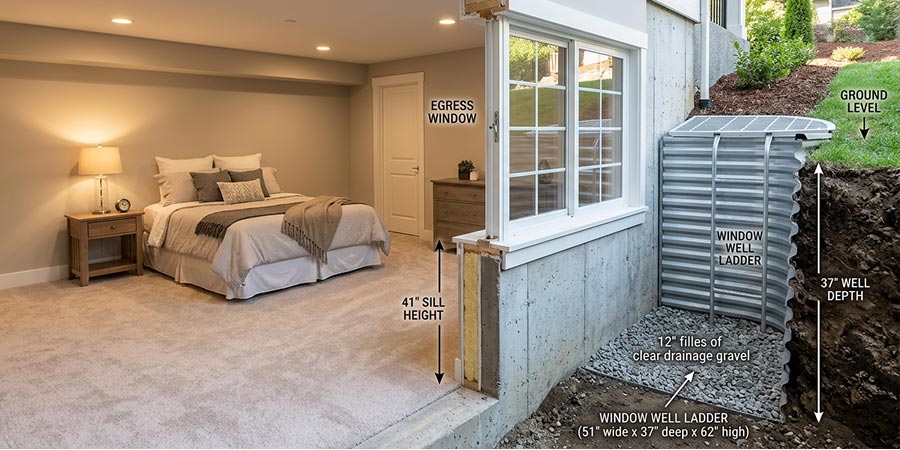
Yes, with one narrow exception: a bedroom is exempt from the separate-window requirement only if a door on the same floor level provides direct access to the exterior. Short of that, a general basement-level exit elsewhere in the space, such as a walkout door at the bottom of the stairs, does not substitute for a dedicated window in each individual sleeping room.
Bedroom Conversion Checklist
Before converting any basement room into a legal bedroom, confirm that the room has its own compliant egress window or direct exterior door, that the ceiling height and floor area meet the applicable minimums for a bedroom, and that any window well in front of that window meets the required clearance. Skipping the window-specific check is the single most common reason a basement bedroom conversion fails inspection after the drywall is already finished.
What Happens If a Room Lacks a Compliant Escape
A basement room without a compliant egress window can still be finished and used, but it cannot be legally classified or marketed as a bedroom. This has direct consequences at resale: an appraiser or buyer's inspector who finds a basement "bedroom" without a code-compliant window will typically have it reclassified as a den or flex room, which affects both the listed bedroom count and the home's appraised value.
What Factors Can Make a Basement Window Non-Compliant Even If It Looks Large Enough?
A window can look correctly sized in a photo and still fail for reasons unrelated to the glass itself. Hardware intrusions, restricted sash travel, security bars without an interior release, an undersized or poorly drained window well, and a sill height that exceeds the code maximum are the most frequent failure points we encounter in retrofit assessments.
Engineer Sergey Essipov, with 20 years of experience in window manufacturing, explains:
A common misconception in basement window projects is that compliance is determined by the window itself. In reality, inspectors evaluate the entire system frame, sash travel, and window well geometry. Even a correctly sized unit can fail if installation reduces the net clear opening by just a few centimetres. This is why precise manufacturing tolerances and correct rough opening preparation are as important as the glass area itself.
Hidden Compliance Issues
Security bars are a particularly common trap: they are permitted on an egress window only if they include a quick-release mechanism operable from inside without tools, since fixed bars defeat the entire purpose of the opening. Similarly, a window well cover that requires a key or significant force to remove can fail inspection even when the window behind it is perfectly compliant.
Installation Mistakes to Avoid
The most preventable mistakes are ordering by nominal frame size instead of net clear opening, choosing a sliding or awning style for a bedroom application, and installing the window without first confirming the window well design alongside it. Each of these is correctable at the planning stage and expensive to fix once the unit is already set in the wall.
How Does a Window Well Affect Basement Egress Compliance?
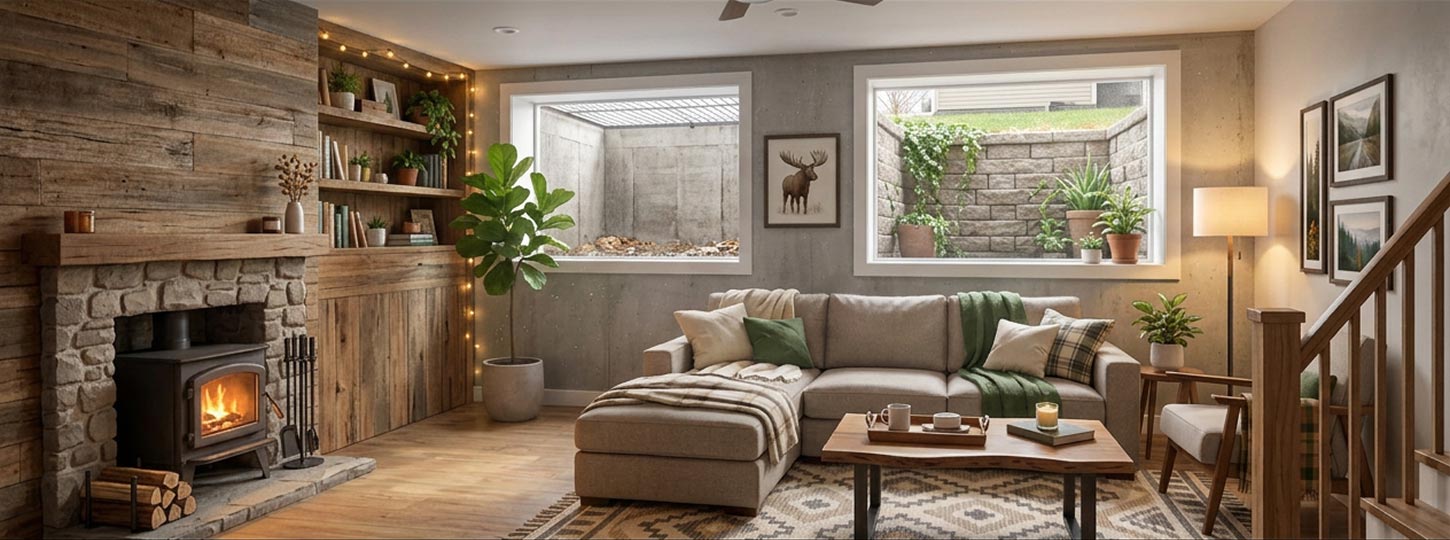
When the egress window sits below the surrounding grade, the window well in front of it is just as code-relevant as the window itself. Under Article 9.9.10.1, a window opening into a well must be provided with a clearance of not less than 550 mm in front of the window, and if the sash swings toward the well on opening, that operation must not reduce the clearance in a way that would restrict an emergency exit.
Engineer Sergey Essipov, with 20 years of experience in window manufacturing, explains:
In egress design, the biggest risk is not choosing the wrong window style, but underestimating how installation details affect safety performance. Hardware projection, sill height, and well clearance all interact. We often see projects where the product technically meets code on paper, but fails in real conditions because the installer did not account for full sash swing and unobstructed escape geometry. Proper planning must treat the window and the wall opening as one integrated safety system.
Window Well Sizing Basics
The 550 mm figure is a minimum, not a comfortable target; it is the space a person needs to physically stand and climb out, not simply the gap needed for the sash to swing freely. Wells sized only to clear the sash, without accounting for the person who needs to use that space in an emergency, are a frequent and avoidable design error.
Companies like Window Force integrate window and window well design into a single system rather than as separate components, which helps reduce errors when a correctly sized window is paired with an undersized or poorly aligned well. This system-based approach improves the reliability of compliance in real installation conditions, not just in design calculations.
Why Drainage Matters Too
A window well that holds standing water after rain or spring thaw is both a moisture problem for the foundation and a practical obstacle to using the window as an exit. Wells are typically built with a gravel base tied into the foundation drainage system, and the surrounding grade should slope away from the house rather than toward the well. A window paired with a properly specified warm-edge spacer system reduces condensation at the glass edge, which matters in a below-grade space where humidity is already harder to manage than it is above grade.
Below-grade installations present a specific challenge that extends beyond the window unit itself: sustained exposure to ground moisture makes IGU seal performance more consequential, not less. Window Force specifies a dual-seal, metal-free warm-edge spacer on every insulated glass unit we manufacture. In a basement setting, where humidity is consistently higher than above-grade, and temperature differentials drive condensation toward the edge of the glass, removing the aluminum thermal bridge at the spacer makes a measurable difference in long-term seal integrity, not a theoretical one.
What Basement Window Styles Work Best for Legal and Practical Egress?
Window style determines how much of the frame becomes usable clear opening, and that single factor explains most of the practical difference between styles for basement egress applications. For homeowners comparing the full range of residential window types, the table below shows how each style performs against the egress clear-opening requirement.
| Window Style | Egress Suitability | Why |
| Casement | Best | The entire sash swings clear; close to full frame area counts as a clear opening |
| Hopper (inward-opening) | Workable in some jurisdictions | Sash swings into the room; well clearance and interior obstruction both matter |
| Horizontal slider | Marginal | Only the moving half of the sash opens, so the total glass area must roughly double |
| Single-hung or double-hung | Marginal | Similar issue to sliders; only one sash typically provides the clear opening |
| Awning (top-hinged) | Generally unsuitable | Hinge position restricts the usable passage regardless of the overall size |
Best Styles for Smaller Foundations
In foundations where the rough opening is constrained, a casement window is usually the most space-efficient way to hit the 0.35 m² target without enlarging the wall opening further than necessary, because nearly the entire sash area becomes usable rather than only half of it.
For homeowners working within a constrained foundation opening, the case for casement over slider isn't only about meeting the 0.35 m² minimum in a smaller frame; it's also about the quality of frame construction under that constraint. Window Force manufactures its casement egress units with lead-free uPVC profiles and fusion-welded corners rather than mechanically joined ones. In a below-grade application where the frame is set into a foundation wall and exposed to seasonal ground movement, a monolithic welded corner maintains its air and water seal through thermal cycling in ways that a corner-keyed or bracket-assembled frame cannot.
Trade-Offs Between Ventilation and Opening Size
Casement and hopper styles that maximize clear opening for egress also tend to maximize ventilation when the window is cracked open partway, a secondary benefit worth factoring in alongside the strict code calculation.
What Should Homeowners Know Before Enlarging a Basement Window Opening?
Enlarging a foundation opening to fit an egress-compliant window is structural work, not a simple swap. It typically requires a permit, a review of the load path above the opening, and coordination with waterproofing and insulation details around the new frame.
Structural and Waterproofing Risks
Cutting a larger opening in a foundation wall requires installing a properly sized lintel or header to carry the load previously supported by the solid wall, and re-establishing the drainage plane around the new opening so water is directed away rather than into it. Skipping either step is a common source of later leaks or settling around the window.
Questions to Ask Before Installation
Before committing to an enlarged opening, confirm which local permit is required, whether the foundation type affects the cutting method and cost, and whether the existing window well can be reused or rebuilt to meet the new clearance requirement. Consult a qualified window installer or contractor to walk through the structural and code-related risks before any cutting begins on the foundation wall; this is not a step worth shortcutting on a load-bearing wall.
How Can You Choose the Right Basement Window Size for Safety, Comfort, and Resale Value?
Once the legal minimum is satisfied, the more useful question becomes how much larger than the minimum makes sense for the room. Daylight, ventilation, furniture placement, and how the space will be marketed at resale all push toward a size that comfortably exceeds 0.35 m² rather than one that just clears it.
Minimum Legal vs. Best Practical Option
A window sized to the bare legal minimum will pass inspection, but often leaves a basement room visibly darker than one finished with a window sized closer to 0.5 — 0.6 m². For a room intended as a primary bedroom rather than an occasional guest space, the larger option is frequently worth the modest difference in excavation and framing cost.
How Larger Windows Improve Basement Usability
A larger, clear opening also offers more flexibility in furniture layout, since the area directly in front of the window needs to remain clear for both daily use and emergency access. In our experience working with basement renovation projects, the rooms that function best as genuine bedrooms, not just code-compliant ones, are the ones where the window size was chosen for daylight first and treated the code minimum as a floor rather than a target.
For homeowners planning a basement conversion with long-term resale value in mind, the combination of a correctly sized egress window and documented product credentials matters beyond the inspection stage. Window Force egress windows are CSA-certified and ENERGY STAR® qualified across all Canadian climate zones, and they carry a 25-year transferable warranty, which means the compliance investment passes to the next owner rather than expiring with the renovation. Our authorized dealer network installs to the standard the warranty assumes, so the performance documented at the time of permit review is the performance a future buyer's inspector will find years later.
What Are the Most Common Mistakes People Make When Planning a Basement Egress Window Project?
The recurring pattern in failed basement bedroom inspections is the same handful of avoidable errors, repeated from project to project.
- Ordering a window based on nominal frame size or glass area rather than confirmed net clear opening
- Choosing a slider or awning style for a bedroom application where a casement would meet code in a smaller, cheaper opening
- Treating the window well as an afterthought instead of designing it alongside the window itself
- Skipping the permit and inspection process, which risks costly rework if the finished space fails review later
- Assuming one basement window can serve as egress for more than one bedroom
DIY Planning Errors
Homeowners managing their own basement renovation most often go wrong by selecting a window from a catalogue photo before confirming the clear-opening dimensions, only to discover the mismatch when a contractor or inspector measures the actual opening on site.
Measurement Mistakes
The second most common error is measuring the glass pane instead of the full clear opening, or using a published "nominal size" instead of an on-site measurement that accounts for the specific frame and hardware installed.
What Should You Remember When Choosing a Legal Basement Window Size?
A legal basement window size is defined by three numbers working together: a minimum clear opening of 0.35 m², a minimum dimension of 380 mm on every side, and a window well clearance of at least 550 mm where the window sits below grade. None of these figures describes the window's frame or glass size on a spec sheet; all three describe the unobstructed space available once the sash is open.
| Requirement | Minimum Standard |
| Clear opening area | 0.35 m² (3.77 sq. ft.) |
| Minimum dimension (each side) | 380 mm |
| Window well clearance | 550 mm in front of the sash |
| Operability | No tools, keys, or special knowledge |
| Coverage | One compliant window per sleeping room |
Working from this baseline, a casement window is usually the most efficient way to hit the target without unnecessarily enlarging the foundation opening, and the well in front of any below-grade window deserves the same planning attention as the window itself. For homeowners weighing replacement window options for an existing basement opening, confirming the net clear opening before ordering, not after, is what separates a straightforward upgrade from a returned window and a missed inspection.

Frequently Asked Questions
Does a sliding window ever meet the basement egress code?
Yes, but only if the openable half of the slider provides a clear opening of at least 0.35 m² with no dimension under 380 mm. Because only one sash moves, the total window area typically needs to be close to twice that of an equivalent casement to achieve the same usable opening.
Do all rooms in a finished basement need an egress window?
No. The requirement applies specifically to rooms used for sleeping. A finished basement used as a rec room, home office, or gym, with no sleeping function, is not subject to the same window-size standard, though general access and light requirements may still apply.
Are basement egress requirements the same across Canada?
The dimensions cited here come from the Ontario Building Code, which closely mirrors the National Building Code framework that most provinces base their own codes on. Provinces and municipalities can apply local amendments, so homeowners in Alberta, British Columbia, or any other province should confirm the current figures with their local building department before finalizing a window order.
Can I add security bars to a basement egress window?
Only if the bars include an interior quick-release mechanism that can be operated without keys, tools, or special knowledge. Fixed bars without a release defeat the purpose of the opening and will not pass inspection.
What happens if my basement window is too small?
A window can meet the clear-opening requirement for the sash itself and still fail inspection if the well in front of it doesn't provide the required clearance, since the well is part of the egress path, not a separate feature. Undersized or poorly drained wells are one of the more common reasons a basement bedroom conversion stalls at the inspection stage.
Is a casement window always required for basement egress?
No, but it is usually the most practical choice. Other styles can technically meet code if the clear opening math works out, but casement windows generally allow the smallest possible frame and rough opening to reach the 0.35 m² minimum, which is why they're the default recommendation for tight basement applications.
People Also Ask