

North-facing windows deliver steady, glare-free daylight and the lowest summer heat gain of any elevation, and they give up almost all passive solar heat in winter, which is why they should be specified for the lowest whole-window U-factor and the highest visible transmittance a budget allows. That single trade-off, light without heat, explains every benefit and every drawback that follows. This guide sets out how it plays out in Canadian homes, room by room and specification by specification.
A north elevation is the orientation where the two headline ratings pull against each other, since every coating layer that lowers the U-factor also reduces daylight that direct sun will not replace. Window Force checks both figures against the certified data for the exact configuration ordered, opening by opening, before a glazing package is released to the floor of its 80,000 sq ft Ontario plant. Production has run on that basis since 2007, with finished units distributed through an authorized dealer network that covers every Canadian climate zone. The guidance below follows the same order of priority.
Key Takeaways
- In the Northern Hemisphere, the sun tracks across the southern sky, so a north-facing window receives mostly indirect skylight rather than direct beam sunlight for most of the year.
- North-facing openings still admit usable daylight throughout the day; the light is lower in intensity, far more constant in level and colour, and produces much less glare than a south or west exposure.
- The main technical drawback is not darkness but the absence of passive solar gain, which shifts the entire performance burden onto the window's U-factor, airtightness, and edge-of-glass detailing.
- Interior glass surfaces remain colder on the north elevation for longer periods, so controlling condensation depends on both glazing quality and indoor humidity control.
- Solar Heat Gain Coefficient carries less weight on the north side than on the south, east, and west elevations, where solar control and overheating risk drive the specification.
- Triple glazing generally returns more measurable comfort on north-facing openings than on any other elevation of the same house, particularly on large fixed units.
- Visible transmittance warrants deliberate attention on the north side, since each additional coating layer removes daylight that direct sun will not replace.
- Orientation is one input among several; window area, air leakage, installation quality, and climate zone determine actual heating performance more than compass direction alone.
What Are North-Facing Windows, and How Does Their Orientation Affect a Room?
A north-facing window is an opening whose exterior face points toward geographic north, which places it opposite the sun's daily path across Canadian skies. Orientation changes four things at once: the quantity of light entering the room, the quality of that light, the amount of solar heat it carries, and the temperature of the glass surface itself. Separating those four variables prevents a homeowner from treating a lighting problem as an insulation problem, or vice versa.
How Can You Tell Which Direction a Window Faces?
The reliable method is to take a compass reading outdoors, standing with your back to the wall and facing away from the house. A phone compass returns a magnetic bearing, and anything between roughly 315 and 45 degrees behaves as a north exposure for practical purposes, with northeast and northwest openings picking up brief early or late sun in midsummer. Three observations confirm the reading without any instrument:
- No patch of direct sun falls on the floor at any point between the autumn and spring equinoxes.
- Brightness in the room changes with cloud cover rather than with the hour of the day.
- Any direct sun that does appear arrives shortly after sunrise or shortly before sunset, and only in the weeks around the summer solstice.
Where two of the three hold, the opening can be specified as north-facing. Corner rooms with glazing on two walls require each opening to be assessed separately, since a northeast unit and a north unit call for slightly different coating decisions.
Why Orientation Matters More at Canadian Latitudes
The higher the latitude, the lower the sun sits in the winter sky, and the more sharply exposures differ from one another. At Canadian latitudes, roughly 43 to 55 degrees north for most of the population, the winter sun rises late, tracks low across the south, and sets early, which compresses the useful solar day into a narrow band that the north wall never sees.
The same geometry produces the opposite effect in summer. The sun rises north of due east and sets north of due west, so a north-facing window can receive a short period of low-angle direct sun in the early morning and late evening around the summer solstice, then returns to purely indirect light for the remainder of the year.
Windows Near Me
Do North-Facing Windows Get Light Throughout the Day?
North-facing windows receive daylight for the entire period the sun is above the horizon, but that daylight arrives as diffuse radiation scattered by the atmosphere and reflected from surrounding surfaces rather than as a direct beam. The distinction matters because diffuse light behaves differently from direct sun in almost every way that affects a room. Both the character of that light and its seasonal variation deserve separate treatment.
Direct Sunlight Compared With Diffuse Daylight
Direct sunlight is intense, strongly directional, and carries most of the solar heat a window admits. It casts hard-edged shadows, moves across a room throughout the day, and can push interior surface temperatures well above the air temperature. Diffuse daylight arrives from the whole dome of the sky at once, producing soft shadows, even illumination across a work surface, and negligible heat gain.
A north window, therefore, delivers lighting conditions that remain effectively constant from mid-morning to late afternoon. The room brightens and dims with the weather rather than with the clock, and that single characteristic is what makes this orientation valuable for specific uses.
Does the Season Change North-Facing Light?
Season changes the amount but not the character. Summer skies at Canadian latitudes are brighter, and the daylight period is far longer, so a north room in July can be well-lit for sixteen hours; the same room in December receives usable light for roughly eight hours and needs supplementary lighting for the rest of the day.
Overcast conditions narrow the gap between orientations. Under a fully clouded winter sky, a north window and a south window of the same size deliver similar illuminance, which is why the performance difference between them is measured across a season rather than on any single day.
What Are the Main Benefits of North-Facing Windows?
The advantages of a north exposure are concentrated in light quality and thermal stability rather than in energy capture. These benefits are real and measurable, but they fall into different categories, and conflating them is a common source of disappointment when a homeowner expects a north window to reduce their heating bill.
Consistent Daylight for Screen-Based and Detail Work
Steady illumination is worth more than peak brightness for any task performed at a screen or over fine detail. Guidance published by the Canadian Centre for Occupational Health and Safety indicates that computer-based tasks need only 75 to 300 lux, while reading printed material of good quality calls for 200 to 500 lux, levels a moderately sized north window supplies through most of a working day without any risk of overshooting them.
The same guidance identifies the underlying problem with high-contrast exposures: the eye adapts to the brightest source in view, making everything else in the field of vision harder to resolve. A north window keeps the brightest surface in the room within a narrow range of the task itself.
Reduced Glare and Fewer Contrast Problems
Glare on the north side is a manageable exception rather than a daily condition. Because no direct beam enters the opening, the two common failure modes of a bright room, veiling reflections on a monitor and a silhouetted view through the glass, largely disappear.
Rooms containing artwork, textiles, or finished woodwork benefit for a related reason. Fading is driven mainly by direct sunlight and ultraviolet exposure, so materials displayed on a north wall age more slowly than identical materials on a south or west wall in the same house.
Lower Summer Solar Heat Gain
The absence of solar gain is a liability in January and an asset in July. A north-facing room does not accumulate the afternoon heat load that drives cooling demand on west elevations, so it holds temperature more evenly through a heat wave and places less demand on cooling equipment.
This is the one seasonal condition in which a north exposure outperforms all other orientations without qualification, and it is becoming increasingly relevant as summer cooling loads increase across southern Canada.
What Drawbacks Should Homeowners Expect From a North-Facing Window?
Three drawbacks recur during consultations and service calls, each with a different remedy. Separating them is worthwhile because two are solved through specification and one through interior design. A fourth point, addressed at the end of this section, concerns what orientation does not explain at all.
Minimal Passive Solar Gain Through the Heating Season
Every window loses heat by conduction and gains it from the sun. On south-facing glass in a Canadian winter, the gain offsets a meaningful share of the loss; on north-facing glass there is almost nothing to offset it, so the opening runs a net energy deficit across the heating season regardless of how well it is built.
The practical consequence is that the north elevation sets the floor for a home's window performance. Improving it yields a larger absolute reduction in heat loss than the same upgrade applied to a south-facing opening of the same size.
Colder Interior Glass Surfaces and Condensation Risk
Without periodic solar warming, the inside face of north-facing glass remains close to its minimum temperature for long stretches of a cold day, making it the first surface in the house where moisture appears. Manitoba Hydro advises that indoor relative humidity be limited to about 30 percent once outdoor temperatures fall below minus 10 degrees Celsius, and notes that higher levels will produce excessive condensation unless the home has high-performance glazing and is well insulated.
That advisory contains useful insight for anyone comparing quotes. Better glazing not only reduces heat loss; it raises the interior glass temperature, which in turn raises the indoor humidity a household can comfortably sustain in winter before moisture appears on the coldest window in the house.
When a North-Facing Room Reads as Dark
Perceived dimness is usually a surface problem rather than a glass problem. Diffuse light entering a room has to be redistributed by the ceiling, walls, and floor to reach the back of the space, and dark or heavily textured finishes absorb most of it within a metre or two of the opening.
Room depth compounds the effect. Daylight penetration falls off rapidly with distance from the glass, so a long north room served by a single standard opening will always need supplementary lighting at its far end, whatever the glazing specification.
What Orientation Alone Does Not Explain
Orientation does not by itself determine a heating bill, and attributing high winter costs to a north-facing window is usually incorrect. In a whole-house energy balance, several variables each carry more weight than the compass direction of one opening:
- Total glazed area, which sets how much of the wall is performing at window U-factor rather than at wall insulation levels.
- Whole-window U-factor, including the frame and the glass edge rather than the centre of the pane alone.
- Air leakage rate through the unit itself, measured under test pressure and reported on the certified label.
- Installation quality at the rough opening, which governs how much air bypasses the window entirely.
- Insulation levels in the surrounding wall assembly, since a cold wall makes a warm window feel colder.
- Climate zone, which determines how many hours a year the temperature difference is large enough to matter.
Air leakage deserves particular attention because it is invisible in most product literature. A high-performance sealed unit fitted into a poorly sealed rough opening will underperform a modest unit installed correctly, on any elevation.
What Direction Gets the Most Sun Compared With North-Facing Windows?
South-facing windows receive the most sun over the course of a year in the Northern Hemisphere, followed by west-facing, then east-facing, with north-facing receiving the least direct exposure. The ranking is stable, but how much sun each elevation actually collects on a specific house depends on conditions that no orientation rule accounts for.
Latitude affects the sun's altitude and, therefore, how deeply the winter sun penetrates a south-facing room. Local obstructions change everything else. A mature tree line, a neighbouring house, a deep roof overhang, or a balcony above the opening can remove most of the theoretical advantage of a south or west exposure, which is why a site assessment matters more than a compass rule on any project involving replacement windows and a change of glazing specification.
Regional climate shifts the value of that sun as well. Where winters are clear and severely cold, south-facing gain becomes a genuine heating contribution, and the north wall becomes a sustained liability; where winters are mild and heavily overcast, the difference between orientations narrows to the point where it rarely drives a purchase decision on its own.
How Do North-Facing Windows Compare With East-, South-, and West-Facing Windows?
Each elevation presents a different combination of light, heat, and risk, and the appropriate glazing response differs accordingly. The table below sets those variables side by side so the north column can be read in context rather than in isolation.
| Exposure | Direct sun period | Daylight character | Relative solar heat gain | Overheating and glare risk | Primary metric to prioritize |
| North | None for most of the year; brief low sun at midsummer sunrise and sunset | Constant, diffuse, minimal variation | Lowest | Low | U-factor |
| East | Sunrise to late morning | Bright early, flat after midday | Moderate | Moderate, at low sun angles near eye level | Balance of U-factor and SHGC |
| South | Mid-morning to mid-afternoon, deepest penetration in winter | High and variable through the day | Highest across a heating season | Moderate in summer, controllable with shading | SHGC matched to climate zone |
| West | Mid-afternoon to sunset | Intense late-day light, strong contrast | High in summer | Highest | Solar control and SHGC |
Read across the rows, and the pattern is straightforward: three elevations require some degree of solar management, and one requires none. That single difference is what separates a north-facing glazing specification from the rest of the house, and it is why the north wall is the wrong place to accept a default package selected for the entire order.
Which Rooms Benefit Most From North-Facing Windows?
Room suitability follows from glare tolerance, temperature preference, and how a space is used through the day rather than from fixed rules about which room belongs on which wall. The categories below reflect the requests that arise most often during window selection.
Home Offices, Studios, and Workshops
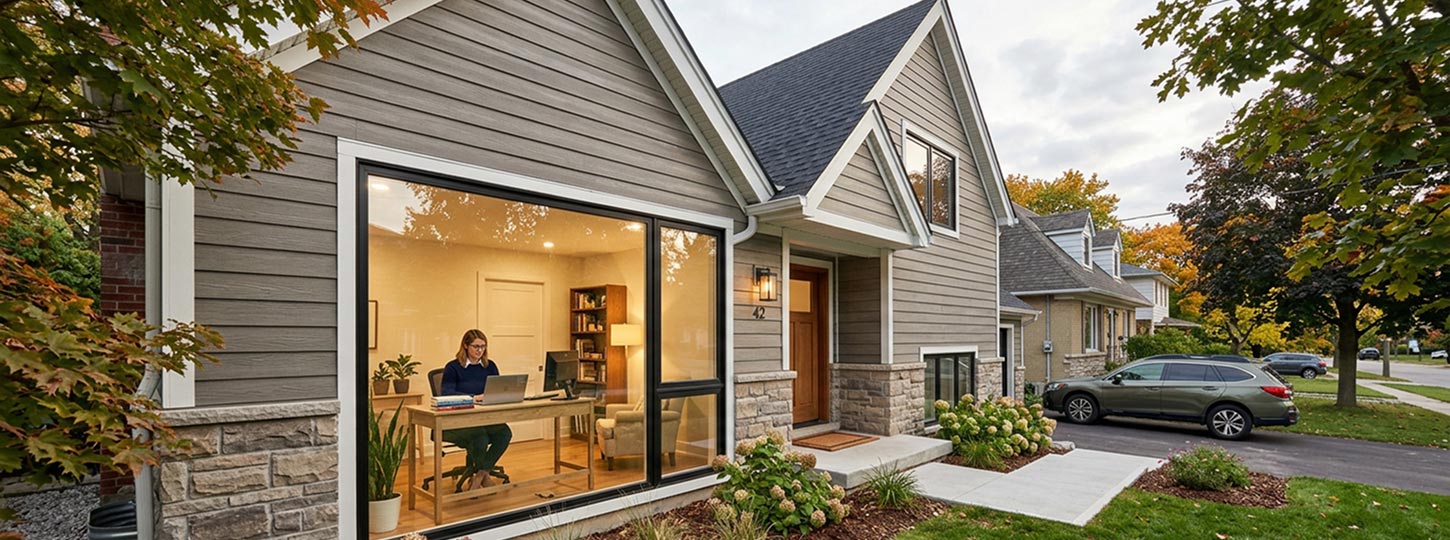
These are the strongest use cases. Screen work, drafting, sewing, painting, and any task involving colour judgement all benefit from illumination that neither shifts throughout the day nor produces reflections, and a north window provides exactly that without blinds or films.
Photographers and painters have specified north light for the same reason for centuries, and the logic has not changed with the arrival of monitors. Consistency is the property being purchased.
Bedrooms and Media Rooms
Bedrooms on the north side stay cooler on summer nights and avoid early-morning wake-ups in June, which many households value more than morning light. The trade-off is a room that can feel cool in the shoulder seasons unless the glazing package is upgraded.
Media rooms benefit from the obvious fact that screens are unwatchable in direct sunlight. A north exposure allows a room to hold usable daylight without competing with the display.
Kitchens, Living Rooms, and Dining Areas
These spaces are the least natural fit, though they remain workable. Food preparation and gathering areas are the rooms in which households most often report that a north exposure feels dim, particularly in a deep floor plan or where cabinetry and countertops are finished in dark tones.
Where the layout is fixed, the response is a larger glazed area rather than a different orientation. Taller openings and picture windows set high on the wall push diffuse light deeper into the room, since daylight penetration depends more on the height of the glass head than on the width of the unit.
How Does a North-Facing Window Affect Heating, Cooling, and Winter Comfort?
The north elevation behaves as a one-way path for heat during the Canadian heating season and as a stabilizing element during the cooling season. Both effects have practical consequences for comfort that appear well before they show up on a utility bill.
Winter Heat Loss on a Low-Gain Elevation
Conductive loss through the glass, the frame, and the glass edge runs continuously whenever indoor and outdoor temperatures differ, and on the north side nothing periodically reverses it. This produces a measurable radiant effect: occupants seated near cold glass lose body heat to the surface and feel cold even when the room air temperature is correct.
Downdraught follows the same mechanism. Air in contact with cold glass cools, becomes denser, and falls along the wall, which is why a north-facing living area can feel draughty in a house with no measurable air leakage at that window.
The frame is the part of that assembly least likely to be examined, and on a low-gain elevation it is the part with nothing working in its favour, because no periodic solar warming interrupts the loss. Window Force extrudes its profiles as multi-chamber sections, dividing the frame cavity into a series of separate air pockets so that heat crossing the opaque perimeter passes through several still-air barriers rather than a single continuous void. On a wall where conduction runs in the same direction every hour of the heating season, that construction registers as a warmer frame surface, which determines whether a seat near the window is usable in January.
The Summer Cooling Advantage
Through the cooling season, the same low-gain characteristic works in the household's favour. North rooms warm slowly, peak lower, and recover faster overnight than west-facing rooms in the same house, which reduces both cooling runtime and the temperature spread between rooms.
The size of that advantage depends on what locally drives summer discomfort. Where humidity, rather than solar load, is the limiting factor, orientation changes little; where clear, high-solar afternoons are the norm, the difference between a north bedroom and a west bedroom becomes obvious by early evening.
Condensation and Interior Surface Temperature
Condensation resistance is governed by the coldest point on the assembly, which on almost every window is the glass perimeter where the sealed unit meets the frame. A warm-edge spacer raises that perimeter temperature relative to a conventional metal spacer, which is why frost on a poorly specified window appears first as a band around the edge of the glass rather than across the centre of the pane.
On the north elevation, that detail reaches its minimum temperature for longer each day than anywhere else on the building, so the spacer specification has a disproportionate effect on how the window behaves during a cold snap.
The elevation that keeps a sealed unit at its lowest surface temperature for the longest stretch also tests the seal most severely, since the perimeter never receives the daily period of solar warming that dries an east or west wall. Window Force assembles its insulated glass on a dual-seal, metal-free warm-edge system in which the primary seal retains the fill gas while the secondary seal carries the structural load and the moisture barrier, with the desiccant held inside the spacer itself. Removing metal from that path raises the edge temperature and slows moisture ingress that eventually fogs a unit from the inside, which, on a north wall, separates a window that still meets its condensation rating after fifteen winters from one that no longer does.
Which U-Factor and SHGC Values Matter Most for North-Facing Windows?
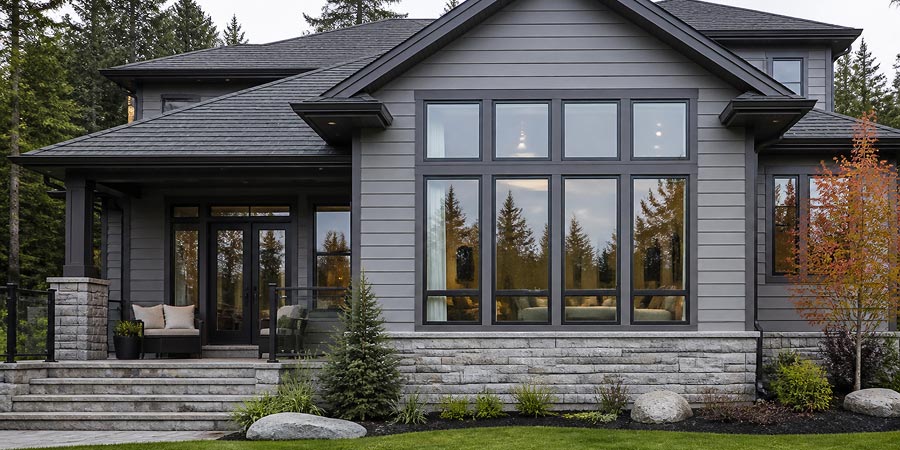
Two ratings govern the thermal behaviour of any glazing package, and their relative importance changes with orientation. Defining each precisely is necessary before deciding which one should drive a purchase on the north side of a house.
What U-Factor Measures
U-factor expresses the rate of heat transfer through the complete window assembly, in watts per square metre per degree Kelvin. A lower number means less heat crosses the assembly for a given temperature difference, and because whole-window U-factor accounts for the frame and the glass edge as well as the glass itself, it is the figure to compare between products rather than the centre-of-glass value quoted on a glass data sheet.
What SHGC Measures
Solar Heat Gain Coefficient expresses the fraction of incident solar radiation admitted through the window, on a scale from 0 to 1. A unit rated at 0.60 admits 60 percent of the solar energy striking it, which is desirable on a south wall in a cold climate and undesirable on a west wall in a hot one.
Why Insulation Outranks Solar Gain on a North Elevation
SHGC only returns a value when solar radiation is available for admission, and on the north side there is very little. Two units with the same U-factor and different SHGC values will therefore perform almost identically in a north opening, while two units with the same SHGC and different U-factors will not. Four figures should be requested from the certified label of any unit destined for a north wall:
- Whole-window U-factor, not the centre-of-glass value, since the frame and glass edge carry a disproportionate share of the loss on a low-gain elevation.
- Visible transmittance for that same configuration, which determines how much daylight survives the coating package.
- Energy Rating, read with the knowledge that it credits solar gain and therefore flatters units intended for sunny walls.
- Condensation resistance or temperature index, which predicts the interior surface behaviour that a north elevation tests hardest.
The practical spread is wide enough to matter. A double-pane unit with one passive coating and an argon fill typically lands near 1.5 to 1.8 W/m2K, while a triple-pane package with two coatings and a krypton fill can reach 0.8 to 1.0, and each step down in that sequence costs visible transmittance that a north room has no surplus to give away.
Is Double or Triple Glazing Better for North-Facing Windows in Canada?
Both configurations are defensible, and the decision turns on climate zone, unit size, and how the room is used rather than on a general preference. The comparison below addresses the north elevation specifically, since the broader question of whether the third pane pays for itself is covered in our guide to triple-pane windows.
When Double Pane Is Sufficient
A well-built double-pane unit with a passive Low-E coating and an argon gas fill remains the correct specification in several common situations:
- Small north openings, where the glazed area is minor relative to the surrounding wall.
- Mild coastal climates with short heating seasons and moderate temperature differences.
- Secondary spaces such as utility rooms, hallways, and vent windows that are not occupied for long periods.
- Whole-house projects where the same budget delivers more by correcting installation and air sealing across every elevation.
The common thread is exposure time. Upgrading a bathroom vent window contributes very little to a whole-house energy balance, while the same money spent on a large opening in an occupied room changes how that room feels.
When Triple Pane Earns the Premium
Triple glazing yields the greatest return on large north-facing units, in colder climate zones, and in rooms where people sit still for hours. The warmer interior pane reduces both the radiant chill near the glass and the downdraught that follows it, and the condensation margin it provides is widest precisely on the elevation where surface temperatures run lowest.
Added weight is the practical constraint rather than the cost. A triple-pane sash is heavier than its double-pane equivalent, so hinges and locking hardware for operable units must be specified for the load at the order stage, particularly for larger casement windows.
What the Upgrade Costs Across Canadian Climates
Window replacement cost on the north side is driven by the glazing build rather than by the compass direction itself. Moving from double to triple glazing, adding a second coating, or specifying krypton in a narrow cavity each carries a defined premium, while the coating family selected for a given elevation generally does not change the price at all, which makes the correct north-side coating one of the few specification improvements available at no additional cost. Where the regional difference appears is in how easily the triple-pane premium is justified:
- A window manufacturer in Winnipeg quotes into prolonged deep cold and a long heating season, where triple glazing on north-facing openings is close to a default expectation, and the premium is recovered in comfort within the first winter. The Winnipeg window replacement cost guide provides regional pricing context.
- A window supplier in Victoria works with a mild, heavily overcast coastal winter, where the same upgrade is a comfort decision rather than a necessity, and the budget often yields a higher return if it is spent on air sealing.
- A window company in Halifax deals with a maritime climate in which wind-driven rain and humidity, rather than extreme cold, set the specification, so gasket quality and drainage detailing compete with the third pane for the same dollars. The Halifax window replacement cost guide covers local market rates.
The pattern holds across the country: the farther a market is from the moderating influence of an ocean, the more likely premium buyers are to prioritize measurable winter comfort over marginal efficiency. Any vinyl windows supplier should be able to state which portion of a quoted premium buys thermal performance and which portion buys daylight, weight, or acoustic performance.
Choosing between double and triple glazing is easier when the decision does not also change the certification or the coverage standing behind the unit. Window Force builds both configurations on the same line, each CSA-certified and meeting ENERGY STAR® requirements across all Canadian climate zones, so a triple-pane package for the large north openings and a double-pane package for the secondary ones can ship on one order without either falling outside the certified range. The 25-year transferable warranty covers both builds on identical terms and passes to the next owner of the home, while the authorized dealer completes the installation in accordance with the specification confirmed at the factory. That keeps the double- or triple-question where it belongs, on comfort and climate zone, rather than on which option has the stronger paperwork.
Which Low-E Coating, Gas Fill, and Spacer Options Work Best on the North Side?
A sealed unit is a system in which the coating, cavity width, fill gas, and spacer each contribute to the final rating, and no single component determines performance on its own. The north elevation changes how those contributions should be weighted, mainly because daylight becomes a resource worth protecting.
Passive and Solar-Control Low-E Coatings
Low-E coatings are microscopically thin metallic layers applied to a specific glass surface inside the sealed cavity. A single-silver passive coating reflects interior heat back into the room while admitting a high proportion of solar energy and visible light, and adding silver layers progressively reduces both solar transmission and daylight.
| Coating family | Silver layers | Approximate SHGC | Approximate visible transmittance | Typical elevation fit |
| Passive, high solar gain | One | 0.65 to 0.70 | 0.75 to 0.80 | North and south |
| Balanced, moderate solar control | Two | 0.38 to 0.42 | 0.68 to 0.72 | East and mixed climates |
| High solar control | Three | 0.25 to 0.30 | 0.62 to 0.66 | West and cooling-dominated climates |
Figures are approximate centre-of-glass values for a double-pane, argon-filled unit and differ from the certified whole-window ratings printed on a product label. The passive coating suits the two opposite elevations for entirely different reasons: solar capture on the south side and daylight retention on the north side.
As Sergey Essipov, a production engineer with more than 20 years of experience in window manufacturing, points out:
Every additional silver layer in a Low-E stack buys solar control and costs visible light, and on a north elevation there is no direct sun to compensate for what the coating takes away. When we build a package for a north opening, we hold the coating to a single silver layer on the inboard surface and put the performance into the cavity instead, with a properly sized air space and a full argon fill, because that lowers the U-factor without darkening a room that is already working with diffuse light.
Argon and Krypton Fills
Argon is the standard inert fill in Canadian residential units because it conducts heat more slowly than air and is more cost-effective. Krypton performs better in narrow cavities, which is why it is useful in triple-pane units where three panes must fit within a conventional sash depth, though it carries a significant price premium.
Cavity width is the variable homeowners rarely see quoted. Argon reaches its optimum performance in a cavity of roughly 12 to 16 millimetres, and a unit built with narrower spacing will not deliver the rating implied by the fill gas alone.
Spacers and the Edge of the Sealed Unit
The spacer holds the panes apart, carries the desiccant, and forms part of the seal, and its material determines how much heat bypasses the glazing at the perimeter. Metal-free warm-edge systems interrupt that path, improving the finished unit's condensation resistance rating and reducing stress on the seal during repeated freeze-and-thaw cycling.
Matching Each Package to Its Opening
Window Force builds to order across more than fifteen glazing configurations, so a single order can carry a different sealed-unit specification for each elevation of the same house, rather than a single compromise applied to every opening. The available coatings, fills, and cavity options are set out under our glass options, and the selection for each unit is confirmed against its exposure before the order enters production.
Sergey Essipov notes:
The mistake that costs the most is not the specification; it is the sequencing. When one order carries three different glazing packages for three different elevations, every unit leaves our line labelled with its opening and its coating configuration, because a north unit fitted on a west wall and a west unit fitted on the north wall will both underperform, and neither of them will look wrong from the street.
Retrofit work adds one further constraint. The Window Force Ultraslim Series suits new construction where a slim 2-7/8-inch sightline maximizes the glass area, while the Classic Series is manufactured with a 3-1/4-inch frame depth, so it fits existing openings without disturbing interior or exterior trim, which keeps a north-elevation upgrade from expanding into a finishing project. As a Canadian manufacturer of vinyl windows producing custom units to order, we quote each elevation on its own merits rather than pricing a house as a single specification.
How Can You Make a North-Facing Room Brighter Without Sacrificing Energy Efficiency?
Brightening a north room is a matter of admitting daylight efficiently and then distributing it, not of adding glass indiscriminately. The measures below run from specification decisions made before purchase to adjustments available in any existing room.
Specify Glass With Adequate Visible Transmittance
Visible transmittance is the fraction of visible light a glazing package admits, and it is the rating most often overlooked when buyers compare energy-efficient windows on U-factor alone. Since a north-facing opening has no surplus light to give away, the objective is the lowest U-factor available with an acceptable visible transmittance, rather than the lowest U-factor available at any cost.
Ask for both numbers from the same certified label. A triple-pane unit with a single passive coating and a triple-pane unit with two solar-control coatings can post similar U-factors while differing substantially in the daylight they deliver.
Increase Glass Height Before Glass Width
Daylight penetration into a room scales with the height of the window head above the floor, because a higher head admits light at a shallower angle that reaches farther across the ceiling. Raising the head of an opening by 300 millimetres brings more usable light to the back of a room than widening the same unit by an equivalent area.
Raising a window head transfers the additional load to the frame rather than to the glass, which is where the joint detail begins to matter. Window Force fusion-welds every frame and sash corner, fusing the lead-free uPVC profiles — compounded with UV stabilizers through the full profile wall — into one continuous section instead of drawing them together with corner keys, so a taller unit holds its geometry without the added reinforcement that thickens a sightline. In an elevation where daylight is scarce, a slimmer frame section returns the glass area within the same rough opening, which is the least expensive source of brightness available on a north wall.
Use Interior Surfaces to Redistribute Daylight
Once light enters the room, finishes determine how far it travels. The federal lighting guidance cited earlier sets reflectance targets for well-lit work areas that translate directly into a paint and flooring specification:
- Ceilings from 70 to 80 percent, which makes the ceiling the primary redistributing surface in a north room.
- Walls at 50 percent as a maximum, high enough to carry light and low enough to avoid a bright, flat field of view.
- Floors from 20 to 40 percent, since a dark floor absorbs the light that would otherwise bounce back toward the ceiling.
Matte finishes matter as much as reflectance values. A pale, low-gloss ceiling spreads diffuse light across a room, while a glossy surface produces bright patches and reflections that raise contrast without improving usable illumination.
Choose Window Treatments That Preserve Daylight
Treatments for a north window should prioritize privacy and nighttime heat loss over glare, since there is very little glare to manage. Cellular shades and insulated blinds drawn after dark reduce heat loss during the coldest hours and can be left fully open during the day without the overheating penalty that the same approach would incur on a west wall.
Mounting matters more than fabric. A shade mounted above the window head, stacking clear of the glass, preserves the full opening through daylight hours, which is the entire point on an elevation working with limited light.
Conclusion: How to Choose the Right Windows for a North-Facing Room
North-facing windows trade solar energy for optical stability. They give up the passive heat a south-facing elevation collects and return daylight that stays constant, glare that stays low, and summer temperatures that stay even, which makes them well-suited to work spaces, bedrooms, and any room where a screen or a task surface is in use for hours at a time.
Because no solar gain arrives to offset the loss, the specification has to do the work: a low whole-window U-factor, a coating chosen to preserve visible light rather than to block sun, a properly sized cavity with an argon or krypton fill, a warm-edge perimeter, and an installation that seals the rough opening correctly. Homeowners who apply those five criteria to their north elevation, and let the other elevations be specified on their own terms, will get more comfort for the money than any single upgrade applied uniformly across the house. Qualifying energy-efficient units may also be eligible for federal and provincial rebate programs; the Canada window and door rebates guide summarizes which programs are available in each province.
Frequently Asked Questions
Do north-facing windows make a house colder?
They contribute more net heat loss than other orientations because they gain almost no solar heat, but they do not make a house cold on their own. Total glazed area, whole-window U-factor, air leakage, and insulation levels have a greater effect on winter comfort than the direction in which any single window faces.
Is a north-facing window good for a home office?
Yes, and it is generally the best orientation for one. The light is steady enough to work under all day, produces no screen reflections from direct sun, and does not require blinds to be adjusted as the sun moves.
Should north-facing windows have a low or high SHGC?
SHGC is not the deciding factor on a north elevation, because there is little direct solar radiation available to admit or block. Prioritize a low U-factor and an adequate visible transmittance instead, and reserve SHGC decisions for the south, east, and west sides of the house.
Do north-facing rooms get more condensation?
They are usually the first place condensation appears, since the interior glass surface stays colder for longer without periodic solar warming. The two remedies are better glazing, which raises the surface temperature, and controlled indoor humidity, which lowers the point at which moisture forms.
Is triple glazing worth it on north-facing windows only?
Upgrading only the north elevation is a legitimate strategy when the budget is limited because that elevation yields the greatest comfort improvement per dollar spent. The main caution is visual consistency, since sightlines and glass tint can differ slightly between glazing packages on the same wall.
Will a north-facing window fade furniture and artwork?
Fading is driven primarily by direct sunlight and ultraviolet exposure, both of which are minimal on a north elevation, so materials age noticeably more slowly there. Diffuse daylight is not entirely without effect over decades, but it is the lowest-risk exposure for displayed items in a house.
Can a north-facing room be made as bright as a south-facing one?
Not in terms of peak brightness, and that is rarely the objective. A north room can be made to be comfortably and evenly lit through a combination of taller glazing, high-visible-transmittance glass, pale matte finishes, and well-placed task lighting, which produces better working conditions than a south room with unmanaged glare.
Does window style matter on a north elevation?
Fixed and casement units seal more tightly than sliding or hung styles, which matters more on the elevation where conductive and infiltration losses are least offset by solar gain. Fixed units also allow a larger glass area within the same rough opening.
People Also Ask